
The worst way to spend a gap year is to “stay busy.” The best way is to treat it like a 12‑month campaign to make program directors take you seriously.
You are not killing time. You are building a case. Month by month.
Below is a concrete, structured 12‑month roadmap: what to do, in what order, and what you should have on your CV at each checkpoint.
First, Define the Year: Your 3 Core Pillars
Before we go month-by-month, you need a frame. A good gap year CV is built around three pillars:
-
- USCE/observerships, sub‑internship equivalents, paid clinical work, strong letters.
-
- Abstracts, posters, manuscripts, QI projects, maybe a small grant or IRB-approved project.
-
- Specialty-focused experiences, teaching, leadership, community work that clearly points to this field.
A common mistake: scattering your efforts. A shadowing week in cardiology, a dermatology observership, a random basic science paper, some EMT shifts. Looks unfocused. Programs see “I just did whatever I could get.”
Your goal: By month 12, your CV should tell a unified story that screams: “This person is serious about [insert specialty] and has momentum.”
Global Year Structure at a Glance
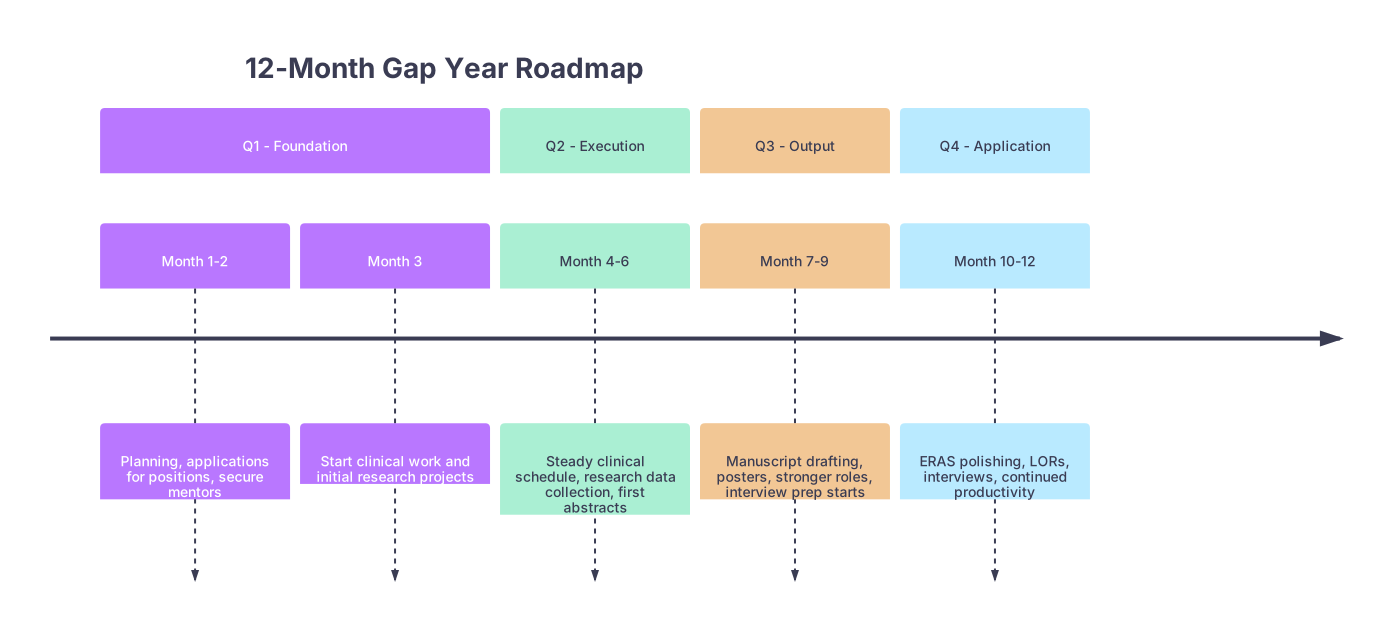
Think of your gap year in four quarters.
| Period | Event |
|---|---|
| Q1 - Foundation - Month 1-2 | Planning, applications for positions, secure mentors |
| Q1 - Foundation - Month 3 | Start clinical work and initial research projects |
| Q2 - Execution - Month 4-6 | Steady clinical schedule, research data collection, first abstracts |
| Q3 - Output - Month 7-9 | Manuscript drafting, posters, stronger roles, interview prep starts |
| Q4 - Application - Month 10-12 | ERAS polishing, LORs, interviews, continued productivity |
You will adjust exact months depending on ERAS cycle and whether you just graduated or took time off earlier. But the sequence holds.
Month 1–2: Ruthless Planning and Position Hunting
At this point you should stop doing ad‑hoc volunteering and design the year like a project.
Step 1: Choose Your Priority Mix (Clinical vs Research)
Use this as a rough guide:
| Applicant Profile | Clinical Focus | Research Focus | Notes |
|---|---|---|---|
| Failed Step attempt / weak clinical evals | High | Medium | Need strong USCE + letters |
| No publications, OK scores | Medium | High | Push hard on scholarly output |
| Switching specialties | High | Medium | Prove fit in new specialty |
| Strong on both, just extra time | Medium | Medium | Target high‑tier programs |
Make a decision. Do not try to be everything.
Step 2: Secure Anchors for the Year
By the end of Month 2, you should have at least one long-term anchor locked in:
- A 6–12 month clinical position (examples):
- Research assistant with significant patient contact in cardiology, oncology, EM.
- Clinical assistant / scribe in an academic ED or outpatient specialty clinic.
- Hospitalist service observer with defined schedule and letter potential.
- Or a 6–12 month research position:
- Full‑time research fellow in a department aligned with your specialty.
- Paid research coordinator for a PI known to write strong letters.
You find these through:
- Department websites (search “[Hospital] [Specialty] research coordinator / fellow positions”).
- Cold emails to PIs with:
- 1‑page CV
- Step scores, med school, graduation year
- Clear ask: “6–12 month full‑time role; interested in X field; aiming to apply to 20XX match in Y specialty.”
- Your med school network and alumni.
By the end of Month 2, on paper you should have:
- 1–2 pending or confirmed clinical/research positions.
- 2–3 mentors tentatively on board (even informally: “happy to work with you”).
Step 3: Fix Baseline Weaknesses
Parallel track:
- If you need Step 2 or an improved score: build that into Q1–Q2 (and cut something else).
- If you have glaring gaps (no US letters, no recent clinical activity): prioritize USCE early.
At this point you should not be signing up for random weekly 2‑hour volunteer gigs that do not translate into letters or measurable roles.
Month 3–4: Start Doing Real Work, Not Just “Observing”
Now you execute. No more “planning.”
By Month 3 you should be:
- On a regular clinical schedule (3–5 days per week if possible).
- Embedded in at least one research or QI project with your name on something concrete.
Clinical: Your Weekly Structure
Aim for a predictable weekly backbone. For example:
- Mon–Wed: Outpatient clinic / inpatient team (scribe, assistant, observer with responsibilities).
- Thu: Research day (data extraction, chart review, meetings).
- Fri: Flex day (extra clinic, Step prep, writing).
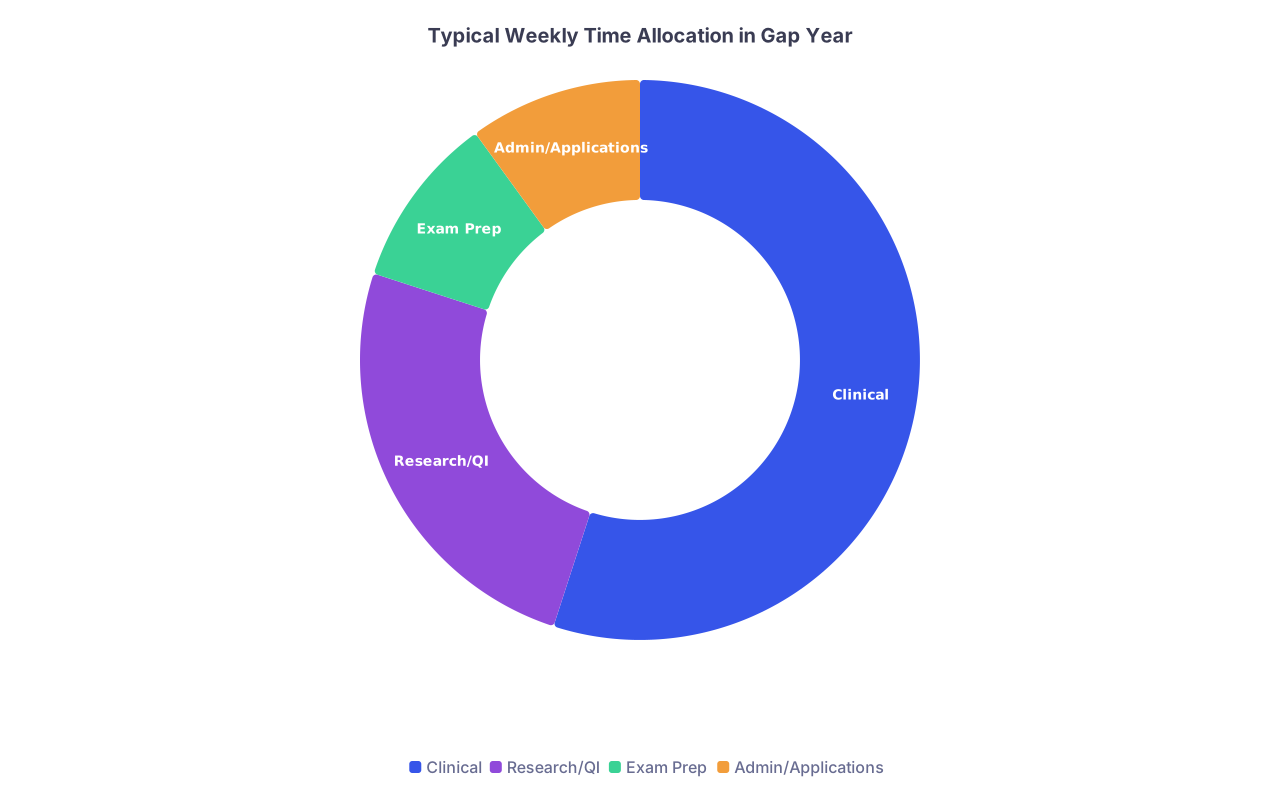
| Category | Value |
|---|---|
| Clinical | 55 |
| Research/QI | 25 |
| Exam Prep | 10 |
| Admin/Applications | 10 |
Key rule: At this point you should be known by name on at least one team. Not “the observer who shows up sometimes.” Program directors write letters for people they see consistently.
What you want to be doing in clinic:
- Pre‑charting, note drafting (even if not signed by you).
- Following a small set of patients longitudinally.
- Presenting briefly to attendings.
- Taking responsibility for something mundane but real (follow‑up calls, tracking labs).
Those details show up in letters.
Research/QI: Set Projects with Clear Endpoints
Early projects must have a near‑guaranteed output. Examples:
- Retrospective chart review with:
- 3‑month data collection
- 3‑month analysis and abstract
- QI project:
- Simple process change on a unit (improve discharge summaries, follow-up rates, vaccine documentation).
- Pre/post intervention, basic stats.
At this point you should have:
- Your name on at least 1 project protocol or IRB submission.
- A clear target conference (e.g., ACP, CHEST, RSNA, ACEP, ASN) and abstract deadline flagged on your calendar.
Month 5–6: Build Momentum and Secure Future Letters
This is where most people drift. You will not.
By Month 6 you want two things:
- At least one supervisor already thinking, “I will write this person a letter.”
- One or more abstracts either submitted or in advanced draft.
Clinical: Transition from “New” to “Reliable”
At this point you should:
- Volunteer for small leadership‑like tasks:
- Orient new observers/assistants.
- Help run a teaching conference, journal club, or case presentation.
- Ask for mid‑rotation / mid‑year feedback:
- “I am applying to internal medicine this upcoming cycle. Could you share feedback on how I am doing and what I can improve before application season?”
You are planting the seed for strong, specific letters.
If by Month 6 you have not found a potential letter writer, your placement is wrong or your visibility is too low. Fix it:
- Increase your days per week in that setting.
- Switch to a team/attending more engaged with education.
- Or add a second clinical site where letters are realistic.
Research/QI: Push Toward First Output
At this point you should:
- Have a draft abstract for at least one project.
- Be actively handling:
- Data collection
- Basic analysis
- Figure/table creation
Try to grab last‑author or middle‑author spots where realistic, but do not obsess over authorship order yet. You need activity and output.
This is also the right time to:
- Start a secondary, smaller project:
- Case report.
- Brief report.
- Educational poster with residents.
Why? Because Manuscript #1 will hit delays. Always have something else moving.
Month 7–8: Convert Work into Lines on the CV
At this point you should start turning effort into things you can type into ERAS.
Clinical: Formalize Letters and Roles
By Month 7–8:
- Identify your top 2–3 letter writers.
- Have an explicit conversation:
- “I am planning to apply in the upcoming ERAS cycle. Would you feel comfortable writing a strong letter of recommendation for me based on our work together?”
If someone hesitates or says “I can write a standard letter,” that is a no. You need strong letters.
Also:
- Ask to give a short teaching session:
- 15–20 minute talk to students or residents on a topic you know well.
- That becomes:
- “Presenter, Educational Session on X, Department of Y, Hospital Z (Month Year).”
Small thing. Adds academic flavor.
Research/QI: Draft Manuscripts and Presentations
By Month 8 you want:
- At least one abstract submitted or accepted (regional/national).
- One manuscript in progress (even if not submitted yet).
- Possibly one case report written and submitted.
These go on CV as:
- “Submitted” or “In preparation” under Publications (yes, ERAS allows that, clearly labeled).
You should also be tracking:
- Which projects align with target programs:
- Doing GI research? Highlight when applying to programs with strong GI divisions.
- QI in sepsis care? Big plus for IM and EM.
At this point you should be able to answer: “What is the main academic theme of my application?” in one sentence.
Month 9–10: Application Build and Final Polish
This is where the year’s work has to crystallize into a convincing ERAS application.
Month 9: Map Experiences to Application Sections
You now:
- Download/preview the ERAS CV structure.
- Start plugging in:
- Experiences (clinical, research, teaching, leadership).
- Publications/presentations (accepted, submitted, in preparation).
- Awards or recognitions (even small internal ones).
Check for:
- Redundancy: three almost identical observer roles in IM clinics? Combine or emphasize the richest one.
- Gaps: no leadership? Elevate any coordinating, teaching, or organizing tasks you handled.

At this point you should have:
- Draft personal statement that actually reflects your year:
- Concrete examples from your gap year work.
- Clear link between experiences and specialty choice.
Month 10: Lock Letters and Tailor Strategy
Make sure:
- All letter writers have:
- Your CV.
- Personal statement draft.
- Brief bullet list of key things you hope they can mention (clinical reliability, work ethic, analytical skills, etc.).
- You have a mix of:
- 2–3 clinical letters in your specialty (ideal).
- 1–2 research/QI letters if research-heavy year.
- Possibly 1 “character” letter from someone who knows you very well.
Then:
- Build your program list realistically:
- Use your scores, graduation year, visa status (if relevant), and this new CV to stratify “reach / realistic / safety” programs.
Do not underestimate the value of geography: if your gap year has been at Hospital X in City Y, apply broadly in that region. Local letters travel well.
Month 11–12: Interview Season Without Losing Momentum
Many applicants make a fatal mistake here: they shut down their projects once interviews start. Program directors notice.
During Interviews: Use the Year as Your Selling Point
You must be fluent discussing your gap year:
“Tell me about what you did during your time off.”
Your answer should be structured:- 1–2 sentences on why you took the year.
- 3–4 sentences on clinical role and responsibilities.
- 2–3 sentences on research/QI and key findings.
- 1 sentence on what you learned and how it shapes residency goals.
“What is your biggest accomplishment this year?”
Have one ready: a project outcome, a patient story, or a leadership action where you changed a process.
Keep Producing While Interviewing
You do not stop:
- Continue clinical shifts where possible (even part‑time).
- Keep pushing manuscripts toward submission.
- Update CV as new acceptances or publications come in.
Programs sometimes ask for updates. Being able to say, “Since I applied, our abstract was accepted to ACC, and our manuscript is under review at Journal X” is strong.
At this point you should have:
- A clean, updated CV that you send to any program requesting it.
- A short “update email” template you can adapt if appropriate:
- 3–4 bullet points summarizing new achievements since application submission.
Sample Year Configurations (So You See It in Practice)
Here are three realistic 12‑month structures that I have seen actually work.
| Profile | Clinical Component | Research/QI Component | CV Highlights by Year End |
|---|---|---|---|
| IMG, aiming IM | 4 days/wk inpatient observer/assistant | 1 day/wk QI + chart review | 2 IM letters, 1 abstract, 1 QI poster |
| US grad, switching to EM | 0.6 FTE ED scribe | EM education research fellow | EM‑specific letter, 1 pub, 2 posters, teaching |
| Low research, strong scores | Hospitalist service assistant 3 days | Full‑time research assistant 2 days | 3 letters, 2 abstracts, 1 submitted manuscript |
The pattern is obvious:
- Stable clinical base.
- Focused academic work.
- Multiple points where supervisors see you enough to write real letters.
Common Ways People Waste a Gap Year (And How to Avoid Them)
Quick list, because I have watched too many people do this:
Short, scattered observerships
Four different 2‑week observerships in four hospitals. Looks like nothing.
Fix: Prefer 3–6 months at one place over endless “tours.”Unguided research
Joining a basic science lab with no path to authorship in under a year.
Fix: Ask bluntly before starting: “What is the realistic timeline and authorship expectation for me?”Overworking in non‑CV jobs
Full‑time non‑clinical job to pay bills, leaving zero bandwidth for meaningful clinical or scholarly work.
Fix: If you must work, find something at least adjacent to healthcare and carve out protected time each week for CV‑building roles.No visible narrative
Doing good things but in totally unrelated areas: pediatrics one month, neurosurgery the next, dermatology the next, applying to internal medicine.
Fix: Once you decide a specialty, bias almost everything toward that field or settings that obviously feed into it (e.g., hospital medicine for cards/ID/pulm).
Putting It All Together
A strong gap year CV is not about “how much you did.” It is about:
- Consistency in one environment.
- Visibility to people who matter (letter writers).
- Output that can be listed and verified (abstracts, posters, manuscripts, defined roles).
- A cohesive specialty‑focused story.
Your 12 months should read like a deliberate apprenticeship, not a random collection of shifts and shadowing.
Today, do one concrete thing:
Open a blank document and write “Gap Year Anchor Plan” at the top. Under it, list:
- One potential long‑term clinical site (or type of role) you will commit to.
- One research/QI area and at least one PI or department you will email.
- The specialty you are building this entire year around.
If you cannot name those three in writing yet, you are not planning a gap year. You are drifting. Fix that now.