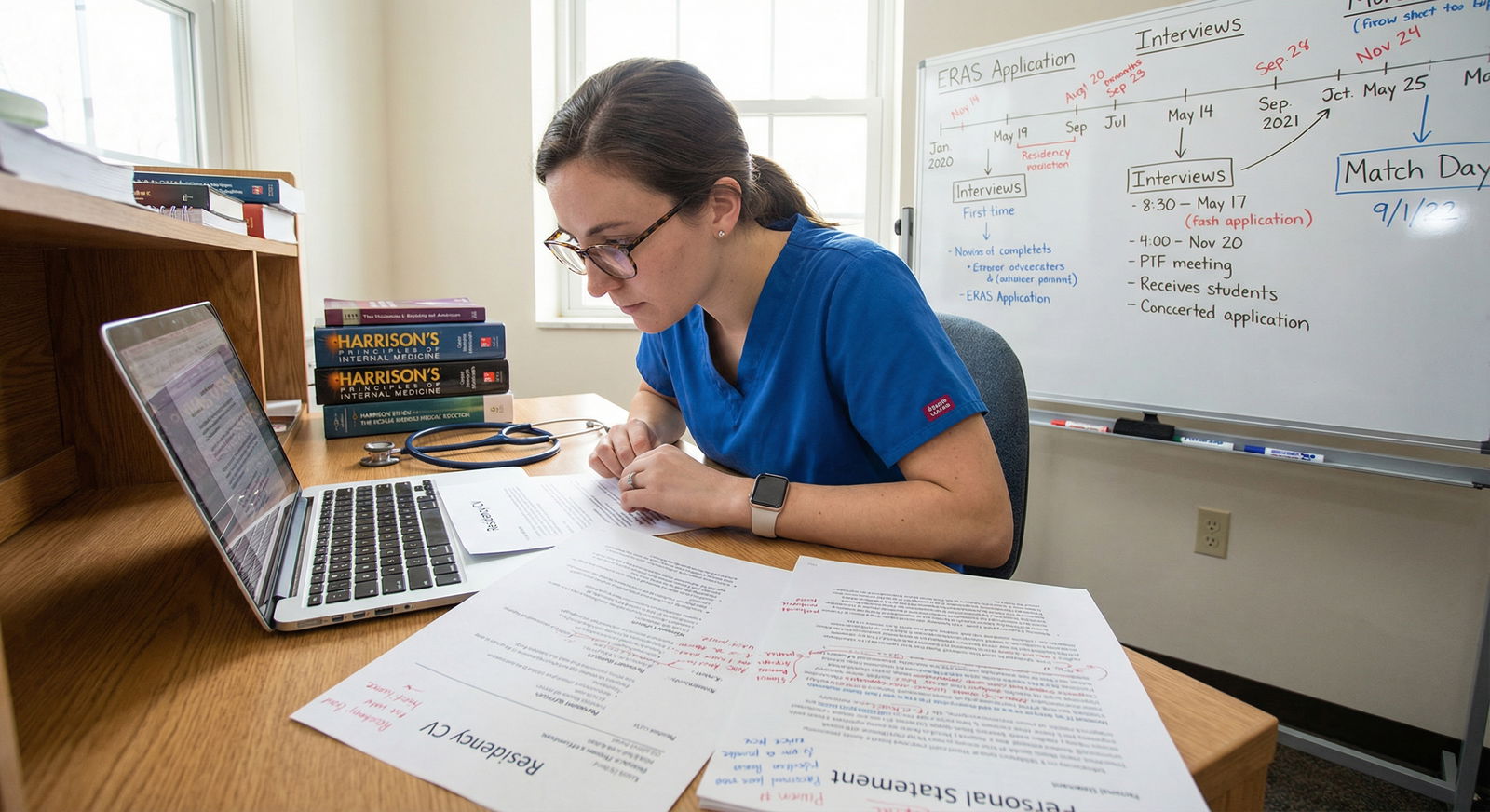
It is August of MS1. You barely know where your classrooms are, you are still pretending Anki is “kind of fun,” and someone on your orientation tour has already asked about away rotations and Step scores. You know residency applications are far away. You also know they are not.
This is where you start building your residency CV. Not in MS4. Not even in MS3. From day one.
I will walk you through it the only way that makes sense: chronologically. What you should be doing each semester, and then each month when it matters most. What to say yes to, what to ignore, and how to avoid the classic trap: doing a lot of things that look busy and add nothing to your CV.
Big Picture: What Your Residency CV Actually Needs
Before we zoom into the timeline, you need a mental template. At the end of MS3, the “good” residency CV usually has:
- Solid academic performance (no major red flags, reasonable Step 2 score).
- 1–3 meaningful research projects, ideally with at least one poster / abstract, maybe a paper.
- A few sustained longitudinal activities (tutoring, clinic, community work).
- 1–2 leadership roles where you did real work, not just held a title.
- Some teaching or mentoring experience.
- Evidence of professionalism and maturity, not chaos.
And the key word: sustained. Not “I joined 8 clubs MS1 and disappeared by MS2.”
The whole MS1–MS2 blueprint is about setting up those sustained threads.
MS1 Fall (Aug–Dec): Foundation and Positioning
At this point you should not be chasing a dozen CV lines. You should be setting the stage.
August–September (Weeks 1–8): Do Less, But Do It Right
Your priorities:
Protect your academics
- Aim for solid performance, especially if your school has internal grades or AOA.
- Learn how you actually study. Flashcards, question banks, small group. You need this dialed in, because poor grades are harder to hide than a thin activities section.
Light exploration, not commitment
- Go to interest group intro meetings (EM, IM, surgery, peds, psych, etc.).
- Listen more than you talk. Notice which residents/faculty seem engaged in mentoring.
- Do not sign up for 6 leadership roles “to build your CV.” That is how people burn out by October.
Start your “people map”
- Make a note of:
- Faculty who spoke well and seemed student-friendly.
- Residents who stayed after sessions answering questions.
- Any mention of “If you want to get involved in research, email me.”
- You’re building a list of potential mentors and research connections.
- Make a note of:
Practical weekly structure (by late September):
- Classes / studying: your default full-time job.
- One recurring outlet: intramural sports, gym, music—whatever keeps you sane.
- 1–2 interest group events or lunch talks per week. Not more.
October–December: First Real Moves
By mid-October, you should start quietly positioning yourself for research and future leadership.
At this point you should:
Identify 1–2 likely specialties
- Not final choices. Just “leading suspects.”
- Example: You like neuro and psych content; note those interest groups and faculty.
- Why: Research and leadership look more coherent if they align with a couple of areas rather than being random.
Informational conversations (target: 3–5 people)
- Email a few faculty or residents:
- “I am an MS1 interested in [X]. I liked your talk on [Y]. I would appreciate 15 minutes of advice on how to get involved in the field as a student.”
- Goals of these chats:
- Learn what students in that specialty actually do at your school.
- Identify research groups that reliably include students.
- Get permission to follow up in a couple of months.
- Email a few faculty or residents:
Soft research scouting
- Watch who is publishing and presenting with students.
- Look for:
- Clinical research coordinators
- Division chiefs known for student projects (for example, cardiology, EM, heme/onc)
- You are not committing yet. You are listening.
Minimal but strategic involvement
- Choose no more than 2 recurring things:
- Example: student-run free clinic once per month + medical students’ interest group role (non-leadership).
- Show up consistently. Faculty and older students notice who is actually there.
- Choose no more than 2 recurring things:
MS1 Spring (Jan–May): Lock in Research and Longitudinal Activities
Now you start building the spine of your future CV.
January–February: Start of Semester – Lock Your Priorities
At this point you should:
Decide on your 2–3 long-term buckets Every strong CV from MS1–MS2 usually revolves around:
- Research
- Community / clinic involvement
- Leadership / teaching
You will not grow all three fully in MS1, but you must pick which ones to seed.
Secure a research home (this is big)
- Ideal timeline: identify and commit to a research group by February–March of MS1.
- Aim for a team that:
- Has prior student posters/papers.
- Actually answers emails.
- Has at least one organized person (often a fellow or research coordinator).
Your email should be short and specific:
- Who you are.
- Why you are interested in their work.
- What you are asking: “Is there a small project or sub-analysis I could join as an MS1 over the next few months?”
Clarify expectations
- Time per week.
- Concrete deliverables: chart review, data cleaning, literature review, helping with a poster.
- Timeline: can this lead to a submission by late MS2 or early MS3?
If you are hearing only vague promises and no timeline, that is a red flag. Good mentors talk in specifics.
March–May: Execution Mode
By March, your life should look more structured.
Weekly rhythm:
- Classes / studying: still the backbone.
- Research: 3–5 hours per week. More during lighter weeks.
- 1–2 clinical/community activities monthly.
- No more than 1 leadership-style involvement (committee, group role).
At this point you should:
Have defined tasks in research
- Examples:
- Extracting variables from charts into REDCap.
- Screening articles for a systematic review.
- Building a case series draft.
- Push for measurable steps:
- “I would like to aim for a poster submission for [regional meeting] next spring. Is that realistic with this project?”
- Examples:
Choose where to show up consistently
- If your school has:
- Free clinic
- Pipeline program (mentoring pre-meds/undergrads)
- Peer tutoring
- Pick one and stick with it. Enrollment committees like continuity.
- If your school has:
Start tracking everything
- Keep a simple document:
- Project names, faculty leads, dates.
- Exact tasks done, hours per week, outcomes (poster, abstract, submission dates).
- Future you (writing ERAS) will thank you.
- Keep a simple document:
MS1 Summer (Between M1 and M2): Output Season
This is where many CVs separate. Some people drift; others produce posters and papers.
You have three main options:
- Research-heavy summer
- Research + clinical exposure
- Structured program (NIH, HHMI, institutional grants)
| Path | Main Goal | CV Output Potential |
|---|---|---|
| Full-time research | Abstract/paper | High |
| Mix research/clinic | Experience + CV | Medium |
| Funded program | Prestige + pubs | Very High |
March–April of MS1: Plan the Summer (yes, that early)
At this point you should:
Confirm your summer research plan
- Ideally you continue with your existing group.
- Clarify:
- Full-time vs part-time.
- Specific deliverables: poster, abstract, manuscript draft.
- Meetings: weekly check-ins to keep you honest.
Apply for small grants or programs
- Many schools have summer research funding with deadlines in Feb–March.
- External examples: NIH summer programs, specialty-specific student research grants.
Grants are double value: money + a nice line on the CV.
During the Summer (8–10 weeks): Push for Tangible Products
At this point you should:
Treat it like a job
- 30–40 hours per week if full-time.
- Have a task list at the start of each week.
- End every week with:
- Data completed.
- Sections of a poster or manuscript drafted.
- Specific questions for your mentor.
Aim for at least one submission
- Best-case scenario:
- Abstract to a regional/national meeting (for example, ACP, ATS, AANS, ACEP, depending on your field).
- If you are on a slower-moving project:
- Push for a case report or small retrospective that can be turned around faster.
- Best-case scenario:
Start learning the language of your field
- Read your group’s prior publications.
- Learn how they structure intros, methods, and discussion.
- You are training to sound like someone in that specialty on your future personal statement.
MS2 Fall (Aug–Dec): Consolidate and Elevate
Now it gets tighter. You are balancing:
- Higher-level coursework / organ systems.
- Early Step 1/Step 2 thinking (depending on your school).
- Existing research.
- Leadership opportunities that actually matter.
August–September: Clean Up and Commit
At this point you should:
Audit what is working and what is dead weight
- Research:
- Are you still moving toward a product? Or waiting 3 months between emails?
- Activities:
- Are you still attending that one group you joined out of guilt? Stop.
Cut ruthlessly. PDs prefer 4 real things over 10 hollow bullet points.
- Research:
Step into 1–2 leadership roles Ideal targets:
- Coordinator/director role in:
- Free clinic
- Pipeline/mentoring program
- Major student organization (e.g., IMIG, Surgery IG, SNMA, LMSA, specialty interest groups)
- Responsibility should include:
- Scheduling volunteers
- Organizing events
- Managing a small team
- Interfacing with faculty
Titles without responsibility are transparent on a CV.
- Coordinator/director role in:
Finalize research timelines
- For each active project, write:
- “Target: abstract submission to [meeting] by [month/year].”
- “Target: manuscript draft by [month/year].”
- Review these with your mentor. Get their buy-in.
- For each active project, write:
MS2 Spring (Jan–May): Finish Products Before Dedicated
This stretch is critical. You need to convert work into CV lines before Step dedicated period eats your life.
January–February: Push Outputs
At this point you should:
Submit abstracts and posters
- Many national meetings have abstract deadlines 6–9 months before the conference.
- Even if the conference is in MS3, you want the submission on your CV now.
Close at least one project
- Aim to have:
- 1 completed poster or oral presentation.
- 1 manuscript submitted (accepted is nice; submitted still counts).
- Aim to have:
If your main project is moving slowly, do a smaller parallel project (case report, quality improvement) with a faster timeline.
- Document everything properly
- Exact authorship order.
- Official conference/journal names.
- Submission dates, acceptance dates.
You will not remember this accurately during ERAS season if you do not log it now.
March–May: Transition to Step / Board Focus
At this point you should be winding down responsibilities.
Deliberate off-ramping
- Leadership roles:
- Identify your successor.
- Write a short handoff document (future CV bonus: “developed handoff system for program continuity”).
- Community roles:
- Scale back to minimal involvement.
- Leadership roles:
Research during pre-dedicated
- Shift to low-intensity tasks:
- Occasional email check-ins.
- Light manuscript edits.
- Anything requiring real cognitive bandwidth should be either:
- Done now.
- Or postponed to after boards.
- Shift to low-intensity tasks:
You do not win points for torpedoing your Step 2 studying to finish one more graph.
Parallel Tracks: What You Should Layer In Across MS1–MS2
These do not fit perfectly by month, but they should run in the background.
Building Teaching and Mentoring Experience
Ideal timing:
- Late MS1: begin light peer tutoring (if your grades support it).
- MS2: more formal roles.
Options:
- Anatomy TA, small group facilitator, peer tutor.
- Mentoring pre-meds through pipeline programs.
- Step prep tutoring near the end of MS2 if you performed well.
These roles signal:
- Communication skills.
- Reliability.
- Willingness to support a team—residency programs care about this more than students realize.
Crafting a Coherent Story
Throughout MS1–MS2, pay attention to your emerging narrative:
Example 1: “Chronic disease management in underserved populations”
- Free clinic involvement.
- Research in diabetes or heart failure.
- Leadership in a community outreach program.
Example 2: “Medical education and mentorship”
- Peer teaching, anatomy TA.
- Research in curriculum design or assessment.
- Leadership in student academic support.
Programs remember coherence. They do not remember “joined nine random things.”
Quick Visual: Effort Focus Over Time
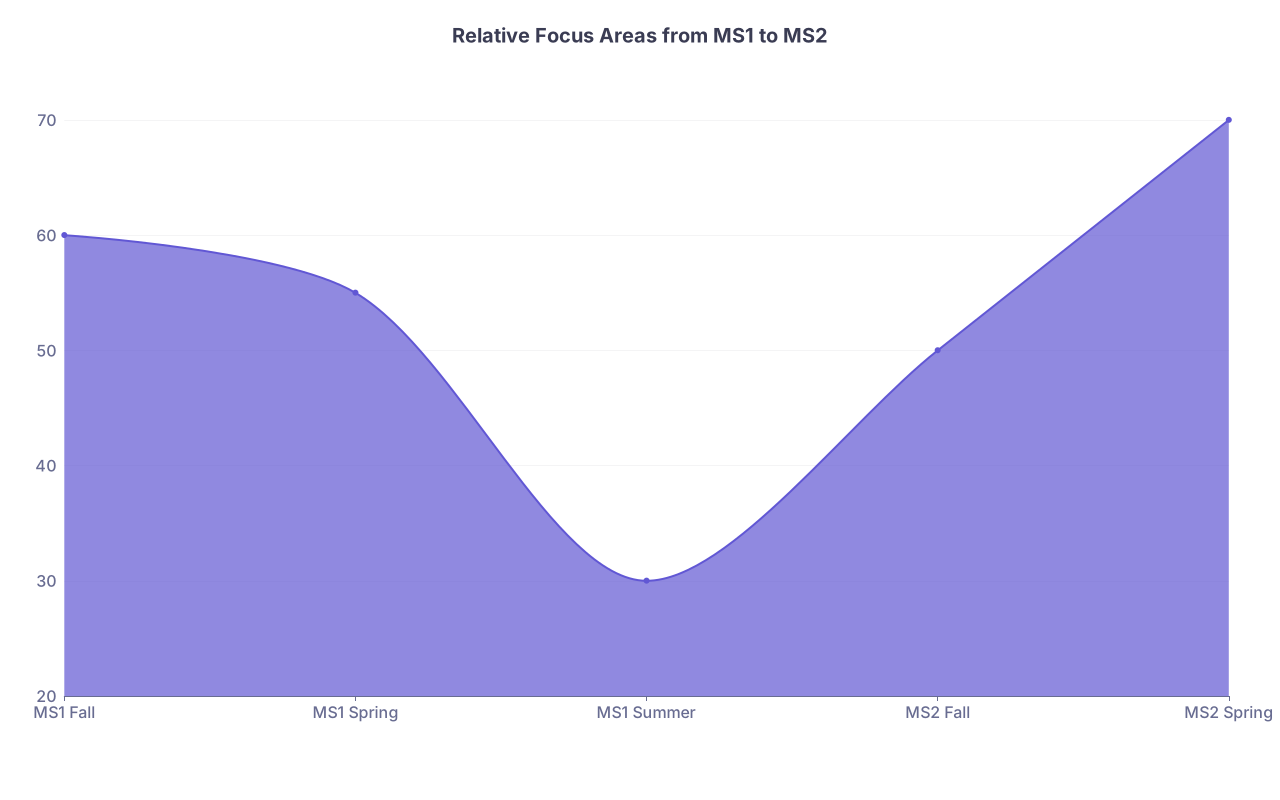
| Category | Value |
|---|---|
| MS1 Fall | 60 |
| MS1 Spring | 55 |
| MS1 Summer | 30 |
| MS2 Fall | 50 |
| MS2 Spring | 70 |
(Think of that line as academic intensity. You layer research and leadership where the academic load dips a bit.)
And a simple timeline of your progression:
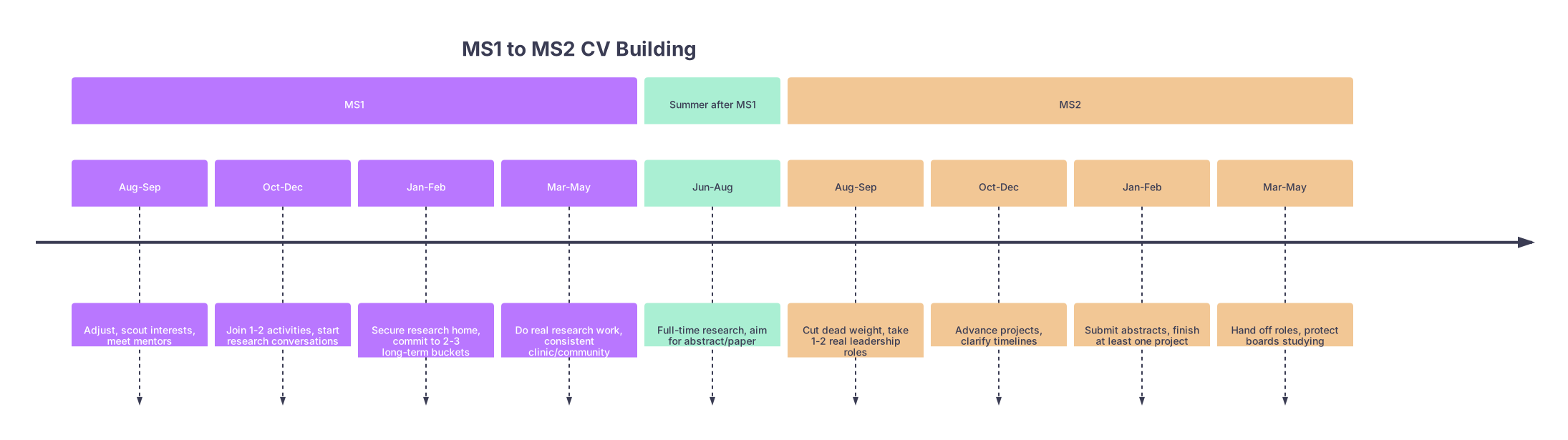
| Period | Event |
|---|---|
| MS1 - Aug-Sep | Adjust, scout interests, meet mentors |
| MS1 - Oct-Dec | Join 1-2 activities, start research conversations |
| MS1 - Jan-Feb | Secure research home, commit to 2-3 long-term buckets |
| MS1 - Mar-May | Do real research work, consistent clinic/community |
| Summer after MS1 - Jun-Aug | Full-time research, aim for abstract/paper |
| MS2 - Aug-Sep | Cut dead weight, take 1-2 real leadership roles |
| MS2 - Oct-Dec | Advance projects, clarify timelines |
| MS2 - Jan-Feb | Submit abstracts, finish at least one project |
| MS2 - Mar-May | Hand off roles, protect boards studying |
What a Strong MS1–MS2 CV Looks Like (Example)
By the end of MS2, a well-built CV might include:
| Category | Example Outcome |
|---|---|
| Research | 2 posters, 1 manuscript submitted |
| Leadership | Free clinic director, IG vice president |
| Teaching | Anatomy TA, peer tutor |
| Service | 2-year continuity clinic or outreach |
| Academics | Solid transcript, competitive Step score |
And underneath that table is 2 years of deliberate, timed decisions. Not luck.
Common Mistakes by Timeline (And What You Should Do Instead)
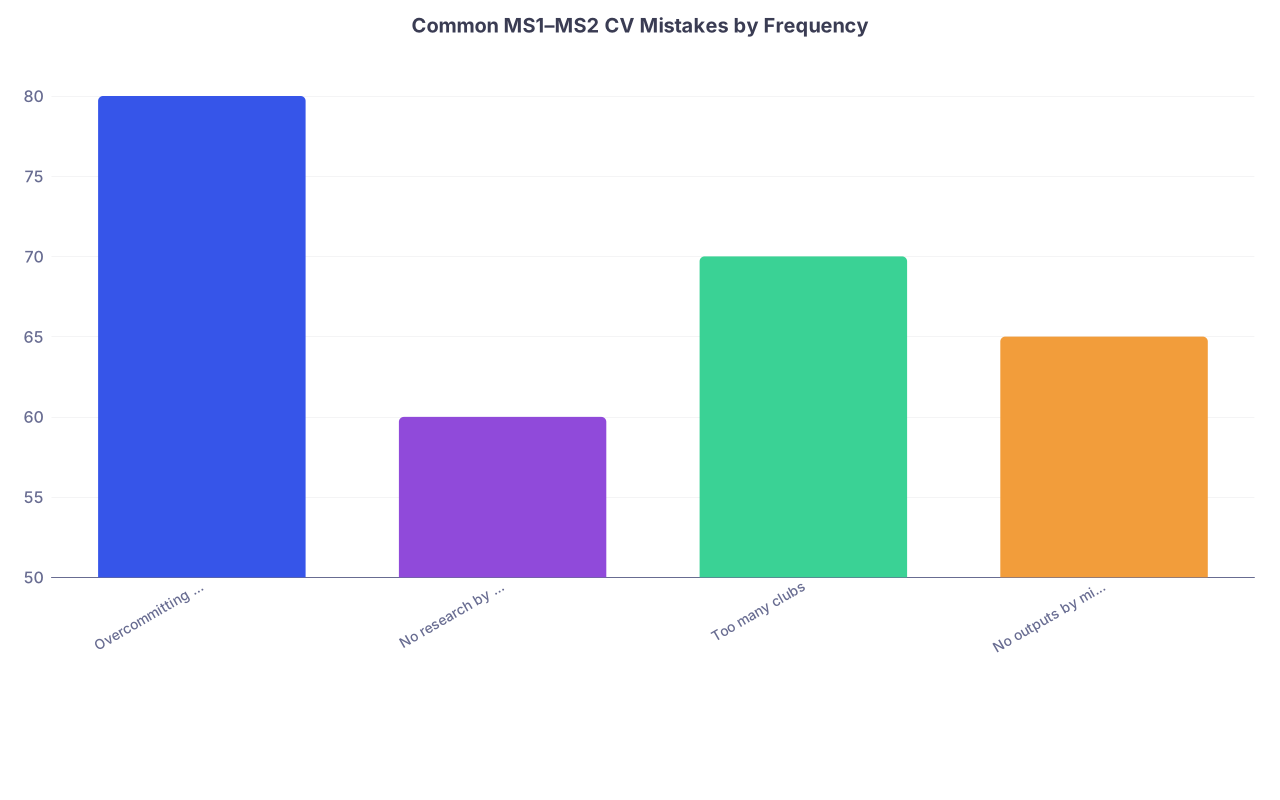
| Category | Value |
|---|---|
| Overcommitting MS1 | 80 |
| No research by end of MS1 | 60 |
| Too many clubs | 70 |
| No outputs by mid MS2 | 65 |
MS1 Fall Mistake: Joining Everything
- Problem: 7 memberships, 0 depth.
- Fix: Cap yourself at 1–2 consistent involvements; treat the rest as “just attending talks.”
MS1 Spring Mistake: Still “Looking for Research”
- Problem: You end MS1 with vague plans and no project.
- Fix: By February, you should either:
- Be on a project.
- Or have emailed 10+ potential mentors and adjusted your approach.
MS1 Summer Mistake: Unstructured “Shadowing Only” Summer
- Problem: Great stories, weak CV.
- Fix: Shadowing is fine, but pair it with at least one concrete, documentable output (research, QI, or program development).
MS2 Spring Mistake: Trying to Start New Projects During Dedicated
- Problem: Divided focus, mediocre boards score, half-baked research.
- Fix: Either front-load projects earlier, or accept that some work will restart after boards.
Bringing It Together: How to Think Day to Day
You will not wake up every morning thinking, “How can I optimize my ERAS application?” Nor should you. You are trying to become a competent physician first.
So here is how you translate this blueprint into ordinary weeks:
Once per month (MS1–MS2)
- Ask: “Is everything I am doing still moving toward a product, a skill, or a story I care about?”
- If not, cut or adjust.
Once per semester
- Review your research timeline with your mentor.
- Update your CV document: roles, dates, outputs.
When saying yes to something new
- Ask three questions:
- Does this align with my emerging interests or narrative?
- Will this likely lead to a concrete outcome (poster, leadership responsibility, teaching hours)?
- Can I realistically do this without hurting my academics or existing commitments?
- Ask three questions:
If you cannot answer “yes” to at least two of those, it is probably a no.



Key Takeaways
- Start positioning in MS1 Fall, but keep commitments light; lock in research and 2–3 long-term activity buckets by MS1 Spring.
- Use the MS1 summer and MS2 Fall–Spring to convert work into concrete outputs: abstracts, posters, manuscripts, real leadership, and teaching.
- Repeatedly prune and refocus; depth beats breadth. At any point, you should know your projects, your timeline, and your emerging narrative for residency.