
The lazy MS4 summer is a myth. The weeks before ERAS opens will either sharpen your CV or lock in your weaknesses.
You are out of time for big reinventions. But you still have 8–12 weeks to make very strategic, high-yield upgrades. That is what we are going to do. Week by week, then down to what each day should look like when the portal opens.
Big-Picture Timeline: MS4 Summer CV Upgrade
At this point, you should think in weeks, not vague “soon.” Here is the structure you are working with.
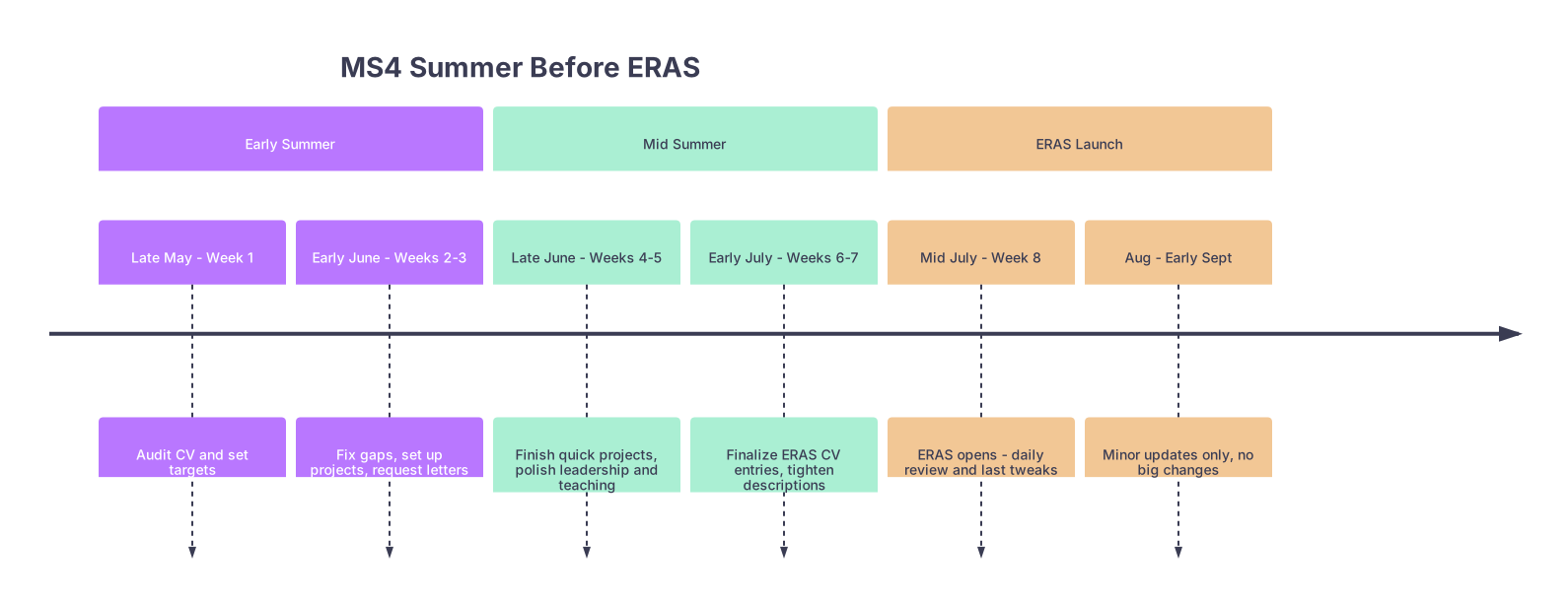
| Period | Event |
|---|---|
| Early Summer - Late May - Week 1 | Audit CV and set targets |
| Early Summer - Early June - Weeks 2-3 | Fix gaps, set up projects, request letters |
| Mid Summer - Late June - Weeks 4-5 | Finish quick projects, polish leadership and teaching |
| Mid Summer - Early July - Weeks 6-7 | Finalize ERAS CV entries, tighten descriptions |
| ERAS Launch - Mid July - Week 8 | ERAS opens - daily review and last tweaks |
| ERAS Launch - Aug - Early Sept | Minor updates only, no big changes |
Here is how the hours actually break down across the summer if you do this correctly:
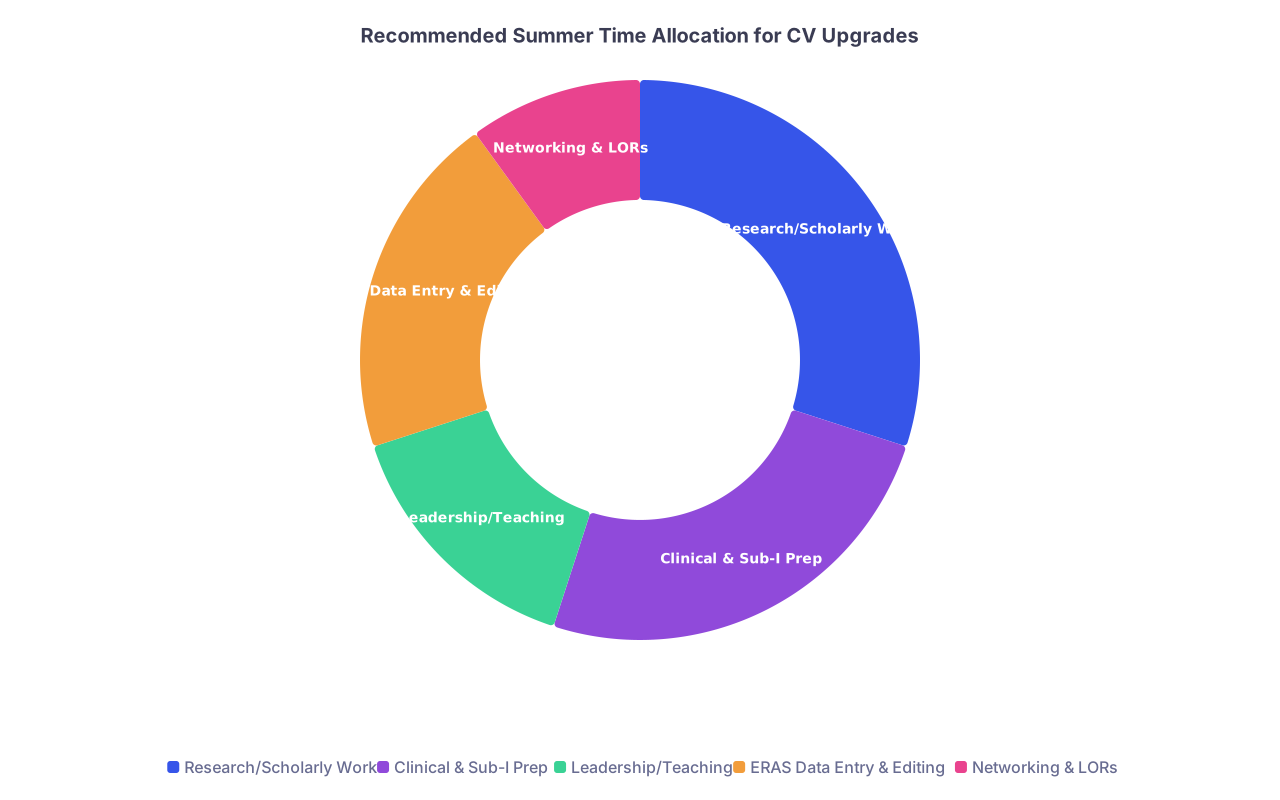
| Category | Value |
|---|---|
| Research/Scholarly Work | 30 |
| Clinical & Sub-I Prep | 25 |
| Leadership/Teaching | 15 |
| ERAS Data Entry & Editing | 20 |
| Networking & LORs | 10 |
Now, let’s walk it chronologically.
Late May – Week 1: Brutal CV Audit and Target Setting
If you are reading this in June, fine. Start today and compress. But do not skip this step.
Day 1–2: Dump Everything You Have
At this point, you should:
- Export your current ERAS-style CV (or whatever version you used for away rotations).
- Pull up your school’s MSPE “CV worksheet” if they gave you one.
- Open your publications spreadsheet, abstract list, and any research logs.
Then:
- List every activity in the last 4–6 years:
- Research projects, posters, manuscripts (even “in progress”).
- Leadership roles (class rep, interest group officer, QI committee).
- Teaching/tutoring (TA roles, peer teaching, OSCE coaching).
- Volunteer and community service.
- Work experience, especially pre-med clinical work.
- Put it into rough ERAS buckets:
- Work
- Volunteer
- Research
- Leadership/Teaching
- Honors/Awards
No formatting. Just get it all out.
Day 3–4: Compare Against Your Target Specialty
Now you reality-check against what your specialty expects. Use real program data, not gossip.
Look at:
- Program websites (especially their “resident bios” pages).
- NRMP and specialty “Charting Outcomes” PDFs.
- PubMed searches of current residents to see typical output.
Boil that into a quick comparison.
| Specialty | Research Output | Leadership/Teaching | Service/Volunteer Emphasis |
|---|---|---|---|
| Academic IM | 1–3 pubs/abstracts | Some leadership or TA | Moderate |
| Community IM | Posters/abstracts nice | Optional | Moderate |
| Derm/Plastics | 5+ projects, multiple | Strongly expected | Lower weight |
| EM | 1–2 projects helpful | Leadership preferred | Strong EM interest, service |
| Peds/FM | Optional, 1–2 fine | Some teaching helpful | Strong emphasis |
Now ask, right now, what looks weak or empty:
- No leadership at all?
- Research listed as “in progress” with no concrete output?
- Tons of random one-off volunteering with no continuity?
- Teaching experience missing?
You are not going to fix everything. You will pick 2–3 specific upgrade targets for the summer. That is it.
Example targets:
- Turn “in progress” research into at least one submitted abstract or manuscript.
- Convert informal teaching into a formal, documentable role.
- Make one leadership role concrete and active, not just a line on paper.
- Clean up CV descriptions so they sound like a resident wrote them, not an undergrad.
Write your 2–3 targets down. Keep them visible.
Day 5–7: Build Your Summer CV Plan
At this point, you should block out actual weeks.
For each target, answer:
- What is the smallest verifiable outcome I can get in 6–8 weeks?
- Example: “Submitted case report,” “Abstract submitted to regional meeting,” “Launched 3-session M3 teaching series.”
- Who controls whether that happens?
- Attending, research mentor, clerkship director, student group president.
- What do I need from them this week?
Then create a simple weekly map (by hand, not in your head):
- Week 2–3: Draft and submit case report; confirm authorship with mentor.
- Week 2–4: Start and complete 3–5 teaching sessions with documentation.
- Week 3–5: Run one tangible leadership project (journal club, QI checklist, curriculum session).
Now you have a plan. Next, execution.
Early June – Weeks 2–3: Fast Wins and High-Yield Fixes
Here is where you stop “collecting experiences” and start finishing things.
Research and Publications: Converting “In Progress” to “Submitted”
If your CV has lots of “data collection in progress,” programs yawn. They want endpoints.
At this point, you should:
- List every ongoing project with:
- PI name
- Your specific role
- Current status (data collected? analysis started? draft written?)
- Prioritize 1–2 projects where you can realistically get:
- A submitted abstract, or
- A submitted manuscript, or
- A completed poster accepted to a local/regional meeting.
Then:
- Email your mentor something like:
- “I will draft the case report/manuscript/abstract this week and send you a version by Friday.”
- Set a 3–4 day deadline to produce a rough draft.
- Ask directly: “Is there a specific meeting or journal we can target this summer?”
If your mentor is slow (many are):
- Push for at least: “Okay to list as ‘Manuscript in preparation’ with you as supervising author?”
- And try to get one abstract submitted somewhere with your name on it, even a hospital conference.
You are aiming for entries you can list as:
- “Submitted” or “In press,” not just “in progress.”
Teaching and Mentoring: Make It Formal
Informal teaching does not exist on ERAS. It needs a title and dates.
At this point, you should:
- Email clerkship directors, course directors, or education chiefs:
- “I would like to help run M2/M3 review sessions for X clerkship over the next month. Could I be listed as a peer-teacher or session facilitator?”
- Volunteer for:
- OSCE practice sessions
- Anatomy or skills labs
- Shelf review sessions
Minimum goal:
- 1 clear teaching role, with:
- Title (e.g., “M3 Medicine Shelf Review Facilitator”)
- Start and end month (even if it is one month)
- Approximate hours or number of sessions.
Leadership and Service: One Real Project, Not Ten Random Shifts
Random 1–2 hour volunteer events are CV clutter.
Better:
- Take on one concrete project that you can describe as an accomplishment.
Examples for June–July:
- Organize a 3-part virtual Q&A for M1s interested in your specialty.
- Coordinate a donation drive or screening event with measurable numbers (“Recruited 12 volunteers, screened 80 patients…”).
- Lead an interest group journal club and standardize it (set schedule, invite speakers, track attendance).
At this point, you should rewrite vague roles like:
- “Member, Internal Medicine Interest Group”
Into:
- “Executive board member, planned and led 4 journal clubs for 30+ students over 3 months.”
But you must actually do at least some of that this summer.
Mid-June – Week 4: Clean, Quantify, and Request Letters
You should now have projects moving. Time to refine what already exists.
Clean Up Old Entries
Open your CV or ERAS draft and look for these sins:
- Bullet points with no numbers:
- Fix: “Taught students” → “Led weekly 1-hour review sessions for cohorts of 10–15 M2 students.”
- Vague verbs:
- “Helped with research” → “Performed chart review of 150 patients and extracted data for outcomes analysis.”
- Redundant college-level fluff:
- Old minor roles from undergrad that add nothing now. Trim them.
Aim for each major entry to have:
- 1–3 concise bullets
- At least one specific metric (hours, number of students, sessions, patients, dollars raised, etc.)
Request Letters of Recommendation (LORs) While You Are Active
Letters are not CV items but they validate the CV.
At this point, you should:
- Identify 3–4 attendings who:
- Actually saw you work.
- Can comment on your clinical ability and reliability.
- Ask while you are fresh in their mind, ideally at the end of a rotation or project.
Your ask sounds like:
- “I am applying to [specialty] this cycle. I valued working with you on [rotation/project]. Would you be comfortable writing a strong letter of recommendation on my behalf?”
Strong is the keyword. It gives them an out.
Then send:
- Updated CV
- Brief bullet list of what you did with them
- Your specialty target and any programs of particular interest.
Late June – Weeks 5–6: Lock In Teaching, Leadership, and ERAS Structure
By now, your goal is no new big commitments. Just finishing.
Finalizing Short-Term Projects
At this point, you should:
- Push your in-progress work over clear thresholds:
- Abstract – actually submitted.
- Case report – drafted and sent to mentor.
- Teaching series – at least 2–3 sessions completed.
- Leadership project – at least one discrete event completed with tangible numbers.
Document everything:
- Keep emails verifying acceptance, participation numbers, or roles.
- Save conference acceptance notices, even if the meeting happens after ERAS opens.
- Take a photo of posters (for your own records).
Translating Summer Work into Strong CV Phrases
Now you write it like a resident.
Weak:
- “Participated in quality improvement project about hand hygiene.”
Better:
- “Co-led multidisciplinary QI project to improve inpatient hand hygiene compliance; designed data collection tool and analyzed pre/post metrics for 3 hospital units.”
You should also be consistent with verb tense:
- Use past tense for completed roles.
- Present tense for ongoing but active roles.
- Avoid “in progress” unless there is a clear endpoint (e.g., “Manuscript in preparation”).
Early July – Week 7: Pre-ERAS CV Polish and Cross-Checks
ERAS typically opens in early July. Before that portal goes live, your offline version should be almost final.
Structured ERAS CV Draft
At this point, you should:
- Have every activity slotted into ERAS-like fields:
- Organization name
- Role/position
- Start/end dates (month/year)
- Average hours per week
- Brief description
Watch for:
- Unrealistic hour counts that will raise eyebrows.
- Gaps longer than 3–4 months with no obvious activity:
- If you had a break, that is fine—just be ready to explain it, and where appropriate you can list significant life obligations honestly (illness, caregiving, etc.) if they materially impacted your timeline.
Top 5–10 Experiences: “Most Meaningful” Thinking
ERAS does not have the same “most meaningful” flag as AMCAS, but programs still scan for your core identity.
At this point, you should identify:
- 3–5 clinical or service experiences that:
- Directly support your specialty choice.
- Show longitudinal involvement or growth.
- 2–3 scholarly or leadership experiences that:
- Show initiative.
- Produced a real outcome.
Make sure these entries are:
- Clear, specific, and free of fluff.
- Consistent with what you will talk about in your personal statement and interviews.
Mid-July – Week 8: ERAS Opens – Daily Tasks for the First 10 Days
Once the ERAS portal opens, time gets weird. People waste days “fiddling” instead of executing.
Here is what your first 10 days should look like.
Day 1–2: Data Entry Sprint
At this point, you should enter everything you have prepared:
- All experiences (work, research, volunteer, leadership, teaching).
- Honors and awards.
- Publications, abstracts, and presentations:
- Use correct citation formats.
- Be honest about status: Published / In press / Submitted / In preparation.
Block 2–3 hours, sit down, and get the skeleton in. Do not obsess over micro-editing yet.
Day 3–4: Description Polishing Pass
Now you refine. Focus on:
- Short, active, specific descriptions.
- Eliminating repetition (do not describe the basics of “3rd year clerkship” in every entry).
- Highlighting outcomes, not duties:
- “Improved X”
- “Developed Y”
- “Presented Z”
Example upgrades:
“Student volunteer at clinic”
→ “Coordinated intake and triage for 15–20 uninsured patients per shift at student-run free clinic; supervised new volunteers and assisted with Spanish interpretation.”“Research assistant on cardiology project”
→ “Collected and managed clinical data from 220 cardiology patients; performed preliminary analysis in SPSS for study on readmission predictors.”
Day 5–6: Consistency and Specialty Coherence Check
At this point, you should do a specialty lens review:
- Does your CV clearly point toward your chosen field?
- Are your experiences obviously aligned with your stated interest in, say, Pediatrics or EM?
- Are there activities that belong but need reframing?
For example:
- Generic volunteer work becomes:
- “Experience working with underserved pediatric populations” (for Peds).
- “Outpatient continuity care with complex chronic conditions” (for FM).
You are not inventing anything. You are connecting the dots.
Day 7–8: External Review
Have 1–2 trusted people skim:
- A resident in your target specialty.
- A faculty mentor.
- A career advisor who actually knows your specialty.
Ask them to answer:
- “If this CV was all you saw, what kind of resident would you think I am?”
- “What looks weaker or confusing than it should?”
- “What looks padded?”
Then fix only the real issues. Do not start rewriting everything based on stylistic preferences.
Day 9–10: Freeze the Core, Leave Space for Micro-Updates
By the end of this window:
- Your entire ERAS CV should be functionally complete.
- You should only plan to add:
- New acceptances (poster, publication).
- Updated roles if something significant and verifiable changes.
Do not keep “tweaking” every line for weeks. Programs care more that:
- It is accurate.
- It is clear.
- It is coherent with your letters and personal statement.
August to Application Submission (Early–Mid September): Minor Edits, Not Reinventions
This is maintenance mode, not construction.
At this point, you should:
- Add any newly accepted:
- Abstracts
- Manuscripts
- Awards
- Make minor clarity edits if a mentor points out something confusing.
What you should not do:
- Start new major projects just to have another line. They will be obviously superficial.
- Inflate roles or hours because you feel behind. Programs notice patterns.
Instead, channel energy into:
- Strong personal statement that matches your CV.
- Thoughtful program list.
- Preparing to talk about every line on your CV without hesitation.
Key Takeaways
- The MS4 summer is not for creating a new identity. It is for finishing and sharpening what you already started: turning “in progress” into “submitted,” informal roles into formal ones, and vague bullets into precise accomplishments.
- Work week by week: early June to set targets and launch projects, late June to complete and document them, early July to structure and polish ERAS entries, and mid-July onward to finalize and lightly maintain.
- When ERAS opens, move fast but not sloppy: enter everything, then systematically refine descriptions, check specialty coherence, get one or two sharp external reviews, and freeze the core CV so you can focus on the rest of your application.