
The obsession with “Honors and Awards” on ERAS is wildly overblown.
I’m saying that as someone who has stared at that blank section and thought, “Cool. I’m done. I’ll never match.”
If you’re scrolling Reddit or talking to classmates, it honestly feels like everyone else has:
- AOA
- Gold Humanism
- Research awards
- Teaching awards
- Some random “Leadership in Medicine” scholarship you’ve never even heard of
And you? Maybe a couple of random scholarships you don’t even know if you should list. Or literally nothing.
Let me be blunt: having no awards or honors does not automatically tank your chances in the Match. But letting that anxiety paralyze you and keep your CV weak in the other sections will.
Let’s pick this apart like we’re doomscrolling FREIDA at 2 a.m.
What Programs Actually See When You Have “No Awards”
First big reality check: ERAS is not a beauty contest for the “Honors/Awards” box.
Program directors are not sitting there saying, “Reject anyone with zero honors.” They’re scanning patterns. Signals. Context.
Here’s what that empty section can and cannot suggest.
It does not automatically mean:
- You’re lazy
- You’re average
- You’re not competitive
- You don’t care
It can raise questions if it lines up with other red flags:
- Low Step scores
- Weak clinical comments
- No research
- No leadership, no service, nothing that shows initiative
So the problem isn’t “no awards.”
The problem is “nothing else compelling either.”
Programs care way more about:
- Step 2 score
- Clinical performance (MS3 evaluations, narrative comments)
- Quality of letters of recommendation
- Research / scholarly work, especially in competitive fields
- Genuine interest and fit for their program (through your personal statement, experiences, and interview)
I’ve literally heard an APD say during a review:
“Honors section is nice, but if their letters are fire and they’ve clearly done the work in this specialty, I don’t care.”
So yeah, honors help. But they’re seasoning, not the main dish.
The Honest Truth: Who Actually Needs Honors to Compete?
Let me be harsh for a second, because the anxiety monster in your head is already being harsh, just not accurate.
There are some situations where honors/awards make more difference:
- Ultra-competitive specialties (Derm, Ortho, ENT, Plastics, Uro, Neurosurg)
- High-tier academic programs that filter heavily on metrics
- When your scores or grades are borderline and you need extra positives
Even then, lack of honors is not a death sentence. It just means you need to be strong somewhere else:
- High Step 2
- Multiple solid specialty-specific letters
- Tangible research output (poster, paper, abstract)
- Legit commitment to the field (sub-I performance, elective choices, etc.)
| Specialty Type | Do Honors Matter A Lot? | Can You Match Without Them? |
|---|---|---|
| Ultra-competitive | Yes, often | Yes, with strong other areas |
| Moderately competitive | Helpful but not critical | Common |
| Less competitive | Nice but optional | Absolutely |
| Primary care | Minimal | Very common |
For IM, Peds, FM, Psych, EM, Neuro at many programs? Tons of residents have zero “fancy” awards on paper. What they did have: evidence they show up, learn, work, and don’t make the team’s life miserable.
How to Make a “No Awards” CV Still Look Strong
Here’s the part that actually matters: what you can do about it.
You can’t go back and magically generate AOA. But you can absolutely build a CV that says:
“I may not have trophies, but I’ve done real, meaningful things.”
1. Maximize the Experiences Section (Your Real Power Zone)
If your “Honors” line is thin, your “Experiences” sections (Work, Research, Volunteer, Leadership) need to carry your application. Stop thinking “I did nothing.” You almost definitely did more than you realize.
Ask yourself:
- Did I have a longitudinal clinic role?
- Did I tutor or mentor younger students?
- Was I on any committee? Curriculum, wellness, diversity, anything?
- Did I have a non-medical job? (That actually counts and can look really good.)
- Did I help organize a student group event or conference?
Don’t list things as one-line fluff. Build them out.
Weak version: “Volunteer, Student Clinic – 2022–2023”
Stronger version: “Clinical Volunteer, Student-Run Free Clinic
- Completed weekly 4-hour shifts managing patient intake and counseling
- Coordinated social work referrals for uninsured patients
- Led orientation session for 5 new volunteers”
See the difference? Same role. Way more impact.
2. Turn “Just Doing My Job” Into Actual Accomplishments
You’re probably downgrading half your life as “not award-worthy.” Which is true. But it is CV-worthy.
You:
- Took initiative?
- Improved a system?
- Created a template, checklist, or resource people still use?
- Taught someone something that kept spreading?
That’s impact. Programs love impact.
Example:
You made an Anki deck for your rotation and shared it with classmates?
That’s “Educational resources for peers – created and distributed X-card deck used by Y students.”
You reorganized sign-out on a sub-I so nights were less chaotic?
That’s “Improved handoff system for team, reducing missed tasks and increasing clarity.”
You don’t need a plaque. You need to describe what you actually did and how it helped.
3. Fix the “Empty” Look of Your CV Without Lying
There’s this terrible feeling when you preview your ERAS PDF and see three tiny lines under Honors/Awards and big white space everywhere else.
Here’s how to make the document feel fuller and more substantial without making stuff up:
- List scholarships that are even vaguely selective.
- Include school-based recognitions (Dean’s List, small teaching awards, local leadership awards).
- If your school doesn’t have many formal awards, lean heavily into your roles and responsibilities instead.
But don’t fake it. Program directors do notice inflated nonsense like:
- “Award: Best Team Player” that your friend made up at a group dinner
- “Named award” that doesn’t exist on your school’s website
If you have nothing legit, leave it blank and let your narrative live elsewhere. Empty is better than dishonest.
4. Let Your Letters of Recommendation Do the “Honors” Work
Here’s the dirty secret: a killer letter from someone respected in the field is worth more than any random school award.
You want letters that say things like:
- “Top 10% of students I’ve worked with in the last 5 years”
- “One of the strongest sub-interns on our service this year”
- “I would be thrilled to have them as a resident at our program”
That’s functional AOA, in narrative form.
To get those letters:
- Show up early, leave late, actually be useful
- Ask for feedback and improve, visibly
- Tell the attending you’re interested in their specialty and program
- When you ask for a letter, explicitly ask: “Would you feel comfortable writing me a strong letter of recommendation for X specialty?”
If they hesitate or say something vague, find someone else. You need strong letters, not lukewarm paragraph summaries.
5. Use Your Personal Statement as Context, Not Excuses
Your personal statement is not the place to cry, “I didn’t get any awards, but I tried really hard!” That just highlights the insecurity.
Instead:
- Show consistency: long-term commitments, not random one-month stints
- Show growth: you took on more responsibility over time
- Show insight: what you learned about the specialty, yourself, and patient care
You’re painting a picture of someone who:
- May not have a shelf full of trophies
- But will absolutely show up, grow, and contribute for four years straight
Programs want the person behind the CV. If that story is strong, the missing honors line fades.
Concrete Moves You Can Still Make Before Applying
If you’re not in the application cycle yet, you actually have time to do damage control in a productive way.

| Step | Description |
|---|---|
| Step 1 | Realize no awards |
| Step 2 | Take on longitudinal role |
| Step 3 | Start small research or QI project |
| Step 4 | Strengthen letters and descriptions |
| Step 5 | Leadership or teaching role |
| Step 6 | Submit abstract or poster |
| Step 7 | Polish CV and PS |
| Step 8 | Time before ERAS? |
If you have 6–12+ months:
- Join a research or QI project in your specialty of interest
- Take on a tutor or TA role
- Step into a small leadership position in a student group (even if it’s “events coordinator” or “clinic scheduler”)
- Stick to something consistently so you can show commitment
If you have less than 6 months:
- Make sure your letters are from people who actually know your work
- Rewrite your experiences to show depth and impact
- Talk to your advisor honestly: “I’m worried my lack of awards will hurt me. Where can I realistically strengthen my app this cycle?”
Don’t waste the remaining time doomscrolling. You can’t invent honors, but you can shore up the weak sides of your app.
What Program Directors Actually Care About (Data, Not Feelings)
You might feel like awards are everything. They’re not.
NRMP Program Director Survey after survey shows the consistent big-ticket items:
- Step 2 score
- Letters of recommendation in the specialty
- MSPE / clinical evaluations
- Clerkship grades
- Personal statement and perceived fit
“Honors/Awards” appears, but not at the same level as those core elements. It’s a bonus.
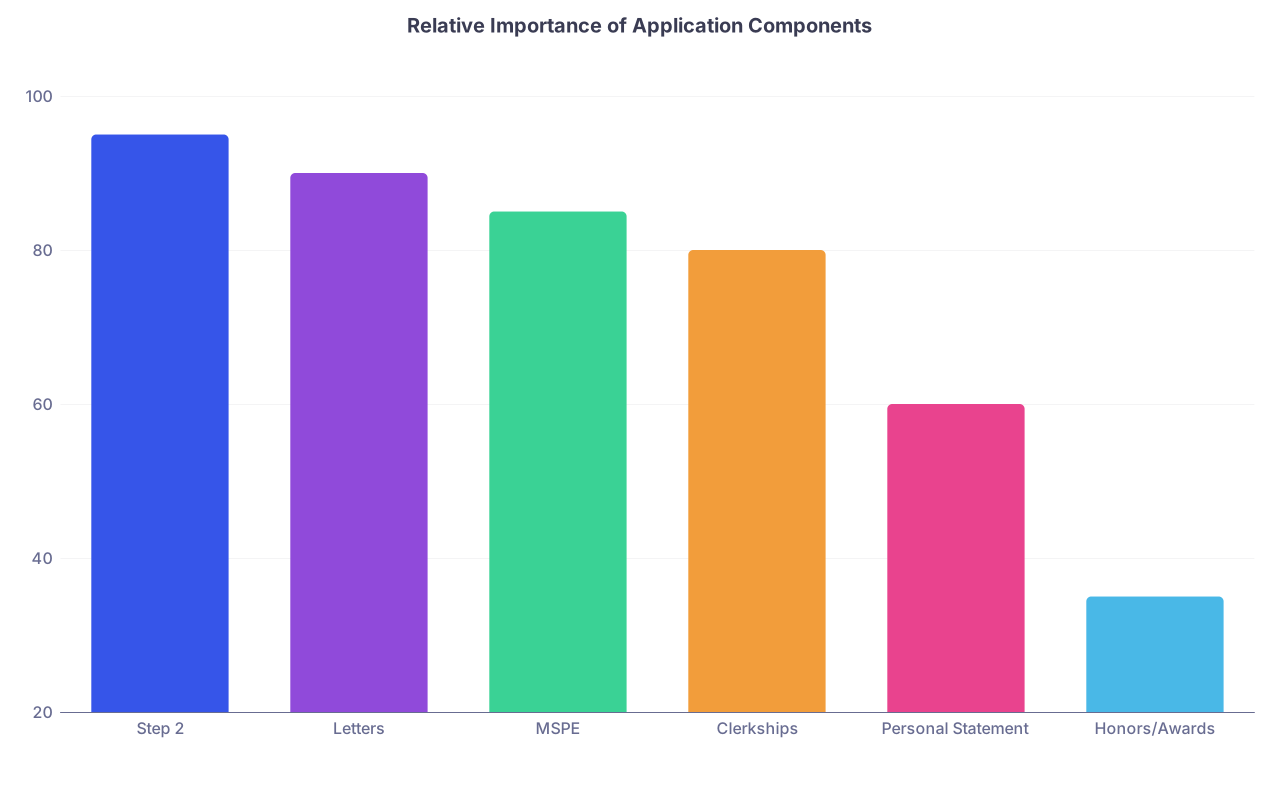
| Category | Value |
|---|---|
| Step 2 | 95 |
| Letters | 90 |
| MSPE | 85 |
| Clerkships | 80 |
| Personal Statement | 60 |
| Honors/Awards | 35 |
So yeah, having AOA or GHHS might nudge you up a little at certain places. But almost nobody is getting into residency because of a single award.
People get in because their overall story makes sense:
- Scores in range
- Competent and liked on rotations
- Some proof of interest in the field
- Not a nightmare to work with
You can be that person without any formal honors.
Translating Your Anxiety Into a Plan (Instead of Just Spiraling)
Here’s the part my inner catastrophizer hates: you actually have control over some of this.
Today, you can:
- Open your CV and brutally expand your descriptions to show what you really did
- List out everything you’ve done the last 4–6 years and see what’s missing from your ERAS
- Email someone you worked closely with and ask: “Would you feel comfortable writing me a strong letter?”
- Book 30 minutes with an advisor/Dean and say: “I’m scared my lack of honors makes me uncompetitive. Can we review my CV together?”
You can’t magically change your “Honors” section. But you can absolutely change how the rest of your application reads.
FAQs (The Stuff You’re Probably Still Stressing About)
1. Should I list tiny, random awards to make the section look less empty?
If they’re real and objectively given by an institution (school, hospital, organization), yes. Even if small. Example: “Community Service Scholarship” or “Department Book Award.” Don’t invent or exaggerate. And don’t list nonsense like “Best Friend Award” from your roommate. It’s better to have a short, honest section than a long, sketchy one.
2. My school doesn’t have AOA or GHHS. Am I automatically behind?
No. Lots of schools don’t. Programs know this; it’s literally in your MSPE. They don’t expect AOA from a school that doesn’t offer it. In those cases they look more at your clinical comments, grades, ranking categories, and letters. You’re not secretly penalized for your school’s system.
3. Is it better to leave the Honors section totally blank or put something mediocre?
If it’s real and official, put it. A small local scholarship or departmental recognition still shows someone thought well of you. What you don’t want is to stretch random stuff into “awards.” For example, just being in a club is not an “honor.” When in doubt: if it required selectivity or someone choosing you → probably okay to list.
4. Will programs think I’m lazy if I have no awards?
Most won’t jump there automatically. Especially if other parts of your app show work ethic: strong comments like “hardworking,” “eager to help,” “reliable,” plus decent experiences. They’re more likely to think, “Okay, this school maybe doesn’t hand out awards like candy,” or “This person focused on actually doing the work instead of chasing lines on a CV.”
5. I’m applying to a competitive specialty with no honors. Should I still try?
You can, but you need to be strategic. Apply broadly, include a realistic backup (like IM or prelim), talk to advisors in that field about whether your numbers and experiences are in range. You’ll need strong letters, some research, and a well-crafted story of commitment. People do match into competitive specialties without big awards, but not usually on vibes alone.
6. What’s one thing I can do this week that would actually help my CV?
Pick one attending or supervisor who knows your work and schedule a quick meeting or send an email: “I’m applying to X specialty and really value your perspective. Could I get your feedback on my CV and see if you’d feel comfortable writing me a strong letter?” That single step can turn a blank “Honors” section into a file with a powerful letter—and that matters far more.
Open your CV right now and scroll past the Honors section. Look at your experiences. If a stranger read only those, would they understand how hard you’ve worked and what you actually contributed? If not, fix that today. That’s where your Match story is going to be won or lost.