
The way most applicants show a medical school transfer on their CV looks messy—and programs will assume your training was messy too.
You can do better. You can make your path look intentional, organized, and completely standard. Because it basically is, if you present it right.
This is for you if:
- You did basic sciences at one school and clinicals at another
- You switched MD/DO programs after M1 or M2
- You moved from a Caribbean / international school to a US school (or vice versa)
- You had any formal “transfer of credit” situation
Let me walk you through exactly how to make your CV, ERAS, and story look seamless instead of chaotic.
Step 1: Get Clear On Your Story Before You Touch Your CV
If you cannot explain your own path in 2–3 clean sentences, your CV will reflect that confusion.
First, write it out plainly for yourself. Not for programs. Just for you.
Something like:
- “I completed my pre-clinical curriculum at X University School of Medicine (2019–2021), then transferred to Y University School of Medicine for clinical training and graduation (2021–2024). All core clerkships and subinternships were completed at Y or its affiliated hospitals.”
or
- “I initially enrolled at A Medical College, then transferred to B College of Osteopathic Medicine after M1 due to a family relocation. My degree was conferred by B COM; all clinical rotations were completed through B COM–affiliated sites.”
If you can’t do that yet, you’re not ready to format anything. Get it to:
- One sentence about timeline
- One sentence about what was done where
- One sentence (optional) about why (only if needed later for interviews or PS – not on CV)
Once that’s clear, everything you write—education section, rotations list, personal statement—has to line up with that same simple narrative.
Step 2: Decide Your Overall Presentation Strategy
You’ve got two main options for how to list your medical education:
- Single “graduating” school as primary + brief transfer note
- Both schools fully listed in education with clear roles (pre-clinical vs transfer)
If your transfer was:
- Early (M1–M2),
- Your final school awarded your degree,
- And your transcript from the final school clearly shows transfer credit,
then 90% of the time you should use strategy #1. Cleaner, easier to read, less distracting.
If your situation is:
- International/Caribbean pre-clinicals + US clinical transfer
- Complex credit evaluations
- Two different degrees or name changes
- Or your prior school will show up elsewhere in your application (like prior graduate work at the same university)
then use strategy #2 so nothing looks hidden.
You’re not trying to “hide” the first school. You’re trying to prevent your CV from looking like a patchwork blanket.
Step 3: How To List Education So It Looks Seamless
Here’s how I’d structure the Education section on a residency CV.
If you’re using Strategy #1: One primary school + transfer note
You center your degree on the institution that granted it.
Example:
Education
Y University School of Medicine – City, State
Doctor of Medicine (M.D.), Expected May 2025
- Completed full clinical curriculum at Y University–affiliated sites
- Transferred from X University School of Medicine after successful completion of pre-clinical coursework (M1–M2)
Then, in smaller detail (often not even needed on a CV if ERAS/VSLO captures it):
X University School of Medicine – City, Country
Pre-clinical medical coursework completed, 2019–2021
- Completed basic science curriculum; credits transferred to Y University
The key move:
You make it undeniably clear where the degree comes from. Then, you calmly acknowledge the transfer as a factual background line—not as a “big thing” that needs its own drama.
If you’re using Strategy #2: Both schools clearly listed
You give each school its own entry but still highlight the degree school.
Education
Y University School of Medicine – City, State
Doctor of Medicine (M.D.), May 2025
- Clinical clerkships and advanced rotations completed at Y University–affiliated hospitals
- Degree awarded with transfer credit for prior pre-clinical coursework
X University School of Medicine – City, Country
M.D. Candidate (transferred), 2019–2021
- Completed pre-clinical/basic science curriculum (M1–M2)
You’re not pretending the first school never existed. You’re showing the logical progression: started here, transferred there, graduated there. Straight line.
Step 4: How To List Clerkships & Rotations Without Confusing People
Programs care a lot more about where you did your clinical work than where you sat in a lecture hall for anatomy.
So your Clinical Experience / Clerkships section needs to be absolutely crystal.
Basic rule:
List rotations by site and hospital, not by “School A” vs “School B.”
Example:
Clinical Clerkships
Internal Medicine – 8 weeks
Y University Hospital, City, State
General Surgery – 8 weeks
Y University Hospital, City, State
Pediatrics – 6 weeks
Children’s Hospital at Y University, City, State
Family Medicine – 4 weeks
Community Health Clinic, Y University Affiliate, City, State
Psychiatry – 4 weeks
Y Behavioral Health Center, City, State
If some cores were done through your first school and others at your final school, do not play games. Just show where you were physically training.
Example mixed situation:
OB/GYN – 6 weeks
City Women’s Hospital, Affiliated with X University School of Medicine, City, Country
Neurology – 4 weeks
Y University Hospital, City, State
Two lines. Two places. No mystery.
If someone wants the story, your transcript and MSPE/Dean’s letter will back it up.
Step 5: Make Your ERAS and CV Tell the Same Story
This is where people screw up. CV says one thing, ERAS entries say another, MSPE says something slightly different, and suddenly you look disorganized or evasive, even if nothing bad happened.
You must harmonize:
- ERAS Education section
- ERAS Experiences (if you list pre-clinicals as “education only,” fine; don’t double count)
- CV Education section
- MSPE (you don’t control it, but you know what’s in it)
- Transcripts
Your dates must match. Your school names must match. No “A Medical College” in one place and “AMC” in another.
Here’s a simple sense-check flow:

| Step | Description |
|---|---|
| Step 1 | Write 2 line transfer story |
| Step 2 | Format CV education |
| Step 3 | Fill ERAS education exactly the same |
| Step 4 | Compare dates with transcripts |
| Step 5 | Check MSPE for wording |
| Step 6 | Done |
| Step 7 | Fix inconsistencies |
| Step 8 | All match? |
If you find differences:
- Adjust your CV and ERAS to match official documents, not the other way around.
- If there’s a real discrepancy (like the first school listing a different month than you remember), accept that the paper trail wins and standardize to that.
Programs will always trust official documentation over your memory.
Step 6: Handle “Why Did You Transfer?” Without Making It A Drama
The CV is not where you explain why. It just reflects what happened.
The “why” comes up in:
- Personal statement (maybe)
- Secondary questions
- Interviews
Your first instinct might be to over-explain on paper. Don’t. Brevity looks more confident.
On CV:
“Transferred from X University School of Medicine after completion of pre-clinical curriculum (M1–M2).”
That’s it.
For interviews, your answer needs to be:
- Neutral in tone
- Brief
- Focused on logistics, fit, or opportunity—not gossip or complaints
For example:
- “My family relocated to [city/state], and it made sense to pursue my degree closer to them. I was fortunate that Y University accepted transfer credit for my completed pre-clinical work, and I finished my full clinical training there.”
or
- “I realized I wanted a stronger connection to [region / health system], and Y University offered more aligned clinical opportunities and mentoring in [specialty]. Once I completed my pre-clinical curriculum at X, I transferred and did all my core rotations and subinternships at Y.”
Bad moves:
- Bashing the first school
- Talking about Step failures or disciplinary issues unless directly asked
- Acting defensive or overly apologetic
If there were serious issues (academic difficulty, professionalism concerns), that’s an interview strategy question—still not something you “solve” inside the CV format.
Step 7: Special Situations And How To Present Them
Let’s deal with the weird ones I see over and over.
1. Caribbean / International basic sciences → US transfer
You must be especially clean with dates and rotation sites.
Your Education might look like:
Y University School of Medicine – City, State
Doctor of Medicine (M.D.), May 2025
- Completed all core and elective clinical clerkships at Y University–affiliated hospitals
- Transferred after completion of basic sciences at X International School of Medicine
X International School of Medicine – Country
Basic Science Curriculum Completed, 2019–2021
Then your Clerkships are all US sites. Label hospitals clearly as US institutions.
If you did any clinicals through the international school (e.g., third-year cores abroad), don’t hide them. List them with actual hospital names and locations, not just “X School Affiliate.”
2. DO student transferring between osteopathic schools
Same rules. But be careful with the degree name and letters (D.O. vs MD).
Also, if you did OMM-related teaching or extra activities at the first school, you can group them under a “Medical School Activities” or “Leadership & Teaching” section without turning it into a whole backstory about transferring.
3. Merged institutions / name changes
If your school changed names or merged mid-training, that’s not really a “transfer,” but it can look like one if you’re sloppy.
Pick the current official name and use a short parenthetical.
Example:
Y University School of Medicine (formerly X College of Medicine) – City, State
Doctor of Medicine (M.D.), May 2025
Then keep using Y’s name everywhere. Consistency again.
Step 8: Use Formatting To Control The Narrative
You can make the same facts look chaotic or totally fine, depending on how you format.
Here’s a quick comparison.
| Approach | Impression |
|---|---|
| Multiple bolded schools with no explanation | Looks fragmented, raises questions |
| One primary school bolded, prior listed with smaller note | Looks intentional and organized |
| Dates that overlap or contradict transcripts | Looks careless or evasive |
| Simple, single-line transfer note | Looks transparent and confident |
General rules:
- Only your graduating school gets full emphasis (bold name, full degree line).
- Prior school(s) get smaller entries or bullets, not full dramatic treatment.
- Do not stack unnecessary detail under the prior school. No long bullet lists. You’re not applying from there.
Think: spotlight on the degree-granting institution. Supporting role for the earlier one.
Step 9: Make Sure Your Training Looks Continuous
Programs hate gaps they don’t understand.
If you transferred and:
- Lost a semester,
- Took time off between schools,
- Repeated a year,
you have to make the timeline look coherent.
Use months + years consistently. No vague “2020–2022” nonsense if you actually had a 6-month gap in there. Someone will notice.
If your path:
- M1–M2 at X: Aug 2019 – May 2021
- Gap + transfer paperwork: Jun 2021 – Dec 2021
- M3–M4 at Y: Jan 2022 – May 2024
Your Education section might compress it:
Y University School of Medicine – City, State
Doctor of Medicine (M.D.), May 2024
- Enrolled Jan 2022 – May 2024
X University School of Medicine – City, Country
Pre-clinical coursework completed Aug 2019 – May 2021
Then the “gap” is addressed in:
- ERAS “Experiences” (if you worked, did research, cared for family, studied)
- Or a brief explanation if it really was pure administrative delay
But you do not re-engineer dates to fake continuity. You just make the timeline readable and then be ready with a simple, unemotional explanation.
Here’s a visual of what a clean, documented path looks like, even with a transfer:
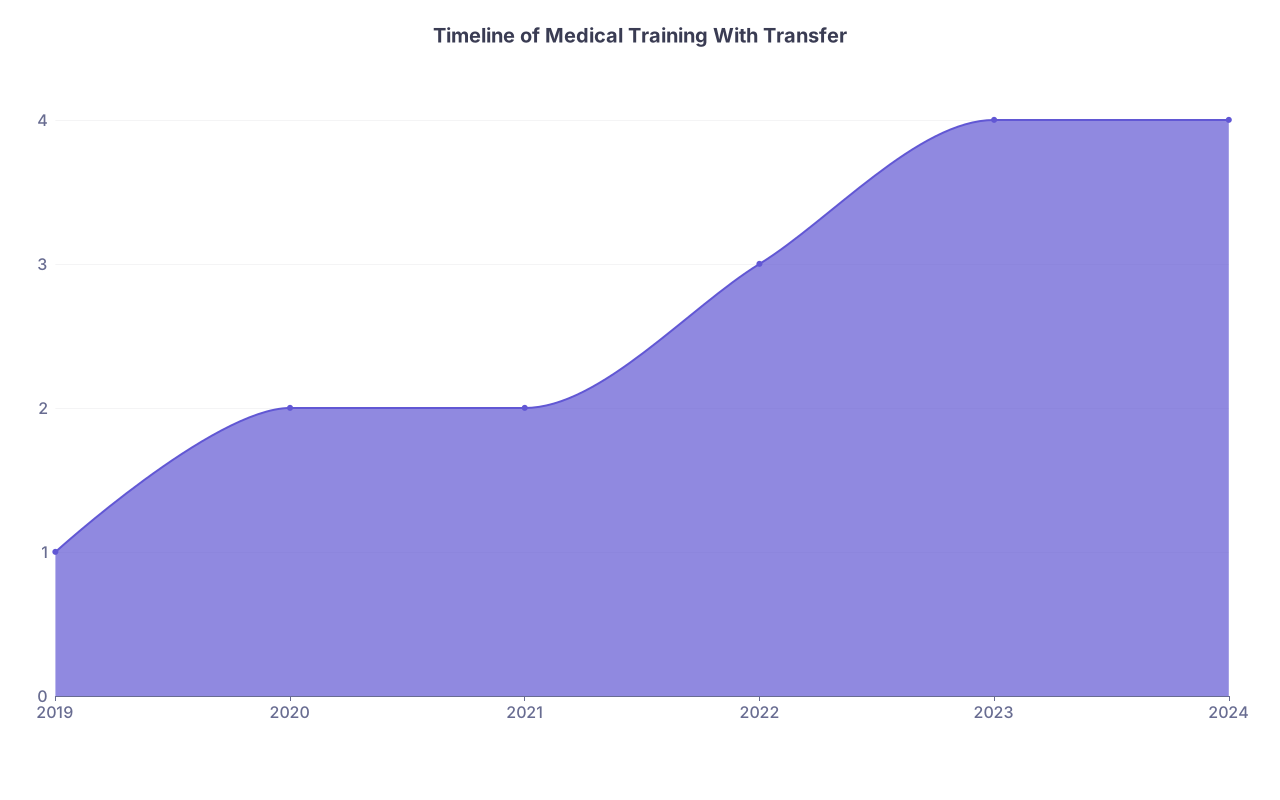
| Category | Value |
|---|---|
| 2019 | 1 |
| 2020 | 2 |
| 2021 | 2 |
| 2022 | 3 |
| 2023 | 4 |
| 2024 | 4 |
(Think of the values as rough “year of training.” It shows you didn’t go backward forever or disappear.)
Step 10: Sanity Check With Someone Who Reads Applications
If you have access to:
- A home program PD or APD
- An advisor in Student Affairs
- A mentor who sits on residency selection committees
send them:
- Your CV
- Your ERAS education section
- A 2–3 sentence written explanation of your transfer path
Ask one specific question:
“Does anything about this make my training look disorganized, risky, or harder to understand than it needs to be?”
If they hesitate, fix it. Usually the fix is:
- Too many words about the transfer
- Inconsistent dates
- Over-emphasizing the first school like you’re graduating from there
If you don’t have that kind of person available, at least do this solo test:
Read your CV top to bottom pretending you’ve never met you. Could you reconstruct:
- Where this person started med school
- Where they graduated
- Where they did their core clinical work
in under 20 seconds? If not, you’re not done.
One Clean Example: Put It All Together
Here’s what a solid CV segment might look like for a transfer student:
Education
Y University School of Medicine – City, State
Doctor of Medicine (M.D.), May 2025
- Enrolled Jul 2022 – May 2025
- Completed all core and elective clinical clerkships at Y University–affiliated hospitals
- Degree awarded with transfer credit for completed pre-clinical curriculum
X University School of Medicine – City, Country
Pre-clinical medical coursework completed, Aug 2020 – May 2022
Clinical Clerkships
Internal Medicine – 8 weeks
Y University Hospital, City, State
General Surgery – 8 weeks
Y University Hospital, City, State
Pediatrics – 6 weeks
Children’s Hospital at Y University, City, State
Psychiatry – 4 weeks
Y Behavioral Health Center, City, State
Family Medicine – 4 weeks
Community Health Clinic, Y University Affiliate, City, State
OB/GYN – 6 weeks
City Women’s Hospital, Y University Affiliate, City, State
That’s it. Clear. Boring in a good way.
To show the overall application flow a transfer student should follow, here’s a simple process map:

| Step | Description |
|---|---|
| Step 1 | Clarify transfer story |
| Step 2 | Standardize dates with transcripts |
| Step 3 | Format CV education and clerkships |
| Step 4 | Align ERAS entries with CV |
| Step 5 | Review MSPE for wording |
| Step 6 | Get advisor or mentor review |
| Step 7 | Refine and finalize documents |
And if you want a quick at-a-glance checklist of what to verify before you hit submit:
| Item | Status |
|---|---|
| Degree-granting school clearly primary | |
| Prior school listed briefly and consistently | |
| Clinical sites clearly labeled by hospital | |
| Dates match transcripts and MSPE | |
| ERAS education matches CV wording |
Bottom Line
If you transferred medical schools, you’re not an outlier. You’re just someone with a slightly more complex path.
Three things you absolutely need to get right:
- Clarity and consistency – Same schools, same dates, same story across CV, ERAS, and official documents. No contradictions.
- Calm, minimal framing – List the transfer as a simple fact, not a headline. Spotlight your graduating school and your clinical training, not the administrative move.
- A clean, practiced explanation – Two or three sentences for interviews that sound confident, neutral, and forward-looking.
Do that, and most programs will see exactly what you want them to see: a straightforward medical education with a normal, understandable transfer, not a red flag.