
The belief that one bad semester permanently poisons your residency CV is nonsense. Programs do not run your ERAS as a binary toxicity scan. They run a pattern recognition exercise.
Let’s break the myth before it buries you.
What Programs Actually Look At (Not Your Worst Moment in Isolation)
Attendings and PDs are not circling your transcript hunting for the lowest semester like it’s a “gotcha” game. They’re doing three things:
- Checking that you meet their basic academic bar.
- Looking for trajectory – up, down, or flat.
- Asking, “Does this performance match the story this applicant is telling?”
That’s it. Your “disaster” second year fall? It lives inside that bigger picture, not in its own glowing red box.
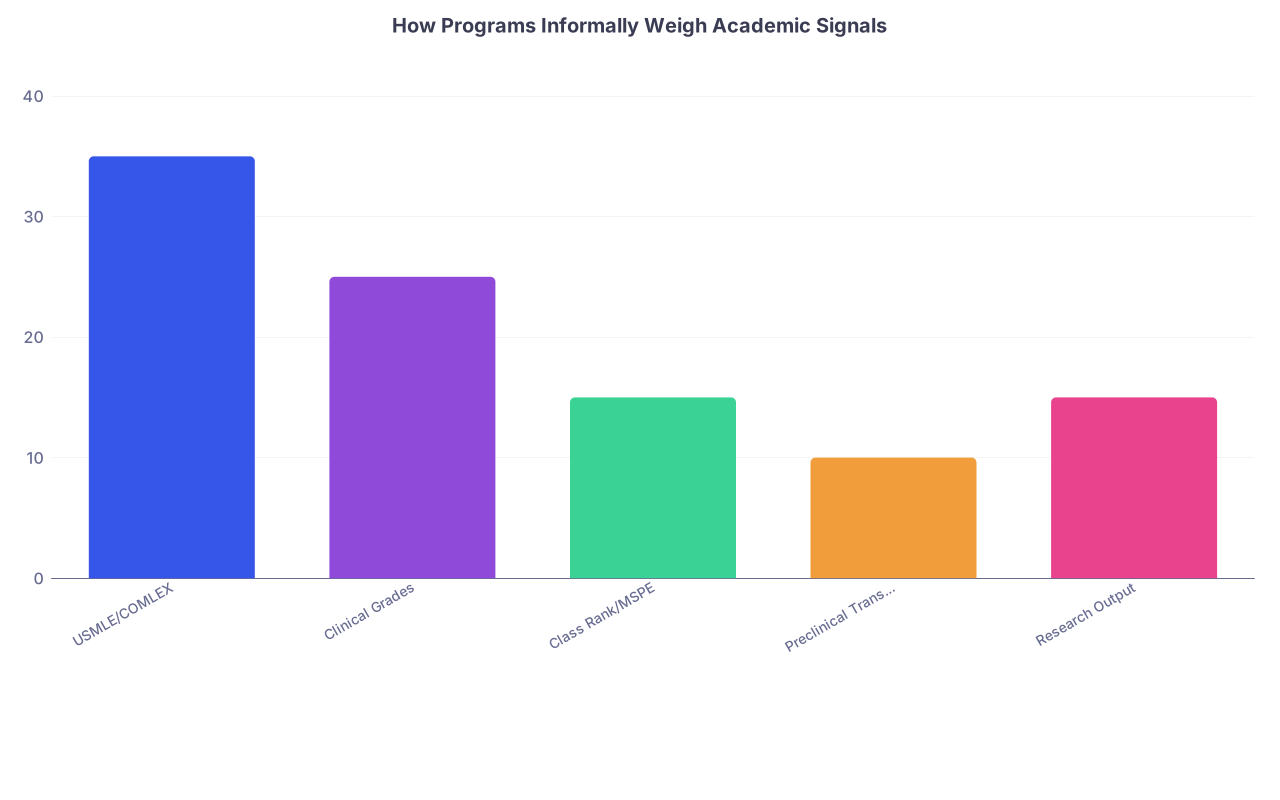
| Category | Value |
|---|---|
| USMLE/COMLEX | 35 |
| Clinical Grades | 25 |
| Class Rank/MSPE | 15 |
| Preclinical Transcript | 10 |
| Research Output | 15 |
Is this exact weighting identical everywhere? No. But talk to enough PDs and you’ll hear versions of the same thing:
- Step scores and clinical performance drive the bus.
- Preclinical wobbles are background noise unless they signal a deeper problem.
That last part is where you either win or lose: do the numbers look like a one-off bruise, or a chronic illness?
The Bad Semester Myth: Why It Feels Worse Than It Is
You know your personal low point. You remember:
- The exam you almost failed.
- The remediation letter.
- The misery of watching your classmates post “honors again!” while you’re calculating if you can still graduate.
You anchor to that moment. Programs don’t. They don’t have the emotional memory attached to it, just a data point.
I’ve watched students whisper on away rotations:
“I had a 2.7 semester second year. I’m done for derm, right?”
And the attending – who actually reads applications – just shrugs:
“Show me your Step 2 and third-year evals.”
That’s the pattern: applicants catastrophize a single bad term; programs zoom out.
So the real question isn’t “Did I have a bad semester?” It’s:
“Did I leave it unexplained, uncorrected, and unbalanced by stronger signals later?”
If you fix those three, the ‘permanent poison’ narrative falls apart.
How Bad Semesters Are Actually Interpreted
Programs loosely classify academic histories into types. Let me translate how your “mess” probably looks from their side.
| Pattern Type | Program Interpretation |
|---|---|
| One bad semester early | Maturity curve, adjusted, likely fine |
| Mid‑preclinical dip + recovery | Stress/overload, now stable if later strong |
| Repeated declines over time | Risk for residency performance |
| Bad step + good clinical | Test issues but clinically strong |
| Good steps + weak clinical | Possible red flag for real-world work |
Scenario 1: Early One-Off Bad Semester
Example: MS1 Spring was a mess – couple of borderline passes, maybe a remediation – then the rest is fine.
Program’s internal monologue:
“MS1 slump. Common. Did they recover? Step decent? Clinical OK? Then I don’t care.”
They might not even mention it in committee. It blends into the pile of “humans who struggled early.”
Scenario 2: Mid-Training Burnout or Life Event
Example: MS2 Fall tanks after a breakup, illness, or family crisis. Then Step 1 is solid, MS3 evals are strong, no more academic problems.
Here, the pattern matters. A contained dip followed by clean performance and strong exams tells them:
“This was situational, not structural.”
If you never acknowledge it anywhere, a PD might glance at it and shrug. If you briefly explain it in your MSPE or a note from your dean, they’ve got closure: “OK, resolved.”
Scenario 3: Ongoing Decline or Repeated Failures
This is where people actually do get burned.
Multiple weak semesters, failed shelves, poor Step 2 – that is what programs read as risk. Not the single ugly term. The persistent slide.
Your job is to make sure your record screams “contained problem, now controlled” not “gradual failure to adapt.”
Fixing the Record: What You Can Still Change
You can’t time-travel and retake that biochem exam. But your transcript is not the only thing on your CV. And the application isn’t graded like an undergrad GPA.
Here’s where you still have leverage – real, data-visible leverage.
1. Crush What Comes After the Bad Semester
Programs heavily weight what you did after you stumbled. Trajectory sells.
Prioritize:
- USMLE/COMLEX Step 2: Especially now that Step 1 is pass/fail, Step 2 is your quantitative redemption arc. A strong Step 2 (think at or above your target specialty’s average) reframes your earlier grades as growing pains.
- Core clinical rotations: Honors or strong evals in IM, surgery, peds, etc, are gold. Attendings explicitly write things like, “Independent, reliable, learns quickly.” That does more to repair your image than a distant B in physiology ever could.
- Sub-internships/Aways in your target specialty: This is proof of function. If you work like a junior resident and your eval says so, that can override a lot of earlier noise.
The implicit narrative you want:
“Yes, I struggled. Notice that everything after that term trends up.”
2. Use Research and Projects as Competence Evidence
If you had a rough academic term, show that you still used your time usefully and can finish things.
This does not mean you need some 10‑publication PubMed page. But you can strengthen your CV with:
- 1–2 solid projects in your specialty of interest (retrospective chart review, QI, education research).
- A poster or two at regional or national conferences.
- Some continuity with a mentor who will write, “This student shows resilience and growth.”
This matters more than you think. Research isn’t just “points” – it’s a proxy: Can you manage long-term tasks without someone spoon-feeding you?
3. Strengthen Non-Grade Signals on Your CV
Programs aren’t blind to the fact that grades are a flawed measure of who survives internship.
You can offset one bad semester with:
- Leadership roles that span multiple years – it signals responsibility and stability.
- Longitudinal clinical involvement – free clinic, EMS, community work, with continuity. Not one-off CV padding.
- Teaching / tutoring roles – especially if you later tutor subjects you once struggled in. Yes, I’ve seen PDs comment on that specifically: “Tells me they mastered the content and can teach it.”
None of this erases an academic dip. What it does is crowd it out of the mental picture. When a PD thinks of you, they think: “Chief of clinic volunteers, strong Step 2, good IM rotation,” not “MS2 spring looked bad.”
When (and How) to Address the Bad Semester Directly
The second half of this myth is that if you ever mention your bad semester, you’ll “draw attention” to it and die. Wrong. Silence can look worse than a concise, adult explanation.
There are three main places this might get addressed:
- MSPE (Dean’s Letter)
- Personal statement (sparingly, if at all)
- Interview responses
1. MSPE / Dean’s Letter
Most schools have boilerplate language for academic difficulties. Yes, PDs read it. But they read hundreds of them. They’re looking for:
- Was there a formal action (probation, remediation)?
- Did the student later do fine or excel?
- Does the school characterize this as a resolved, one-time problem?
If your MSPE says, “Student struggled during one term due to personal issues, successfully remediated, and has demonstrated consistent performance since,” that’s a closed loop. Programs move on.
2. Personal Statement: Be Surgical
Do not turn your personal statement into a confessional essay about your worst semester. That’s self-sabotage.
You mention it only if:
- It’s part of a clear, coherent narrative of growth.
- You can describe it briefly, take ownership, and pivot to concrete evidence of improvement.
Something like:
During my second year, I overloaded myself with responsibilities and my academic performance suffered. After that semester, I met with mentors, reorganized my study approach, and adjusted my schedule. Since then, I have maintained strong performance in my clinical rotations and on Step 2, and I am more deliberate about how I balance commitments.
Then you move on. No multi-paragraph apology tour.
3. Interviews: Expect the Question, Own the Answer
If a PD or faculty asks, “Can you tell me about what happened that term?” they’re not trying to humiliate you. They want to know:
- Are you defensive or reflective?
- Did you learn anything useful from it?
- Are you likely to fall apart again under residency stress?
Bad answer:
My school was unfair, the exams were poorly written, everyone struggled.
Good answer:
I underestimated how much time I needed, tried to juggle too many things, and my grades reflected that. I changed how I study, used faculty resources, and since then my performance has been stable. It was a painful lesson, but it forced me to build systems I’ll use in residency.
Short, specific, accountable. Then stop talking.
Specialty Reality Check: Where One Bad Semester Actually Matters
Let’s not pretend every field weighs this equally. Some are more forgiving than others.
| Specialty | Sensitivity to One Bad Semester |
|---|---|
| Internal Med | Low |
| Family Med | Very Low |
| Pediatrics | Low |
| General Surgery | Moderate |
| Anesthesiology | Moderate |
| EM | Moderate |
| Derm/Plastics/Neurosurg | High (but still pattern-driven) |
In ultra-competitive specialties, the real problem usually isn’t the one bad semester itself. It’s that:
- The bar is already absurdly high
- Your weaker term sometimes correlates with weaker Step or weaker research compared to your peers
In other words, a 3.0 semester isn’t what kills a derm applicant. A 3.0 semester plus average Step 2 plus limited research plus no strong letters kills them. It’s cumulative competitive disadvantage, not moral judgment.
For the vast majority of core specialties – IM, peds, FM, psych, even many surgery programs – a single bad term that’s clearly behind you is background noise if the rest of your file is strong.
Concrete Moves: How to Improve Your Residency CV After a Bad Semester
Let’s translate this into a playbook you can actually follow.
If You’re Pre-Clinicals or Early MS3
You still control a lot of the “big ticket” items:
- Target a strong Step 2 – build a real study plan, not vibes and question bank screenshots.
- Aim to impress on core rotations – be the reliable, teachable student. Clinical evals echo loudly.
- Seek 1–2 substantive research or QI projects – ideally in your specialty of interest with a mentor who knows your story and growth.
- Document the turnaround – meet with your dean, make sure your improvement gets captured in future letters.
If You’re Late MS3 or MS4 Applying Soon
You have less runway but still more power than you think:
- Maximize your sub-I / away rotation in your chosen field.
- Make sure your letters come from people who have seen you at your best after your bad semester.
- Ask your dean to address the dip briefly and clearly if it involved formal action.
- Tighten your personal statement to focus on strengths; mention the dip only if omitting it leaves a confusing hole.

| Step | Description |
|---|---|
| Step 1 | Bad Semester |
| Step 2 | Focus on Step 2 and cores |
| Step 3 | Leverage rotations and letters |
| Step 4 | Research or QI project |
| Step 5 | Clarify in MSPE if needed |
| Step 6 | Apply with growth narrative |
| Step 7 | Stage |
If You Already Applied Once and Didn’t Match
Now you’re not just battling a bad semester; you’re battling outcome data. But the fix is the same principle: show new, stronger signals.
- Take (or retake) Step 2/3 if it’s a weak point.
- Do a research year or prelim year where you collect great evaluations.
- Get fresh letters that explicitly comment on your reliability and growth.
I’ve seen unmatched applicants with ugly early transcripts match solid IM or FM programs after a strong prelim year and good letters. Again: trajectory.
The Actual Myth vs. Reality
Let’s strip it down.
The myth says:
“One bad semester brands you forever. Programs will see it and toss your application.”
Reality looks like this:
- Programs are pattern detectors, not one-line judges.
- A contained bad term in a story of growth and strong subsequent performance is rarely fatal.
- What you do after the bad semester is far more important than the bad semester itself.
- Silence and shame do more damage than a brief, accountable explanation paired with concrete improvement.
If you remember nothing else:
- One bad semester is a data point, not a destiny.
- Trajectory and recent performance carry more weight than old stumbles.
- Your job isn’t to erase the bad term; it’s to bury it under stronger, newer evidence.