
You’re sitting there with your CV open, ERAS portal on the other screen, and a pit in your stomach.
Before med school you were… something else. Engineer. Teacher. Accountant. Military. Sales rep. Graphic designer. Stay-at-home parent for a decade. Now you’re trying to turn that whole previous life into a coherent, compelling residency application.
But right now your CV looks like two separate lives stapled together. “Pre-med life” and “medical student.” No bridge. No obvious narrative. And you’re worrying: are they going to see this as a mess? Or worse, a red flag?
Here’s how to stop looking like “random career changer who decided med school on a whim” and start looking like “mature, intentional applicant who brings serious extra value to this residency class.”
Step 1: Decide Your Core Narrative Before You Touch Your CV
Most non-trads mess this up right here. They start formatting instead of thinking.
You need one sentence that explains your whole trajectory. If you cannot say it out loud, your CV will feel scattered.
Think: “I used to do X, I realized Y, and now I’m bringing Z to residency.”
Examples:
- “I spent 8 years as a software engineer; I realized I cared more about the people behind the data than the product; now I bring systems thinking and quality-improvement instincts to internal medicine.”
- “I was a high school teacher; I saw how health and home life wrecked kids' learning; now I bring communication skills and patience to family medicine.”
- “I was an Army medic; I saw what good trauma care and leadership can do; now I bring calm under pressure and operational discipline to emergency medicine.”
Write your version. Literally type it in a note. This is your filter.
Everything from your prior career that goes on your CV should support that sentence. If it doesn’t, it’s either cut or moved down so far it’s basically background noise.
Step 2: Choose a CV Structure That Works for a Non-Trad
Traditional CV order:
- Education
- Research
- Work experience
- Volunteer
- Leadership
- Interests
For you, that can bury the most interesting part of your story. You might want a modified structure that makes your transition obvious and attractive.
Here are three realistic options:
| Option | Best For | Key Feature |
|---|---|---|
| Classic (Education first) | < 3-5 years prior work | Looks “standard” to programs |
| Hybrid (Clinical-focused) | 5-10+ years prior work | Groups clinical-relevant work up front |
| Strengths-focused | Major career before medicine | Highlights skills/themes then details |
Most of you will do best with a hybrid:
- Education (medical school, previous degrees)
- Clinical Experience (includes prior healthcare roles, scribe, CNA, medic, etc.)
- Relevant Professional Experience (prior career jobs that actually add to your narrative)
- Research & Scholarly Work
- Leadership & Teaching
- Volunteer / Community Service
- Skills & Interests (optional but good for non-trads)
Notice what’s missing: a giant “Other Random Jobs” graveyard. That’s intentional.
If you were an engineer for 8 years at 3 companies, sure, list them. If you worked at Best Buy 12 years ago for 6 months? That can probably die.
Step 3: Translate Prior Career Stuff Into Residency Language
Right now your old job bullets probably sound like a resume, not a residency CV. Program directors don’t care that you “increased market share” or “optimized sales funnels.”
You need to translate everything into skills that matter in clinical training:
- Leadership and team function
- Communication with difficult people
- Time management and multitasking
- Systems thinking and process improvement
- Teaching and mentoring
- Handling stress and critical situations
- Cultural competence and working with diverse communities
Take an example.
Old bullet – software engineer:
- “Led agile development team of 6, shipping new features on a two-week sprint cycle.”
Transformed for residency:
- “Led a team of 6 across disciplines to deliver complex projects under strict timelines; coordinated priorities, negotiated conflicts, and maintained performance under pressure.”
Old bullet – teacher:
- “Taught 5 sections of 10th grade biology; implemented new assessment methods.”
Transformed:
- “Educated and managed 150+ adolescents daily, adapting explanations for diverse learning needs and maintaining engagement and discipline in high-stress settings.”
Old bullet – retail manager:
- “Managed 15 employees and achieved 120% of quarterly sales targets.”
Transformed:
- “Supervised a team of 15 in a fast-paced environment, balancing competing demands while maintaining performance metrics and addressing customer concerns.”
If the bullet doesn’t show something that would help on a ward at 3 a.m., change it or cut it.
Step 4: Decide What to Keep, What to Shrink, and What to Kill
You’re not applying to MBA programs. You do not need every role you’ve ever had.
Use this brutal filter:
- Does this experience support my narrative sentence?
- Does it highlight a skill/trait that residency programs value?
- Does it add something different than my other entries?
If “yes” to at least two of those, it stays.
If “yes” to only one, it might be merged or minimized.
If “no” to all, delete.
Concrete examples:
- You were an EMT → keep, detail it. Highly relevant.
- You were an IT project manager → keep, but 2–3 strong bullets max.
- You were a bartender 10 years ago → maybe 1 brief line if it speaks to customer interaction or working under pressure. Otherwise, cut.
- You had three almost-identical consulting jobs → keep the one or two where you had promotion, leadership, or something distinctive. Combine or shorten the rest.
You’re not hiding anything; you’re curating. There’s a difference.
Step 5: Align Each Prior Role With the Specialty You’re Targeting
You cannot have a generic “prior career” section if you’re aiming at a specific field.
You’re applying to EM? Highlight:
- Crisis management
- Rapid decision making
- Shift work or irregular hours
- Comfort with chaos and uncertainty
- Experience with vulnerable populations
You’re applying to psych? Highlight:
- Communication, especially with distressed people
- Conflict resolution
- Motivational interviewing style work
- Experience with mental health, social work, or counseling environments
You’re applying to surgery? Highlight:
- Focus, precision, and stamina
- Working on long, complex projects
- Tolerance for hierarchy and feedback
- Systems/process improvement in high-stakes contexts
You massage this mostly in your bullet wording and ordering.
Same job, two versions.
Engineer applying to surgery:
- “Led implementation of safety-critical code in a regulated environment, requiring precision, meticulous documentation, and iterative quality checks.”
Engineer applying to psych:
- “Collaborated with multidisciplinary teams and non-technical stakeholders, translating complex concepts into accessible language and building consensus under pressure.”
Same job. Different emphasis. That’s how you make a “prior life” feel tailored, not random.
Step 6: Handle Big Gaps and Career Length Without Looking Weird
Non-trads often have:
- A long gap before med school (travel, caregiving, burnout)
- A huge block of years in one non-medical job
- An apparent drop in “prestige” (consultant → student again)
You cannot hide this, but you can frame it.
On your CV:
- Use continuous date ranges. Do not leave unexplained multi-year holes.
- If you had a formal gap (e.g., “2016–2017: Family Caregiver”), you can list it briefly with 1–2 honest bullets:
- “Primary caregiver for family member with advanced illness; coordinated appointments, managed medications, and advocated in healthcare settings.”
If you were in one role for 10+ years, that’s not a problem. Programs like stability. Just make sure your bullets for that role evolve:
- Early bullet: basic responsibilities
- Later bullets: leadership/mentoring, project oversight, quality improvement
What you don’t want: 10 years of “did the same stuff at higher pay.” That looks stagnant.
Also: be ready to own the “why now?” question in your personal statement and interviews. Your CV sets up the facts; your narrative explains the motivation.
Step 7: Use a Short “Profile” or “Summary” Line Strategically
ERAS isn’t LinkedIn, but you can use the “Experiences” and sometimes personal statement headers to crystallize your identity.
For your CV (and really for your thinking), having a one-liner at the top of your working draft helps anchor things, even if it never appears verbatim anywhere.
Examples:
- “Former civil engineer focused on systems reliability, now applying those skills to internal medicine and hospital quality improvement.”
- “Ex-educator with a decade of classroom experience, now committed to patient education and longitudinal primary care.”
- “Military veteran and former medic seeking a residency in emergency medicine, bringing leadership and crisis-tested calm.”
You’re telling the PD: “Here’s what you’re getting if you pick me.”
Step 8: Mine Your Prior Career for Real Achievements (Not Fluff)
A lot of non-trads undersell their prior life. They shrink it to:
- “Worked as an engineer.”
- “Taught high school.”
- “Managed a team.”
No. You probably did serious stuff. Use it.
Good bullets have:
- Action verb
- Concrete scale or outcome
- Skill/trait embedded
Examples:
Engineer:
- Weak: “Worked on a software project.”
- Strong: “Designed and implemented a scheduling system used by 500+ clinicians, improving on-call coverage accuracy and reducing scheduling conflicts.”
Teacher:
- Weak: “Taught biology to high school students.”
- Strong: “Developed and delivered biology curriculum for 150+ students annually, incorporating individualized support that improved pass rates by 15%.”
Military:
- Weak: “Served as Army medic.”
- Strong: “Provided frontline trauma care and triage for 200+ soldiers in austere environments, maintaining composure and performance under life-threatening conditions.”
Then think: “How does this read from a PD’s lens?” They see leadership, initiative, maturity. That’s the goal.
Step 9: Make the Medical Stuff Look Like a Natural Extension, Not a Hard Reset
You want the PD to think: “Oh, of course they went into medicine. This progression makes sense.”
So link your prior and current experiences explicitly.
You can:
Show continuity of skills:
- Former teacher → medical school peer tutor, OSCE coach, patient education project
- Former engineer → QI projects, EMR optimization, workflow redesign research
- Former manager → chief of student clinic, interest group president, orientation leader
Use similar language:
- If your old job involved “process improvement,” don’t suddenly call it “QI” and pretend it’s different. Show you’ve been doing that kind of thinking for years, now just in a clinical setting.
Order your experiences smartly:
- Don’t bury your best bridge. For example, if you were a data analyst and then did a big outcomes research project in med school, put that research high. It’s the perfect connector.
Many non-trads scatter their connectors—one teaching thing here, one leadership thing there—so the through-line gets lost. Bundle them and make the pattern obvious.
Step 10: Use One or Two Anchor Experiences as Your “Signature”
Your CV should have 1–2 standout entries that scream “this is who I am” and tie your past to your future specialty.
Examples:
- A QI project that leveraged your prior operations background to redesign discharge instructions.
- A community health program you built using your past nonprofit/logistics experience.
- A medical education project that used your teaching background to improve OSCE performance.
- A research project on health tech where you wrote code or built an app prototype.
These become:
- The backbone of your personal statement
- The stories you lead with in interviews
- The things letter writers mention
If you don’t have such an anchor yet and you’re early enough in the cycle: make one. Join or start something in 3–6 months that obviously uses your old skills in a new medical context.
Step 11: Polish the Presentation Like a Professional (Because You Are One)
Non-trads have one built-in advantage: you’ve likely written resumes, managed teams, and seen ugly vs clean documents.
Your residency CV should feel like this: “This person knows how to be a professional adult.”
Concrete expectations:
- Consistent formatting for dates and locations
- No ridiculous jargon from your old field that clinicians won’t understand (nobody cares about “synergistic stakeholder alignment”)
- No 10-line paragraphs in bullets—2 lines max
- No typos. Programs are much less forgiving when you’re older and supposed to be “seasoned”
And please, drop the corporate fluff:
- “Results-oriented self-starter with a proven track record of excellence” → trash.
- Replace with actual evidence in your bullets.
You’re not interviewing for a marketing director role. You’re showing you can be trusted with patients at 3 a.m.
Step 12: Pressure-Test Your CV With Two Specific People
You want two types of feedback, not ten.
A fellow med student or resident (preferably traditional)
- Ask: “Does this read like a normal residency CV, or do any parts feel out of place, confusing, or irrelevant?”
Someone from your old world (former boss/colleague)
- Ask: “Did I accurately represent my responsibilities and impact? Is anything major missing or misrepresented?”
The first person keeps you from overshooting into “corporate nonsense.”
The second keeps you honest and reminds you not to minimize your prior accomplishments.
And if they both say, “This actually makes sense, I’d want to work with you”—you’re close.
A Quick Visual: How Your Time/Experience Mix Might Look
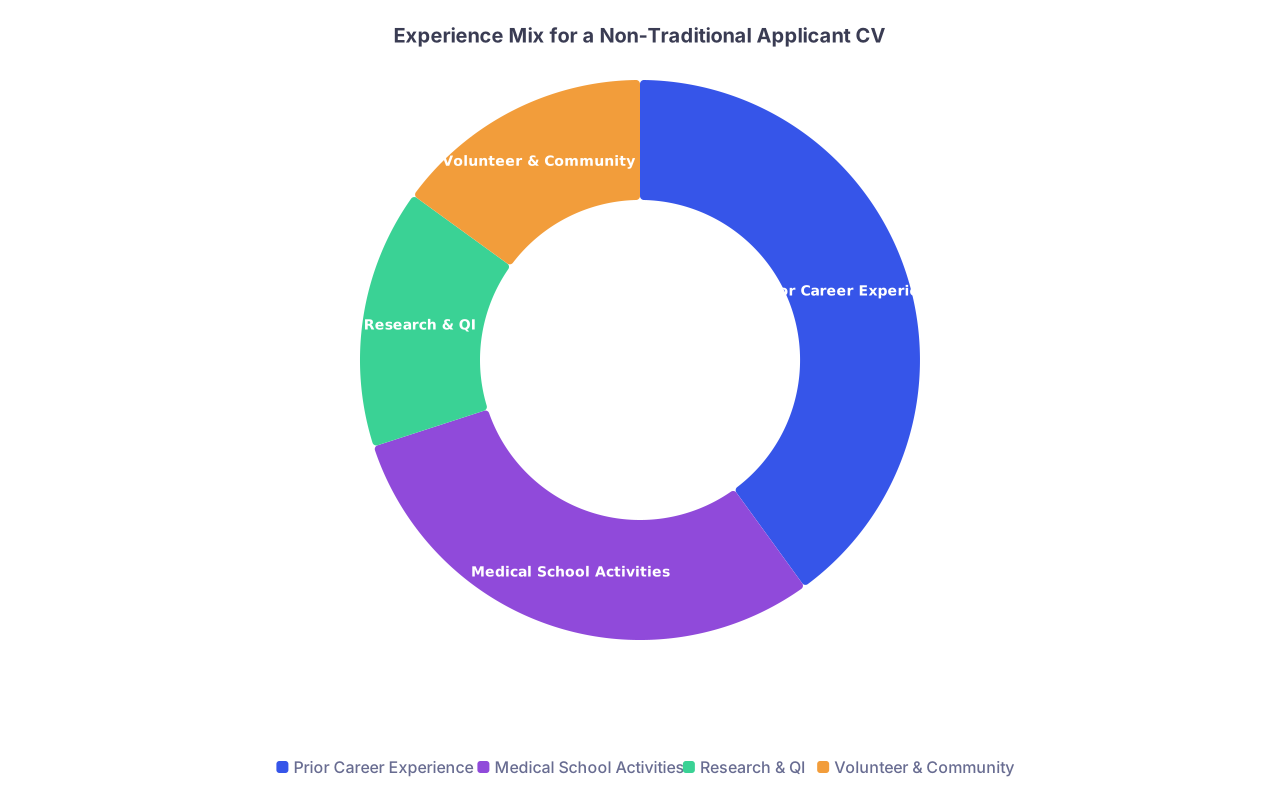
| Category | Value |
|---|---|
| Prior Career Experience | 40 |
| Medical School Activities | 30 |
| Research & QI | 15 |
| Volunteer & Community | 15 |
You’re not trying to hide that big slice of prior career. You’re just integrating it.
Example Mini-Makeover: Turning a Disjointed CV Into a Narrative
Let me show you what this looks like in action.
Hypothetical applicant: 34-year-old former high school biology teacher, now applying to pediatrics.
BEFORE:
- Work experience:
- “High school biology teacher, 2011–2019”
- “Taught students”
- “Attended parent meetings”
- “Barista, 2009–2011”
- “High school biology teacher, 2011–2019”
- Med school:
- “Pediatric interest group member”
- “Volunteer at free clinic”
AFTER (focused, residency-facing):
Education:
- MD Candidate, Class of 2025
- BS Biology, 2010
Clinical Experience:
- Student volunteer, community pediatric clinic
- “Provided supervised anticipatory guidance to families, emphasizing preventive care and health education.”
Relevant Professional Experience:
- High school biology teacher, 2011–2019
- “Taught biology and health-related content to 150+ students annually, adapting complex topics to varied literacy levels.”
- “Developed structured communication strategies for difficult parent meetings, balancing advocacy for students with empathy for family challenges.”
- “Mentored at-risk students and coordinated with counselors and social workers to address behavioral and mental health concerns.”
Leadership & Teaching:
- Peer tutor, medical school
- “Led weekly review sessions for first-year students, integrating active-learning strategies from prior teaching career.”
- Pediatric interest group, curriculum liaison
- “Collaborated with faculty to design a pediatric skills workshop focused on communication with children and caregivers.”
Now the reader thinks:
“Of course this person is going into peds. And they’ll probably be excellent with families and teaching learners.”
That’s the whole game.
Use a Simple Timeline if Your Path Looks “Messy”
If you’ve had lots of moves/roles, a mental timeline helps you keep it straight and avoid contradictory dates.
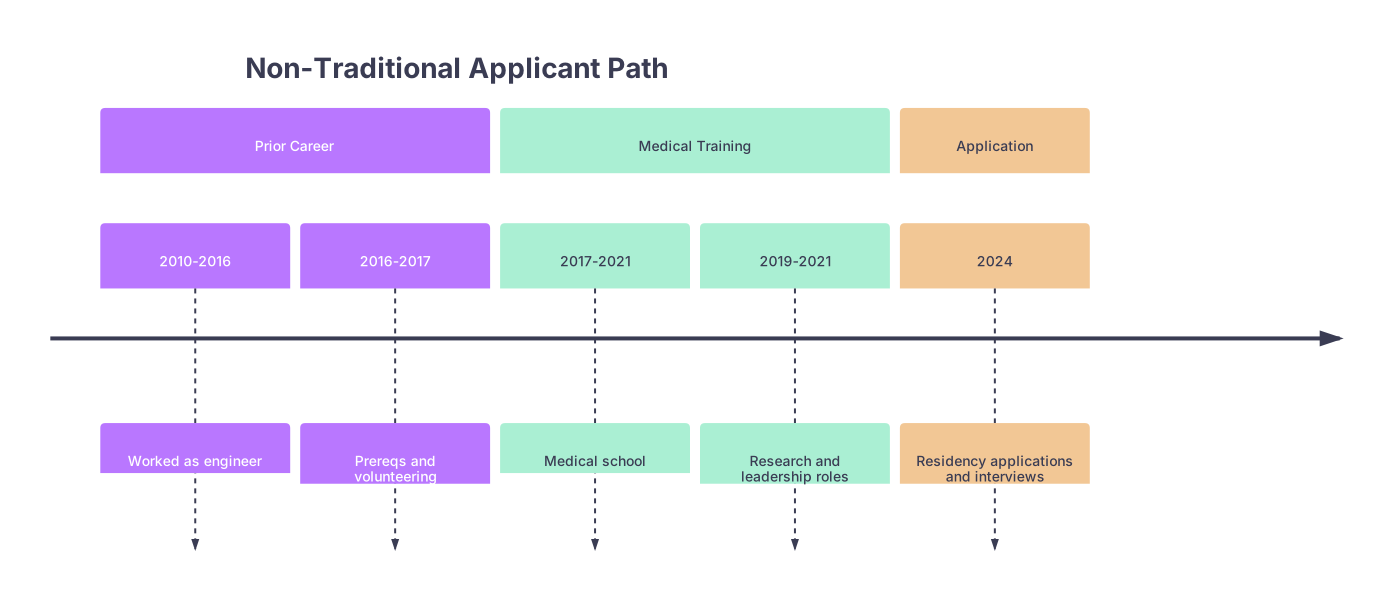
| Period | Event |
|---|---|
| Prior Career - 2010-2016 | Worked as engineer |
| Prior Career - 2016-2017 | Prereqs and volunteering |
| Medical Training - 2017-2021 | Medical school |
| Medical Training - 2019-2021 | Research and leadership roles |
| Application - 2024 | Residency applications and interviews |
You don’t need to include this diagram in ERAS obviously, but building your own version keeps your story coherent.
Final Check: What You Want a PD to Say After Reading Your CV
You’re done when a reasonable program director could read your CV and say, in one breath:
“This applicant used to be a [X], which gave them [A, B, C strengths]; they clearly transitioned to medicine for [Y reason], and now they’re bringing those strengths to [Z specialty] in a way that actually matters on the wards.”
If that sentence isn’t obvious, you still have work to do.
Key Takeaways
- Start with a clear one-sentence narrative linking your prior career, your motivation for medicine, and the value you bring to residency. Then build your CV to support that line.
- Translate every prior role into residency-relevant skills—leadership, communication, systems thinking, teaching, handling stress—and cut anything that does not serve your story.
- Create 1–2 anchor experiences that bridge your old world and medicine, then let those anchors dominate your CV, personal statement, and interview stories so your path looks intentional, not accidental.