
The idea that “Step 1 going pass/fail means your CV now has to be perfect” is wrong—and it’s exactly why so many of us are freaking out.
USMLE changing Step 1 to pass/fail didn’t magically make program directors kinder or less picky. It just shoved the anxiety sideways. Before, you could obsess over one number. Now, it feels like you have to obsess over everything: research, leadership, volunteering, sub-I’s, letters, “fit,” whatever that even means.
Let me say this directly: yes, your CV matters more now—but not in the “if it’s not spectacular, you’re doomed” way your brain is telling you. It matters differently. And there are very specific, realistic ways to make it stronger even if you feel late, behind, or average.
What Changed With Pass/Fail (And What Didn’t)
Here’s the part no one says out loud on those official webinars:
Program directors still need a way to sort people. Step 1 used to be their easy filter. Now:
- Some shifted weight to Step 2 CK
- Some leaned harder into school reputation and class rank
- Some started scrutinizing CVs more
- Some are…awkwardly improvising and pretending they “holistically review” 3,000 apps in a week
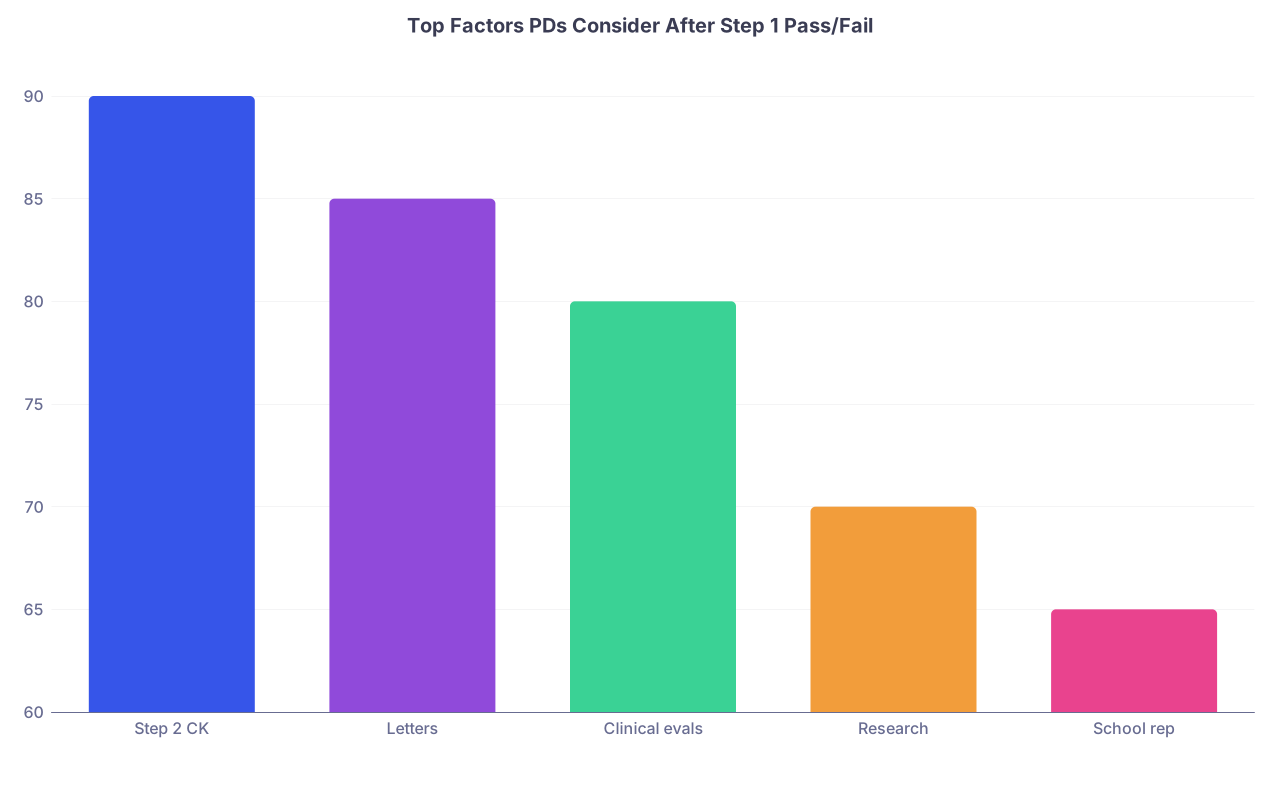
| Category | Value |
|---|---|
| Step 2 CK | 90 |
| Letters | 85 |
| Clinical evals | 80 |
| Research | 70 |
| School rep | 65 |
So no, your CV is not “everything,” but yes, it’s more visible now. Red flags and empty sections stand out more. But average is not a death sentence.
What didn’t change:
- They still care if you can function on the wards
- They still care if you’ll make their lives easier, not harder
- They still like people who show up, work hard, and aren’t a disaster
That’s the bar. Not “cured cancer by M3” or “published in NEJM twice.”
Reality Check: How Programs Actually Look at Your CV
Let’s kill one nightmare first: nobody is sitting there with two CVs side by side thinking, “Well, her research is slightly better so he’s trash.”
Most places scan fast. Like, stupidly fast. I’ve watched faculty scroll through ERAS:
- “School? Okay.”
- “Step 1 pass, good. Step 2… okay.”
- “Any research? Yeah, fine.”
- “Volunteer stuff, leadership… looks normal.”
- “Letters? From people I know? Great.”
- “Any huge red flags? No? Move on.”
What they’re really asking in their heads is more basic:
- Do you meet our baseline?
- Do you fit the usual profile of people we take?
- Do you seem like someone who gives a crap?
- Are there any reasons to say no?
That last one is huge. Your CV is not just about impressing. It’s about avoiding easy reasons to reject you.
So your job is not to build a “perfect” CV. Your job is to:
- Hit baseline signals for your specialty
- Reduce obvious red flags or gaps
- Add a few clear strengths that are easy to remember
Translating “My CV Is Trash” Into Actual Categories
The worst feeling is staring at your CV and thinking, “There’s nothing here.” Usually that’s not true. It’s more like:
- You’re underselling what you’ve already done
- You’re missing 1–2 key things for your target specialty
- Your experiences look random instead of intentional
Let’s break it down by the buckets programs actually look at.
| Bucket | What PDs Look For |
|---|---|
| Academics | Passed exams, Step 2 CK, honors |
| Clinical | Sub-I performance, comments |
| Research | Any output, relevance, consistency |
| Service | Long-term involvement, not 1-offs |
| Leadership | Responsibility, initiative |
If you’re spiraling, go through each bucket and ask:
“Is this catastrophically empty, or just not amazing?”
There’s a big difference between “no research at all” vs “one poster that I think is lame.” Programs don’t see “lame,” they see “some research experience.”
Step 2 CK vs CV: Which One Actually Matters More Now?
Harsh answer: for most competitive specialties, Step 2 CK is now the main objective number. They care. A lot.
But here’s the part your anxiety likes to skip: after they filter by Step 2 (and basic school cutoffs), they’re back to your CV and letters.
Think of it like this:
- Step 2 CK: Gets you into or out of the initial sort pile
- CV + letters: Decide whether you’re interview-worthy
- Interview: Decides if you’re rank-worthy
So no, your CV doesn’t matter “more than everyone else’s.” But if your Step 2 CK is:
- Average or slightly below for your specialty → CV matters more for you
- Strong → CV still matters, but you’re starting interviews from a better place
If you’re planning Step 2 and panicking about your CV simultaneously, prioritize in this order:
- Don’t bomb Step 2
- Fix one meaningful CV gap
- Polish what you already have
You cannot “CV your way” out of an absolute Step 2 disaster in ultra-competitive fields. But you can offset a merely average score with solid, coherent experiences.
How to Improve Your CV Now (Even If You Feel Late)
Let’s get into the part your brain actually wants: what can you do right now that moves the needle.
1. Pick a Specialty Story and Aim Your CV Toward It
Programs hate randomness. You did derm research, EM volunteering, peds leadership, surgery interest group, and now you’re applying IM? Confusing.
You don’t need some perfect, linear story, but you do need a plausible narrative. Example:
- Interested in IM → outcomes research in cardiology, clinic volunteering, IM interest group
- Interested in EM → ED volunteering, EMS, simulation teaching, QI in ED throughput
- Interested in psych → mental health hotline, psych research, advocacy work
If your CV is a mess, pick what you’re realistically targeting and ask:
“What 2–3 things on here actually support that?”
Then emphasize those. Re-order sections. Cut clutter. Rename vague entries to sound more aligned with that field.
2. Fill One Glaring Gap Instead of Trying To Fix Everything
Most of us have one of these:
- No research at all
- No longitudinal service
- No leadership
- No letters from the specialty we want
You can’t fix all four in six months. But one? You can.
If you’re early M3:
- Ask attendings: “Do you have any small project I can help with?” Even a chart review that becomes a poster counts.
- Join a clinic or longitudinal volunteering gig now and commit through the year.
If you’re late M3 / early M4:
- Prioritize a sub-I in your intended field where you can crush it and get a letter.
- Ask your home PD or advisor: “Is there any quick, ongoing QI or education project I can join?” Even being the “data person” looks better than nothing.
This doesn’t produce 5 pubs overnight. It changes the story from “no interest in this field” to “developing interest with early involvement.”
3. Turn Weak Entries into Strong, Specific Ones
A lot of CV “weakness” is just bad descriptions. These are real things I’ve seen:
- “Volunteer, 2019–2021”
- “Research assistant”
- “Mentor”
That tells no one anything.
You want each entry to answer three questions fast:
- What did you actually do?
- Did you show responsibility or initiative?
- Is there a tie to your specialty or to patient care?
Weak:
“Volunteer, Student-Run Clinic”
Stronger:
“Student clinician at student-run free clinic providing primary care for underserved adults; performed focused histories, basic exams, and patient education under supervision.”
Weak:
“Research assistant, Cardiology”
Stronger:
“Assisted in retrospective cardiology outcomes study; screened charts, abstracted data for 200+ patients, and co-authored an abstract accepted to regional ACC meeting.”
Same activity. Different signal.
4. Use Your Sub-I’s and Rotations Strategically
This is the part no one tells you until it’s too late: your performance comments and letters can outshine a mediocre CV—or sink a decent one.
If your CV feels thin, then your goal on key rotations is:
- Be unmissably reliable (on time, prepared, follows through)
- Be the person residents want back
- Make it obvious you care about the specialty
Then—this is crucial—convert that into a letter.
At week 2–3 of a sub-I, say to a resident or attending who likes you:
“I’m thinking of applying to [specialty]. If things continue to go well, would you feel comfortable writing me a strong letter?”
Strong. Not “a letter.” “Strong.” Give them an out and a standard.
5. Stop Hiding “Nontraditional” or “Non-Medical” Strengths
You know what I see a lot? People burying the coolest part of their CV because it’s “not medical enough.”
Things like:
- Running a small business
- Coaching a sports team
- Doing IT work, graphic design, tutoring
- Caring for a family member for years
Programs like grown, functioning humans. They like people with signs of maturity, grit, and actual life experience. Don’t bury those at the bottom with no detail. Frame them:
- What skills? (organization, communication, teaching, leadership)
- What responsibility? (managing finances, leading a team, long-term caregiving)
- What impact? (grew something, improved something, stuck with something)
This especially helps if your “traditional” academic CV isn’t flashy.
Does Everyone Else Now Have a Better CV Than Me?
Your brain is telling you a very predictable lie: “Step 1 is pass/fail, so now everyone is focusing on research and leadership and you’re the only one behind.”
Reality:
- A small subset of gunners always had 10 pubs and 8 leadership roles. They’re loud and everywhere online.
- A huge middle group has 1–2 posters, some minor leadership, some volunteering. That’s it.
- Another group has almost nothing and is too paralyzed to start.
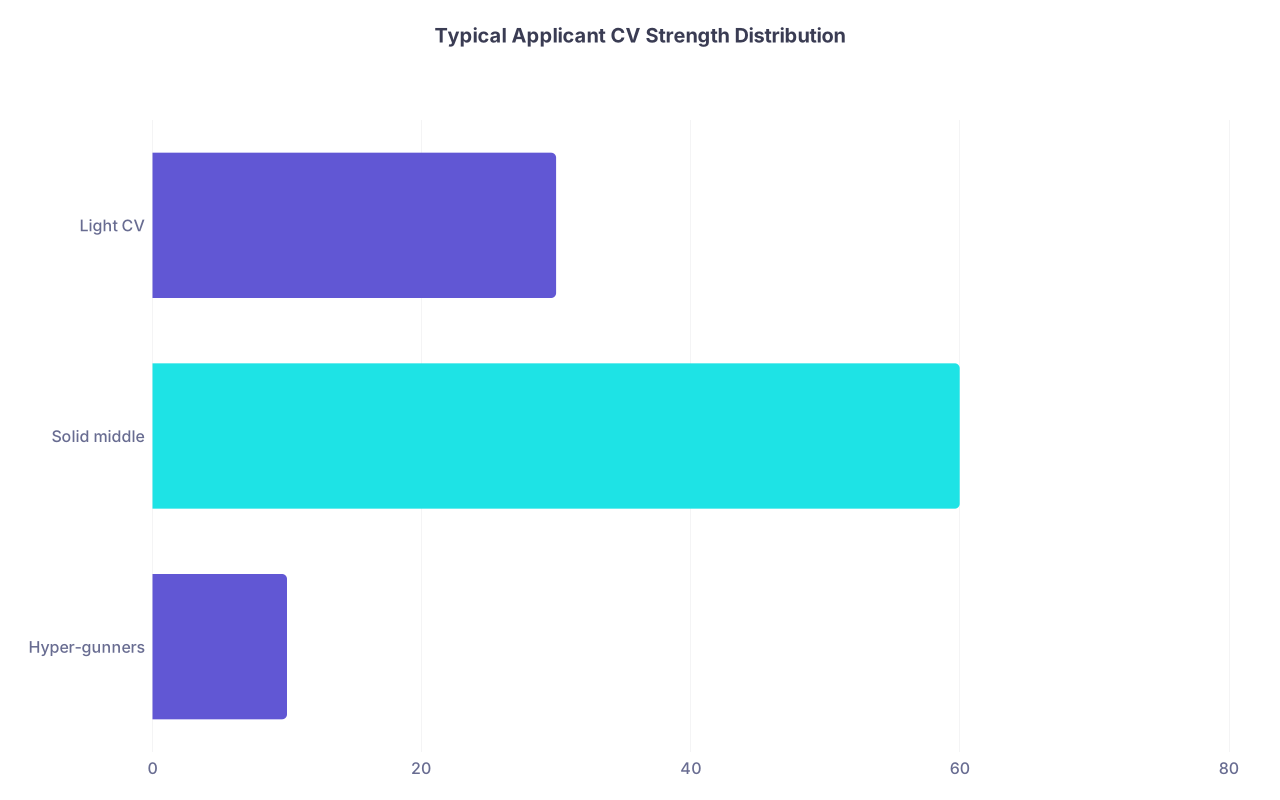
| Category | Value |
|---|---|
| Hyper-gunners | 10 |
| Solid middle | 60 |
| Light CV | 30 |
You might not be in the hyper-gunner group. Fine. Most matched residents aren’t.
Programs don’t need 10 chiefs. They need:
- Hardworking normal people
- With at least some evidence they give a damn
- Who won’t explode when things get hard
Your CV doesn’t have to beat “everyone.” It has to clear the bar for the kind of programs you’re applying to, in the context of your Step 2, your school, and your specialty.
Short-Term Plan: What To Do in the Next 3 Months
If you’re spiraling, make it concrete. Three months is enough to shift your trajectory.

| Step | Description |
|---|---|
| Step 1 | Today - Audit CV |
| Step 2 | Week 1 - Pick Specialty Story |
| Step 3 | Week 2 - Identify Biggest Gap |
| Step 4 | Weeks 3-6 - Join 1 Project or Activity |
| Step 5 | Weeks 4-8 - Improve Descriptions |
| Step 6 | Weeks 6-12 - Targeted Rotations and Letters |
| Step 7 | End of 3 Months - Reassess CV |
Be brutally honest with yourself about these questions:
- What’s the single weakest bucket on my CV?
- What’s one realistic thing I can start this MONTH to address it?
- Who can I email today (faculty, PD, chief, advisor) to find that thing?
You’re not fixing your entire career in 3 months. You’re moving from “this looks empty and random” to “this looks intentional and developing.”
The Uncomfortable Truth About Anxiety and CVs
A lot of us (me included) use CV anxiety as a distraction from scarier stuff:
- Fear of actually emailing faculty and being ignored
- Fear of finding out we’re not as “strong” as we thought
- Fear of choosing a specialty and being wrong
So we stay in the one place that feels both awful and safe: refreshing SDN/Reddit, doom-scrolling match stats, mentally comparing our worst qualities to other people’s highlight reels.
You don’t need to stop being anxious to fix your CV. You just need to act while anxious.
One email. One conversation. One extra clinic session. One small project.
That’s how the people with “surprisingly decent” CVs got there. Not by being braver. Just by being slightly more willing to do the uncomfortable thing on a random Tuesday.
FAQs
1. I have almost no research. Am I screwed for competitive specialties?
For derm, plastics, ortho, ENT, neurosurg? Lack of research is a real handicap. I’m not going to sugarcoat that. Those fields expect evidence you can engage with academic work.
But “no research” doesn’t always mean “too late.” Options:
- Join a small project now (retrospective, QI, case series) and try to get at least a poster.
- Consider a dedicated research year if you’re dead set on a hyper-competitive field.
- Or—and this is allowed—reconsider targeting a slightly less research-obsessed specialty where your other strengths matter more.
You’re not doomed. But for the very competitive stuff, ignoring the research expectation and hoping your personality carries you is magical thinking.
2. My school isn’t well-known. Does that make my CV matter more?
Yes and no. Being from a less-known school means you don’t get the instant “name brand” bump. So:
- Strong Step 2 CK becomes more important.
- Your letters from recognizable or respected faculty help a lot.
- A coherent, active CV helps convince them you’re not just an unknown risk.
But you’re not automatically behind every “Top 20” student. A slightly weaker school + strong CV + good letters can absolutely beat a big-name school + bland application.
3. I feel late (M4 / near ERAS). Is there anything I can still realistically do?
You can’t magically create years of longitudinal work now, but you can:
- Optimize your ERAS descriptions so every line actually says something substantive
- Reorder and group experiences to highlight relevance to your specialty
- Make your sub-I or away rotation count and secure at least one strong letter
- Ask if there’s a small, quick-win project you can be added to (case report, QI)
At this stage, you’re in “polish and signal” mode, not “overhaul my life” mode. That’s still worth doing.
4. Should I do an extra year just to improve my CV?
Only if three things are true:
- You’re going for a highly competitive specialty
- You currently have very weak specialty-relevant experiences (especially research)
- You actually have access to a meaningful research/job opportunity, not just vague plans
A random unstructured “extra year” with nothing concrete is a waste. But a focused research year with a real mentor and projects? For certain specialties, it can absolutely change your trajectory.
5. How do I stop comparing my CV to everyone else’s?
You won’t. Your brain is wired for that. The goal isn’t to stop comparing; it’s to compare differently:
- Compare yourself to where you were 3–6 months ago.
- Compare your actual actions, not just outcomes (“Did I send the email? Did I show up?”).
- Compare your CV to the baseline expectations of your specific specialty, not to the loudest gunner on Reddit.
Then channel the discomfort into one concrete move.
Open your CV right now and pick one experience that feels weak or vague. Rewrite that description so a stranger could understand what you did and why it mattered. That’s your first step out of the anxiety spiral and into actually building the CV you’re scared you don’t have.