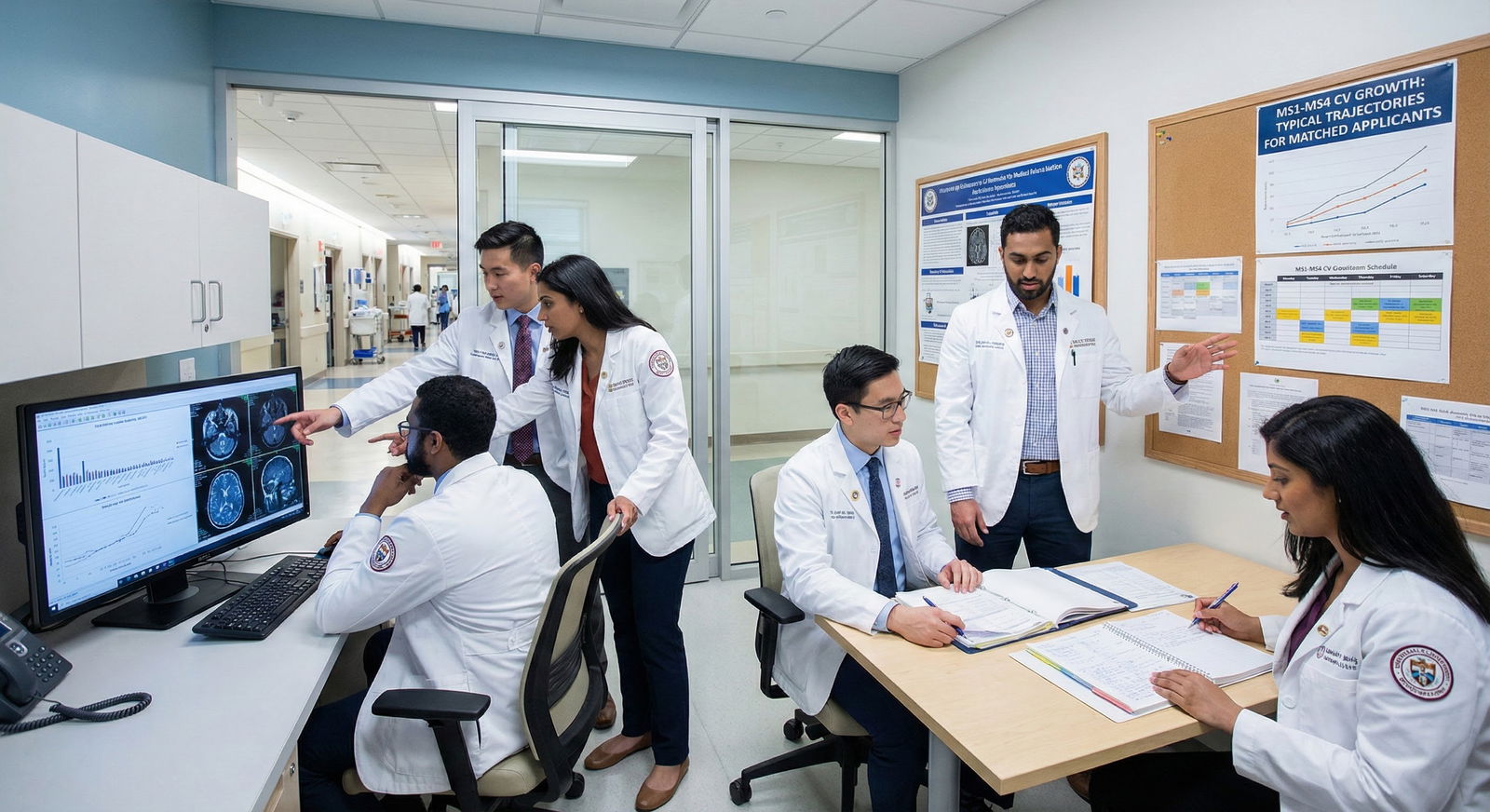
The obsession with “tons of research” for residency is wildly overblown—and it’s making people panic for no reason.
You’re sitting there thinking: “I only have one research project. Everyone else has 10 posters, 3 publications, and a Nobel Prize pending. Program Directors are going to toss my application in the trash in 0.3 seconds.”
I’ve watched people talk themselves into feeling like they’re already unmatched… in August.
Let’s go straight at the fear: no, having only one research project is not automatically a red flag. But. In some contexts, it can be a weakness if you don’t understand how PDs think and you don’t manage the rest of your application.
So let’s unpack this without sugarcoating but also without the doom spiral.
What PDs Actually See When They Look at “Only One” Research Project
Most of the anxiety comes from imagining some mythical PD who wants every applicant to be an R01-funded superstar. That’s not real.
Here’s what’s more real: PDs look at your research in context.
| Scenario | How It Usually Looks to PDs |
|---|---|
| Community IM / FM / Peds, 1 project | Normal, not a problem |
| Mid-tier academic IM, 1 solid project | Fine if other parts are strong |
| Competitive academic IM, 1 project | Neutral to mild weakness |
| Super competitive fields (Derm, Plastics, Ortho), 1 project | Often below average |
| No research at all | Noticeable, but not always fatal |
They’re asking themselves things like:
- Does this person understand basic research principles enough to interpret evidence?
- Did they stick with something long enough to see it through?
- Does their research fit their story/specialty at least somewhat?
- Is this a checkbox, or does it show curiosity, persistence, or initiative?
That’s key: one serious, coherent, completed project often looks better than five half-hearted, abandoned ones.
I’ve seen:
- Applicants with one longitudinal QI project and a poster match into solid academic IM.
- Applicants with ten “works in progress” and no final outputs look flaky.
You’re fixating on the number of projects. PDs are looking at substance and follow-through.
When “Only One Project” Is Totally Fine (And When It Starts to Hurt)
Let’s separate reality from worst-case fantasy.
You’re probably fine if:
- You’re applying to:
- Family med
- Peds
- Psychiatry
- EM (most programs, not the crazy academic ones)
- Community internal medicine
- Your single project is:
- Real (not “data collection assistant for 2 weeks”)
- At least poster or abstract level
- Something you can talk about intelligently
- The rest of your app shows:
- Solid Step/COMLEX scores (or at least not scary low)
- Strong clinical grades / MSPE
- Decent letters
- Some evidence of interest in your chosen field
In that case, your one project is not some blinking red alert. It’s “okay, this student did some research, cool, move on.”
Where you start getting into “hmm” territory is here:
It starts to hurt more if:
- You’re aiming for:
- Dermatology
- Plastic surgery
- Neurosurgery
- Ortho
- ENT
- Highly academic internal medicine (top 10–20 programs)
- Or:
- Your project is barely describable (“I helped someone with data once”)
- You have zero outputs: no poster, no abstract, no presentation, nothing
- You can’t explain your role when asked
- Your CV makes it look like you did it because you had to, not because you cared
In those more cutthroat environments, research isn’t just a checkbox. It’s a sorting tool. PDs look at research productivity because they want people who will publish under their name and help the department look good.
But even there—one solid, meaningful project with your name on something tangible is much better than you’re giving yourself credit for.
What Matters More Than the Number: Depth, Ownership, and Outcome
If you’re stuck with one project, you can’t magically add three more first-author publications before ERAS. Fine. Then your job is to squeeze every drop of value out of that one project.
Depth matters way more than you think.
PDs like:
- Ownership: “I designed the survey, did the stats with the mentor, and wrote the abstract.”
- Grit: “We hit a wall with recruitment, but I figured out a new way to reach patients.”
- Follow-through: “We turned it from a poster into a manuscript and submitted it.”
They do not care if you were:
- Research shadow #7 who “helped collect data”
- Floating “lab assistant” who doesn’t understand the hypothesis
- Someone who lists 5 projects with zero clear role
If your one project:
- Has a clear research question
- Has a defined methodology you understand
- Has at least a poster/abstract/presentation
- Gave you talking points about problem-solving or critical thinking
…then you’re in much better shape than the “I have 6 projects but don’t remember what any of them were about” crowd.
How to Talk About Only Having One Project Without Sounding Defensive
The fear is: “They’ll ask why I only did one project and think I’m lazy.”
You don’t answer that fear by pre-apologizing. You answer it by sounding like someone who owned that experience.
Imagine an interview:
“Tell me about your research experience.”
You can go one of two ways:
Version 1 (panic mode):
“I only have one project, but I know I should’ve done more. It was kind of hard with COVID and rotations, so I just did this one thing…”
This screams insecurity.
Version 2 (composed, honest, not overselling):
“I worked on a single, long-term project in [field/topic]. We were looking at [brief question]. I helped with [specific role: data analysis, protocol development, survey design, etc.], and we presented it at [conference].
What I really took away from it was [specific skill/insight: reading papers more critically, understanding limitations, troubleshooting recruitment]. It also made me more interested in [X aspect of your chosen specialty].”
You’re not hiding that it’s one project. You’re framing it as a serious, intentional experience. That lands very differently.
Later, if they ask directly, “Did you have other opportunities for research?” you can be honest without sounding like a victim:
“Our school didn’t have a deeply embedded research culture, so I chose to commit to one substantial project rather than spread myself thin. I’m very open to doing more in residency—I really enjoyed [specific aspect].”
You’re allowed to have a normal human trajectory.
Okay, But I’m Still Freaking Out: What Can I Actually Do Now?
You’re mid-application cycle or just before it, staring at your one lonely project. What’s salvageable?
If you’re about to apply this year
You don’t have time to create real new projects from scratch that will mature before ERAS. But you can:
Strengthen the output of your current project
- Ask your mentor: “Is there a chance we can submit this as a poster/manuscript before the fall?”
- Even “manuscript in preparation” looks better than “project with no clear endpoint.”
Improve how it looks on your CV
Be specific on ERAS:- Clarify your role
- Use action verbs (designed, analyzed, implemented, presented)
- Don’t bury it under vague titles
Lean hard into everything else:
- Honors in core rotations
- Strong, specific letters
- A personal statement that actually sounds like a human, not ChatGPT 2019
- A coherent story of why this specialty fits you
And yes, apply smart:
- Add more community programs
- Include a mix of reach / realistic / safety
- Be honest about competitiveness
If you’re 6–18 months out from applying
You actually have room to move, even if it doesn’t feel like it.
Here’s the part nobody likes hearing: you don’t need a perfect big-name research lab. You just need one more respectable thing you can own.
That might look like:
- A QI project on your home ward
Example: cutting discharge delays, improving handoff quality, vaccine updates. These can turn into posters surprisingly fast. - A chart review project with a willing attending
Not every project needs an RCT. Retrospective projects get you posters. - An education project
Curriculum tweaks, student workshops, simulation design—these can count if done well and presented.
And no, this doesn’t have to eat your entire life. I’ve literally seen 3rd years do:
- One small QI poster + one med-ed abstract = “multiple projects” on paper.
Is it fake? No. It’s playing the game without burning out.
How Much Research Do Applicants Actually Have? (Not Instagram Version)
You see the gunner in group chat: “I have 12 pubs, 8 first-author, 6 oral presentations at national conferences.” Cool. That person exists. They’re not the median.
Here’s the part that would probably calm you down if schools actually shouted it from rooftops: most people have very modest research portfolios.
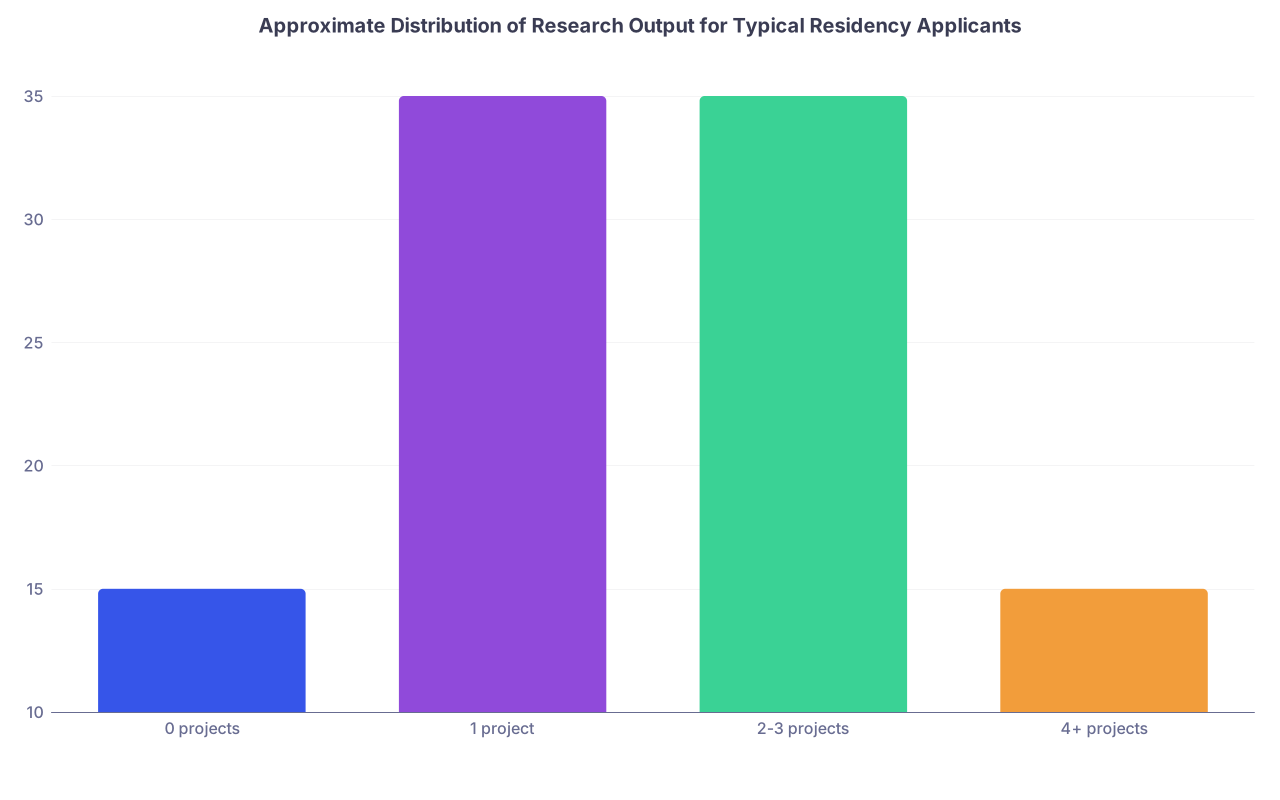
| Category | Value |
|---|---|
| 0 projects | 15 |
| 1 project | 35 |
| 2-3 projects | 35 |
| 4+ projects | 15 |
Roughly speaking (varies by specialty and school), you’ve got:
- A chunk with 0 meaningful research
- A big crowd with 1–3 decent things
- A loud minority with 5+ publications—who make everyone else feel behind
You’re comparing your behind-the-scenes to everyone else’s highlight reel.
Specialty Reality Check: Where One Project Is Enough vs. Risky
Let’s be brutally honest by field.
| Specialty Type | One Solid Project | No Research |
|---|---|---|
| Community FM/Peds/Psych | Totally fine | Usually okay |
| Community IM/EM | Fine | Noticeable but survivable |
| Academic IM/Peds | Acceptable if other areas strong | Weakness |
| Competitive surgical (ENT, Ortho) | Below average | Major problem |
| Ultra-competitive (Derm, Plastics, NSurg) | Often not enough | Almost impossible |
If you’re going for:
- Family, psych, peds, community IM/FM: One real project is already checking the box for most places.
- Academic IM, heme/onc dream, cards later: One solid project is okay, especially if it’s in something related, but try to build a second thing if you still have time.
- Derm, plastics, NSurg, ENT, Ortho at powerhouse academic centers: Yeah, in these worlds, one project is often below the bar. You either need:
- Extra time (research year)
- More projects before applying
- Or to accept casting a wider net and including less competitive programs / backup plans.
That’s not a moral judgment. It’s just the market.
How to Stop Letting This One Line on Your CV Dominate Your Brain
The scariest part isn’t actually the PDs. It’s the loop in your head: “I didn’t do enough. I should’ve started earlier. I blew it.”
You cannot time-travel. You can only:
- Present what you have in the strongest, clearest way
- Improve what you can reach in the time you have
- Apply intelligently instead of aspirationally delusional
- Not sabotage yourself with insecurity in interviews
And I’ll be blunt: I’ve seen people with average research match great because they were:
- Likeable on interview day
- Good storytellers about their path
- Clearly reliable and not exhausting to work with
I’ve also seen “research monsters” get screened out because:
- They had weird interpersonal vibes
- Their letters were lukewarm
- Their story was “I did everything to get in” but with no actual why for the specialty
Research is one axis. That’s it. PDs are not running a university PhD program. They’re filling a team they have to work with at 3 a.m.
Quick Reality-Based Action Plan
If you’re still reading and your heart rate is at least slightly lower, here’s what to do:
- Stop calling it “only one project.” Start calling it “my main project.”
- Make sure it’s clearly and specifically described on ERAS.
- Get at least one mentor letter that references your work ethic on that project.
- If time allows, tack on one more realistic, finishable thing (QI, med-ed, chart review).
- Apply to a range of programs that matches your full profile, not just your anxiety.
And then? Accept that you’re a normal human who didn’t dedicate their entire 20s to padding a PubMed search of your name. That’s not a character flaw.
FAQ (Exactly 5 Questions)
1. Will PDs reject me automatically if I have only one research project?
No. Most won’t. Automatic rejections are more likely for things like failed Steps, egregiously low scores, visa issues, or unprofessionalism. One project—especially with a poster or abstract—puts you squarely in the “some research” camp, which is fine for many specialties and programs.
2. Does my research have to be in the same specialty I’m applying to?
It helps, but it’s not mandatory. IM PDs don’t freak out if your project was in cardiology, nephrology, or even med-ed. What matters more is that you can articulate what you did, what you learned, and how it shaped your thinking. For hyper-competitive specialties, specialty-aligned research does matter more, though.
3. Is a QI or education project “real” research for my CV?
Yes, if it’s structured and has an outcome. A QI project with pre/post data and a poster is absolutely research experience. Same with an education project that results in a workshop, curriculum, or presented abstract. Don’t downplay these just because they’re not bench science.
4. Should I delay graduation or take a research year just to add more projects?
Only if your target specialty is truly research-heavy and ultra-competitive (derm, plastics, NSurg, some top-tier IM tracks) and you have mentors telling you that more research is your main bottleneck. If you’re aiming for community IM, FM, peds, psych, or EM, a research year just to bump your project count from one to three is usually not worth the time, cost, and stress.
5. How do I list a project that isn’t published yet?
On ERAS, list it under “Research Experience” with your role and dates. If there’s a poster or abstract, list that under “Publications/Presentations.” If a manuscript is submitted or in progress, you can say “manuscript submitted” or “manuscript in preparation” once it’s real—not just wishful thinking. PDs don’t expect every project to be published, but they do like to see some endpoint.
Key points:
One meaningful, well-presented project is not a red flag for most residency programs.
Depth, ownership, and how you talk about that project matter more than raw project count.
If you have time, add one more realistic, finishable thing; if you don’t, focus on strengthening the rest of your application instead of spiraling over what you can’t change.