
Last October, I watched a PD scroll through ERAS at 11:45 p.m., eyes half-closed, 400 applications deep. He stopped, opened one PDF, and said, “Now this is a top 10% CV.” The file was open on the projector for 10 seconds before he short-listed the applicant without a word from anyone else in the room.
You want to know what we saw on that screen that you do not see when you stare at your own CV. That’s what we’re going to dissect. Line by line. Section by section. No sugarcoating.
The First 15 Seconds: How a “Top 10%” CV Hooks a Selection Chair
Let me tell you how this works behind closed doors.
Faculty are not reading your CV like a personal statement. They’re scanning it like a radiologist looks at a chest X‑ray. Pattern recognition. Red flags. Standout features. Almost no one “deep reads” on the first pass.
The first 15 seconds usually go like this:
- Name, school, degrees. Quick gut check: “Who are you and from where?”
- Snapshot of research and leadership: How many lines? How recent? Any big names or recognizable journals?
- Awards and honor societies: AΩA? Gold Humanism? Anything “distinction,” “with honors,” or “outstanding” in the title?
- Work/volunteering: Is there depth, continuity, and something clearly related to the specialty?
A “top 10%” residency CV does not mean you were a perfect med student. It means that when this 15‑second scan happens, the reader’s brain says: “This one is clearly above the pile.”
Let me make that more concrete.
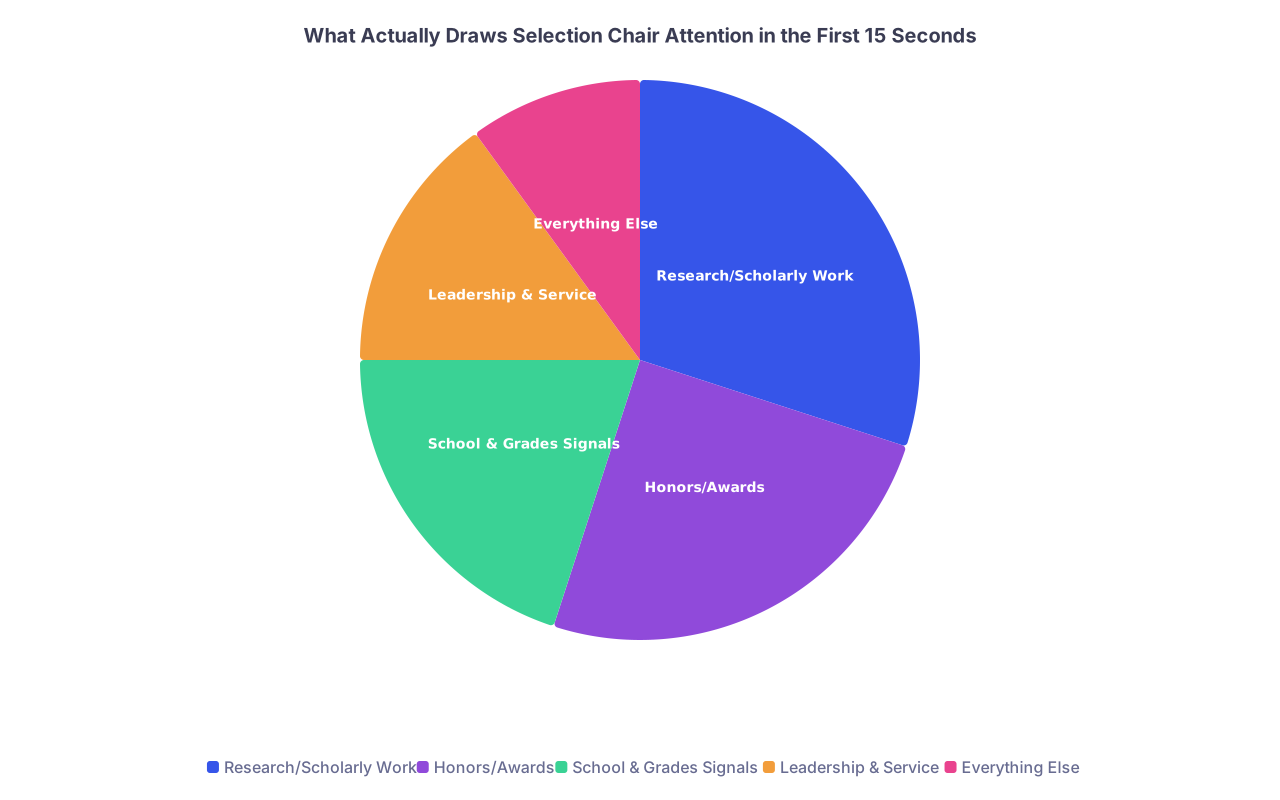
| Category | Value |
|---|---|
| Research/Scholarly Work | 30 |
| Honors/Awards | 25 |
| School & Grades Signals | 20 |
| Leadership & Service | 15 |
| Everything Else | 10 |
The exact numbers vary by specialty, but this is roughly how the subconscious triage looks. If your CV front-loads those first four buckets with substance and clarity, you read like top 10%.
If it’s all fluff and scattered bullet lists? You’re noise.
The Overall Shape: What a Top 10% CV Feels Like
Before I break down each section, you need to understand something programs don’t say out loud.
We care less about any one line and more about pattern and story.
A top 10% CV has three qualities:
- Density without clutter – Not five lines total in every category, not 75 meaningless blurbs. It reads like a busy, engaged human being, not a hoarder of activities.
- Trajectory – You did not just dabble. There’s visible growth: member → leader, assistant → first author, volunteer → program creator.
- Alignment with your specialty – Your interest in EM did not appear magically 6 months before ERAS. For IM, EM, surgery, psych, whatever—there’s an arc that makes sense.
Here’s how the structure usually looks when we see a CV and think, “This is top-tier.”
| Category | Typical Top 10% Signals |
|---|---|
| Research/Scholarly Work | 3–10 entries, 1–3 first-author, mix of outputs |
| Leadership | 2–4 roles, at least one with real responsibility |
| Awards/Honors | 2–5, including at least one competitive or national |
| Volunteering/Service | 2–5 activities, multi-year continuity |
| Teaching/Tutoring | At least one meaningful teaching role |
Are there exceptions? Of course. The IMG with 20 publications and nothing else. The US MD with no research but insane leadership and letters. But those are edge cases. The majority of our “auto‑shortlist” people look roughly like that table.
Now let’s drill into sections.
Research and Scholarly Work: The Section That Moves You Up a Pile
If you want the truth, this is the section that shoves people from “maybe” to “probably yes” most often. Especially for IM, radiology, derm, competitive surgery, and academic EM.
Not because everyone wants a physician‑scientist.
Because research is a sanity filter. It shows you can commit, finish what you start, and function on a team where no one is holding your hand.
Inside the room, what we quietly score is not just “how many publications.”
We’re thinking:
- Is there progression? Poster → podium → publication. Co-author → first author.
- Is there coherence with the specialty? A psych applicant with several psych‑related projects reads very differently from random ophthalmology case reports they clearly did for CV padding.
- Are there outputs beyond “in progress”?
Here’s how we mentally rank your research, whether we tell you or not:
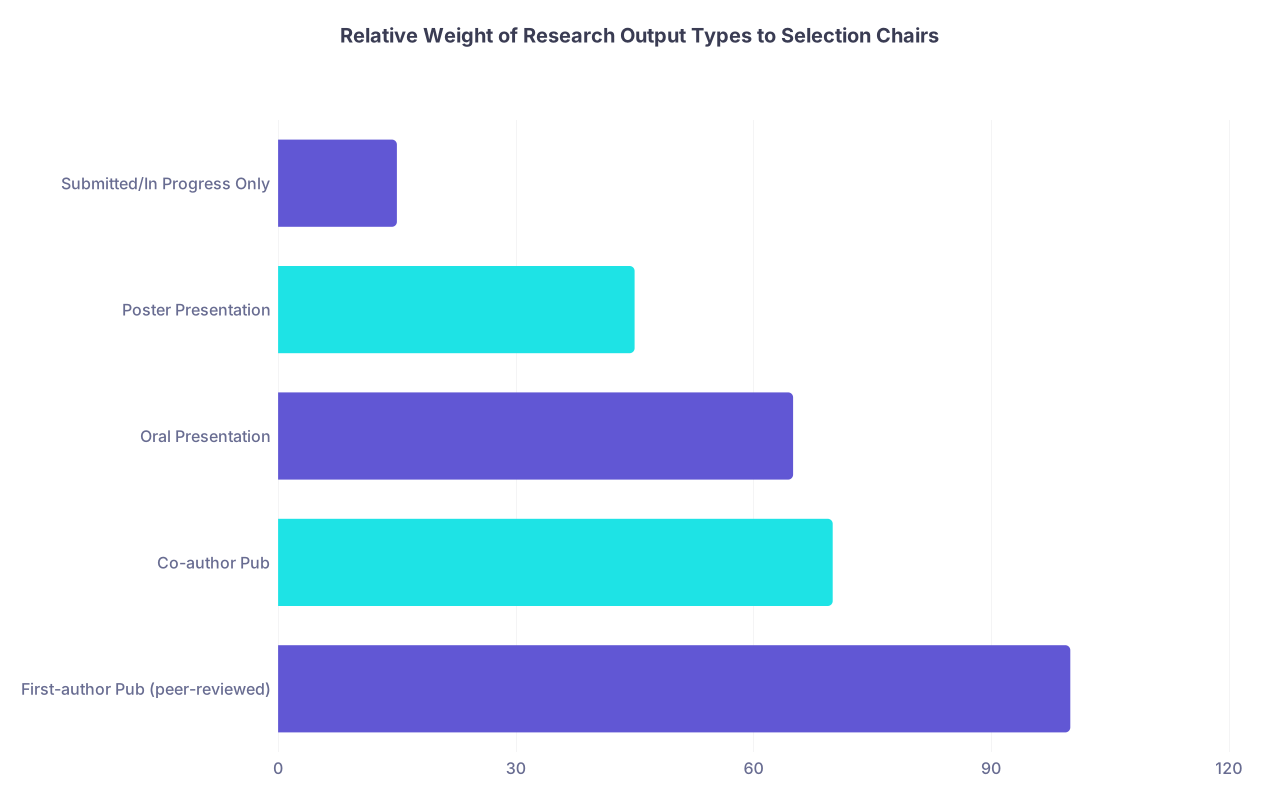
| Category | Value |
|---|---|
| First-author Pub (peer-reviewed) | 100 |
| Co-author Pub | 70 |
| Oral Presentation | 65 |
| Poster Presentation | 45 |
| Submitted/In Progress Only | 15 |
If your CV is all “in preparation,” you will not read as top 10%. Someone in that pile has actual completed work.
What “Top 10%” Research Looks Like on the Page
Patterns I see over and over in applicants who get instant interest:
- At least one first‑author pub or accepted manuscript.
- 3–6 posters or presentations at regional or national meetings.
- A clear thread: “In med school I worked on [X disease/specialty area] with [Dr. RecognizableName]. That led to [poster → paper → second project].”
Specific example from an actual internal medicine applicant who shot up the rank list:
- 2 first‑author original research papers in hospital medicine.
- 1 co‑author QI publication.
- 3 national conference posters.
- All under one mentor, all clearly part of a coherent theme.
Not derm‑level insane. Just tight, consistent, finished.
If you’re late in the game and do not have this yet, focus on one realistic project you can push to completion with something accepted before ERAS: a case report, a brief report, a QI abstract. Finished small beats sprawling “in prep” every time.
Leadership and Roles: The Difference Between “Busy” and “Impressive”
Here’s the ugly truth: most students massively overrate being “member, interest group.” You get almost zero credit for that.
Selection chairs look for roles where if you disappeared, something would actually break.
A top 10% CV almost always has at least one of:
- President/Chair of a student group that does more than hold pizza meetings.
- Orientation leader or curriculum committee rep with real responsibilities.
- Founder or co‑founder of a clinic, initiative, or project that clearly persists beyond the applicant.
The key thing we look for is scope. Does your description make it sound like you:
- Sent a couple emails and attended meetings?
- Or coordinated 50 volunteers, managed a budget, built a new curriculum, ran a major event?
When I read “President, Internal Medicine Interest Group,” I skip to the bullet. If it says, “Organized monthly noon lectures,” that’s nothing. If it says, “Oversaw 12-person board, increased membership from 40 to 140, created student-run residency prep series attended by 90+ MS3/MS4s,” that’s something.
The top 10% CV usually shows laddering:
- MS1: member
- MS2: committee/informal leadership
- MS3/MS4: defined leadership title with measurable outcomes
If your CV is missing titles, you can still salvage this by reframing your impact in the bullets: aim for verbs and numbers, not vague fluff.
Awards, Honors, and Distinctions: Signals That Quietly Scream
Awards are one of the fastest mental shortcuts we use internally. They’re not a meritocracy of the universe. But they are incredibly efficient filters late at night when we’re tired.
There’s a hierarchy here, whether people say it out loud or not:
- National-level honors or scholarships (e.g., national specialty society awards)
- Institution-level distinctions (AΩA, Gold Humanism, “graduation with distinction,” “top clinical performance”)
- Department or rotation‑specific awards (e.g., “Outstanding Student in Surgery Clerkship”)
- Campus-level but low-bar stuff (generic “participation” awards; we mostly skim past these)
A CV that hits top 10% usually has at least one solid signal from tier 1–2 and a couple from tier 3.
If you’re not in AΩA or GHHS, you’re not dead. What hurts more is having nothing that indicates your school thought you were particularly good at anything.
So yes, you should absolutely:
- Apply for internal scholarships.
- Nominate yourself (or have mentors nominate you) for teaching and service awards.
- Ask your student affairs office what end-of-year awards exist and what they look for.
Most students assume “if I deserve it, they’ll find me.” Wrong. Many of these are application-based or require someone to bother writing your name down. Advocate for yourself.
Volunteering and Service: What Chairs Actually Read For
The selection discussion almost never goes, “Wow, they did 300 hours of volunteer work.”
No one has time to count your hours.
The questions we actually ask in our heads when we see your volunteering:
- Is there continuity? Did you vanish after MS1?
- Is there ownership? Did you lead anything or just show up?
- Does it align with who you say you are in your personal statement?
Top 10% CVs rarely have 15 random one-off events. They have 2–4 things done deeply:
- 2–3 years at a free clinic, moving from volunteer to shift lead.
- Long-term work with a vulnerable population, then a related QI project.
- A service initiative they built and sustained: screening drives, mentorship programs, outreach.
When you see faculty circling something on a CV, it’s usually not, “Oh, 120 hours.” It’s the line that shows progress or impact:
“Co‑founded longitudinal mentorship program pairing 50 premeds with med students; raised $5,000 in donations; outcomes tracked over 2 years.”
That sounds like a person who will show up on our QI committee and not waste everyone’s time.
Teaching and Mentorship: The Quiet Section That Sells You as a Resident
Program directors are always, always thinking about one thing: “What will this person be like as a PGY‑2 or PGY‑3 when we need them to teach interns and students?”
Teaching experience is an underrated section. The best CVs highlight it clearly:
- Peer tutoring (especially if formal or paid).
- TA roles in anatomy, clinical skills, or problem-based learning.
- Workshops you designed or led.
- Mentoring programs with defined responsibilities.
The red flag is not “no teaching.” The red flag is a CV full of “I love medical education” language in the personal statement with zero teaching activity listed. That’s how you get eye rolls.
If you want to elevate your CV in 6–9 months, grabbing a solid teaching or mentoring role is one of the fastest, most feasible ways to look more “top 10%.”
Formatting and Presentation: The Stuff No One Admits Matters (But It Does)
Here’s the part people get weirdly defensive about. They say, “Content is what matters!” Sure. But your CV is being read by very tired people, very fast. Design that fights the reader will lose you points.
Inside selection committee meetings, I’ve heard:
- “Why is this so cluttered?”
- “What am I even looking at?”
- “This looks like a job resume. Where are the dates?”
A top 10% residency CV, visually, has:
- Clear section headings that match or parallel ERAS sections.
- Reverse chronological order within sections.
- Consistent formatting of titles, authors, dates, and locations.
- No color, no fancy icons, no cutesy fonts. This is not LinkedIn. This is medicine.
If your CV is hard to skim, it will be skimmed worse.
And one more insider point: the ERAS-generated CV format is ugly but familiar. We know how to read it. When you upload an additional PDF CV, keep it clean, clinical, and easily mappable to what ERAS already shows us. No one wants to learn a brand-new structure just for you.
How Selection Committees Quietly “Score” Your CV
No, not every program uses a literal point system. But many do, and even those that do not still behave like they do.
The mental or actual scoring usually bundles CV plus metrics. It often looks something like this behind the scenes:
| Bucket | Example Range for 'Top 10%' CVs |
|---|---|
| Academics/Exams | Top quartile of their pool for that year |
| Research/Scholarly | Multiple outputs, at least one strong |
| Leadership/Service | Clear sustained leadership, not just member |
| Honors/Awards | ≥1 major distinction, several minor |
| Fit/Alignment | Specialty-consistent story and activities |
You cannot “win” every bucket. Nobody does.
But if you want to read as top 10%, you need to be obviously strong in at least two of them and not dead in the others. Research + leadership. Academics + service. Honors + teaching. That kind of combo.
Where students go wrong is they try to be “fine” in everything and excellent in nothing. That reads as middle of the pack.
If You’re Not There Yet: How to Move Your CV Up a Decile
Let me be blunt: if you’re 2–3 months from ERAS, you’re not going to transform into a research monster. But you can still move the needle.
Think in terms of leverage, not volume.
If you have 6–12+ months before you apply, here’s the highest-yield path I’ve watched actually work for students:

| Step | Description |
|---|---|
| Step 1 | Now - Honest CV Audit |
| Step 2 | Join active project with clear timeline |
| Step 3 | Take real role in existing org |
| Step 4 | Apply to tutor or teach MS1s |
| Step 5 | Commit to 1 clinic or program |
| Step 6 | Push for 1 finished output - poster or paper |
| Step 7 | Deliver 1 measurable outcome or event |
| Step 8 | Document teaching hours and feedback |
| Step 9 | Take increasing responsibility over time |
| Step 10 | You look like progression, not padding |
| Step 11 | Main Weakness? |
Notice what I did not say: “Join five new things.”
Selection chairs can smell last-minute desperation activity a mile away. The applicant who suddenly joined three interest groups as a “member” six months before ERAS? That does nothing.
Pick 1–2 lanes and go deep. Produce something you can point to.
Concrete Before-and-After Examples
To really drive this home, let me show you how we see entries differently.
Weak research entry:
- “Research assistant, cardiology department. Helped with data collection and chart review.”
Top 10%‑style version of the same work:
- “Research assistant, cardiology department. Extracted and managed data for retrospective heart failure outcomes study (n=820); co‑authored abstract accepted for presentation at [Regional Conference 2025].”
Weak leadership:
- “Member, Surgery Interest Group.”
Better, but still mid:
- “Vice President, Surgery Interest Group. Helped coordinate events.”
Stronger:
- “Vice President, Surgery Interest Group. Led 8-person board, organized 6 skills workshops (average attendance 45 students), launched resident-student mentorship program pairing 30 MS2s with surgery residents.”
The difference is not magic. Same role, reframed with scope, scale, and outcomes.
Students constantly under-sell themselves. Selection chairs reward the ones who do not.
The Real Secret: Consistency Between Your CV, PS, and Letters
Here’s the last behind-the-scenes truth you probably do not hear:
We do not view your CV in isolation.
We read it together with:
- Your personal statement: Does the story match what your CV suggests?
- Your letters: Do attendings mention the same things you emphasized?
- Your experiences in ERAS: Are the “most meaningful” ones reflected strongly on the CV?
The most persuasive “top 10%” applications are internally coherent. The CV anchors the whole narrative.
If your PS screams, “I’m passionate about community health,” but your CV is research-only, zero longitudinal service, and no related work? We don’t buy it. You read like you wrote what you thought we wanted to hear.
The CV is where you prove you did the work you claim to care about.
You do that well, and by the time you show up for the interview, half the room is already on your side.
FAQ: What Selection Chairs Won’t Tell You Publicly
1. Do I need publications to have a ‘top 10%’ CV?
No, but you need something scholarly that is real. For some community programs or less research-heavy specialties, a strong CV can be built on leadership, teaching, and service—especially if backed by glowing clinical letters. But at competitive or academic-leaning programs, zero posters, zero abstracts, zero QI, zero anything is going to knock you out of the top bucket, even if your scores are good. Aim for at least one completed, presentable project.
2. How bad does it look if all my research is ‘in progress’ or ‘submitted’?
Bad enough that you will lose to someone with completed work. We all know “in progress” can mean “will never see daylight.” A single accepted abstract or poster is more convincing than three “submitted” manuscripts. If you’re close, push hard to get one thing over the line—acceptance to a meeting, internal research day, even a local poster session. You want at least one line you can’t be bluffing about.
3. Is being just a ‘member’ of several organizations worth listing?
One or two, sure. Ten, absolutely not. It clutters your CV and screams padding. Membership with no visible activity is noise to selection chairs. Save the space for roles where you did something you can describe: planned events, supervised people, ran projects. If you must list plain membership, keep it short and grouped, not spread all over the document.
4. How much do we actually care about formatting and typos?
More than people admit. No one is rejecting you solely for a typo. But a sloppy CV full of inconsistent dates, random bolding, and grammatical errors makes you look careless. And guess what we do not want on night float? Careless. The bar is not perfection; it is “clean, consistent, and easy to read.” If your CV looks chaotic, it subtly lowers the room’s confidence in you.
5. If I’m late in med school, what’s the single highest-yield thing I can still do for my CV?
Pick one meaningful lane and produce a tangible outcome. Late MS3 or early MS4? Join an ongoing project that can yield a poster in 3–6 months, or take on a real teaching or leadership role that leads to a clear, measurable result (workshop series, revamped curriculum, new clinic workflow). Then write it on your CV with specific verbs and numbers. You will not transform into a unicorn this late, but you can absolutely move from “forgettable” to “solidly competitive.”
You now know how a “top 10%” residency CV actually reads from the other side of the table: dense but not bloated, with real products, real responsibility, and a story that holds together.
Your job over the next months is not to collect more lines. It’s to do a few things deeply enough that when a tired selection chair opens your file at midnight, their brain says almost automatically: “This one rises to the top.”
Get that foundation in place, and when interview season starts, you will not just be begging for invitations—you’ll be choosing how to spend them. What you do with that leverage on the interview trail, we can dissect another day.