
Debunking the Myth That COMLEX Prep Needs Totally Different Books
Why do so many DO students think they need a completely separate, COMLEX-only library when 80–90% of their exam is the same medicine their MD classmates are studying?
Let me be blunt: the idea that COMLEX prep requires an entirely different set of books is one of the most persistent—and most expensive—myths in osteopathic education. It’s fueled by fear, marketing, and groupthink on student forums. Not by data.
Let’s pull this apart.
What COMLEX Is Actually Testing (Not What People Say It Is)
People love to say, “COMLEX is so different,” with no follow-up beyond “more OMM” and “weird questions.” That vagueness is exactly how bad advice survives.
If you read NBOME’s own blueprint instead of Reddit, you see something boring but critical:
- The core is still systems-based pathophysiology, pharmacology, microbiology, and clinical reasoning.
- A chunk (roughly 10–15% for Level 1) is osteopathic principles and OMM.
- The style is more “clinical integration + management + safety” than raw Step 1 biochem trivia, but the underlying medicine is the same.
In other words:
Most of COMLEX is not uniquely “DO content.” It’s just medicine, framed via NBOME’s style.
That means a huge portion of your prep can—and should—use the same high-yield resources that have been battle-tested for USMLE.
Where COMLEX is genuinely different:
- OMM and osteopathic philosophy
- Heavy emphasis on “what do you do next?” and patient safety
- Awkward question wording, longer stems, and sometimes poorly written distractors
Notice what I didn’t list: “Entirely different physiology,” “new pharmacology universe,” or “brand-new pathology you can only learn from COMLEX-only books.” Because that’s not real.
The Resource Myth: Who’s Selling It, Who’s Paying for It
Here’s the usual script I’ve watched play out every cycle.
MS2, January:
Someone panics in a GroupMe: “Heard USMLE resources don’t cover COMLEX. What are you guys using for OMM? Also heard you HAVE to use dedicated COMLEX question banks.”
Cue a buying frenzy. People stack:
- One big USMLE book
- One or two COMLEX-specific review books
- A massive, disorganized OMM text
- Two question banks “since COMLEX is so different”
- Maybe some random school-provided COMLEX resource no one actually finishes
By May, their desk looks like an exam-prep graveyard.
Here’s the problem: there’s no credible evidence that using all-DO-branded resources improves COMLEX performance over a strong USMLE-style core plus targeted OMM supplementation. None.
What is associated with stronger scores?
- High question volume with good explanations
- Repeated review of high-yield systems and fundamentals
- Knowing OMM cold, but in a structured, concise way
- Actually finishing the resources you start
None of that requires a unique COMLEX-only bookshelf.
What the Data and Score Patterns Actually Support
Programs that track their students’ board performance quietly know this: students who crush USMLE-style resources generally don’t tank COMLEX. The opposite, in fact.
Step-style prep builds:
- Pathophysiology understanding (why things happen)
- Pharmacology mechanisms and side effects
- Pattern recognition in vignettes
- Comfort with uncertainty and test-taking
Those skills transfer almost 1:1.
Are there DO students who used almost exclusively USMLE materials plus a brief OMM add-on and walked away with 650+ on COMLEX? Yes. I’ve seen it repeatedly.
Are there DO students who bought every COMLEX-specific product they could find and still struggled because they never mastered fundamentals, never did enough high-quality questions, and spread themselves too thin? Also yes. A lot more of those.
This isn’t cherry-picking. It’s the same pattern med schools see with any standardized exam: depth with a few strong tools beats surface coverage with ten mediocre ones.
Where USMLE Resources Work Perfectly—and Where They Don’t
Let’s categorize this without the emotional baggage.
| Content Area | USMLE Resources Adequate? | Needs COMLEX-Specific Add-On? |
|---|---|---|
| Pathology | Yes | No |
| Pharmacology | Yes | No (minus a few OMM drugs) |
| Cardiovascular | Yes | No |
| Musculoskeletal (non-OMM) | Yes | No |
| Biostats/Ethics | Yes | No |
| OMM / Osteopathic Principles | No | Yes |
If you’re using a solid Step-style foundation (think something like Boards & Beyond / Pathoma / USMLE-style Qbank / concise review notes), you’re already covering:
- 90–95% of cardiovascular, pulmonology, GI, renal, neuro, etc.
- Most pharm and micro high-yield bugs and drugs
- The conceptual “why” behind management decisions
What those resources will not give you:
- Fryette mechanics, sacral dysfunctions, Chapman points
- HVLA setup language and barriers (anatomic vs physiologic)
- The osteopathic “reasoning + whole-person” framing NBOME loves in vignettes
So no, you don’t need a totally different library. You need a small, sharp OMM toolkit layered on top of the same core everyone else uses.
Concrete Resource Strategy: What Actually Works Together
Here’s the approach that consistently works and doesn’t waste your time or money.
1. Use a mainstream “backbone” for core medicine
Pick:
- One primary video/content resource for foundations (e.g., Boards & Beyond-style or equivalent)
- One main Qbank that’s actually good (e.g., UWorld-type for Step-style vignettes)
- One concise outline-style or Anki-based review that you’ll actually touch daily
These will cover the bulk of COMLEX medicine better than most COMLEX-only books. Why? Because they’re ruthlessly filtered for high-yield and have been stress-tested by millions of exam-takers.
2. Add a focused, not bloated, OMM resource
You do need a dedicated OMM source. But you need it small and usable, not a 700-page nostalgia piece for your school’s OPP department.
Things that tend to work:
- A slim OMM review book with diagrams and clinical tie-ins
- High-yield OMM Anki deck that actually matches NBOME-style questions
- A targeted OMM question source with explanations that walk through the “why,” not just “memorize this tender point”
What doesn’t work:
- Huge, dense OMM textbooks you “plan” to read but never will
- OMM resources that are pure memorization lists with no reasoning or clinical anchors
3. Use a COMLEX-style Qbank as a second layer, not the foundation
This is where students get it backwards. They buy the COMLEX-specific bank first, then try to fill in gaps with USMLE-style resources when they realize they still don’t understand renal physiology.
The smarter sequence:
- Build your foundation with a high-quality Step-style bank (better question quality, better explanations, clearer content organization).
- In the last 4–6 weeks, layer in a COMLEX-style Qbank or practice exams to adapt to:
- Question phrasing
- Timing and fatigue
- NBOME’s favorite “what’s the safest next step?” games
You’re training two things: medical knowledge (best done with quality Step-style tools) and test-language fluency (best done with COMLEX-format practice). Those are not the same job; stop treating them like they are.
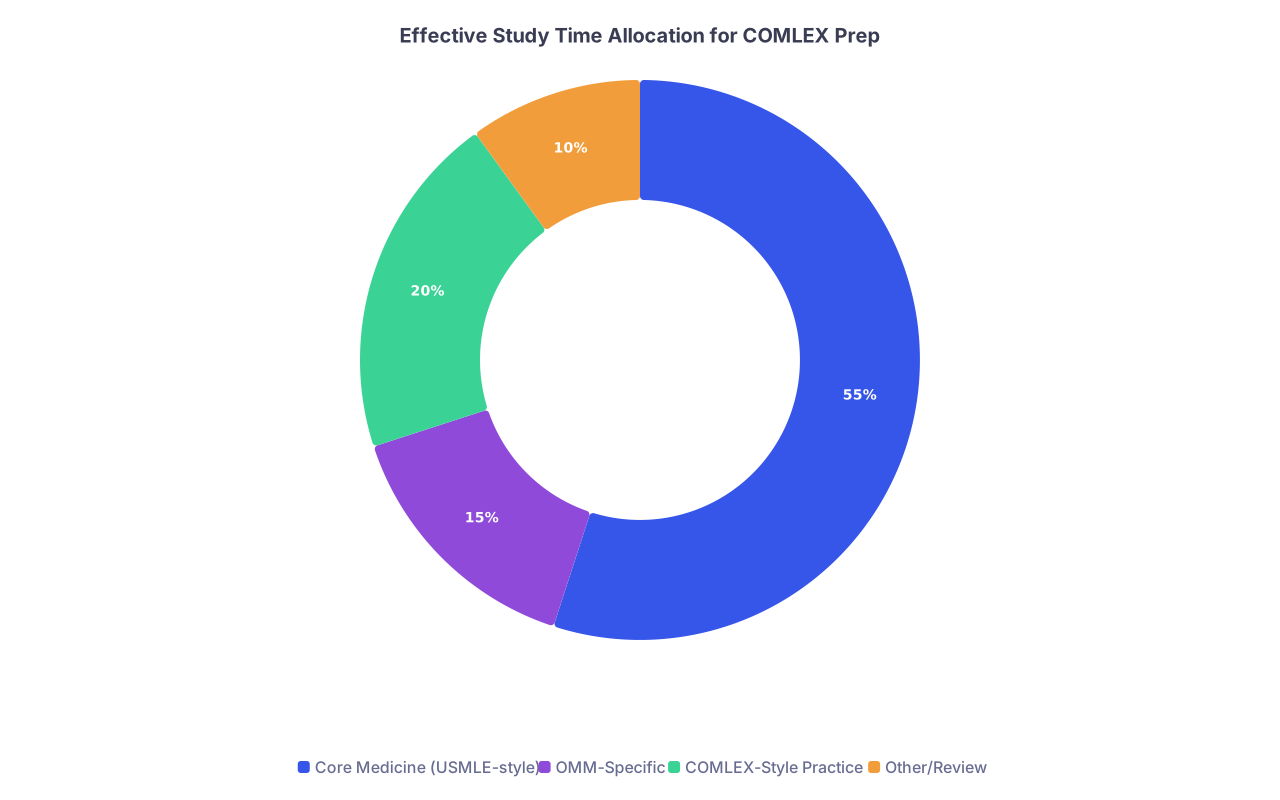
| Category | Value |
|---|---|
| Core Medicine (USMLE-style) | 55 |
| OMM-Specific | 15 |
| COMLEX-Style Practice | 20 |
| Other/Review | 10 |
That split—roughly 50–60% core medicine, 15–20% OMM, 15–25% COMLEX-style practice—is what I see in students who score solidly in the 600s without melting down.
The Psychological Trap: “If It Says COMLEX On It, It Must Be Better”
A lot of this myth is psychological, not rational.
You’re a DO student. You’re told constantly that you’re “different,” that licensing is “different,” that residencies might see you “differently.” So when it comes time for boards, anything labeled “USMLE” feels foreign. Unsafe. Not for you.
Meanwhile, anything branded “COMLEX” or “osteopathic” feels tailor-made. Safer. Like someone finally remembered your exam exists.
Marketing teams love that insecurity. They’ll slap “COMLEX-focused” on generic content and sell you the same pathophys you could get elsewhere—often with worse explanations—just because the cover has a caduceus and the word “osteopathic” on it.
Here’s the uncomfortable truth: a lot of “COMLEX-only” resources are derivative, low-yield, and rushed. The market is smaller than USMLE’s, so fewer companies invest heavily in top-tier content. The big quality engines are still on the USMLE side, and DO students benefit from that whether they like it or not.
Do you need some COMLEX-flavored resources? Yes.
Do you need to abandon everything USMLE-branded and rebuild from scratch? Absolutely not. That’s how you end up overpaying and under-prepared.
How to Adapt USMLE Resources Specifically for COMLEX
The better question is: how do you bend USMLE-style prep to fit COMLEX, not throw it out?
Here’s how:
When you’re doing Step-style questions, constantly ask, “What’s the next best step, and why?” COMLEX leans hard on management, disposition, and safety. Train that habit early.
When you see MSK/neuromuscular complaints, mentally integrate OMM. Ask yourself:
- Where would I place my hands?
- What somatic dysfunction patterns fit this?
- Is there a viscerosomatic reflex I should remember here?
For ethics and biostats, know that COMLEX scenarios often feel more “real world” and less polished. You’ll get vague outpatient notes, unhelpful nurses, half-finished charts. Don’t panic. Apply the same frameworks from USMLE prep: autonomy, beneficence, justice, informed consent, error disclosure.
Use your OMM resource like a narrow scalpel, not a textbook.
- Quickly review sacral/inominate mechanics.
- Drill Chapman points that actually show up.
- Practice reading OMM-focused vignettes under time pressure.

| Step | Description |
|---|---|
| Step 1 | Core Content with USMLE Resources |
| Step 2 | High-Quality USMLE-style Qbank |
| Step 3 | Identify Weak Systems |
| Step 4 | Targeted Review of Weak Areas |
| Step 5 | Add Focused OMM Study |
| Step 6 | COMLEX-Style Qbank & Practice Exams |
| Step 7 | Refine Test-Taking & Timing |
| Step 8 | COMLEX Exam |
Notice what’s missing from that flow: “Buy 6 extra COMLEX-only textbooks.”
What About People Who Took Only COMLEX-Focused Paths and Did Fine?
You’ll always hear anecdotes like, “My friend only used COMLEX-specific resources and got a 650.” Sure. You can pass (even do well) with a lot of different approaches. But that doesn’t mean every approach is equally efficient or scalable.
A few key points:
- Survivorship bias is real. You don’t hear loudly from the students who followed the same COMLEX-only path and barely scraped by.
- Many of those students had very strong school curricula and preclinical exams that essentially functioned as Step-style prep behind the scenes. Their “resources” weren’t the whole story.
- If you’re average or slightly below in class rank, you have less room for inefficiency. You can’t afford to waste time on bloated, low-yield material just because it has COMLEX on the cover.
You’re not trying to prove that it’s possible to pass using COMLEX-only tools. You’re trying to maximize your odds and sanity with limited time. That’s a different problem.
When You Do Need Something COMLEX-Specific
Let me be fair: there are clear cases where COMLEX-specific tools matter more.
You should strongly consider more COMLEX-specific prep if:
- You are skipping USMLE entirely and your school’s basic science teaching is weak or disorganized.
- You consistently bomb COMLEX practice exams despite knowing the underlying medicine, implying a serious mismatch with NBOME’s style.
- You’re retaking after a failure and your previous attempt was built only on USMLE-style sources without OMM or format adaptation.
Even then, the answer isn’t “throw away everything USMLE-style.” It’s “shore up with better-format practice and more deliberate OMM work.”
Use COMLEX-specific:
- Practice exams (COMSAEs, school-provided sims)
- Targeted question banks to adapt to style
- A single, tight OMM review source
Not: a library-sized detour away from high-quality mainstream resources.
The Bottom Line
COMLEX doesn’t require a completely different set of books. It requires a strong core in the same medicine everyone else studies, plus a focused OMM and NBOME-style overlay.
High-quality USMLE-style resources are often better for mastering the underlying material than many COMLEX-branded tools. Layer OMM and COMLEX-format practice on top; don’t reinvent your entire prep.
The “COMLEX needs totally different books” myth mainly benefits companies selling duplicate products and students looking for reassurance, not those trying to study efficiently and score high.