What are you actually buying when you drop $800–$2,000 on a boutique exam course… that you do not already get from a $70–$300 q-bank?
Let me ruin the suspense: the marketing is better than the evidence.
Everyone loves a shiny “high-yield” boutique course with hand-drawn slides, charismatic tutors, and promises that “our students score in the top 5%.” Q-banks look boring by comparison. Just thousands of questions and some clunky UI. No hype. No cinematic trailer.
But if you care about what moves your score—not your anxiety—then you have to separate three things:
- What feels good
- What looks impressive
- What reliably improves performance
Those are not the same.
The Core Myth: “Content Beats Questions”
The myth goes like this:
“If I just find the right course with perfectly organized content, I can shortcut the grind, understand everything faster, and then crush questions later.”
This is comforting. It is also mostly wrong.
For high-stakes exams (Step 1/2, shelf exams, COMLEX, etc.), the performance chain is roughly:
- Base knowledge
- Applied reasoning under constraints (time, fatigue, pressure)
- Pattern recognition from exposure to variants of the same idea
Q-banks directly train the last two. Courses mostly inflate the first—sometimes efficiently, often redundantly.
There is a reason NBME-style practice and q-banks dominate the study plans of people who score 250+ or >260. They do not just “watch everything then do questions.” They flip it:
- Heavy questions
- Targeted review of what those questions exposed as weak
Boutique courses try to reverse this with 60–200+ hours of guided videos. Students tell themselves, “I’ll do questions after I finish this course.” Translation: “I’ll delay the part that actually hurts—and helps.”
What The Data Actually Supports
Nobody has a randomized controlled trial of “boutique course vs only q-bank,” but we do have a few things that matter:
- General learning science
- What consistently shows up in exam performance research
- Actual behavior of high scorers vs average scorers
Let’s line a few core methods against each other.
| Method | Evidence for Score Impact | Typical Cost Range |
|---|---|---|
| High-quality Q-bank | Strong, repeated support | $70–$400 |
| Timed practice NBMEs | Strong, predictive | $60–$300 |
| Flashcards (esp. spaced) | Strong, durable memory | Free–$120 |
| Boutique video course | Weak–mixed, indirect | $500–$2,500 |
| Live tutoring bundles | Mixed, depends on usage | $100–$5,000+ |
The consistent pattern:
- Doing lots of exam-style questions with feedback → strong effect
- Practicing under test-like timing/conditions → strong effect
- Repeated retrieval and spaced repetition → strong effect
- Passive or semi-passive content consumption (lectures, courses) → much weaker effect unless tightly integrated with active work
And boutique courses, for all their production value, are mostly in that last category.
Why Boutique Courses Feel So Good (And That’s The Problem)
People do not buy $1,200 courses because they love setting fire to cash. They buy them because the courses hit psychological pressure points medical students live with:
- Anxiety
- Time scarcity
- Fear of missing “secret high-yield content”
- Decision fatigue
Boutique programs exploit these with:
- “We’ve pre-digested everything for you”
- “Only what you truly need to know”
- “Most efficient system on the market”
- “Our students’ average score is X above national mean”
I’ve seen behind the curtain of a few of these operations. The actual ingredients:
- A curated outline that overlaps 80–90% with what you already have in your review book and q-bank explanations
- Some decent mnemonics
- Variable instructor quality—often 1–2 stars carry the whole brand
- A lot of structure that you could build yourself with a calendar and a q-bank
And the “our average student scores higher” claim? That’s selection bias. The kind of student willing to buy a boutique course is already more motivated, more anxious, or more resourced than average. You’re not comparing apples to apples.
Q-Banks vs Boutique Courses: What Actually Builds Skill
Let’s strip the branding and look at what each tool really does.
| Feature / Outcome | Q-Bank (UWorld, AMBOSS, etc.) | Boutique Course (video-heavy) |
|---|---|---|
| Active recall | High | Low–Moderate |
| Exam-style reasoning | High | Indirect |
| Pattern recognition | High | Low |
| Timing & stamina training | High | Very low |
| Concept organization | Moderate | High |
| “Feeling prepared” | Moderate–Low | High (often falsely) |
Notice where q-banks dominate: the parts that line up tightly with actual test performance.
Courses can be useful for:
- Big-picture frameworks
- Cleaning up truly weak foundation in a subject (like if you basically missed all of cardiology in M2)
- Giving a road map when you’re paralyzed by choices
But they do not substitute for getting pummeled by thousands of questions and then ruthlessly learning from the damage.
The Money Math: Cost Per Point
Let’s be cold-blooded.
What are you actually paying per realistic point of improvement?
Assume roughly:
- A good q-bank + NBMEs used well can move many students 20–40 points from their starting practice scores (not everyone, but commonly).
- A boutique course, on top of that, for most students, adds maybe 0–10 real points. Often closer to zero if it displaces q-bank time.
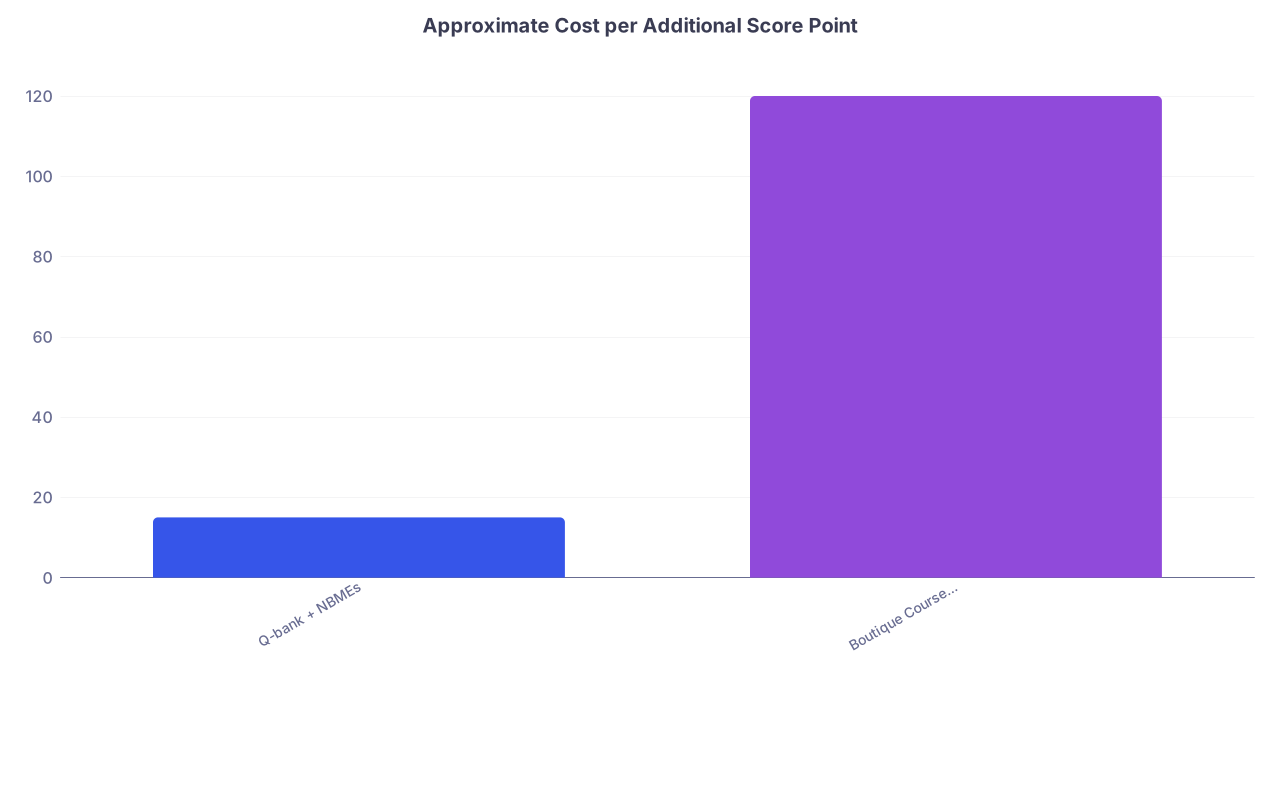
| Category | Value |
|---|---|
| Q-bank + NBMEs | 15 |
| Boutique Course Add-on | 120 |
Interpretation: you might be paying an order of magnitude more per point for a boutique add-on than for core practice resources.
If you’re already doing:
- Full UWorld (or equivalent)
- Some supplemental q-bank or well-used flashcards
- Several NBMEs or COMSAEs/CCS practice
Then yes, a course might give you a small extra nudge or fill a few comprehension gaps faster. But most students buy the course instead of doubling down on the high-yield boring stuff.
That’s the real cost: not just the money, but the opportunity cost.
When Boutique Courses Actually Make Sense
They’re not useless. They’re just wildly oversold.
They can be rational in a few specific scenarios:
You’ve failed an exam already
- You clearly have foundational gaps + poor strategy
- A structured course combined with relentless q-bank work may help you rebuild, especially if your self-organization is poor
You’re chronically disorganized or severely overwhelmed
- You’ve “started studying” ten times and never built a system
- A rigid schedule from a course can be a scaffold, but only if you still do a heavy dose of questions
You’re fixing a narrow problem with a targeted mini-course
- Example: 10–20 hour focused course on EKGs, biostats, or CCS, not a 150-hour “all of medicine” monster
You have more money than time
- Not common among med students, but exists
- If the course lets you cover must-know content slightly faster so you can do more q-bank blocks, it’s fine—but again, you’re paying for speed and structure, not magic content
In all those, the key is this: the course supplements questions; it does not replace them.
Red Flags That a Course Is Mostly Hype
A few patterns I’ve seen that should trigger skepticism:
- Heavy emphasis on “secret” or “proprietary” tricks
- More marketing copy about “average scores” than about how they integrate timed practice and spaced repetition
- 100–200+ hours of video with little forced active engagement
- Students bragging “I watched the whole course” instead of “I mastered X number of questions and NBMEs”
- No transparent breakdown of how your weekly time should be allocated between their content and actual question practice
If the sales pitch spends more time on “You’ll feel confident” than “You’ll do X number of timed mixed blocks,” that tells you exactly what they think you’re really buying.
How To Actually Use Q-Banks Like A Pro
Here’s the part most students quietly butcher, then blame the resource.
A high-quality q-bank becomes insanely powerful when you:
- Do timed, mixed blocks early, not just “system-only” review forever
- Treat each missed question as a springboard to review the concept family, not just that stem
- Actively write or tag flashcards from recurring themes and mistakes
- Revisit question explanations even after you start getting similar items right (to reinforce patterns, not individual tricks)
And you track your weaknesses, not with vibes, but with data:
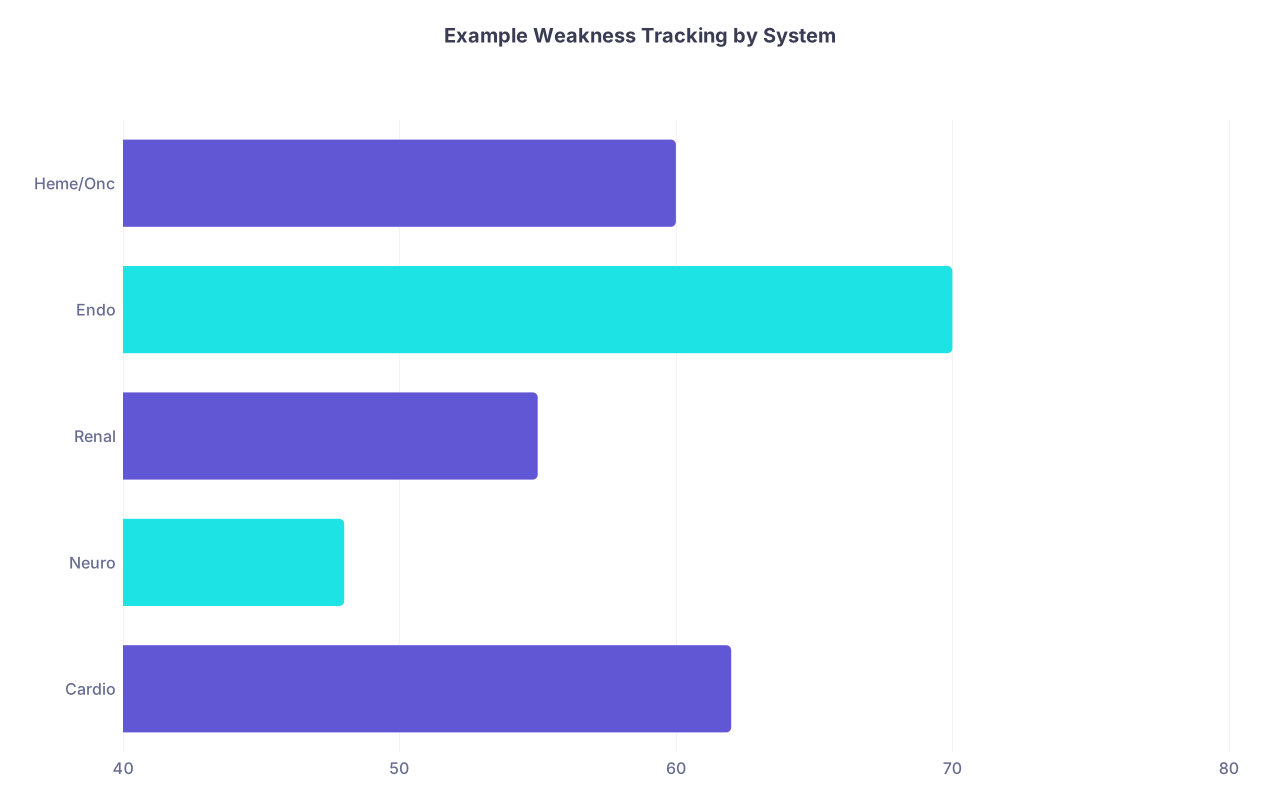
| Category | Value |
|---|---|
| Cardio | 62 |
| Neuro | 48 |
| Renal | 55 |
| Endo | 70 |
| Heme/Onc | 60 |
A student who scores 48% in Neuro and 62% in Cardio doesn’t need a $1,200 “all-systems” course. They need:
- Focused neuro review (maybe a short targeted resource)
- Extra neuro-heavy question blocks
- Intentional revisiting of neuro misses
That’s surgical. A boutique course is a shotgun.
A Realistic Hybrid That Actually Works
If you’re trying to decide where to put your money and time, a sane structure looks like this:
- Anchor: One primary q-bank (UWorld/AMBOSS/etc.)
- Scaffold: A concise primary reference (Anki deck, board review book, or a single lean video series—not three)
- Reality checks: Periodic NBMEs / COMSAEs / shelf practice exams
- Optional:
- Short, focused mini-courses for very specific, chronic blind spots
- Maybe a compressed review course if you already have a question discipline and just want a big-picture pass
Notice what’s not on that list: a 150-hour boutique course that becomes your main activity.
If your schedule for the week has more hours labeled “watch videos” than “timed mixed blocks,” your plan is upside down.
Decision Flow: Do You Need A Boutique Course?
Here’s the blunt version.

| Step | Description |
|---|---|
| Step 1 | Thinking about boutique course |
| Step 2 | Start q-bank + review plan first |
| Step 3 | Keep pushing q-bank & basics |
| Step 4 | Consider short, targeted course |
| Step 5 | Use more practice exams & review strategy |
| Step 6 | Skip course; retool current resources |
| Step 7 | Buy course but keep q-bank central |
| Step 8 | Using a q-bank daily? |
| Step 9 | Plateaued on multiple NBMEs? |
| Step 10 | Main issue: content gaps or test-taking? |
| Step 11 | Cost vs expected benefit reasonable? |
If you’re not already grinding questions, you have no business even looking at boutique course websites. That is harsh, but it is accurate.
So, Do Expensive Boutique Courses “Beat” Standard Q-Banks?
No. Not even close.
They can:
- Organize your thinking
- Reduce some planning anxiety
- Occasionally accelerate learning in a weak area
But they do not substitute for, or outperform, disciplined, high-quality q-bank work combined with practice exams and spaced repetition. Period.
For 90% of students, the constraint isn’t lack of special content. It’s lack of consistent, uncomfortable practice in the exact format the exam uses.
Years from now, you won’t remember the color palette of some boutique course’s slide deck. You’ll remember whether you were the person who chose polished comfort—or relentless, slightly boring, question-based work that actually changed your score.
FAQ (5 Questions)
1. If I can only afford one big resource, should it be a q-bank or a boutique course?
Q-bank. Every time. If you have to choose between a top-tier q-bank and a fancy course, buy the q-bank and supplement with free/cheap content (YouTube, school notes, Anki). Courses can layer on top; they should not replace the core.
2. Are cheaper “mass-market” video courses (e.g., board review series) better or worse than boutique ones?
They’re usually similar in actual impact. Boutique doesn’t automatically mean better pedagogy; it often just means smaller scale and more aggressive marketing. A concise, widely used review course + strong q-bank use will beat a shiny boutique course with poor question discipline.
3. What if my school gives us a bundled course for free—should I still use it?
If it’s free, treat it as a menu, not a mandate. Use specific sections to patch weak areas, but don’t let it consume the bulk of your time. Your primary engine should still be: questions → targeted review → questions.
4. How do I know if I’m over-relying on courses and underusing q-banks?
Look at your last 7 days. If you spent more hours watching or “reviewing” than doing timed blocks and reviewing those questions in depth, you’re skewed. Another red flag: you’ve finished >70% of a big course but <50% of your main q-bank.
5. Can a tutor combined with a boutique course be worth it for a struggling student?
Sometimes, but only if the tutor is ruthless about shifting you toward active work. A good tutor will use the course as a framework and then pound you with questions, spaced recall, and exam strategy. A bad tutor will just hold your hand through watching more videos—which is an expensive way to stay stuck.