
Most students are using too many pediatrics resources and remembering almost nothing that matters on test day.
Let me be blunt. For the Pediatrics shelf and Step 2 CK, breadth of books is not your problem. Signal-to-noise is. You do not need five pediatrics texts, three flashcard decks, and two video series. You need a very tight core: one primary text, one question bank strategy, and a couple of targeted add-ons. Then repetition.
I will walk you through a deliberately narrow, high-yield pediatrics book list that pulls double duty: it will carry you through the Peds clerkship and meaningfully raise your Step 2 CK score.
The Core Strategy: How to Think About Resources
Forget “what’s popular.” Start with this: what actually predicts performance?
For Pediatrics shelf and Step 2 CK, your score is driven by three things:
- How many high-quality questions you do
- How many times you see the same core patterns (asthma, bronchiolitis, sepsis, FTT, murmurs, developmental delay, rashes, vaccines)
- Whether your one main book actually matches how NBME asks questions
The mistake I see constantly: students half-finish 3–4 different books and never fully internalize any of them. You want the opposite: overlearn 1–2 carefully chosen resources that actually mirror NBME style and CK emphasis.
So the framework:
- One concise, exam-focused pediatrics book
- One robust question strategy (AMBOSS + UWorld)
- One tiny reference for rapid look-up during rotation
- One good resource for images/visual stuff (esp. rashes, congenital anomalies)
That is it. If you stick to this, you can score in the 80s+ on shelf and meaningfully boost Step 2 CK.
Tier 1: Your Primary Pediatrics Book
You only need one main text. It must be:
- Peds-shelf aligned (NBME structure, not board fantasies)
- Dense enough to be worth the time
- Concise enough that you can actually finish it during the rotation
- Written in Q/A or case-based style if possible
Let me go through the realistic options and tell you what to do.
1. BRS Pediatrics – Excellent but slightly dated (still very usable)
BRS Pediatrics used to be the default. Many schools still recommend it. It is structured by topic, pretty readable, and has end-of-chapter questions.
Strengths:
- Strong pathophysiology + clinical reasoning
- Pretty comprehensive for a small book
- End-of-chapter questions that reinforce key points
Weak points:
- Older editions miss some current vaccine nuances, updated guidelines, and some CK-style nuance
- Can be a touch too “boardy” and not always aligned perfectly with NBME shelf blueprint
Verdict:
If you already have it and like the BRS style, you can absolutely use it as your primary text, but I would not go hunting it down as your first choice in 2026 if you have better-aligned options. Supplement with updated Qbanks.
2. Case Files Pediatrics – Great for understanding, not sufficient alone
Case Files is excellent for teaching you how to think like a pediatrician. You get ~60 cases, each with:
- Brief history and physical
- “Clinical pearls”
- Short discussion + questions
Strengths:
- Makes you think in the “what do I do next?” format that CK and shelf love
- Very readable, can do a few cases per night
- Good for building illness scripts (e.g., “this is what pyloric stenosis looks like every time”)
Weak points:
- Not comprehensive, by design
- Does not systematically cover all vaccine schedules, developmental milestones tables, etc.
- Not enough volume to serve as your only resource
Verdict:
Use Case Files Pediatrics as a secondary supplement for understanding and retention. It is a strong “second” resource, not your main spine.
3. Blueprints Pediatrics – Too long for most students, too unfocused
Blueprints has detail, yes. But for most third-years, it is a trap.
Strengths:
- Reasonably comprehensive
- Chapter-based structure like a mini-textbook
Weak points:
- Wordy, inefficient for the return you get per page
- Does not mirror NBME question style particularly well
- Hard to finish during a busy clerkship unless you sacrifice questions (which you should not)
Verdict:
Skip it. If your school library has it and you want to read a single chapter (e.g., NICU, cardiology), fine. But it is not your primary tool in a max-efficiency, shelf + CK overlapping plan.
4. Lange/LWW type full texts (Nelson Essentials, etc.) – Overkill for shelf/CK
If we were training you for pediatrics residency boards, maybe. For shelf and Step 2 CK? Completely overpowered.
Verdict:
Use as reference only. Not for systematic reading. Definitely not part of a “narrow” list.
So what is the actual primary text?
If you want a strict book answer: BRS Pediatrics as the main reading + Case Files Pediatrics for applied reinforcement is a time-tested pair that still works.
But here’s the modern reality: the “primary” resource for pediatrics shelf + Step 2 CK is gradually shifting away from a classic book toward AMBOSS articles + UWorld blocks as your true spine, with a small book (like Case Files) pulled in for narrative context.
Let’s formalize what I would actually do today.
Tier 2: Questions First – AMBOSS + UWorld as Your Real Spine
If you remember one piece of this article, make it this:
Your Qbanks are more important than your book.
The highest-yield “peds book” for shelf and CK is essentially this combination:
- UWorld Step 2 CK – all pediatrics questions
- AMBOSS – full pediatrics library questions + the associated articles
You then use BRS or Case Files as a structured supplement, not the other way around.
UWorld Pediatrics – Non-negotiable
You do every single pediatrics question in UWorld at least once. Ideally, early enough in the rotation that you have time to redo your incorrects or at least heavily review marked ones.
How to integrate this with your “book”:
- Start the rotation: skim pediatrics section headings in UWorld to see the terrain
- Daily during rotation:
- 1–2 timed blocks of mixed or pediatrics-heavy Step 2-style questions
- For topics you keep missing (e.g., neonatal jaundice thresholds, congenital heart disease lesions), read one short structured resource after reviewing explanations
This “one short resource” can be:
- AMBOSS article on that topic
- BRS chapter subsection
- A single Case Files case covering that pathology
AMBOSS Pediatrics – Where “book” and Qbank blur
AMBOSS is not a classic book, but functionally it behaves like one with:
- Systematic articles (e.g., “acute otitis media”, “bronchiolitis”, “developmental milestones”)
- Embedded questions and high-yield “Key findings,” “Next step,” “Red flags”
For pediatrics, AMBOSS articles are extremely aligned with shelf and CK. Vaccine schedules, fever workup, neonatal respiratory distress, cardiology lesions — all there, up to date, and exam-framed.
If your school gives you AMBOSS, your “primary peds book” may essentially be:
- UWorld questions
- AMBOSS questions
- AMBOSS articles for topics you consistently miss
You can then use Case Files Peds just to deepen understanding when you want narrative clinical reasoning.
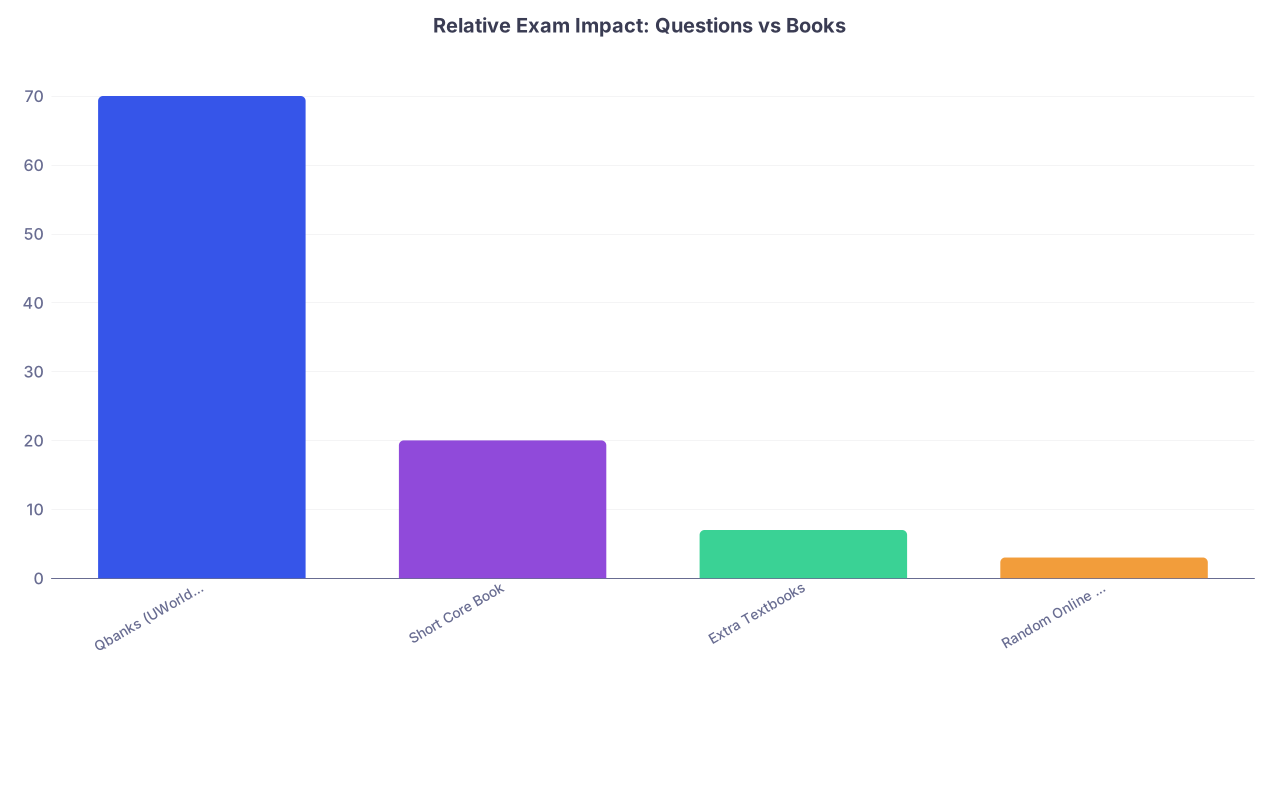
| Category | Value |
|---|---|
| Qbanks (UWorld+AMBOSS) | 70 |
| Short Core Book | 20 |
| Extra Textbooks | 7 |
| Random Online Notes | 3 |
If you are thinking about time allocation: roughly 70% of your dedicated peds study time should be questions, 20% a concise core text, 10% everything else.
Tier 3: Narrow Book List – What You Should Actually Own/Use
Let me give you a very clean, minimal stack that I would endorse in 2026 for maximum overlap between Peds shelf and Step 2 CK.
The Minimalist Core Stack
You want:
- A Q-first foundation (UWorld + AMBOSS)
- A concise case-based book
- Optional: a structured board-review outline if you are a “read then questions” learner
- Something small for on-the-ward quick reference
Here is the lineup.
1. Case Files Pediatrics – Non-negotiable narrative resource
Use it like this:
- Early rotation:
- Read 1–2 cases per night focusing on the most common chief complaints: fever, respiratory distress, rash, vomiting/diarrhea, seizures, well-child visits
- Mid-late rotation:
- Target weak spots. Keep a list from UWorld/AMBOSS: e.g., “I keep missing congenital heart lesions, rheumatic fever, JIA vs SLE, malabsorption.” Read those specific cases.
High-yield sections:
- Neonatology (jaundice, sepsis, RDS, NEC)
- Pulm (asthma, bronchiolitis, croup, epiglottitis)
- ID (meningitis, sepsis, otitis media, pneumonia, TB)
- GI (pyloric stenosis, intussusception, malrotation, GERD, IBD)
- Cards (VSD/ASD, TOF, transposition, Kawasaki, rheumatic fever)
You will see these patterns on both shelf and CK. Again and again.
2. BRS Pediatrics (if you are the “outline reader” type)
If you hate outline books, skip this and live in AMBOSS articles instead. But if you like white-coat-pocket-style condensed content, BRS can still work well.
Use BRS like this:
- First 1–2 weeks:
- Skim high-yield chapters while you are still orienting (growth/development, immunizations, common infections, neonatal)
- Then only:
- Use as reference when you keep missing a topic in Qbanks
Do not try to read it cover-to-cover as your main activity if that means sacrificing question time.
3. On-the-ward quick reference (optional but nice)
You do not need a full book for this. Most students overdo it. Options:
- AMBOSS app
- UpToDate or institution’s internal guidelines
- A one-page or two-page personal cheat sheet (growth milestones, vaccine schedule, common antibiotic regimens, fluid bolus/maintenance formulas)
Many people used to carry things like “The Harriet Lane Handbook.” For your shelf and Step 2 CK, Harriet Lane is way too detailed. Unless you are super old-school or starting peds residency, skip buying it.
Tier 4: Visual / Image-Based Resources – Underused but High-Yield
NBME and CK love images in pediatrics:
- Rashes (Kawasaki, measles, scarlet fever, slapped cheek, varicella, hand-foot-mouth)
- Congenital anomalies (Down syndrome, Turner, Marfan vs homocystinuria facial features)
- Radiology (intussusception, NEC, pneumonia, croup vs epiglottitis imaging)
- Growth charts and developmental tables
You need some way to lock these in visually. A massive dermatology atlas is overkill. Use either:
- AMBOSS image library (very good)
- UWorld explanations images (honestly enough for the exam)
Target rule: anytime you miss a question with an image, screenshot or tag it and review that cluster of images again 1–2 days before the exam.
How This Overlaps with Step 2 CK
Pediatrics is not just one shelf. It is about 15–20% of the entire Step 2 CK exam when you include:
- Neonatal stabilization, resuscitation, sepsis
- Congenital heart disease
- Pediatric respiratory conditions
- Developmental delay and autism
- Failure to thrive and nutrition
- Pediatric endocrine (T1DM, CAH, hypothyroidism, puberty issues)
- Pediatric nephrology (post-strep GN, HUS, nephrotic)
- Pediatric rheum (JIA, HSP, Kawasaki)
- Child abuse and neglect
So the critical question: does your pediatrics shelf prep directly move your Step 2 CK score? Yes — if you focus on the correct overlap topics.
| Topic Area | Examples That Recur On CK |
|---|---|
| Respiratory | Asthma, bronchiolitis, croup |
| Infectious Disease | Meningitis, AOM, pneumonia, TB |
| Neonatology | Jaundice, sepsis, RDS, NEC |
| Cardiology | TOF, VSD/ASD, PDA, Kawasaki |
| Renal/Rheum | HUS, PSGN, HSP, JIA |
| Development & Vaccines | Milestones, autism, vaccine schedule |
If your “book list” is bloated with low-yield esoterica, you will spend time on diseases that might show up once every 4–5 exams instead of the patterns that appear every few blocks.
That is why a narrow set of resources is superior. You will see bronchiolitis in:
- Case Files
- BRS or AMBOSS
- UWorld
- AMBOSS Qbank
You will see it 8–10 times, in different ways. That repetition is exactly what moves both shelf and CK scores.
How to Actually Study with This Narrow Stack
Books do not raise your score. Your workflow with the books does.
Let me break down a concrete, realistic plan for a 6-week pediatrics rotation that also sets you up for Step 2 CK.
Week 1–2: Foundation and Orientation
Goal: build basic illness scripts, see common bread-and-butter cases.
Daily targets:
- 1 block of UWorld (mixed or pediatric-heavy, timed, tutor review after)
- 1–2 Case Files Peds cases in the evening
- When you miss something repeatedly (e.g., vaccine catch-up schedule, febrile seizure management), read:
- The AMBOSS article or
- The corresponding short section in BRS if you prefer book format
Do not obsess about rare stuff yet. Focus on the big pediatrics archetypes.
Week 3–4: Pattern consolidation
Goal: increase question volume and start drilling weaknesses.
Daily targets:
- 2 blocks of questions most days (mix of UWorld and AMBOSS)
- After each block, identify:
- 1–2 topics you keep missing or guessing on
- Quickly read those topics in AMBOSS or BRS
- 1 Case Files case every other day focused on weak systems (e.g., cardio-heavy week if your Qbank error log is full of murmurs)
This is the phase where your shelf and Step 2 CK overlap really solidifies. You should be seeing the same patterns repeatedly: that is the point.
Week 5–6: Shelf-focused, exam technique
Goal: switch from learning new facts to tightening recall and test strategy.
Daily targets:
- 2 blocks of mixed questions that include peds but also other systems (to simulate CK feel)
- Rapid review:
- Vaccine schedules (esp. catch-up and exceptions)
- Developmental milestones tables
- Neonatal complications (jaundice types/tests, sepsis workup, respiratory distress)
- Urgent pediatrics emergencies (epiglottitis, anaphylaxis, septic shock, intussusception vs malrotation vs pyloric stenosis)
Pull out Case Files only for any concept that still feels conceptually “fuzzy.” But at this stage, most of your time goes to questions and rapid reference notes, not narrative reading.

| Step | Description |
|---|---|
| Step 1 | Start Peds Rotation |
| Step 2 | Week 1-2: Basics |
| Step 3 | Week 3-4: Consolidation |
| Step 4 | Week 5-6: Exam Focus |
| Step 5 | UWorld 1 block/day |
| Step 6 | Case Files 1-2 cases/night |
| Step 7 | UWorld + AMBOSS 2 blocks/day |
| Step 8 | Targeted topic review in BRS/AMBOSS |
| Step 9 | Mixed blocks for CK feel |
| Step 10 | Rapid review of high-yield lists |
Where Students Go Wrong With Pediatrics Resources
I have seen the same self-sabotage patterns every year.
Problem 1: “Reading instead of doing”
Some students will read 50–100 pages of Blueprints or a large text before touching a Qbank. By the time they start UWorld, they have forgotten half of what they read and realize the questions emphasize different angles.
Fix:
From Week 1, your default is questions first, then targeted reading. Never the reverse.
Problem 2: Too many books, not enough passes
Owning BRS, Case Files, Blueprints, and half of Nelson Essentials does not make you prepared. It dilutes your exposure.
Fix:
Pick one narrative case resource (Case Files) + one outline/structured resource (BRS or AMBOSS) and commit. Finish them or nearly finish them. Ignore everything else unless you are using it as a one-off reference.
Problem 3: Not aligning with CK early enough
Some students treat pediatrics shelf as some isolated event. Then 3–6 months later they act surprised when Step 2 CK pediatrics questions feel vaguely familiar but not solid.
Fix:
From day one of the rotation, do your questions in UWorld Step 2 CK mode, not some separate pediatrics-only world. You want your brain to attach “pediatrics” to the overall CK context: differential breadth, multi-system integration, and A/B/C next-step prioritization.
Sample Narrow Resource Setup: What This Looks Like in Practice
To show you how minimal this can be, here are three realistic setups based on student type.
| Student Type | Primary Reading | Questions | Extras |
|---|---|---|---|
| Qbank-first | AMBOSS articles | UWorld + AMBOSS | Case Files |
| Reader-then-questions | BRS Pediatrics | UWorld + AMBOSS | Case Files (targeted) |
| Time-crunched | Case Files only | UWorld (twice through peds) | AMBOSS for weak spots |
You do not need more than this. If you add another entire book, you should have a very good reason.
A Quick Note on Milestones, Vaccines, and Charts
These always get asked. They always trip people up who “kind of sort of remember” ranges from a table but never made them stick.
High-yield move:
- Take one afternoon and build a single consolidated sheet for:
- Gross motor, fine motor, language, social milestones by age (2, 4, 6, 9, 12, 15, 18, 24 months, then 3, 4 years)
- Vaccine schedule and key contraindications
- Fever workup by age (especially neonates vs older infants)
Use AMBOSS/BRS tables or your school’s handout to create this. Then:
- Review that single sheet:
- Daily for 3–4 days
- Then every 2–3 days until the shelf
For Step 2 CK prep months later, review the exact same sheet for 20–30 minutes. This is how you exploit overlap.
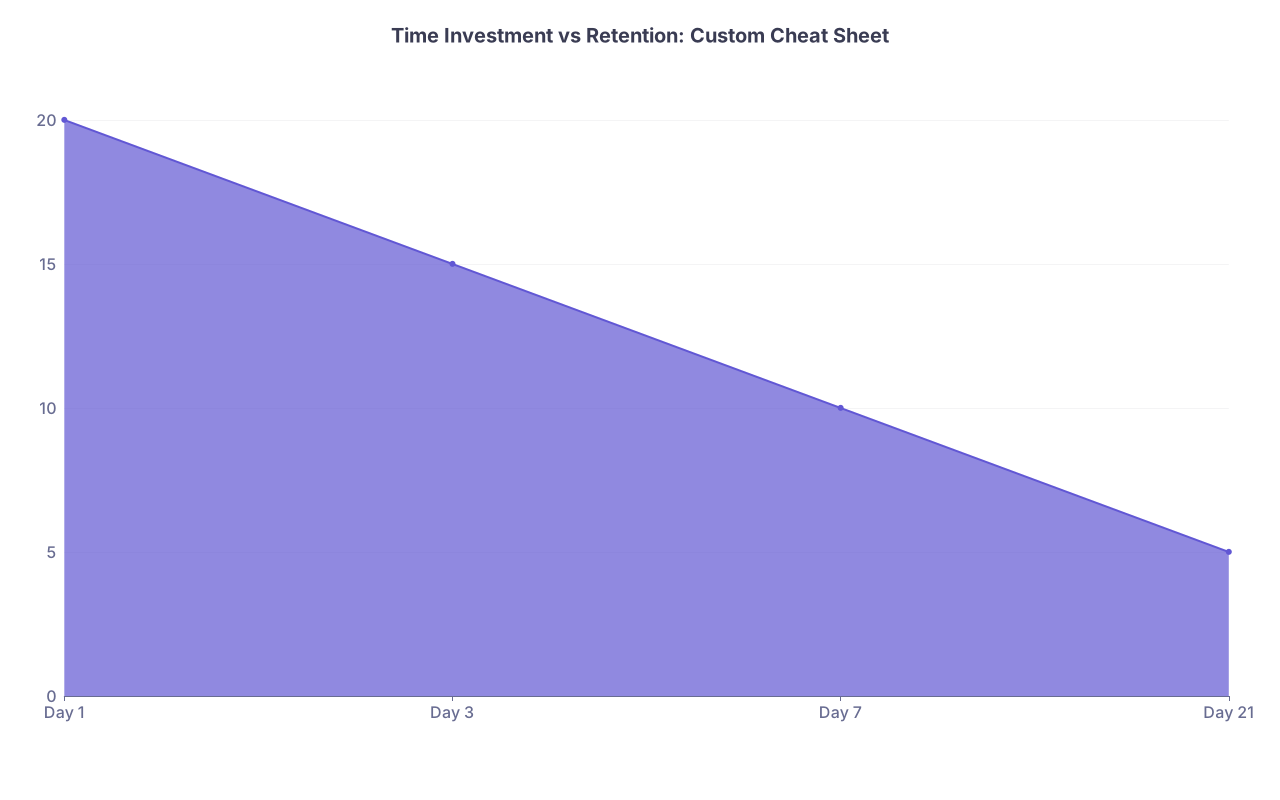
| Category | Value |
|---|---|
| Day 1 | 20 |
| Day 3 | 15 |
| Day 7 | 10 |
| Day 21 | 5 |
Twenty minutes now saves you a lost question every exam block later.
Wrapping It Up
Let me keep the closing simple.
Narrow beats broad. One case-based book (Case Files), one structured source (BRS or AMBOSS articles), and a Qbank-heavy plan (UWorld + AMBOSS) will outperform a stack of half-read texts every time.
Questions are the backbone. At least 70% of your pediatrics study time should be active questions, with reading driven by your misses. That same question work directly powers your Step 2 CK pediatrics performance.
Exploit overlap deliberately. Focus your limited reading and memorization on the pediatrics topics that hammer both shelf and CK: neonatology, respiratory, ID, cardiology, renal/rheum, vaccines, and development. Everything else is optional.
If your peds “book list” is longer than what fits easily in your backpack, it is probably already too big.