Only about 15–20% of USMLE-style questions show an actual radiologic image, yet those images disproportionally decide how “clinical” your score report looks.
If you freeze every time you see a CT slice or a grainy chest x‑ray, this is where you are silently leaking points.
Let me walk you through the radiology resources that actually move your score, how to use them fast, and what the exam is really testing when they throw you an image.
Why Radiology Recognition Matters For USMLE (More Than You Think)
Here’s the blunt truth: the exam does not care if you can “read films like a radiologist.” It cares whether you can:
- Recognize a pattern in 5–10 seconds
- Link that pattern to one or two key diagnoses
- Pair that diagnosis with management / next step / risk factor
That is it.
But most students study radiology backwards. They:
- Memorize 100+ buzzword images from random Google searches
- Scroll mindlessly through image atlases
- Never practice radiology under timed, question-based conditions
Then they are shocked when a basic pneumothorax or SAH CT feels foreign in the real exam interface.
The fix is not “more images.” It is the right type of images, under exam-like constraints, with ruthless pattern drilling.
What Types of Radiology Images USMLE Actually Loves
USMLE image patterns are boringly predictable. That is excellent news for you.
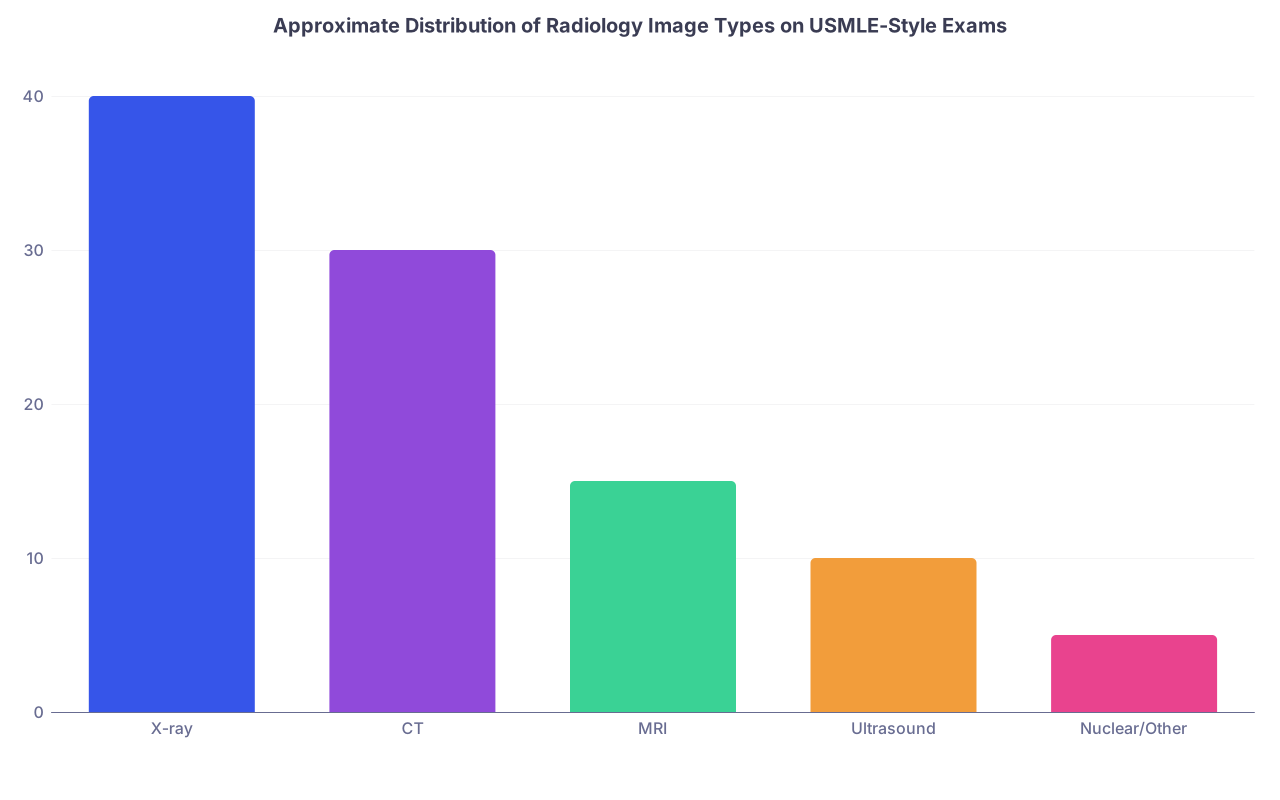
| Category | Value |
|---|---|
| X-ray | 40 |
| CT | 30 |
| MRI | 15 |
| Ultrasound | 10 |
| Nuclear/Other | 5 |
These are the buckets you must own cold:
Plain films (X‑ray)
- Chest: pneumothorax, pleural effusion, pneumonia pattern, CHF edema, COPD hyperinflation, tension pneumothorax, mediastinal widening (aortic dissection), hilar lymphadenopathy (sarcoid, lymphoma), foreign body aspiration in kids
- Abdomen: SBO vs large bowel obstruction, free air under diaphragm, calcified gallstones, renal stones
- MSK: fractures (Colles, scaphoid), osteomyelitis, osteoarthritis vs rheumatoid, bone tumors (sunburst, onion-skin, soap-bubble)
CT
- Head: epidural vs subdural vs subarachnoid vs intraparenchymal bleed, ischemic stroke (early vs late), hydrocephalus, mass effect/herniation
- Chest: PE CT angiogram basics, lung nodules/masses, ground-glass vs consolidation, bronchiectasis
- Abdomen/Pelvis: appendicitis, diverticulitis, pancreatitis, AAA, kidney stones
MRI
- Brain: demyelinating plaques (MS), pituitary tumor, acoustic neuroma, spinal cord compression, herniated disc, epidural abscess, AVN of femoral head
Ultrasound
- OB: ectopic pregnancy, IUP vs empty uterus, free fluid
- Abdomen: cholecystitis, biliary dilation, AAA screening, hydronephrosis
- DVT compression ultrasound basics
Nuclear and other
- HIDA scan pattern, V/Q mismatch, thyroid uptake, bone scan “hot spots”
USMLE radiology is not about subtlety. It is about “this is screaming obvious if you know what to look for.” Which means your resources should be curated around high-yield patterns and not obscure zebra films.
The Core Radiology Resources That Actually Work For USMLE
Let me break these down by function, not just by brand.
1. Interactive USMLE-Style Question Banks With Radiology
If you only fix one thing, fix this: you must see radiology in the same interface and context as the real exam.
The best tools for that:
- UWorld (Step 1 & 2 CK)
- AMBOSS
- NBME practice forms (especially newer ones)
Use them for radiology in a specific way:
- Do blocks in tutor mode when you are specifically hunting for image-based questions.
- Every time a radiologic image appears, force yourself to describe it aloud (or in your head) before looking at the options:
- “This is a frontal chest x‑ray. Trachea is deviated to the left. Right lung looks lucent with absent markings. There is a visible pleural line.” ⇒ Tension pneumothorax.
- After the question, screenshot or mark any image that felt even slightly uncertain. Make your own “radiology weak deck” (Anki or OneNote).
Most students glance at the image, scroll down to see if the explanation helps, and never build internal pattern memory. That is why they keep missing the same patterns.
2. Dedicated Radiology Pattern Atlases (But Only the Right Kind)
You need an image atlas, but not a 900-page radiology textbook. You need a USMLE-friendly, pattern-focused resource.
Three that consistently work:
LearningRadiology.com (by Herring)
- Free, clinically oriented, with “must-not-miss” patterns.
- Excellent for bread-and-butter chest, abdomen, and trauma films.
- Use: search specifically for topics you keep missing (“pneumothorax x ray,” “SBO x ray”), spend 10–15 minutes drilling multiple images of each.
Felson’s Principles of Chest Roentgenology (if you have more time)
- Slightly old school but beautifully systematic.
- High-yield if your school/emphasis is big on chest x‑ray interpretation.
- Use: skim the first ~5–7 chapters and focus on pattern recognition—do not get lost in pathology minutiae.
Core Radiology-Style Summaries
- Chapters or summary PDFs on “ER films you must not miss.”
- When you find a good one (some schools provide them), focus on: tension pneumo, free air, SBO, fractures, AAA, intracranial bleeds.
You are not trying to become a PGY‑2 radiology resident. You are building a mental “flash index” of 40–60 images that USMLE loves to recycle in some variation.
Resource Comparison: What To Use, When, And Why
| Resource | Best For | Phase |
|---|---|---|
| UWorld / AMBOSS | Exam-style image questions | Step 1 & 2 CK |
| NBME Forms | True exam look & difficulty | Last 4–8 weeks |
| LearningRadiology | Bread-and-butter patterns | Preclinical/early |
| Felson’s Chest | Systematic CXR skill | MS2–early MS3 |
| Anki (image decks) | Retention of key patterns | Whole prep |
If your time is limited (and it usually is), here’s the priority:
- UWorld/AMBOSS radiology questions
- LearningRadiology or a similar free atlas for your weak spots
- NBME practice tests for real-exam calibration
- Anki with embedded images from missed questions
Felson and full-blown radiology texts are only for those who are ahead of schedule or genuinely enjoy this.
Fast Pattern Recognition: How To Train Like You Actually Mean It
Most students stare at an image for 30 seconds, feel vaguely unsure, then just read the stem. That is passive. Useless.
You want active, systematic pattern recognition.
The 5–10 Second Radiology Triage Script
Every time you see a radiology image on a USMLE-like question, run a quick mental checklist:
What modality is this?
- X‑ray vs CT vs MRI vs US vs nuclear.
- If you cannot name the modality in 1 second, you are already behind.
What body region and plane?
- Chest vs abdomen vs head vs pelvis vs limb
- Axial vs coronal vs sagittal for CT/MRI
Where does your eye go first?
- Bright white abnormalities (blood, calcification, bone)
- Dark lucent areas (air where it should not be, e.g., free air, ptx)
- Symmetry problems (shift, edema, space-occupying lesions)
What is the one-line description?
Example:- “Biconvex lens-shaped extra-axial hyperdensity” ⇒ epidural
- “Crescent-shaped concave hyperdensity crossing suture lines” ⇒ subdural
- “Basal cisterns bright, blood in sulci” ⇒ SAH
What is the classic clinical link?
- Trauma with lucid interval? Epidural.
- Elderly on anticoagulation with gradual decline? Subdural.
- Sudden worst headache, nuchal rigidity? SAH.
You do not need perfect radiologic jargon. You need reliable descriptors that anchor a pattern to a diagnosis.
Radiology Resources USMLE Loves By Modality
Let me be more specific and resource-based now.
A. Chest X‑Ray: The Non-Negotiable Workhorse
If you are underprepared in any one radiology area, it is chest x‑ray.
High-yield patterns:
- Tension pneumothorax
- Simple pneumothorax
- Massive pleural effusion
- CHF pulmonary edema (bat-wing, Kerley B lines)
- Lobar pneumonia vs atypical
- Hyperinflation in COPD
- ARDS diffuse opacities
- Mediastinal widening (aortic dissection, lymphoma)
- TB upper lobe cavitary lesions
Best ways to master:
- LearningRadiology: “Chest X‑Ray Basics” and specific pathology pages
- UWorld/AMBOSS filters: search “pneumothorax,” “pleural effusion,” “CHF” and do every filtered question with images.
- Create a 1-page visual “CXR Hall of Fame” document with 10–15 images (screenshots) and minimal labels that you review once or twice a week.
B. Neuro CT & MRI: Bleeds, Masses, and Demyelination
USMLE does not ask you to appreciate tiny infarcts. It gives you big, loud pathology. You need to hit the usual suspects:
Key CT head patterns:
- Epidural: biconvex, lens-shaped, does not cross suture lines
- Subdural: crescent-shaped, crosses sutures but not midline falx
- Subarachnoid: blood in basal cisterns, sulci, circle of Willis area
- Intraparenchymal hemorrhage: intraparenchymal hyperdensity, hypertension or amyloid angiopathy context
- Early ischemia: subtle hypodensity, loss of gray-white differentiation
Key MRI brain patterns:
- MS: periventricular ovoid lesions, Dawson fingers
- Pituitary adenoma: sellar mass compressing optic chiasm
- Acoustic neuroma: CPA angle mass
- Spinal cord compression: narrowed canal, disc herniation, or epidural abscess
Resources:
- UWorld/AMBOSS—do every neuro image question
- Short neuroimaging review PDFs (many neurology departments have a 20–30 page primer—worth its weight in gold)
- LearningRadiology has a decent neuro section for basic bleeds
C. Abdominal Films and CT: Air, Fluid, and Inflammation
What the exam cares about:
- Free air under diaphragm on erect CXR ⇒ perforated viscus
- Dilated small bowel loops with air-fluid levels ⇒ SBO
- Thumbprinting in colitis/ischemia
- CT for appendicitis: enlarged appendix, fat stranding, appendicolith
- CT for diverticulitis: sigmoid thickening, pericolonic fat stranding
- Pancreatitis: enlarged pancreas, peripancreatic fat stranding, maybe pseudocyst
- AAA: enlarged aorta >3 cm, concerning if >5–5.5 cm or rapidly expanding
Resources to rapidly get competent:
- LearningRadiology abdominal series
- Any surgical clerkship “don’t-miss” imaging handouts
- UWorld surgery + GI sections with images
D. OB/Gyn and Emergency Ultrasound
USMLE uses ultrasound in highly stereotyped ways:
- Positive pregnancy test + pain + adnexal mass + empty uterus on US ⇒ ectopic pregnancy
- Gallstones with thickened GB wall and pericholecystic fluid ⇒ acute cholecystitis
- Dilated renal pelvis/calyces ⇒ hydronephrosis (stone, obstruction)
- DVT exam: non-compressible venous segment
Here, you do not need a full ultrasound course. You need to see a handful of prototypical images until they are burned into memory.
Best sources:
- AMBOSS/online OB & EM ultrasound teaching pages (many EM residencies host FOAMed content with minimal text and many images)
- UWorld OB/Gyn and renal questions with ultrasound images
- For step 2 CK, some students use short YouTube clips from reputable EM ultrasound educators—but keep that controlled; do not get lost for hours.
E. Nuclear Medicine and Miscellaneous
USMLE uses these to test associations, not interpretive nuance:
- HIDA scan: non-visualization of gallbladder ⇒ acute cholecystitis
- V/Q scan: mismatch with normal CXR ⇒ PE in pregnant or contrast-avoidant patient
- Bone scan: multiple hot spots ⇒ metastatic disease
- Thyroid uptake: diffuse vs nodular vs cold nodule pattern
A quick 30–40 minute focused review here near the end of your study period is enough for most.
How To Integrate Radiology Resources Into Your Study Schedule
The worst thing you can do is “radiology week” once and then forget it. Radiology skills decay fast if you do not see images repeatedly.
Better pattern:
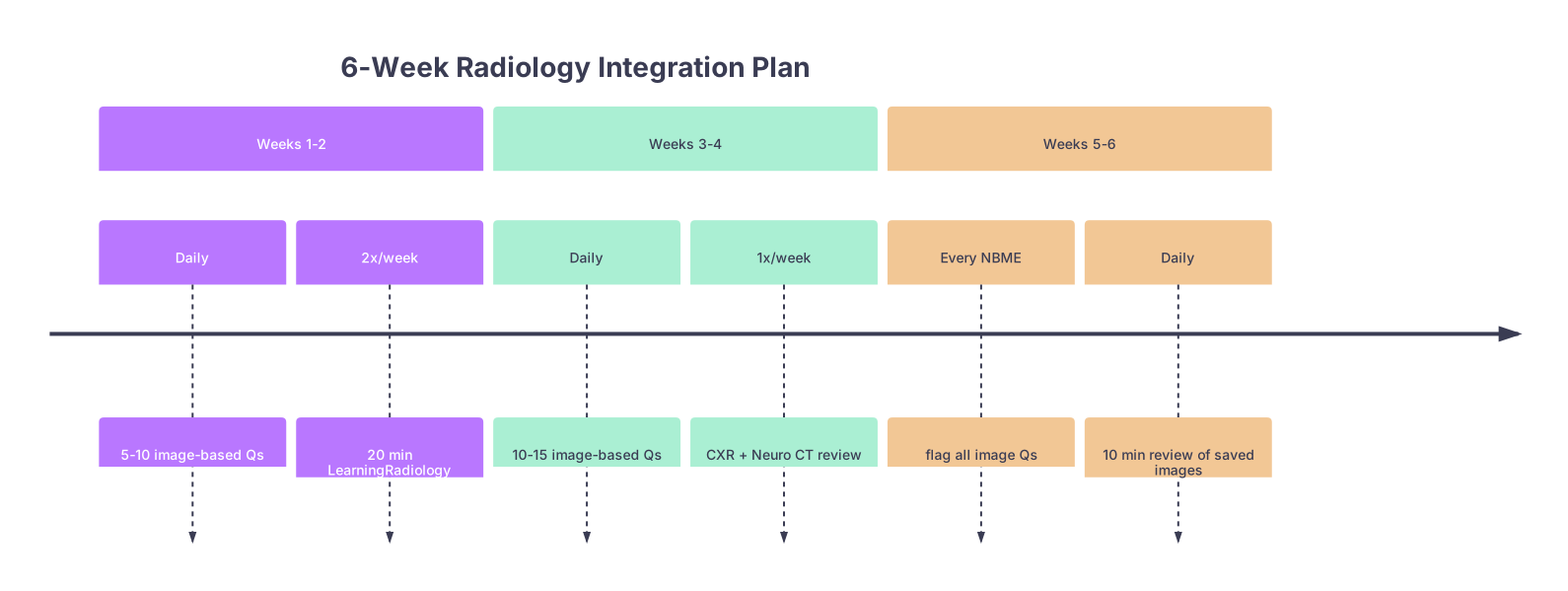
| Period | Event |
|---|---|
| Weeks 1-2 - Daily | 5-10 image-based Qs |
| Weeks 1-2 - 2x/week | 20 min LearningRadiology |
| Weeks 3-4 - Daily | 10-15 image-based Qs |
| Weeks 3-4 - 1x/week | CXR + Neuro CT review |
| Weeks 5-6 - Every NBME | flag all image Qs |
| Weeks 5-6 - Daily | 10 min review of saved images |
Concrete breakdown:
Daily during main prep:
- Do 5–15 image-based questions (from UWorld/AMBOSS).
- After the block, quickly scroll back and re-view each image, verbalizing what it shows.
Twice weekly (early phase):
- 15–20 minutes of LearningRadiology or equivalent, targeted to one topic (CXR one day, abdominal films another).
Last 2–3 weeks:
- Every NBME: after you finish, go back and only look at the image questions you got wrong or guessed.
- Save those images and review them repeatedly.
This is how you build reflexes, not just vague familiarity.
Building Your Own High-Yield Radiology Deck (Even If You Hate Anki)
You do not need a massive pre-made radiology deck. In fact, most are bloated.
What works far better:
- Every time you miss an image-based question badly, capture the image (screenshot or export).
- Make a simple flashcard:
- Front: the image only (no text)
- Back:
- 1-line description (“Biconvex hyperdense lesion between skull and brain”)
- Diagnosis (“Epidural hematoma”)
- Key association (“Middle meningeal artery tear, temporal bone fracture, lucid interval”)
Review these briefly 3–4 times a week.
You will end up with 50–150 cards that are 100% custom-tailored to your blind spots. That is exponentially more efficient than sifting through 2,000 generic radiology cards.
Common Mistakes Students Make With Radiology Prep
I have watched students repeat the same mistakes year after year:
Over-focusing on obscure patterns
They learn every interstitial lung disease pattern but cannot confidently call a basic tension pneumothorax. USMLE punishes that.Passive scrolling
Looking at atlases without forcing themselves to name what they see. If you are not actively describing the image, you are not learning.Never training under time
Radiology on exam day still sits inside a 90-second-per-question world. If you spend 60 seconds on the image alone, you are in trouble.Ignoring modality recognition
If CT vs MRI vs US is not automatic, half the stem becomes noise.Saving radiology for “later”
They tell themselves they will do it closer to the exam. They never do. Integration from day one of serious prep is smarter.
Quick Specialty-Specific Angles (For Clerkships and Step 2 CK)
Radiology emphasis shifts slightly on CK and clerkship shelves:
- Internal Medicine / Step 2 CK
- Chest imaging: CHF, COPD, pneumonia, PE CT
- Abdominal CT: pancreatitis, appendicitis, diverticulitis
- V/Q scans and DVT US
- Surgery
- Abdominal obstruction, perforation, free air
- Trauma CTs
- Post-op complications (ileus vs SBO, abscess)
- OB/Gyn
- OB ultrasound and ectopic pregnancy
- US for ovarian torsion vs cyst vs normal
- Pediatrics
- Intussusception (target sign on US), foreign body aspiration CXR, croup vs epiglottitis imaging patterns
Strategy: for each clerkship, do a 30–60 minute mini-radiology block specifically for that rotation at the beginning. It pays off all block.
A Sample One-Week Mini-Plan if You Are Behind on Radiology
You are three weeks out from your exam, realize your radiology is weak, and need a rapid salvage plan. Here is a tight one-week fix:
Day 1–2: Chest & Basic Abdomen
- 40–60 UWorld/AMBOSS questions with CXR/abdominal films filtered (spread across 2 days).
- 30–40 minutes LearningRadiology chest & abdomen patterns.
Day 3–4: Neuro + Trauma
- 40–60 neuro and trauma questions with CT/MRI.
- 30 minutes going through a neuroimaging primer (bleeds and strokes).
Day 5: Ultrasound & Nuclear
- 20–30 OB, renal, hepatobiliary, and vascular ultrasound questions.
- 20–30 minutes of targeted review (ectopic, cholecystitis, DVT, AAA US).
Day 6–7: Consolidation
- Do a mixed block of 40–80 questions; flag every image-based question.
- Build or update your radiology Anki/flashcards from any misses.
- Short daily 15-minute rapid scroll of your saved images.
Not elegant. But very effective in a crunch.
FAQs
1. Do I need a full radiology textbook for USMLE prep?
No. For USMLE Step 1 and Step 2 CK, a full radiology textbook is overkill and a time sink. You need a pattern-focused atlas (like LearningRadiology) plus radiology-rich question banks (UWorld/AMBOSS) and NBME practice forms. A full textbook only makes sense if you genuinely enjoy radiology or are far ahead in your schedule.
2. How many radiology images should I realistically aim to see before my exam?
You do not need to count images obsessively, but a rough benchmark: several hundred. If you complete UWorld/AMBOSS thoroughly and pay attention to every radiology question, plus do a few short atlas sessions weekly, you will easily hit that. The key metric is not raw count; it is whether the classic patterns (pneumothorax, SAH, SBO, epidural, effusion, CHF) feel instantly recognizable.
3. Is it worth buying a separate radiology question bank?
Usually no, not for most students. The main USMLE-oriented qbanks already include plenty of images. A dedicated radiology qbank becomes useful only if:
- You are strongly interested in radiology as a career, or
- You have chronically weak radiology skills even after standard prep.
For pure score gains on USMLE, I would first max out UWorld/AMBOSS and NBME before considering extra paid radiology content.
4. How should I review radiology images when I am exhausted and low on focus?
Keep it short and visual. In low-energy periods, skip long explanations and instead do a 10–15 minute “image scroll”: open your saved radiology deck or screenshots and force yourself to name the diagnosis and one key feature for each image. No timers, no full questions. Just pattern–name–feature. This maintains your recognition circuits without heavy cognitive load.
5. I am terrible at cross-sectional anatomy for CT/MRI. Any quick fix?
You do not need full anatomy lab-level mastery. Focus on:
- Recognizing ventricles, midline, and major cisterns in brain CT
- Understanding basic chest CT levels (aortic arch, carina, heart chambers)
- Identifying liver, spleen, kidneys, aorta, and IVC on axial abdomen
Short targeted cross-sectional anatomy PDFs or 1–2 high-yield YouTube videos from reputable sources can patch this in a day or two. Then reinforce by carefully inspecting every CT in your qbank.
6. How close are NBME radiology images to the real exam?
NBME forms are the closest you will see. Image quality, cropping, and “obviousness” are extremely similar to the live exam. If you can consistently interpret most NBME radiology questions correctly, you are in safe territory. When you miss one on an NBME, treat that image as high-priority for your review deck—because there is a real chance you will see an analogous pattern on test day.
Key points, so you leave with clarity:
- USMLE radiology is about rapid, high-yield pattern recognition, not deep radiology training.
- The most efficient prep is image-rich qbanks + a lean atlas + your own custom image deck.
- Integrate radiology daily in small doses, not once in a huge, forgettable cram session.