
The panic around “old edition” board books is overblown—and often wrong.
I’ve watched students burn money and sanity sprinting to buy the brand‑new edition of every resource, convinced last year’s version is basically trash. It is not. Most of the time, “new edition” means “marginal changes plus new cover,” not “your old book will fail Step 1 for you.”
Let’s dismantle the superstition and talk about what actually changes, what actually matters, and when “old edition” really is a problem.
The Myth: “If It’s Not the Latest Edition, It’s Useless”
You’ve probably heard some version of this:
“Do NOT use the 2021 First Aid. Step changed. You’ll get wrecked.”
Or:
“Only use the newest Pathoma / BRS / UWorld / name‑your‑idol. Everything else is outdated.”
This mindset is mostly marketing dressed up as “advice.”
Here’s the uncomfortable truth:
For board review books, the vast majority of core content does not change year to year because human physiology, anatomy, and basic pathology do not change year to year. Hypertension is still hypertension. Starling forces are still Starling forces.
What does change:
- Emphasis: what gets tested more or less.
- Formatting and structure: tables, mnemonics, organization.
- A subset of details: guidelines, drug recommendations, terminology, scoring schemas.
And those changes are not evenly important across all book types or all exams.
Let me put numbers to this.
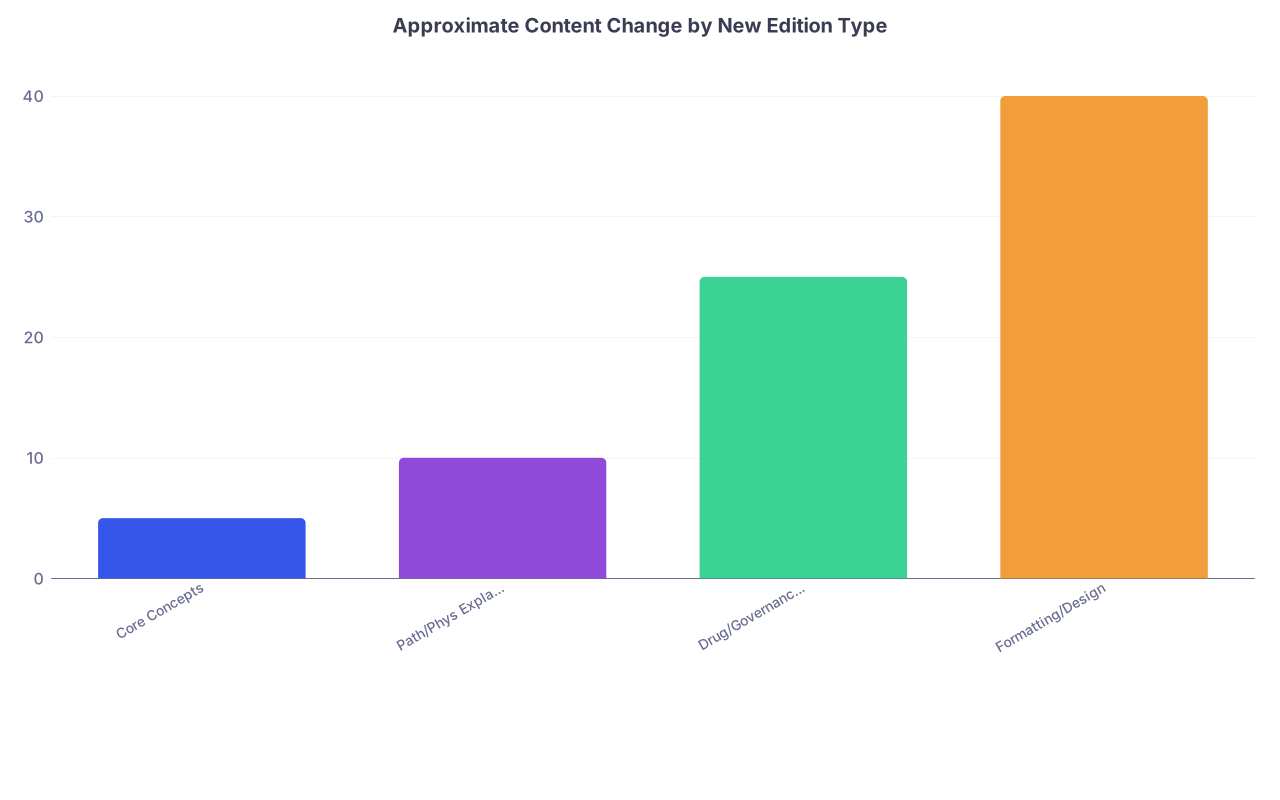
| Category | Value |
|---|---|
| Core Concepts | 5 |
| Path/Phys Explanations | 10 |
| Drug/Governance Details | 25 |
| Formatting/Design | 40 |
That’s not a formal meta‑analysis; it’s reality from going page‑by‑page across editions over several years. You see small tweaks in explanation clarity, a chunk of updates in drugs/guidelines, and a lot of cosmetic/formatting touch‑ups.
So no, the 2‑year‑old edition is not some relic from the pre‑antibiotic era.
What Actually Changes From Edition to Edition
Let’s be specific, because hand‑waving is how myths survive.
1. First Aid–type “Big Compendium” Books
Think First Aid for the USMLE Step 1 / Step 2 CK, Boards & Beyond printed notes, or any central board compendium.
What actually changes year to year?
Corrected errors and typos.
Yes, these exist. Sometimes they’re trivial. Occasionally they’re big—wrong enzyme, wrong inheritance pattern. These are usually documented in errata.Reorganized content.
Topics get shifted between chapters, tables merged or split, mnemonics swapped out. Feels new, but 90%+ of the underlying fact set is identical.Updated drug lists and guidelines.
New first‑line hypertension recommendations, new anticoagulant choices, changes in sepsis management, updated diabetes algorithms. These are the areas where old editions age fastest.Added “buzzword” or “exam‑style” pearls.
They look huge at first glance (“updated for new exam style!”), but they’re usually small nudges in emphasis rather than brand‑new concepts.
When I’ve compared a 4‑year gap in First Aid editions for Step 1, the overwhelming majority of text was word‑for‑word identical. Newer edition: some reformatting, a handful of new images, some reorganized tables, and maybe a few pages’ worth of truly new or significantly edited content.
2. Subject Review Books (BRS, Rapid Review, Costanzo, etc.)
These live in the middle—more detailed than First Aid but still “review.”
Changes here typically involve:
- Better wording and explanations of the same physiology or pathology.
- Occasionally new diagrams or revised figures.
- Very small content additions: a disease gets fleshed out, or a clinical vignette is added.
- Question sets at the end of chapters might get reshuffled with some items swapped.
A 1–2 edition difference? Usually negligible from a content standpoint.
A 10‑year difference? Now you start to see real shifts—especially in pharm, infectious disease, oncology.
3. Question Banks and Case Books
This is the category where “old” hurts the most.
Qbanks (UWorld, AMBOSS, etc.).
The NBME style evolves. Qbanks track that. Old qbanks miss evolving question style and content emphasis. A 5‑year‑old Qbank CD? That’s like studying for the wrong exam.Case books (e.g., Case Files).
Newer editions update guidelines (e.g., ACS, ACC/AHA, IDSA) and diagnostic sequences. Imaging vs. no imaging, biopsy vs. excision, first‑line vs. second‑line therapy—these change.
I’m much more critical here: using a heavily outdated Qbank or guideline‑driven case book is an actual disadvantage.
4. Guideline‑Heavy Content: Pharm, ID, Oncology, OB/GYN
Fields where practice really does change quickly:
- New cancer regimens.
- Evolving antibiotic resistance patterns and recommended regimens.
- Obstetric and gynecologic screening/treatment protocols.
- Cardiology guidelines (statin thresholds, ACS management, etc.).
Here, a book that’s 7–10 years old is not just “suboptimal”—it can be wrong relative to current exam answers.
When an “Old Edition” Is Totally Fine vs Actually Risky
Let’s do a sane breakdown. Not everything needs the newest version.
| Resource Type | 1–3 Years Old | 4–7 Years Old | 8+ Years Old |
|---|---|---|---|
| Anatomy / Neuroanatomy review | Safe | Usually safe | Questionable |
| Physiology review (e.g., BRS) | Safe | Usually safe | Questionable |
| Pathology (e.g., Pathoma) | Safe | Usually safe | Questionable |
| Pharm / ID / Oncology text | Use caution | Risky | Avoid |
| OB/GYN / IM guideline heavy | Use caution | Risky | Avoid |
| First Aid–style compendium | Safe | Use caution | Risky |
| Qbanks / case‑based resources | Use caution | Risky | Avoid |
Is this absolute? No. But it’s a far more accurate starting point than the lazy “must be latest edition” rule that gets repeated in group chats.
The Real Risk: Mismatch With the Exam, Not the Year on the Cover
The boards don’t change randomly. They shift in:
- Emphasis: more ethics, more multi‑step reasoning, fewer pure recall “memorize this random fact” questions.
- Guidelines: what’s considered first‑line/standard of care.
- Style: more long stems, imaging incorporated, lab trends rather than single snapshots.
So what’s dangerous about an old edition is not that your Krebs cycle diagram is from 2016. It’s when the decision‑making framework in the book no longer matches what exam writers expect.
For example:
- OB/GYN: the sequence of management for abnormal Pap results has changed over the years. An old algorithm can lead you to the “wrong” next step relative to the exam key.
- Anticoagulation: the role of DOACs vs warfarin, bridging, and perioperative management has evolved.
- Sepsis and shock: resuscitation targets and early management bundles have shifted.
Those are the high‑yield failure points of old resources. Not the fact that the book calls an ependymoma “perivascular pseudorosettes” instead of spending another line describing them.
How to Tell If Your Old Edition Is Good Enough (Without Guessing)
Here’s the method I’ve watched actually work for students who do not want to go broke chasing every shiny cover.
Step 1: Identify What You’re Using It For
Be honest: is this your primary resource or a secondary supplement?
- Primary for Step 2 CK management questions? I’m stricter.
- Secondary for brushing up renal phys? I’m relaxed.
Primary + guideline‑heavy + very old = bad combo.
Secondary + basic concept + moderately old = totally fine.
Step 2: Check How Far the Exam Has Shifted
Look at the official exam content descriptions and “changes” over time. NBME, USMLE, and specialty boards often publish updated outlines or sample questions.

| Step | Description |
|---|---|
| Step 1 | Identify resource & edition year |
| Step 2 | Compare with recent guidelines |
| Step 3 | Compare with newer TOC/sample pages |
| Step 4 | Use only as secondary or replace |
| Step 5 | Safe as primary with supplement |
| Step 6 | Guideline-heavy? |
| Step 7 | Major discrepancies? |
You don’t need deep research. Skim:
- New NBME sample questions.
- Updated official outlines (e.g., USMLE content description PDFs).
- Big guideline announcements (e.g., ADA, ACC/AHA, ACOG, IDSA).
If there’s a clear shift—more ethics, more practice‑based questions—accept that your old edition might under‑represent those areas. But that’s fixable with targeted supplementation, not a wholesale burn‑and‑buy.
Step 3: Cross‑Check With a Single Current Source
Here’s the move that almost nobody bothers with but solves 90% of the anxiety:
Use one current, trusted source as your “reality anchor”:
- A current Qbank (UWorld, AMBOSS).
- Or the newest First Aid / Boards & Beyond lectures.
- Or current specialty guidelines (for Step 2/3 or shelf exams).
Then:
- Study from your older book.
- Do questions from the current source.
- Every time your book’s advice conflicts with the question explanations, flag it.
After a week or two, you’ll see patterns:
- If 95% aligns and the mismatches are all pharm/guideline details—you’ve just found what to patch.
- If entire approaches to management are consistently off—your resource is too dated as a primary guide.
This is how you use data instead of fear.
The Money and Stress Angle Nobody Talks About
I’ve seen MS2s drop hundreds of dollars they didn’t have because a classmate said, “Only use the 2024 edition, trust me.” They end up with four half‑read books, all “current,” and mediocre performance.
Content age isn’t the main reason people underperform on boards. Common actual reasons:
- Fragmented resources: three different review books started, none finished.
- Shallow passes: “I read it once, quickly” and called it done.
- Not enough question practice with active review.
- Weak schedule consistency.
Using a 2‑year‑old book thoroughly and pairing it with a modern Qbank beats hoarding six brand‑new resources that you barely touch.
To put perspective on the cost vs benefit:
, Reviewing explanations deeply](https://cdn.residencyadvisor.com/images/articles_svg/chart-relative-impact-on-score-new-edition-vs-better-usa-2414.svg "Relative Impact on Score: New Edition vs Better Usage")
| Category | Value |
|---|---|
| Upgrading to latest edition | 5 |
| Using Qbank thoroughly | 30 |
| [Doing spaced repetition](https://residencyadvisor.com/resources/exam-prep-resources/myth-more-anki-decks-equal-better-recall-on-test-day) | 25 |
| Reviewing explanations deeply | 30 |
Again, approximate, but directionally correct. The marginal gain from “2024 vs 2022 edition” is tiny compared with actually doing the work properly.
A Few Concrete Scenarios (And What I’d Actually Do)
Scenario 1: Step 1, You Have First Aid 2021, Exam in 2025
Modern Step 1 is pass/fail and more conceptual. You’re worried 2021 is “too old.”
What I’d tell you:
- Use First Aid 2021 as your fact anchor. The cell bio, path, phys, micro—mostly fine.
- Pair it with a fully up‑to‑date Qbank. That’s non‑negotiable.
- For pharm or anything that feels “practice guideline” flavored, trust Qbank explanations over the old book.
- If money is tight, do not “upgrade” First Aid. Spend on UWorld/AMBOSS instead.
Scenario 2: Step 2 CK, Case Files IM 10 Years Old, No Other Books
This is where I’d say: don’t lean on it as primary.
- Use it, at most, as extra reading for classic cases.
- Rely on current Qbank + current guidelines‑aligned resources for management strategy.
- If you can only afford one book, I’d rather you get a more recent Step 2 resource and treat the ancient Case Files as optional reading.
Scenario 3: MS1 Physiology, BRS Physiology 3 Editions Old
Zero hesitation: use it.
Physiology doesn’t do radical yearly updates. Renin‑angiotensin system is not getting reinvented out from under you. Worst case: some figures are less polished.
How to Be Smart, Not Scared, About Editions
Stop treating “latest edition” as synonymous with “high yield” and “old edition” as synonymous with “poison.” That’s lazy thinking, and it helps publishers more than it helps you.
A rational approach looks like this:
- Use older editions confidently for stable basics: anatomy, physiology, core pathology.
- Be cautious with older pharm, ID, oncology, OB/GYN, and internal medicine management.
- Make sure something in your arsenal is current and question‑based (Qbank or NBME materials).
- Let real mismatches between your resource and modern questions guide whether you upgrade—not FOMO, not a Reddit thread.
Key points to walk away with:
- “Old edition = useless” is a myth; for most foundational content, a 1–3‑year‑old book is essentially equivalent to the new one if you pair it with current questions.
- The real danger isn’t the year printed on the spine; it’s outdated management algorithms and guidelines in pharm, ID, oncology, OB/GYN, and IM—those you should update aggressively.
- Your score will move far more from how you use resources (especially Qbanks) than from obsessing over having the newest cover of every board review book.