
You are three weeks out from a big exam. Could be NBME subject, could be a high‑stakes school OSCE, could be Step 2. Your UWorld stats look decent overall… except for one annoying cluster: ethics, communication, behavioral science. Every practice block, the same thing: “patient autonomy violated,” “inappropriate disclosure,” “incorrect next step in management (non‑clinical).”
You have maybe 10–14 days of real, focused study time left. You are not going to read 400 pages of ethics policy or a full psych text. You need narrow but powerful resources that hit the way test writers think.
That is exactly what we are going to build: a tight, targeted ethics + behavioral science toolkit that punches way above its size.
1. What Exams Actually Test in Ethics & Behavioral Science
Let me be blunt. Students overcomplicate this section and then get burned by the basics.
Ethics and behavioral science on US-style exams (NBME, Step 1/2, school comps) are not testing whether you are a philosopher. They are testing whether:
- You recognize the dominant bioethical principles in play.
- You know the “NBME-correct” script for communication and professionalism.
- You can apply a few specific behavioral science frameworks to vignettes.
That breaks down into fairly repeatable buckets:
Core ethics:
- Autonomy, beneficence, nonmaleficence, justice
- Truth telling, confidentiality, informed consent, capacity
- Surrogate decision-making and advance directives
- End-of-life care (DNR/DNI, comfort vs curative)
- Professional boundaries (gifts, social media, dating patients, dual relationships)
- Reporting duties (child abuse, elder abuse, threats to others, impaired colleagues)
Communication / professionalism:
- Breaking bad news
- Handling angry or nonadherent patients
- Cultural sensitivity vs enabling harmful practices
- Disclosure of medical errors
- Conflicts of interest
Behavioral science:
- Study design, bias, confounding, effect modification
- Screening test characteristics: sensitivity, specificity, PPV, NPV, likelihood ratios
- Basic epidemiologic measures: incidence, prevalence, relative risk, odds ratio, hazard
- Health behavior models (Transtheoretical Model, Health Belief Model) – usually Step 1 / preclinical
- Simple stats interpretation (confidence intervals, p‑values, Type I/II error) – border between “stats” and “behavioral”
That is the real test scope. Notice what is not here: you rarely need long, narrative textbooks or full “ethics in medicine” courses to score very high. You need:
- Question styles and patterns
- Clean decision frameworks
- A little bit of memorized language that “sounds like the NBME”
2. The Core Problem: Too Much Fluff, Not Enough Pattern Recognition
Most students do one of two things:
- Ignore ethics / behavioral science until 1–2 weeks before the exam, then panic.
- Over-commit to big, vague resources (long ethics chapters, school handouts) that never translate cleanly into multiple‑choice questions.
The smart move is neither.
You want a small number of high-yield resources that:
- Mirror NBME question style.
- Are oriented toward “what is the best next step?” and “which principle is this?”.
- Give you “phrases” and patterns you can recognize 6 months from now.
Let me break down the major resource categories and how to use them, then I will give you a tight, practical study plan.
3. Narrow but Powerful: The Resource Shortlist
I am going to give you specific resources. Not 20 of them. A short list that actually works.
3.1 Question Banks (Non‑negotiable)
If you only used one “resource type” for ethics and behavioral science, it should be questions. Real exam performance is about pattern recognition and decision‑making under exam pressure, not reciting definitions.
You should hit these:
-
- Ethics, communication, and behavioral science questions are dense, well‑explained, and very close to NBME framing.
- For Step 2, the “Professionalism, Systems‑Based Practice, Communication” questions are gold.
- Your job is not just to answer them; your job is to:
- Tag them as “ethics/behavioral.”
- Re‑do the missed ones weekly.
- Extract common answer language (“I’m sorry that happened,” “I understand this is difficult,” “Let us involve your mother in this discussion if that’s your wish.”)
NBME practice forms (Step 1, Step 2, subject exams):
- These tell you how the actual test writers phrase things.
- Ethics questions on NBME are often shorter and more subtle than UWorld.
- Over time you see the same moves: what they reward, what they punish.
| Category | Value |
|---|---|
| Preclinical Block | 80 |
| Shelf Exam | 120 |
| Step 1 | 150 |
| Step 2 CK | 200 |
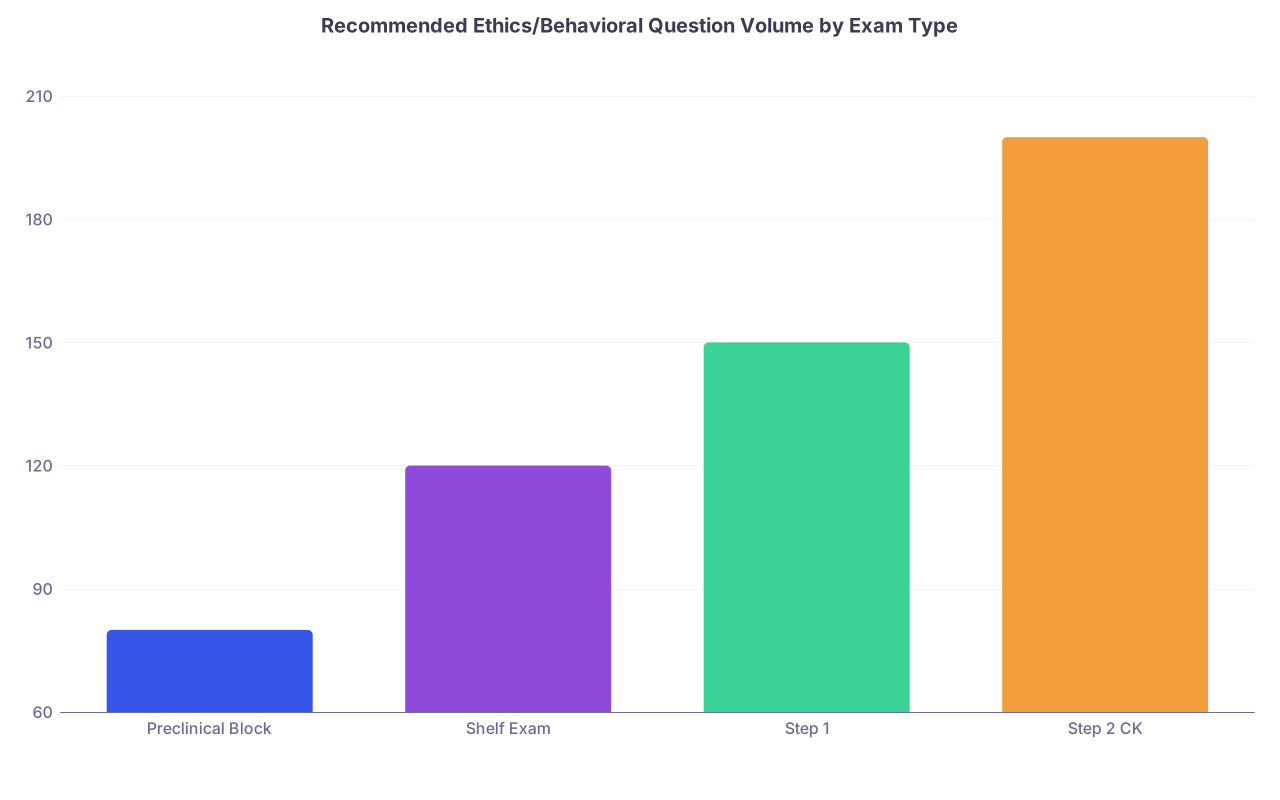
Minimum targets that I like:
- Preclinical block / in‑course exam: ~80 dedicated ethics/behavioral questions
- Shelf exam: 120–150
- Step 1: 150+
- Step 2 CK: 200+ (spread out; not all in one brutal week)
You do not need a separate, “ethics-only” Qbank if you use UWorld + NBME properly. Specialty add-ons (AMBOSS, Kaplan) can help if you are weak, but they are secondary.
3.2 Concise Ethics Framework Resources
You want something that distills core principles and gives you decision trees. Two solid, narrow options:
HY Ethics PDFs / Notes from reputable sources
Many schools have a 10–20 page ethics handout written by someone who actually knows exam patterns. If your school’s is garbage (and many are), look for:- A Step 2–oriented ethics summary (often circulated as “HY Ethics” or “Professionalism HY”).
- Criteria:
- 30 pages or less.
- Lots of case examples.
- Clear “best answer” explanations.
USMLE‑style concise references
Some commercial courses (e.g., Online MedEd, Boards & Beyond, etc.) have a small ethics/professionalism section. I do not like using them as primary, but as quick review:- Watch 1–2 hours, max.
- Immediately follow each short video with 10–15 UWorld questions on that specific topic.
Key idea: content exposure must be welded to question practice. Reading a list of ethical principles alone is almost useless.
3.3 Behavioral Science / Biostats Mini‑Resources
This is where a lot of students lose points because they try to brute‑force an entire stats textbook.
Behavioral science for exam purposes mostly reduces to:
- Biostatistics (core formulas and interpretation).
- Study design + bias types.
- A few behavioral models.
Narrow, high-yield options:
A dedicated biostats/epidemiology chapter or booklet (20–40 pages):
- Goals:
- Memorize core formulas.
- Be able to interpret simple graphs.
- Recognize study designs and their biases.
- Goals:
Video mini‑series:
- Boards & Beyond or similar has short videos on:
- Sensitivity/specificity, likelihood ratios, ROC curves
- Cohort vs case-control vs cross-sectional vs RCT
- Types of bias (selection, recall, information, lead-time, length-time)
- Watch at 1.25–1.5x speed. Then do questions.
- Boards & Beyond or similar has short videos on:
An “equations/formulas” one‑pager:
- Sensitivity, specificity, PPV, NPV
- Odds ratio, relative risk, attributable risk, number needed to treat/harm
- Type I/II error, power, confidence interval interpretation
You can compress the entire behavioral/biostats content into 2–4 pages of annotated formulas and 1–2 hours of practice questions every few days.
| Concept | Core Formula |
|---|---|
| Sensitivity | TP / (TP + FN) |
| Specificity | TN / (TN + FP) |
| PPV | TP / (TP + FP) |
| NPV | TN / (TN + FN) |
| Relative Risk | [a/(a+b)] / [c/(c+d)] |
| Odds Ratio | (a/c) / (b/d) = ad / bc |
If you do not have these formulas instantly accessible under time pressure, you will bleed unnecessary points.
3.4 OSCE / Communication-Skills Oriented Resources
For schools with OSCEs or clinical skills exams, you need the behavioral side of ethics: how you talk, not just what you think.
Two useful, narrow things:
- SPIKES or similar frameworks for breaking bad news and tough conversations.
- One or two short guides to “phrases that help”:
- “Tell me more about…” vs “Why did you…”
- “I can see this is very upsetting” vs “You should not feel that way.”
- Explicit invitation for questions.
You do not need a 200‑page communication textbook. You need 2–3 pages of scripts that you actually say out loud 3–4 times so they come naturally.
4. How to Turn Narrow Resources Into Real Exam Points
Resources do not help if you just hoard them. Let me outline specific workflows. No fluff.
4.1 Build a Micro‑Notebook for Ethics & Behavioral
You need a single, small place where all your high‑yield patterns live. Not twenty scattered screenshots.
I usually recommend:
- 4–8 pages (digital or paper).
- Divided into:
- Ethics principles + patterns
- Specific “best-answer” phrases
- Behavioral science formulas and key ideas
- Common traps and wrong-answer patterns
Example layout:
Page 1–2: Core ethics principles and “trigger phrases”
Page 3–4: Communication scripts (bad news, nonadherence, angry patient, requests for inappropriate things)
Page 5–6: Behavioral/biostats formulas + quick note on types of bias
Page 7–8: Personal error log – screenshots / rewrites of questions you missed
You should be able to flip this notebook in 20–30 minutes for a rapid pre‑exam review.
4.2 Convert Question Bank Explanations Into Patterns
This is the step almost everyone skips.
You do a UWorld question:
A patient with terminal cancer asks you, “Doctor, am I going to die?” You answer: “Let us stay positive and focus on treatment.” Question: Which ethical principle has been violated?
You read the explanation: failure of truth‑telling, disrespect for autonomy, lack of appropriate information disclosure.
Most students nod, click “Next,” and forget it.
What you should do instead:
- Pull one clear rule into your micro‑notebook:
- “When a competent patient directly asks about prognosis, answer honestly using clear language, while being empathetic. Avoid false reassurance or deflection.”
- Note any phrases the explanation used that felt very “NBME”:
- “Provide information in a direct but compassionate manner.”
- “Offer to answer additional questions from the patient and family.”
Do that for ~30–40 questions and you suddenly see that 70% of ethics questions are small variations on maybe 10 recurring scenarios.
4.3 Use Simple Decision Trees for Classic Scenarios
Ethics lends itself well to very simple flowcharts. For example:
- Does the patient have decision‑making capacity?
- Yes → Patient decides, even if family disagrees (unless court order).
- No → Use advance directive; if none, go to legally authorized surrogate.
- Is there an immediate risk to others (e.g., threats, communicable disease, abuse)?
- Yes → You likely have a duty to break confidentiality and report.
- No → Maintain confidentiality.
Here is how this looks in a structured framework:

| Step | Description |
|---|---|
| Step 1 | Patient Scenario |
| Step 2 | May/Should Breach Confidentiality and Report |
| Step 3 | Respect Autonomy and Confidentiality |
| Step 4 | Follow Advance Directive |
| Step 5 | Use Legal Surrogate Decision Maker |
| Step 6 | Has Capacity? |
| Step 7 | Immediate Risk to Others? |
| Step 8 | Advance Directive? |
You can sketch 4–5 of these:
- Capacity and surrogates
- Confidentiality and reporting
- End-of-life decisions (DNR vs DNI vs comfort measures vs full code)
- Conflicts of interest (gifts, pharmaceutical reps, accepting discounts, etc.)
Then drill them enough times that you see the flow in your head when reading the vignette.
4.4 Behavioral Science: Do Not Just Memorize, Interpret
For behavioral/biostats, most exams are not asking, “What is the formula for PPV?” They are asking:
- “Given this graph / data, which statement is true?”
- “Which change will increase PPV?”
- “Which bias is present here?”
Best way to practice:
- Work through 5–10 stats questions in a row.
- For each one:
- Write (from memory) the formula or rule that applies.
- Explain to yourself in plain language what that formula really means.
- Identify why each wrong answer is wrong:
- Confuses association with causation
- Mislabels study design
- Mixes up Type I vs Type II error
That meta‑cognition is what hard‑wires concepts.
| Category | Value |
|---|---|
| Qbank Practice | 50 |
| Micro-notebook Review | 20 |
| Video/Text Content | 20 |
| OSCE/Communication Practice | 10 |
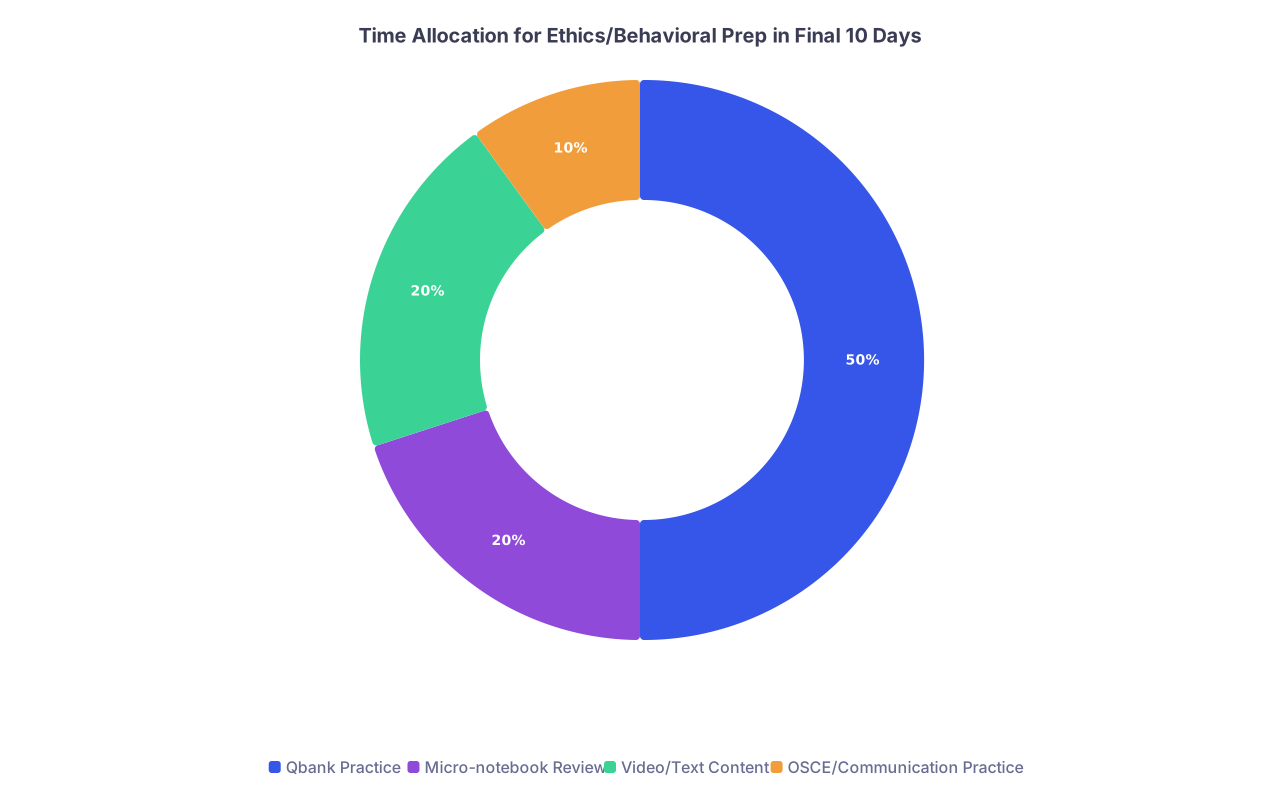
A realistic high-yield split in the last 10 days:
- 50%: Qbank practice (ethics + behavioral clustered sessions)
- 20%: Reviewing your micro‑notebook and missed questions
- 20%: Short, targeted videos/texts for gaps
- 10%: Saying communication scripts out loud / OSCE practice with a partner
5. Concrete 7–10 Day Plan: Putting It Together
Assume you have done some scattered questions but no structured work. You have 7–10 days to sharpen ethics/behavioral before a big exam.
Day 1–2: Build the Skeleton
- Do 20–30 mixed questions per day (UWorld / NBME) filtered for:
- Ethics, communication, professionalism
- Behavioral/biostats
- For every missed question (and any that felt shaky but you got right):
- Write 1–2 lines in your micro‑notebook:
- Scenario → Correct principle
- Wrong phrasing vs NBME‑preferred phrasing
- Write 1–2 lines in your micro‑notebook:
- Watch or read 1 short module on:
- Basic principles of medical ethics
- Capacity and consent
Time: ~2–3 hours per day.
Day 3–5: Intensify Patterns
- Increase to 30–40 questions per day, half ethics/professionalism, half behavioral/biostats.
- Begin active recall:
- Before reading each explanation, try to explain to yourself why your choice was right or wrong.
- Predict the guiding principle (autonomy vs beneficence, etc).
- Add 1–2 decision trees to your notebook:
- Confidentiality/reporting
- Surrogates/end‑of‑life
If you have an OSCE, spend 20–30 minutes each day saying scripted phrases out loud:
- Breaking bad news
- Dealing with anger
- Responding to requests for inappropriate prescriptions (opioids, antibiotics, etc.)
Day 6–7: Compression & Weak-Spot Attack
- Re‑do previously missed questions:
- Use Qbank filters or your marked set.
- Review entire micro‑notebook:
- Try to cover it in 20–30 minutes without looking at answers.
- For each point, test yourself: “Can I generate 1 example vignette where this rule applies?”
- Watch/review any remaining weak areas:
- If biostats is weak: sit with formulas until they are automatic.
- If boundaries/professionalism are weak: target that subset of questions.
Day 8–10 (if you have them): Simulate and Refine
- Do 1–2 full blocks (40 questions each) per day of mixed material, but pay special attention to ethics/behavioral.
- After each block:
- Identify: Did I miss more ethical judgment questions or more quantitative behavioral questions?
- Then spend an extra 45–60 minutes that same day reviewing that subtype.

By the end of this period:
- You have seen the major patterns at least 2–3 times.
- You have a portable, compressed set of notes.
- You have internalized how exam writers phrase “good doctoring.”
That is how narrow resources become powerful.
6. High-Yield Example Patterns (So You See What I Mean)
Let me show you specific patterns that appear again and again, which you should build into your micro‑notebook.
6.1 The “Autonomy vs Family Wishes” Pattern
Vignette:
Competent adult, awake and oriented, refuses treatment. Family is begging you to proceed.
Correct move (99% of the time):
- Confirm capacity.
- Respect the patient’s refusal.
- Acknowledge the family’s distress, but do not override the patient.
Typical correct answer phrases:
- “Respect the patient’s wishes and document the discussion.”
- “Explain the risks, benefits, and alternatives again to the patient and confirm understanding.”
- “Support the family emotionally while honoring the patient’s decision.”
Wrong answer patterns:
- “Seek a court order to treat against the patient’s will.”
- “Ask the family to make the decision since they know the patient best.”
6.2 Confidentiality vs Harm to Others
Vignette:
Patient with HIV refuses to tell sexual partner. Or adult threatens specific violent harm. Or evidence of child abuse.
Correct move:
- Ethical and often legal requirement to breach confidentiality in cases of imminent serious harm to others, or mandatory reporting (child/elder abuse).
Answer phrases you want engraved in your brain:
- “Inform appropriate authorities even if the patient refuses consent.”
- “Encourage the patient to disclose, but ultimately report if they do not.”
- “Explain to the patient that some information must be reported by law.”
Wrong answer patterns:
- “Maintain confidentiality in all circumstances.”
- “Do not report unless the child confirms abuse directly” (you report on reasonable suspicion, not certainty).
6.3 “What Do You Do First?” in Bad News Conversations
Vignette:
You have biopsy results showing metastatic cancer. Patient does not yet know. Exam question: “What is the most appropriate next step?”
Correct sequence (SPIKES‑like):
- Find out what the patient already understands.
- Ask permission to discuss details.
- Deliver information clearly, without jargon.
- Allow silence and emotional reaction.
- Offer support and next steps.
High-yield correct answer:
- “Ask the patient what she understands about her condition and what she has been told so far.”
- “Invite the patient to have a family member or friend present if desired before you discuss the results.”
Commonly wrong but tempting answers:
- “Immediately state the diagnosis in blunt terms.”
- “Begin discussing specific chemotherapy regimens right away.”
6.4 Behavioral Science: Classic Stat Traps
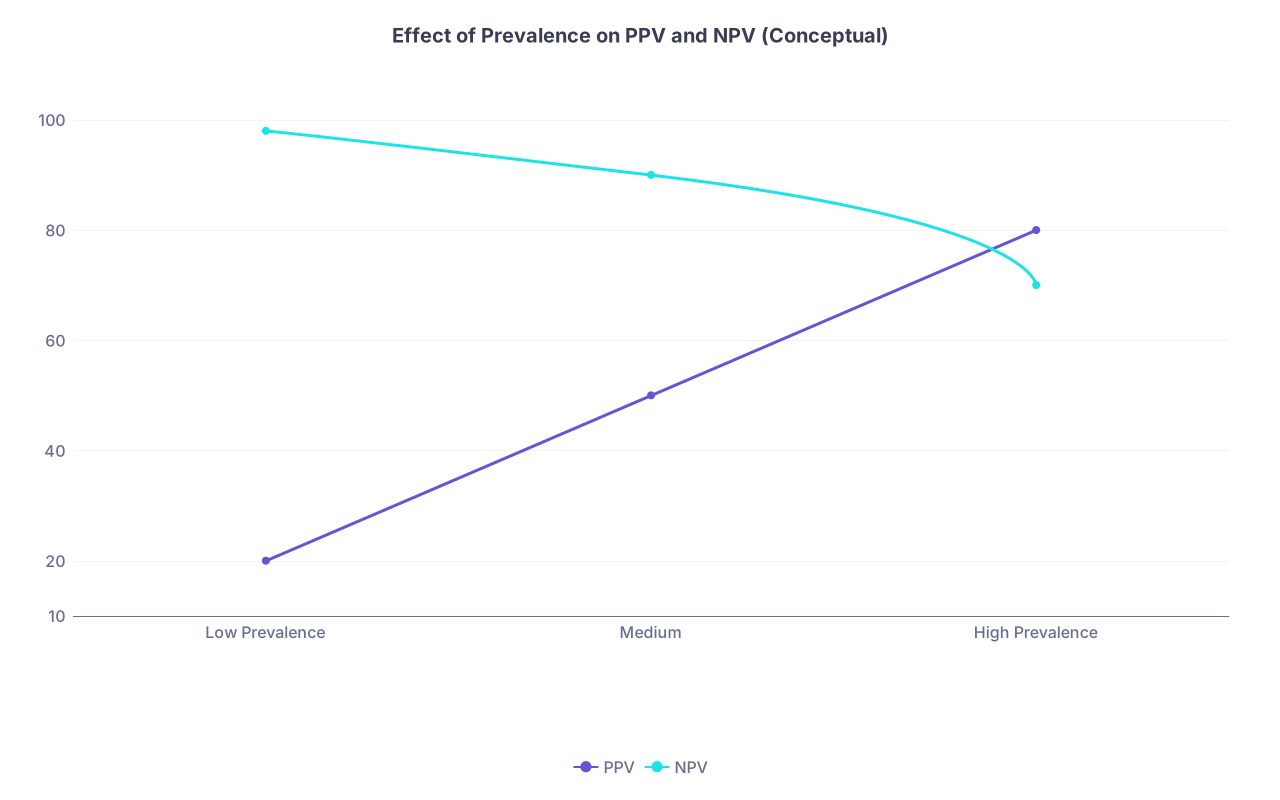
Example: A screening test is applied to a population with lower disease prevalence. Sensitivity and specificity of the test are unchanged. What happens to PPV and NPV?
Correct:
- PPV decreases, NPV increases.
Pattern to memorize:
- Lower prevalence → fewer true positives relative to false positives → PPV drops.
- Lower prevalence → more true negatives → NPV rises.
Common wrong answers:
- “Both PPV and NPV decrease.”
- “PPV increases because fewer people have the disease.”
If you anchor these cause‑effect relationships, you can answer a ton of biostats questions almost reflexively.
| Category | PPV | NPV |
|---|---|---|
| Low Prevalence | 20 | 98 |
| Medium | 50 | 90 |
| High Prevalence | 80 | 70 |
(Not exact numbers—just the conceptual direction.)
7. What to Avoid: Time‑Sinks Disguised as “Thorough Prep”
You have limited time. Some things look serious but are terrible ROI.
Skip or strictly limit:
- Long, narrative ethics textbooks:
- Great if you are doing a bioethics elective. Overkill for exams.
- Massive behavioral science textbooks:
- Your test is not psych residency; you need biostats and basic models.
- Vague school lecture slides:
- If slides are 80% “be a good person” with no clear questions or patterns, they are not your main resource.
- Memorizing obscure ethical theories:
- “Virtue ethics,” “care ethics,” etc., almost never appear explicitly as answer choices.
Stick to:
- Question banks.
- Short, pattern‑based summaries.
- Your own micro‑notebook derived from actual questions.

8. How to Know If Your Ethics/Behavioral Prep Is “Good Enough”
You do not need perfection. You need consistency.
Signs you are in good shape:
- On mixed Qbank blocks, your ethics/behavioral questions are ≥ your overall average.
- When you review questions, you consistently identify the underlying principle (“This is autonomy vs beneficence…”).
- You rarely miss questions because you “did not know the rule.” Instead, if you miss, it is usually one of two plausible options and you can say exactly why your choice was wrong.
Signs you need more focused work:
- You keep being surprised by what the “right thing to do” is.
- You frequently choose “Do whatever the family wants” or “Always maintain confidentiality no matter what” in edge cases.
- Biostats graphs and confidence intervals still feel like a foreign language.
If you are in that second group, double down on:
- Micro‑notebook review.
- Clustering similar questions together (e.g., do 15 capacity/consent questions in a row one evening).
- Writing out the rule for each type of bias or ethical scenario in your own words.
9. Looking Forward: Ethics and Behavioral Science Beyond the Exam
Here is the part everyone expects me to say: “These skills matter clinically, not just for the exam.” But I will be a bit harsher.
You will see real doctors ignore basic ethics or communicate terribly. You will see attendings brush off capacity assessments, bulldoze families, disclose errors poorly, or crack jokes in front of patients. And you are going to feel the temptation to copy them because “that’s how things are done.”
If you do the work now to build a clean, principled, exam‑sharp understanding of ethics and behavioral judgment, you actually have a foundation to push back. To practice differently. To choose better habits early.
Right now, your job is to convert narrow resources into a strong score. After that, your job is to not let the worst parts of the culture overwrite the good instincts you are building.
With the frameworks, micro‑notebook, and Qbank approach we just laid out, you are in a position to turn a “soft” subject into one of your most reliable point sources on exams. Once you have the score in hand, then we can talk about applying this on the wards, in family meetings, and when real patients ask you impossible questions.
But that is a next‑phase problem.
FAQ (Exactly 4 Questions)
1. Do I really need separate resources for ethics and behavioral science, or can I just rely on UWorld?
UWorld plus NBME is enough for many students, especially if you deliberately build a micro‑notebook from those questions. Separate resources help when your baseline is weak or your school exams emphasize these topics heavily. I like adding a short ethics summary (≤30 pages) and a compact biostats booklet or video series. But if your time is tight, prioritize questions and your own distilled notes over adding more commercial products.
2. How often should I review my ethics/behavioral micro‑notebook?
Early on, once per week is enough. In the final 10–14 days before a major exam, aim for quick passes every 2–3 days. The goal is to keep the decision trees and phrases fresh, not to memorize every line. A fast 20–30 minute flip through your notebook before each NBME or full‑length practice exam is ideal.
3. I keep missing “best next step” questions where all answers seem reasonable. What am I doing wrong?
Most likely you are not identifying the single dominant principle in the vignette. Before looking at options, ask yourself: “What is this really about—autonomy, confidentiality, nonmaleficence, justice, capacity, boundaries, or something else?” Then choose the answer that most purely reflects that principle without adding extra assumptions. Also, be ruthless about recognizing NBME‑disfavored moves: lying, stalling, deferring indefinitely, or prioritizing your comfort over the patient’s needs.
4. How much time should I allocate to ethics/behavioral science in a full Step 2 CK study schedule?
Across a 6–8 week dedicated period, I like 2–3 focused ethics/behavioral sessions per week, each about 60–90 minutes. That usually totals 15–25 hours of targeted work plus whatever ethics/behavioral appears in your regular mixed blocks. That is enough to hit 200+ questions, build and maintain your micro‑notebook, and do 1–2 concentrated reviews of your weak areas without cannibalizing your time for high‑density clinical subjects.