
You are three weeks out from Step 2. UWorld says you missed 5 questions yesterday. But when you dig in, 4 of them are the same problem wearing different hats: sensitivity, likelihood ratios, p‑values, CI overlap. You know the clinical medicine. Biostatistics keeps punching you in the face.
You do not have time for a 400‑page epi textbook. You also do not need one.
You need:
- tight, high‑yield micro-resources that actually move the needle, and
- question sets that behave like the real exam, especially in how they word statistics questions.
Let me walk you through exactly what is worth your time and what is not.
The Biostat Problem: Why This Feels Harder Than It Should
Biostatistics on boards is not conceptually deep. It is linguistically annoying.
Boards test you on:
- pattern recognition of a handful of formulas and definitions
- comfort moving between raw 2×2 tables, ratios, and probabilities
- reading tables and graphs under time pressure
- subtle wording tricks in answer choices
They do not care if you could design a trial. They care whether you can:
- Look at a table of test results and immediately see: “They want LR+ or LR−; this is just sensitivity/(1−specificity).”
- Read a forest plot and recognize: “CI crosses 1, so no statistically significant difference.”
- Catch the trick in a question asking “probability of having disease given a positive test” when they gave you sensitivity and specificity but not directly the PPV.
The reason many students stay weak on this:
- They try to “understand everything once” instead of drilling patterns repeatedly.
- They use huge resources for a tiny tested slice.
- They do not separate memorization/recognition (micro-resources) from application under exam conditions (Q‑sets).
So I am going to separate those for you.
Core Micro-Resources: What Actually Builds the Foundation
These are not full courses. They are small, targeted tools you can cycle many times.
1. Dirty Medicine Biostats (YouTube) – Short, punchy, and board‑realistic
If you have not watched Dirty Medicine’s biostats videos, start there. They are easily the highest yield per minute for boards-level stats.
What it does well:
- Focuses on board language, not academic purity.
- Shows the 2×2 table every time and forces you to see the pattern.
- Covers “gotchas”: composite endpoints, NNT/NNH pitfalls, Type I vs II, and interpretation of p‑values and confidence intervals.
How to use it:
- First pass: play at 1–1.25x, pause and reconstruct each formula on scratch paper. Not from memory yet; from the structure.
- Second pass (1–2 weeks later): watch at 1.5x while verbally predicting each answer before he explains it. If you cannot say it out loud in 3–5 seconds, you do not have it.
- Final week: skim selectively. If a topic still feels fuzzy (e.g., hazard ratios, non‑inferiority), rewatch just that chunk.
This is your conceptual glue plus pattern recognition. It is not your only resource, but it’s the backbone.
2. “Biostats for the Boards” Formula Sheets (Anki / PDFs)
You need at least one compact formula/definition reference. I have seen students waste hours re‑deriving PPV from base principles on exam day because they never hammered it into immediate recall.
Good options:
- The dedicated “Biostats/Epi” section in the Amboss Step 1 & 2 High‑Yield PDFs.
- Dedicated Anki decks like “Biostats for Boards” or “Biostats/Epi – Zanki add‑ons” (names vary, but most big Step decks have a biostats subdeck).
- Self‑made 1–2 page cheat sheet summarizing:
- 2×2 table layout
- Sensitivity, specificity, PPV, NPV
- LR+ and LR−
- Risk, odds, RR, OR, RRR, ARR, NNT/NNH
- Type I/II errors, power, alpha, beta
- Confidence intervals and what “crossing” means (1 for ratios, 0 for means)
- Types of study designs and what each actually estimates (cohort → RR, case‑control → OR, RCT → RR; cross‑sectional → prevalence)
You should be able to write all core formulas from memory in under 3 minutes. If you cannot, you are leaving free points on the table.
The Main Q‑Engines: Where You Actually Learn to Answer
Let’s rank the big-name resources by how well their biostats questions mimic the real exam and how you should slot them into your prep.
1. UWorld – Your Primary Biostats Classroom
UWorld is still the best single source for how NBME‑style biostats questions look and sound.
What UWorld gets right:
- The question stems are wordy in the same annoying way as the real thing.
- Many questions require multi-step reasoning: identify study design → pick correct measure → interpret CI or p‑value.
- Explanations actually walk you through the 2×2 table or equations instead of hand-waving.
Where students blow it:
- They treat biostats questions like memorization items instead of pattern drills.
- They read explanations passively instead of reconstructing the table or formula themselves.
How to use UWorld biostats efficiently:
- Create a custom “Biostatistics/Epidemiology only” block every 3–5 days (tutor mode, 10–15 questions).
- Every missed question: redraw the 2×2 table or core formula from scratch in the explanation space.
- Tag biostats questions (use a custom “Biostats” or “Epi/Stats” tag). Last 5–7 days before your exam, redo just those tagged questions in random mode.
If your UWorld biostats percent is under about 70% by 2–3 weeks out, you need to prioritize this more. These are fixed‑content, high‑return points.
2. Amboss – Strong Explanations, Great for Fine‑Tuning
Amboss’s biostats questions are very good for depth and nuance. The style is slightly less “NBME‑ish” at times, but the reasoning is excellent.
Strengths:
- Tools like highlighting key info and showing 2×2 tables explicitly in explanations.
- Good coverage of higher‑level topics: non‑inferiority trials, equivalence, hazard ratios, survival curves, interpreting regression outputs.
- Marginal notes that remind you of definitions in context (power, alpha, confounders).
Best use case:
- After you are comfortable with Dirty Medicine + UWorld core biostats, use Amboss for:
- Topics you still miss or feel shaky about.
- Short targeted sessions of 10–20 questions on “Epidemiology & Biostatistics”.
- Clarifying weird question types: interpreting Kaplan–Meier curves, multivariate regression, interaction vs confounding.
Amboss is your “clean up the weak spots” engine, not your first exposure.
3. NBME Practice Exams – The Gold Standard for Style and Wording
NBME practice forms (both Step 1 and Step 2/3 relevant ones) are where you see exactly how the exam will phrase and balance biostats content.
On NBME forms, you see:
- Very short biostats questions with almost no fluff.
- Tight conceptual items: “Which of the following changes will increase the power of this study?”
- Interpretation questions with graphs/plots that are unforgiving if you misread a label.
How to exploit NBME biostats:
- After each form, go back and pull all biostats/epi questions into a separate doc or Anki deck.
- Force yourself to classify each Q:
- Concept: Power/Type I/Type II?
- Study type: Cohort/case-control/RCT?
- Metric tested: OR, RR, ARR/NNT, LR, etc.?
- If you miss more than 1 or 2 biostats items per form, that is a red flag relative to how small this domain is.
| Resource | Primary Use | When to Use |
|---|---|---|
| UWorld | Core pattern + exam feel | Throughout dedicated, early and often |
| Amboss | Deepen + clarify weak spots | Mid/late once basics are solid |
| NBME Forms | Style calibration + gap check | Throughout; especially final month |
| OnlineMedEd QBank (Biostats subset) | Gentle intro/review | Early MS2 or early dedicated |
Targeted, Smaller Q‑Sets and Modules That Punch Above Their Weight
These are not full question banks, but they are extremely useful if used with intent.
1. UWorld “Biostatistics Review” / “Biostatistics Subject Review” (if available)
Some UWorld versions and dashboards now group biostatistics concepts under a review or subject heading. If yours does, do those.
Use them:
- Once in the first half of dedicated as a baseline.
- Again in the last 7–10 days as a capstone review.
You want to feel bored doing these the second time. That is the right level of over‑preparation.
2. Amboss “Learning Cards” + Q‑Sets for Epi/Stats
Amboss has integrated learning cards that sit between a textbook and a flashcard. Their biostats cards are quite lean and to the point.
Best use:
- 15–20 minute sprints:
- Read 3–5 cards on a subtopic (e.g., diagnostic test characteristics, measures of association, types of bias).
- Immediately hammer 10–15 questions filtering by that topic.
This concentrated micro‑cycle is much more efficient than randomly meeting a biostats question every 40–50 clinical questions.
3. Boards & Beyond Biostats Videos + Qs
Boards & Beyond’s biostats/epi videos are more comprehensive and slightly slower than Dirty Medicine, but they are well-structured.
Who should use them:
- You if you truly never had a functional biostats course in pre‑clinicals and everything feels alien.
- Or, you if you are aiming for near‑perfect understanding (usually high performers gunning for 260+ on Step 2).
Do not binge all of them in week 2 of dedicated. That is bad resource allocation. Instead:
- Pick core videos: screening tests, risk vs odds, NNT, study design, biases, and regression basics.
- Do associated question sets if available, but keep time capped.
Micro-Resources for Visual and Conceptual Anchors
Now the stuff people rarely talk about, but that makes a huge difference when used surgically.
1. One‑Page Biostat Summary Sheets (Print or Tablet)
I am not talking about 10‑page notes. One page.
Make or download a concise one-pager that includes:
- The 2×2 table with a consistent layout:
- Rows: Disease + / −
- Columns: Test + / −
- From that, arrows showing:
- Sensitivity = a/(a+c), Specificity = d/(b+d)
- PPV = a/(a+b), NPV = d/(c+d)
- LR+ = Sensitivity / (1−Specificity)
- LR− = (1−Sensitivity) / Specificity
- Risk definitions:
- Risk = events / total at risk
- RR = risk_exposed / risk_unexposed
- OR = (a/c) / (b/d) = ad/bc
- Translating RRR, ARR, NNT:
- ARR = Risk_control − Risk_treated
- RRR = ARR / Risk_control
- NNT = 1 / ARR
Have this visible while you do early biostats Q‑sets. Then hide it. If you still reach for it during the last 10 days, you are under‑rehearsed.
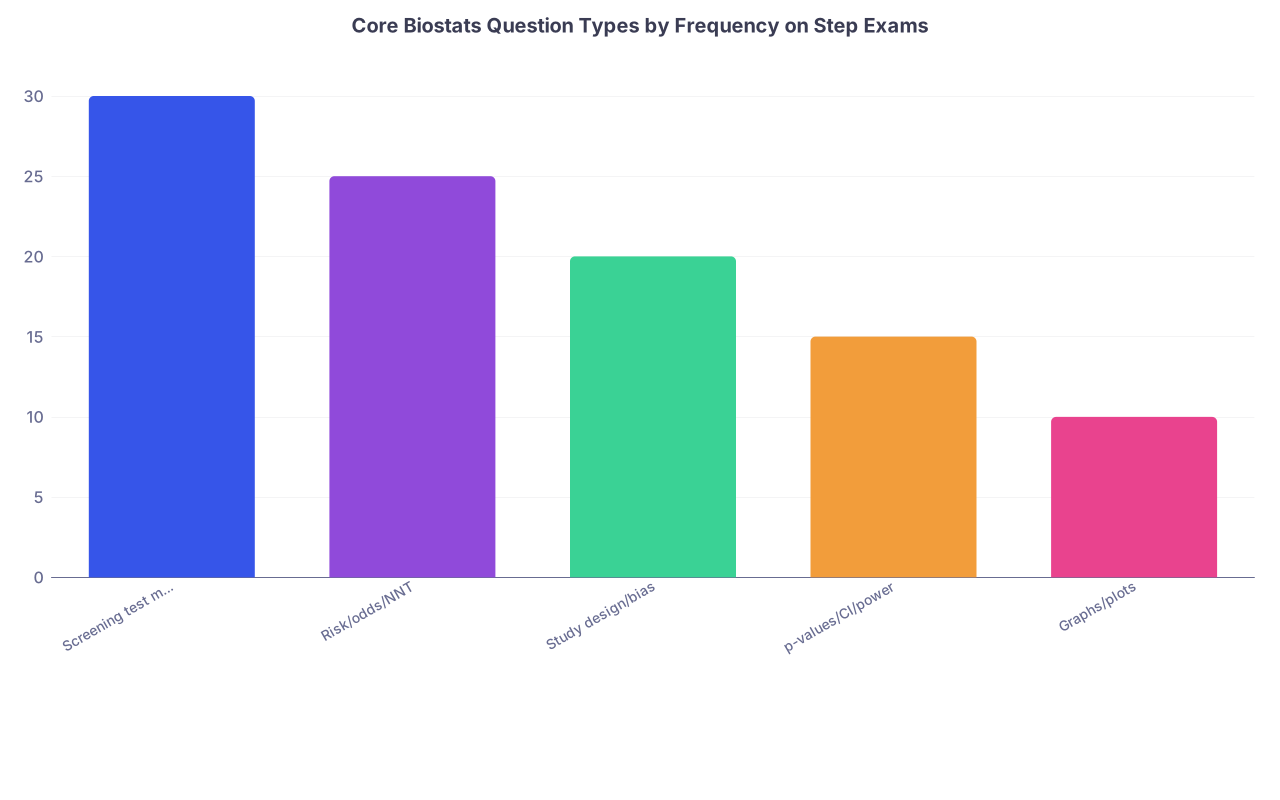
| Category | Value |
|---|---|
| Screening test metrics | 30 |
| Risk/odds/NNT | 25 |
| Study design/bias | 20 |
| p-values/CI/power | 15 |
| Graphs/plots | 10 |
Is that exact distribution? Obviously not. But directionally, that is what I keep seeing in question sets and real exam feedback.
2. Focused Anki Cards for Stats – But Only the Right Kind
Anki is overused for this domain if you are memorizing formulas mindlessly. What you want are:
- Image occlusion cards built on your personal 2×2 table diagram and summary sheet.
- “Given this 2×2 table, what is the PPV?” type cards, where you calculate, not just recall letters.
- Concept cards like:
- “What change increases power?” → Increase sample size, increase effect size, increase alpha, decrease SD.
- “Which study design is best for rare diseases?” → Case‑control.
Make 30–60 truly good biostats cards. Not 300. Then run them once per day in the last 2–3 weeks. That is enough.
Advanced Topics: What to Treat as Bonus vs Required
Students waste time here all the time. Let me be blunt.
You Must Be Solid On:
- Test performance metrics: sens/spec, PPV/NPV, LRs.
- Risk and odds: RR vs OR, when each is used, how to approximate interpretation.
- NNT/NNH, ARR, RRR.
- Study designs: RCT, cohort, case‑control, cross-sectional, case series.
- Common biases: selection, recall, measurement, confounding, lead‑time, length‑time, Berkson, etc.
- Hypothesis testing: null vs alternative, Type I/II error, power, p‑value meaning.
- Confidence intervals and interpretation of overlap / crossing 1 or 0.
You Should Be Familiar With (but not obsess over):
- Hazard ratios and Kaplan–Meier survival curves.
- Non‑inferiority vs superiority vs equivalence trial setups.
- Regression basics: linear vs logistic; crude interpretation of coefficients and p‑values in a table.
- Intention‑to‑treat vs per‑protocol analysis.
Exams increasingly like these, but they rarely require deep math. They want conceptual interpretation.
What you do not need in depth:
- Full derivations of statistical tests (t‑test vs ANOVA vs chi‑square) beyond knowing:
- Continuous vs categorical, 2 groups vs >2 groups, paired vs unpaired.
- Details of every obscure bias subtype.
- Full survival analysis theory.
Use Amboss or Boards & Beyond to plug these advanced holes after your core is strong.
Putting It Together: A 2–3 Week Focused Biostats Plan
Let me give you a concrete, realistic plan. Assume you are within 2–3 weeks of your exam, middle of dedicated, not starting from zero but not confident.
Week 1: Foundation and Pattern Lock-In
- Dirty Medicine biostats videos: all the core ones in 2–3 sittings.
- Build or print your one‑page summary sheet.
- UWorld: 3 biostats‑only blocks (10–15 Q each, tutor mode).
- Start or clean up your 30–60 biostats Anki cards.
Goal at end of week 1:
- You can write all major formulas from memory.
- You recognize test questions by type within a few seconds.
Week 2: Integration with Full-Length Practice
- Continue UWorld mixed blocks, but add:
- 2 targeted biostats blocks (15–20 Q, timed) during the week.
- Take an NBME or free 120–style exam.
- After: isolate all biostats questions, classify, and review explanations in brutal detail.
- Optional: 1–2 Amboss short sessions on advanced topics you missed (e.g., survival analysis, non‑inferiority).

| Step | Description |
|---|---|
| Step 1 | Week 3 Out |
| Step 2 | Dirty Medicine + Summary Sheet |
| Step 3 | UWorld Biostats Blocks |
| Step 4 | Create/Refine Anki Biostats Deck |
| Step 5 | NBME Form with Biostats Review |
| Step 6 | Amboss Targeted Weak Areas |
| Step 7 | Final Week: Re-do Tagged Qs + Light Video Review |
Final Week: Tighten and Protect the Points
- Re‑do all tagged UWorld biostats questions (randomized, timed).
- Run your biostats Anki deck daily (should be fast: 5–10 min).
- 1–2 short review sessions with your summary sheet, especially:
- LRs, NNT, OR vs RR, CI interpretation, power/Type I/II.
- If you are anxious: rewatch one compressed pass of Dirty Medicine at 1.5–2x on topics you still dread.
You are not cramming new concepts in the final week. You are smoothing your pattern recognition.
Common Mistakes I See Over and Over
Let me be clear about a few things I see every year that are just wrong approaches.
Treating biostats as “extra credit.”
It is not. On Step 2 and Shelf exams, you will see enough stats/epi/test interpretation questions that bombing them can swing your score tier. They are deterministic points if you rehearse.Studying biostats only passively.
Watching videos and nodding along is worthless if you never actually calculate or classify anything under time pressure. You need active question sessions.Ignoring advanced topics completely because they feel scary.
Survival curves and non‑inferiority questions look terrifying until you see 10 of them. Then the pattern is obvious: Does the CI stay within the non‑inferiority margin? Does the hazard ratio CI cross 1?Overbuilding Anki decks.
I have seen 200‑card biostat decks that do nothing but eat time. This domain is compact. Hit the high‑value concepts hard and repeatedly; skip the rest.Not reviewing biostats separately from general Q‑bank work.
If you rely only on “whatever pops up” in mixed UWorld blocks, you will not consolidate patterns efficiently. Dedicated biostats blocks speed up learning dramatically.
One Last Layer: Strategy On Test Day
Even with perfect prep, you can fumble these if you panic under the clock. A few practical moves:
- When you see numbers and epidemiologic design terms, immediately label the question type in your head: “2×2 diagnostic,” “RR vs OR,” “bias,” “CI/power,” “trial type.” That alone calms the chaos.
- If you blank on a formula, reconstruct from 2×2 logic:
- Sensitivity = of those who have disease, how many test +?
- Specificity = of those who do not have it, how many test −?
- PPV = of those who test +, how many actually have disease? etc.
- Watch units. Risk differences usually in absolute terms; NNT is 1/ARR where ARR is in proportions, not percent. Convert 20% to 0.20 first.
- Graph questions: read axes slowly before you even look at answer choices. Half of the trick is swapping x and y or misunderstanding “cumulative incidence” vs “probability of survival.”
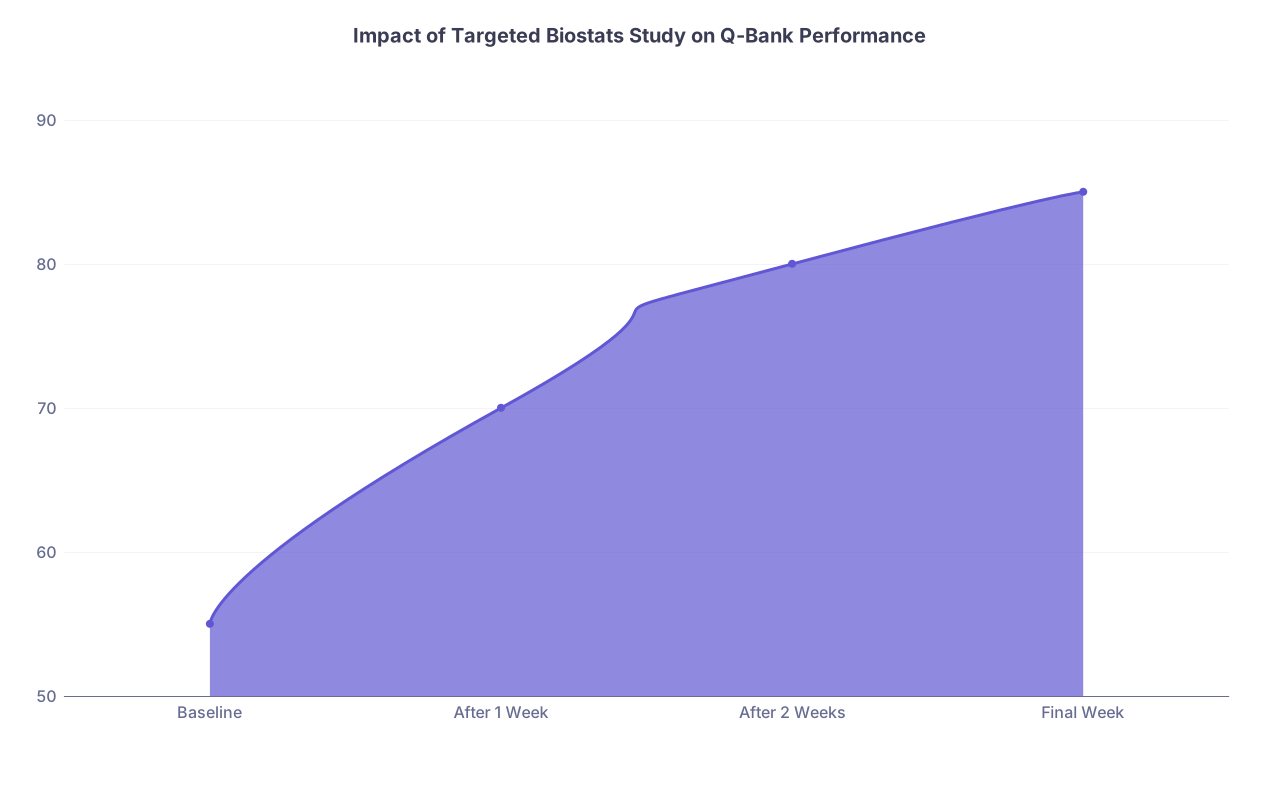
| Category | Value |
|---|---|
| Baseline | 55 |
| After 1 Week | 70 |
| After 2 Weeks | 80 |
| Final Week | 85 |
A realistic jump if you are actually doing what I just outlined.
Final Thoughts: What Actually Matters
If you skimmed, here is the distillation.
- Use Dirty Medicine + a 1‑page formula/summary sheet + a small, focused Anki deck as your core micro-resources. That is your foundation.
- Let UWorld be your main biostats “classroom,” with Amboss and NBME forms to polish and calibrate. Do targeted biostats blocks, not just random exposure.
- Separate concept learning from pattern drilling under time pressure. Biostatistics is less about intelligence and more about repetition of the same 15–20 ideas until they are boring.
If biostats still feels mysterious after that, it is not because you are bad at math. It is because you have not cycled enough good micro-resources with enough real questions yet. Fix that, and these become some of the easiest points on the exam.