
The biggest mistake people make with neuroanatomy for boards is thinking it is about memorizing structures. It is not. It is about recognizing patterns of deficits and instantly mapping them to a lesion.
Let me break this down specifically: if you are not drilling the right question types and not using the right 2–3 core resources, you are wasting time.
The Real Neuroanatomy Target on Boards
Neuroanatomy on USMLE-style exams (Step 1, Step 2 CK, COMLEX, shelf exams) is not a free-for-all. It clusters into very predictable buckets.
Here is the practical breakdown of what the exams actually test:
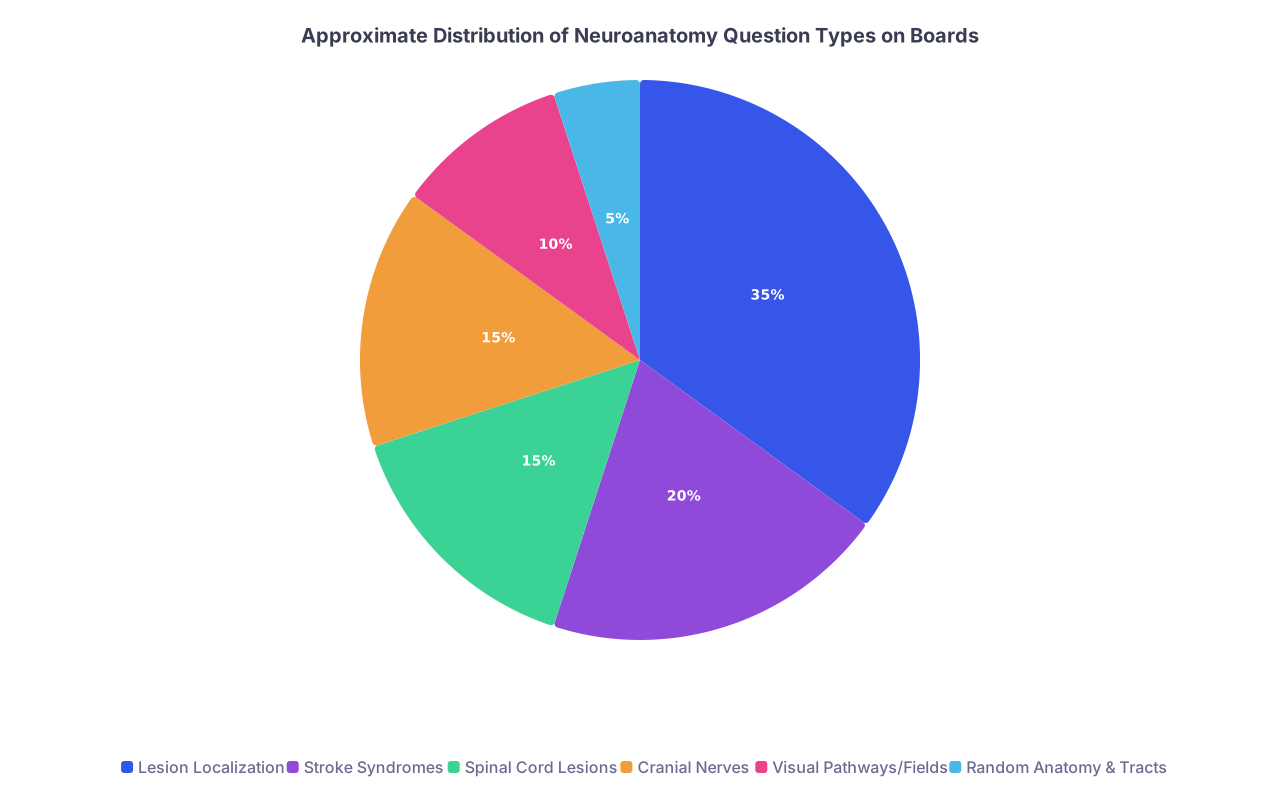
| Category | Value |
|---|---|
| Lesion Localization | 35 |
| Stroke Syndromes | 20 |
| Spinal Cord Lesions | 15 |
| Cranial Nerves | 15 |
| Visual Pathways/Fields | 10 |
| Random Anatomy & Tracts | 5 |
If your study plan does not reflect that distribution, you are overdoing the wrong things.
At base, exam neuroanatomy boils down to:
- Can you localize lesions from symptom clusters?
- Can you tie that localization to a vascular territory or named syndrome?
- Can you connect that to a tract or nucleus with a simple “input → processing → output” logic?
Everything else is noise.
Core Texts: What Actually Moves the Needle
Most neuroanatomy textbooks are written for PhD-level detail. Useless for board prep. You need a tightly curated stack.
1. High-Yield Neuroanatomy (Fix) – the Board-Focused Spine
This is the single most efficient dedicated neuroanatomy book for boards. I have seen students go from “I hate neuro” to “this is actually manageable” with just this text plus questions.
What it gives you:
- Clean, labeled cross-sections (spinal cord, brainstem) tied directly to clinical syndromes.
- The classic lesions: Brown-Séquard, medial medullary, lateral medullary (Wallenberg), medial pontine, lateral pontine, Weber, Benedikt, Parinaud, etc.
- Simple tables of tracts and nuclei with concise function and lesion findings.
How to use it in a board-focused way:
- Read once quickly, then return to:
- Brainstem lesion chapters
- Spinal cord lesion chapter
- Visual pathways chapter
- Every time you miss a neuroanatomy question, go back and anchor it to a figure in Fix. Do not just reread the explanation in UWorld. Link it to a picture in this book.
2. Neuroanatomy through Clinical Cases (Blumenfeld) – the Concept Builder
Blumenfeld is excellent, but you do not need to read it cover-to-cover for boards. Use it surgically.
What it does well:
- Realistic case vignettes that mirror question stems.
- Radiology integration (CT, MRI, angiography) with clinical deficits.
- Reasoning paths: “Here is the deficit → here is the tract → here is the localizing anatomy.”
How to use it without drowning:
Focus on:
- Brainstem vascular lesions and clinical syndromes.
- Visual pathway cases.
- Spinal cord lesion clinical scenarios.
Treat it as a concept resource, not your primary review. When a pattern is not sticking (e.g., why lateral medullary does what it does), find that case in Blumenfeld and walk it through.
3. Board Review Anchors: First Aid / Boards & Beyond / Sketchy
Neuroanatomy is a section where individual board-review platforms differ a lot in quality. Quick breakdown:
- First Aid: Good as an index and for last-minute refresh, weak for first-pass learning.
- Boards & Beyond (Neuroscience): Strong conceptual lectures, solid brainstem / spinal tracts emphasis.
- Sketchy: More useful for neuropath, less for pure neuroanatomy. Good for some cranial nerve stories, but do not rely on it to learn pathways.
How to use them:
- Use Boards & Beyond or similar to get a first pass conceptual layer (especially spinal cord and tracts).
- Then lock in details with High-Yield Neuroanatomy.
- Use First Aid mainly to remind yourself of patterns a few days before the exam.
4. Question Banks: The Real Testing Ground
Your “textbooks” only matter insofar as they help you get questions right. Neuroanatomy requires applied practice.
Minimum requirement:
- UWorld (Step 1 and/or Step 2 CK): Do every neuro question. Tag the neuroanatomy ones for a dedicated review block.
- NBME forms: Pay specific attention to neuroanatomy misses. These often cluster in the same blind spots (brainstem, visual fields, weird cranial nerve combos).
If you are COMLEX-bound, COMBANK/COMQUEST will hit some osteopathic-flavored anatomy, but the core patterns are the same.
The Major Neuroanatomy Question Archetypes
Let me give you the patterns you actually get tested on. Once you see these as templates, everything becomes easier.
1. “Where is the lesion?” – Classic Localization Vignettes
These are about pattern recognition. They usually hand you:
- A mix of motor, sensory, and cranial nerve findings.
- A unilateral or bilateral pattern.
- +/- vascular risk factors.
Example archetype:
“62-year-old with sudden onset hoarseness, decreased gag on the right, loss of pain and temperature on left body and right face, and ataxia on right.”
This is screaming:
- Lateral medullary syndrome (Wallenberg), PICA lesion.
- Ipsilateral facial pain/temp loss (spinal trigeminal).
- Contralateral body pain/temp loss (spinothalamic).
- Nucleus ambiguus (hoarseness, dysphagia, uvula deviation).
- Ipsilateral ataxia (inferior cerebellar peduncle).
Your job is:
- Identify which side is the lesion.
- Realize it is lateral vs medial and which level (medulla/pons/midbrain).
- Pick the artery or named syndrome.
Boards expect you to answer in different “languages”:
- “Lesion of right lateral medulla”
- “Occlusion of posterior inferior cerebellar artery”
- “Damage to nucleus ambiguus and spinal trigeminal tract”
Same syndrome, three answer formulations.
2. Stroke Syndromes and Vascular Territories
You must know the big 5:
- MCA
- ACA
- PCA
- Basilar (locked-in, brainstem)
- Lacunar strokes (internal capsule, thalamus)
And then the board-favorite brainstem vascular patterns:
- PICA – Lateral medullary (Wallenberg)
- AICA – Lateral pontine, facial paralysis + decreased lacrimation, anterior 2/3 taste, etc.
- Paramedian branches of basilar – Medial pontine syndromes.
- PCA – Occipital lobe → contralateral homonymous hemianopia ± macular sparing.
| Territory | Hallmark Clinical Pattern |
|---|---|
| MCA | Contralateral face/arm weakness, aphasia (dominant), hemineglect (nondominant) |
| ACA | Contralateral leg weakness, urinary incontinence, abulia |
| PCA | Contralateral homonymous hemianopia ± macular sparing |
| PICA | Lateral medullary: nucleus ambiguus sxs, contralateral body pain/temp loss |
| AICA | Lateral pontine: facial paralysis, decreased lacrimation, taste loss |
Most board questions will not say “MCA stroke” outright. They will give you:
- Atrial fibrillation.
- Sudden onset symptoms.
- Specific face/arm vs leg predominance.
- Maybe eye deviation or aphasia.
Your job is to map motor/sensory + cortical signs (aphasia, neglect, visual field cut) to a vessel.
3. Spinal Cord Lesions and Syndromes
Spinal cord questions are high-yield and very repeatable.
You must know the following patterns cold:
- Anterior spinal artery occlusion.
- Brown-Séquard syndrome.
- Tabes dorsalis.
- Subacute combined degeneration (B12 deficiency).
- Syringomyelia (especially with Chiari).
Boards test:
- Which tracts are involved (spinothalamic, dorsal columns, corticospinal, etc.).
- Whether findings are ipsilateral vs contralateral.
- The level of lesion.
Classic archetypes:
- Trauma → initial flaccid paralysis, then later spasticity below lesion, loss of pain/temp, preserved dorsal columns → Anterior cord syndrome.
- Knife wound → ipsilateral motor loss + loss of vibration/proprioception, contralateral pain/temp loss starting a few levels below → Brown-Séquard.
- B12 deficiency → bilateral dorsal column and corticospinal tract involvement, positive Romberg, spastic paresis → Subacute combined degeneration.
Pattern: When motor + vibration/proprioception are ipsilateral and pain/temp are contralateral, think “hemisection” and Brown-Séquard.
4. Cranial Nerve Lesion Patterns
Cranial nerve neuroanatomy on boards is less about memorizing every nucleus and more about 2 things:
- Knowing the “function clusters” of each nerve (motor, parasympathetic, sensory).
- Knowing what happens when you knock out a nerve vs a nucleus vs fascicle in the brainstem.
High-yield nerves and patterns:
- CN III: Down and out eye, ptosis, mydriasis. Compressive lesions (PComm aneurysm, uncal herniation) often hit parasympathetics first → blown pupil.
- CN IV: Vertical diplopia, worse going down stairs, head tilt away from lesion.
- CN VI: Inability to abduct eye, horizontal diplopia.
- CN VII: Upper vs lower motor neuron lesion (forehead sparing in UMN).
- CN V: Facial sensation, corneal reflex, jaw weakness.
- CN IX/X: Dysphagia, hoarseness, uvula deviation away from lesion (nucleus ambiguus).
You also get mixed lesions in brainstem syndromes. Example:
- Lateral pontine (AICA) → facial paralysis (CN VII nucleus), decreased lacrimation, taste, and salivation, plus contralateral body pain/temp.
Your board-level task:
- Identify which cranial nerve(s) is/are involved.
- Decide if it is a peripheral nerve issue vs brainstem nucleus vs higher (cortex/internal capsule).
5. Visual Pathways and Visual Field Defects
These are classic, and there is no excuse for missing them. The examiners love these because they reward organized thinking.
You need:
- A mental map of the pathway: retina → optic nerve → chiasm → tract → lateral geniculate → optic radiations (Meyer’s loop and dorsal) → visual cortex.
- To tie lesion location to visual field pattern.

| Step | Description |
|---|---|
| Step 1 | Retina |
| Step 2 | Optic Nerve |
| Step 3 | Optic Chiasm |
| Step 4 | Optic Tract |
| Step 5 | Lateral Geniculate |
| Step 6 | Meyers Loop |
| Step 7 | Parietal Radiations |
| Step 8 | Inferior Visual Cortex |
| Step 9 | Superior Visual Cortex |
Basic patterns:
- Optic nerve lesion → monocular vision loss.
- Chiasm (usually pituitary adenoma) → bitemporal hemianopia.
- Optic tract → contralateral homonymous hemianopia.
- Meyer’s loop (temporal lobe) → contralateral superior quadrantanopia (“pie in the sky”).
- Dorsal radiations (parietal lobe) → contralateral inferior quadrantanopia (“pie on the floor”).
- Occipital lobe infarct (PCA) → contralateral homonymous hemianopia ± macular sparing.
Boards may show a field chart or a vague description (“cannot see objects in the right upper visual field”). Practice converting those quickly to a lesion site.
6. Brainstem Cross-Section Pattern Recognition
If you cannot look at a brainstem cross-section and anchor basic landmarks, you will bleed points. You do not need research-level detail; you need major tracts and nuclei.
You should recognize, from a simple drawing:
- Medulla: Pyramids (corticospinal), medial lemniscus, nucleus ambiguus, inferior olivary nucleus, spinal trigeminal nucleus.
- Pons: Basis pontis (corticospinal), medial lemniscus, abducens nucleus, facial nerve fascicles, middle cerebellar peduncle.
- Midbrain: Cerebral peduncles, red nucleus, substantia nigra, oculomotor nucleus, Edinger–Westphal, superior and inferior colliculi.
Textbook trick: Use High-Yield Neuroanatomy figures and literally quiz yourself: cover labels and identify 5–7 structures that show up in board questions.
How to Drill These Question Types Efficiently
You do not fix neuroanatomy anxiety by reading more prose. You fix it by pattern exposure and structured repetition.
Step 1: Build a One-Page Tract + Syndrome Map
You need one sheet that ties together:
- Dorsal columns: vibration/proprioception; decussate in medulla.
- Spinothalamic: pain/temp; decussate at spinal cord level, ascending contralaterally.
- Corticospinal: motor; decussate at caudal medulla, then descend contralaterally.
Then, around that, list the core named syndromes:
- Brown-Séquard
- Anterior spinal artery syndrome
- PICA (lateral medullary)
- AICA (lateral pontine)
- PCA (occipital)
- MCA/ACA (cortex)
- Weber (midbrain, CN III + corticospinal)
- Benedikt / Claude / Parinaud (if your exam is heavy on neuro)
This is your “Rosetta stone”. When you see a pattern of deficits, you should feel it land somewhere on that map.
Step 2: Targeted Qbank Pass – Neuro-Only Blocks
Do not sprinkle neuro questions randomly through your studying and expect mastery. Neuroanatomy improves when you create density.
Concrete approach:
- In UWorld, filter by:
- System: Nervous System & Special Senses
- Subsections involving anatomy, stroke, cranial nerves, spinal cord.
- Do 10–15 neuro questions at a time.
- After each block:
- Sort your incorrects by type (e.g., “brainstem localizations,” “visual fields,” “cranial nerves”).
- For each miss, find:
- The figure in Fix or Blumenfeld that matches.
- The vascular territory or tract bundle you missed.
You are turning each question into a 2–3 minute mini-anatomy lesson.
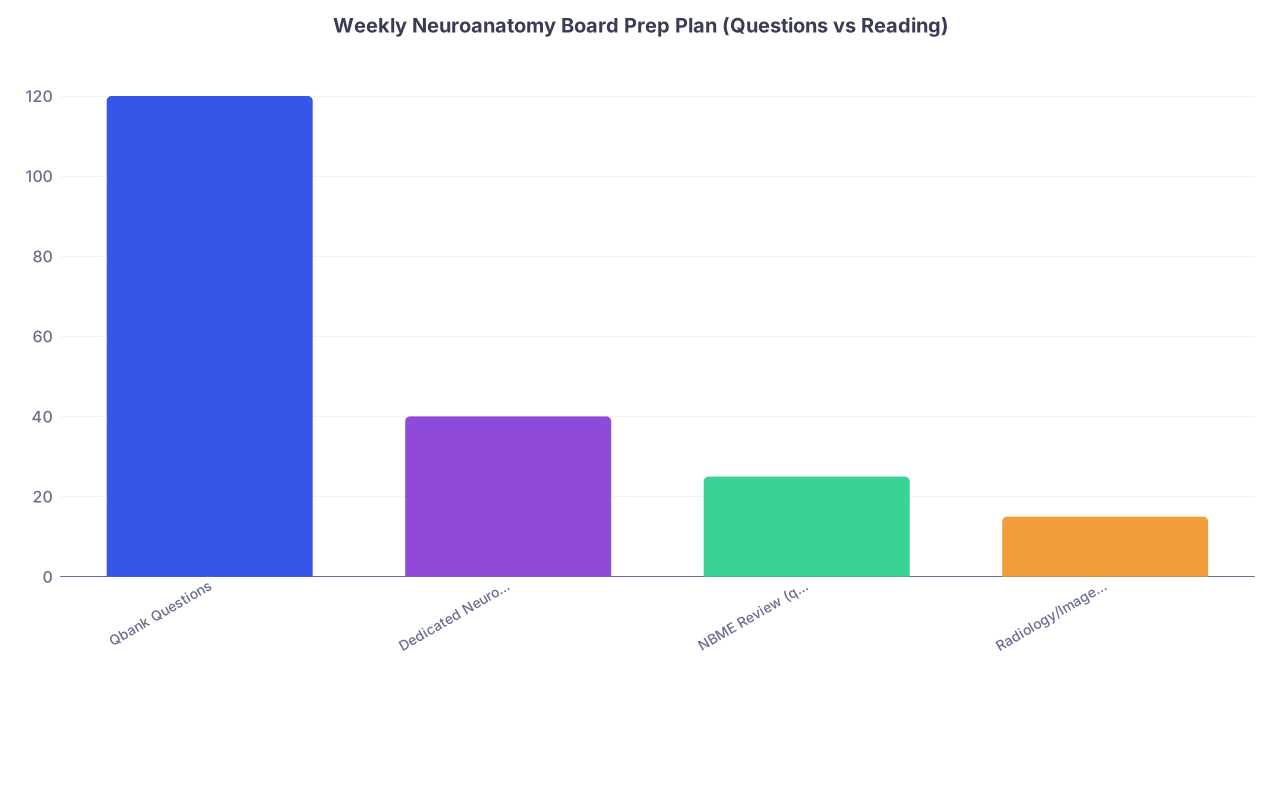
| Category | Value |
|---|---|
| Qbank Questions | 120 |
| Dedicated Neuro Text Reading (pages) | 40 |
| NBME Review (questions) | 25 |
| Radiology/Images (cases) | 15 |
Aim for something like 100–150 neuro questions per week during your heavier neuro block. That is where patterns stick.
Step 3: Radiology Pairing – Do Not Ignore the Images
Board exams increasingly use CT/MRI to make you localize anatomically. If you are skipping the images or just glancing superficially, you are leaving points on the table.
You need to at least:
- Recognize a midline pituitary mass compressing the optic chiasm.
- Distinguish a lateral pontine infarct vs medial medulla based on cross-sections + clinical scenario.
- See an epidural vs subdural vs subarachnoid hemorrhage and tie to anatomy (middle meningeal artery, bridging veins, etc.).
Blumenfeld helps here, as do certain video series (Radiopaedia cases, if you want extra credit). You do not need to become a neuroradiologist. You do need to be comfortable orienting yourself: anterior vs posterior, right vs left, and where the lesion sits relative to ventricles and brainstem.
Step 4: Condense to a Last-Week Neuro Packet
Neuroanatomy decays fast if not refreshed close to the exam.
In the last week before Step or shelf:
- Re-read:
- Brainstem lesion sections in High-Yield Neuroanatomy.
- Spinal cord lesion summary.
- Visual pathways diagrams.
- Do:
- 30–40 neuro questions (mixed difficulty).
- At least one NBME or practice exam where you flag every neuroanatomy stem for posttest review.
The goal here is not “learning from scratch”; it is refreshing pattern recognition, so when a 60-second neuro question appears, you can slam it.
Common Traps and How to Avoid Them
Let us be blunt about where students consistently screw this up.
Trap 1: Memorizing Lists Instead of Building Patterns
If your neuro notes look like:
- “PICA – loss of ipsilateral facial pain and temp, contralateral body pain and temp, nucleus ambiguus dysfunction…”
and you are trying to brute-force memorize the full list, you are doing it the hard way.
Better: Anchor each syndrome to basic principles:
- Lateral vs medial.
- Which cranial nerve nuclei sit there.
- Which tracts pass through that region.
Then you can reconstruct the details instead of regurgitating.
Trap 2: Ignoring Directionality (Ipsilateral vs Contralateral)
So many missed questions boil down to not keeping track of:
- Where a tract decussates.
- Whether the lesion is above or below that decussation.
Spinothalamic: decussates at or near the level in the cord → lesion above decussation = contralateral loss. Dorsal columns: decussate in medulla → lesion below medulla = ipsilateral deficit.
One evening of carefully going through these decussations and drawing them out will pay off more than 100 flashcards.
Trap 3: Overbuilding Resource Piles
I have seen people try to juggle:
- A full neuro textbook.
- High-Yield Neuroanatomy.
- Blumenfeld.
- Multiple question banks.
- Random PDFs.
Result: shallow familiarity with everything, mastery of nothing.
The efficient stack for boards:
- One dedicated text (Fix).
- One clinically oriented atlas or case-based book (Blumenfeld).
- One main Qbank (UWorld) + NBMEs.
- Optional: Boards & Beyond or similar for initial conceptual layer.
That is it. More than that is just procrastination disguised as diligence.
Putting It All Together: A Sample 3-Week Neuroanatomy Board Plan
This is for someone already in content review phase, not day one of med school.
Week 1 – Build the Foundation
- Watch or rewatch your core neuro lectures (Boards & Beyond, etc.) focused on:
- Tracts: corticospinal, spinothalamic, dorsal columns.
- Brainstem anatomy.
- Cranial nerves.
- Read targeted sections of High-Yield Neuroanatomy:
- Spinal cord.
- Brainstem overview.
- Visual pathways.
- Qbank:
- 80–100 neuro questions spread across the week.
- Deep review focusing on anatomy explanations.
Week 2 – Pattern-Heavy Practice
- Re-read High-Yield Neuroanatomy brainstem and spinal lesion chapters.
- Use Blumenfeld for 3–5 key cases:
- A medullary lesion.
- A pontine lesion.
- A midbrain lesion.
- A spinal cord lesion (Brown-Séquard, ASA).
- Visual pathway lesion.
- Qbank:
- 120–150 neuro questions this week.
- Start building your one-page “syndrome map” from missed questions.
Week 3 – Consolidation and Rapid Localization
- Focused daily review:
- Your one-page map.
- Visual field diagrams.
- Brainstem cross-sections with labels covered.
- Qbank:
- 80–100 neuro questions, ideally mixed in full timed blocks with other systems.
- One practice NBME or equivalent:
- Afterward, pull out every neuroanatomy question and dissect it thoroughly with your resources open.
By the end of that, neuroanatomy stops feeling like a maze and starts feeling like a series of familiar puzzles.

Quick Reference: Question Type → Best Resource
| Question Type | Primary Resource | Backup/Deepening |
|---|---|---|
| Brainstem lesion localization | High-Yield Neuroanatomy (Fix) | Blumenfeld cases |
| Spinal cord syndromes | Fix spinal cord chapter | Boards & Beyond neuroanatomy |
| Vascular stroke syndromes | First Aid + UWorld | CT/MRI images in Blumenfeld |
| Cranial nerve patterns | Fix cranial nerve section | Select Blumenfeld cases |
| Visual field defects | Fix visual pathways diagrams | Any neuro atlas or NBME review |

FAQs
1. Do I really need a dedicated neuroanatomy textbook for boards?
Yes. You can scrape by with only First Aid and UWorld, but you will miss the deeper pattern recognition that lets you crush neuro questions quickly. High-Yield Neuroanatomy is short enough and targeted enough that it more than pays for itself in clarity. General anatomy texts are not focused enough on the specific lesion patterns boards love.
2. How many neuroanatomy questions should I aim to complete before Step 1 or a neuro-heavy exam?
Rough target: at least 300–400 neuro-related questions before a major exam. That sounds high until you realize it is just a fraction of a full UWorld pass. Neuro is unforgiving; you need enough repetitions for your brain to auto-complete patterns like “hoarseness + contralateral loss of pain and temperature” without conscious step-by-step reasoning.
3. I keep mixing up lateral medullary vs lateral pontine syndromes. Any quick way to separate them?
Use a simple hook: AICA (lateral pontine) hits facial nerve hard. PICA (lateral medullary) hits nucleus ambiguus hard. So if you see prominent facial paralysis (Bell-like picture) in a lateral brainstem stroke, think AICA / pons. If you see severe dysphagia, hoarseness, decreased gag reflex, think PICA / medulla. Then map the rest of the findings (Horner, ataxia, sensory loss) around that.
4. How much brainstem cross-sectional detail do I actually need to memorize?
You need the “board-level” set, not the neuroanatomist’s set. Specifically: corticospinal tracts, medial lemniscus, spinothalamic tract, major cranial nerve nuclei (III, IV, VI, VII, IX, X, XII), and cerebellar peduncles. If you can point to those on midbrain, pons, and medulla sections and articulate what each does, you are at the right resolution. Anything beyond that tends to be overkill for USMLE/COMLEX.
5. I am terrible at visual-spatial learning. How can I make neuroanatomy stick without feeling lost in diagrams?
Stop trying to learn from unlabeled, busy atlases. Use simplified schematic drawings (Fix is good for this) and redraw them yourself on blank paper. Even terrible sketches work. Pair each sketch with 1–2 clinic-style cases (from question banks or Blumenfeld) that “live” in that slice of anatomy. The combination of drawing (motor memory) and case (clinical context) is far more powerful than staring at a perfect printed diagram.
Bottom line: Neuroanatomy on boards is about recognizing a small number of recurring deficit patterns, not encyclopedic memorization. Stick to a tight stack of high-yield resources, hammer the core question archetypes, and make yourself brutally good at lesion localization from symptom clusters. If you do that, neuro stops being a weakness and starts becoming easy points.