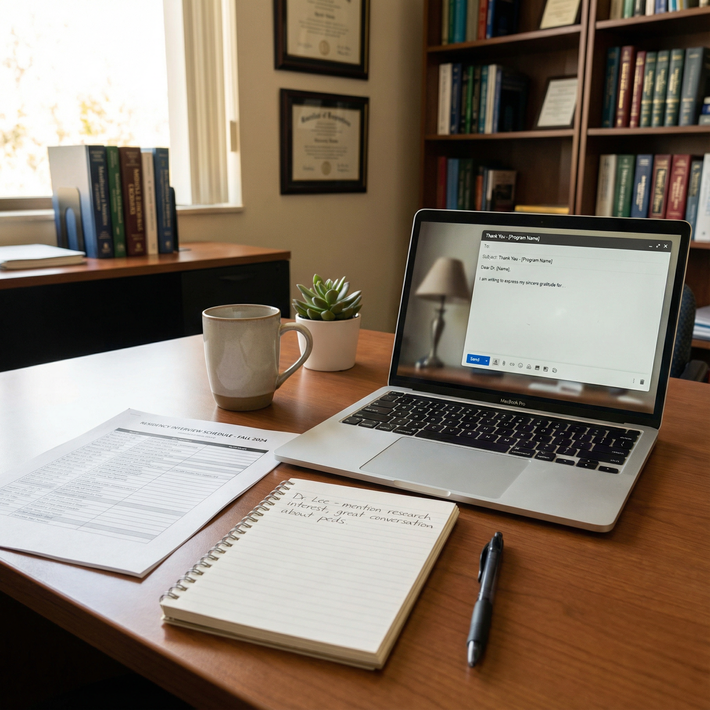
Why Thank You Notes Matter Even More for the Non-US Citizen IMG
As a non-US citizen IMG (international medical graduate), every small advantage matters in the residency match process. A thoughtful residency thank you note or post interview follow up will not turn a “no” into a “yes” by itself—but it can:
- Reinforce a positive impression
- Show professionalism and cultural awareness
- Clarify your fit with the program
- Keep you fresh in the interviewer’s memory when rank lists are made
In the US, sending a brief, professional thank you email after interview is considered good manners in most professional settings. In residency recruitment, it is generally optional but appreciated—and for foreign national medical graduates it is also a subtle way to demonstrate familiarity with US professional norms.
This article will walk you through:
- Whether you should send thank you notes (and to whom)
- Exact timelines and formats that work
- Sample email templates you can adapt
- Common pitfalls that can hurt you instead of helping
- Special considerations for non-US citizen IMGs (visas, communication style, and more)
Core Principles of Residency Thank You Notes
Before we discuss templates and timing, you need to understand the goals and limits of a residency thank you note.
What a Good Thank You Note Can Achieve
A strong note:
Expresses genuine appreciation
You are thanking them for:- Their time
- The opportunity to interview
- Any guidance or insight they shared
Reinforces your fit with the program You highlight:
- Specific aspects of the program that match your goals
- Things you observed at the interview day
- How your background and interests align
Clarifies or emphasizes key points You can briefly:
- Reiterate one or two strengths that matter to that program
- Mention something you forgot to say
- Connect your past experiences with their specific patient population, research, or educational style
Demonstrates professionalism and communication skills For a non-US citizen IMG, this is especially important. Your message showcases:
- Clear, concise written English
- Respectful tone
- Appropriate understanding of US etiquette
What a Thank You Note Cannot and Should Not Do
It cannot:
- Make up for weak scores, weak application, or a poor interview
- Turn a definite “no” into a definite “yes”
- Be used to negotiate rank positions (and you should not ask)
It should not:
- Pressure the program about your rank
- Contain promises you cannot keep
- Ask inappropriate questions about ranking strategy or internal decisions
- Turn into a long biography or second personal statement
Email vs. Handwritten Cards
For residency programs:
- Email is preferred
- Fast, trackable, professional
- Easy for faculty to read and respond to
- Handwritten cards are less common now and can cause delays or get lost in hospital mail systems. Use them only if:
- You are local and dropping it off in the internal mailbox
- The culture of the program explicitly favors handwritten notes (rare)
For a non-US citizen IMG, email also removes concerns about international postal delays and makes communication smoother.
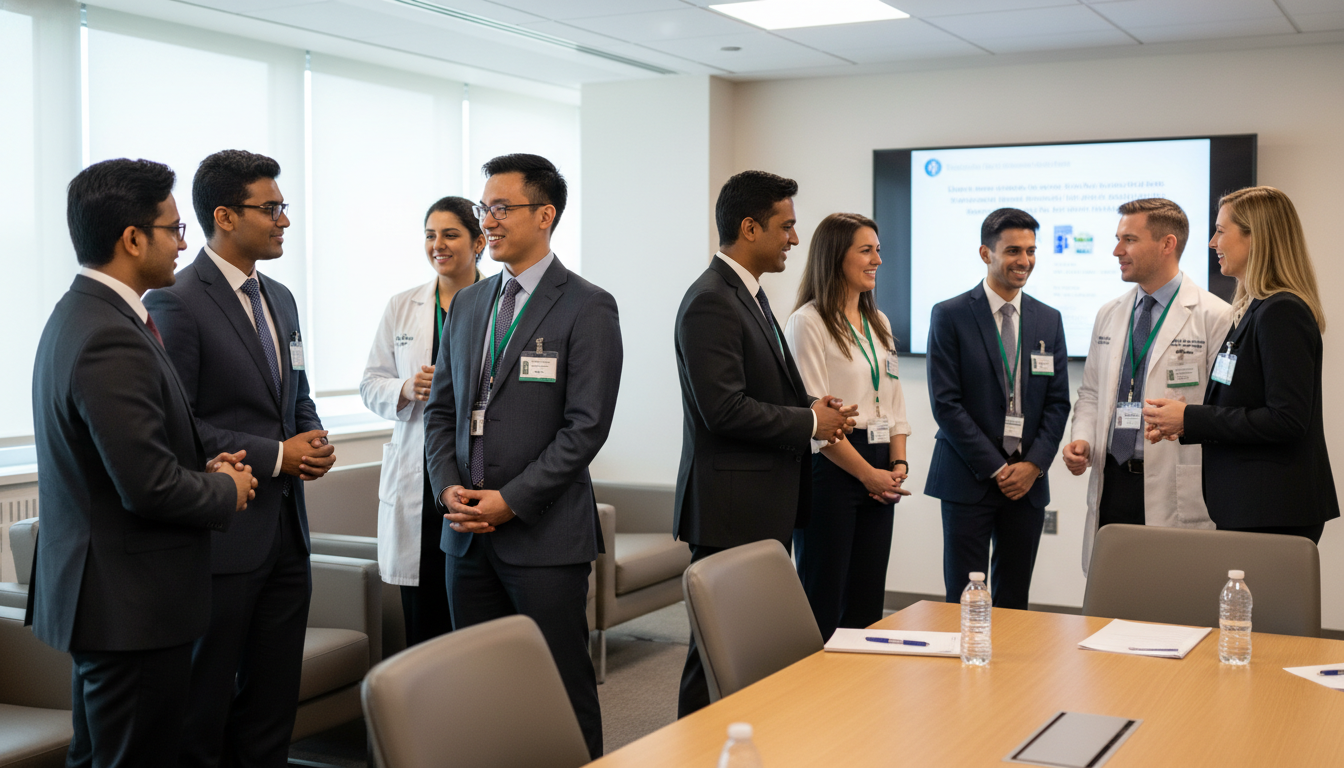
Timing, Recipients, and Format: The Logistics of Follow-Up
When to Send a Thank You Email After Interview
A reliable rule:
Send your thank you email within 24–48 hours of your interview day.
This timing:
- Keeps you fresh in the interviewer’s mind
- Feels timely and sincere
- Avoids looking rushed (within minutes) or forgetful (weeks later)
If you forgot and more than a week has passed, it is still better to send a brief note than to send nothing—just acknowledge the delay briefly (“I apologize for the delayed note.”) and keep it short.
Who Should Receive a Thank You Email?
Residency interview days vary, but these are typical recipients:
Program Director (PD)
- Yes, almost always send a note.
- Keep it concise and respectful.
- Emphasize why the program is a strong fit overall.
Associate/Assistant Program Director(s) (APDs)
- If you interviewed with them, yes, send a note.
- Tailor your message to what you discussed.
Interviewers (faculty, sometimes chief residents)
- If you had one-on-one or small-group interviews, send thank you notes to each interviewer when possible.
- Use your interview schedule or emails to confirm names and titles.
Program Coordinator
- A single group or individual email is appropriate, especially to:
- Thank them for organizing the day
- Clarify any logistical questions (within reason)
- A single group or individual email is appropriate, especially to:
Residents who interviewed you or hosted a social
- Optional but often appreciated.
- Group email to the chief resident or recruiting resident is fine; individual emails if you had one-on-one interviews.
If you don’t have the email address:
- Check the interview information packet, program website, or ask the program coordinator with a short, polite request.
Subject Lines That Work
Keep it simple and clear. Examples:
- “Thank you – [Your Full Name], [Specialty] interview on [Date]”
- “Appreciation for today’s interview – [Your Name]”
- “Thank you for the opportunity to interview – [Your Name]”
For a foreign national medical graduate, avoid overly casual subject lines; keep them professional and descriptive.
Email Length and Structure
Aim for 150–250 words per email:
- Too short: may seem insincere or generic.
- Too long: may not be read fully.
A simple structure:
- Greeting and thanks
- One or two specific details from your conversation or the program
- One or two sentences connecting your background/goals to the program
- Polite closing line
Writing Effective Thank You Notes: Examples and Templates
Below are templates you can adapt. Do not copy them word for word; programs can notice patterns if many applicants use the same text. Add your details, experiences, and tone.
1. Template for Program Director
Purpose: express overall appreciation, reinforce your fit with the program.
Key tips for non-US citizen IMG:
- Mention your visa status only if it was discussed or if you’re addressing a concern.
- Highlight understanding of the patient population and healthcare system transition.
Example:
Subject: Thank you – [Your Name], [Specialty] Interview on [Date]
Dear Dr. [Last Name],
Thank you for the opportunity to interview for the [Specialty] residency position at [Institution Name] on [Interview Date]. I appreciated the chance to learn more about your program’s emphasis on [specific theme: e.g., resident autonomy, underserved care, mentorship, research, etc.].
Our discussion about [specific topic you discussed with PD – e.g., curriculum structure, changes in night float, or community outreach] resonated with my goals as a physician. As a non-US citizen IMG who trained in [Your Country], I am particularly drawn to your program’s strong support for residents transitioning into the US healthcare system and caring for a diverse, often underserved patient population.
My experiences working with [brief relevant experience – e.g., high-volume public hospitals, multicultural communities, resource-limited settings] have prepared me to contribute meaningfully to your team while continuing to grow under your program’s guidance.
Thank you again for your time and consideration. It would be an honor to train at [Institution Name].
Sincerely,
[Your Full Name], MD
AAMC/ERAS ID: [Number]
[Optional: Phone number]
2. Template for Individual Faculty Interviewer
Purpose: personalize the message and reinforce a specific alignment.
Example:
Subject: Thank you for our conversation on [Date]
Dear Dr. [Last Name],
Thank you for taking the time to speak with me during my interview at [Institution Name] on [Date]. I especially enjoyed our conversation about [topic: e.g., managing complex comorbidities, quality improvement projects, or medical education], and I appreciated your insights into how residents are involved in [specific area you discussed].
Your description of the program’s culture—particularly the emphasis on [e.g., teamwork, graduated autonomy, scholarship]—aligns strongly with what I am seeking in a residency. Having trained as a foreign national medical graduate in [Country], I value environments where faculty are both supportive and challenge residents to grow. I was encouraged to hear how you and your colleagues mentor residents through that process.
Thank you again for your time and for sharing your perspective on [Program Name]. I hope to have the opportunity to work with you in the future.
Best regards,
[Your Full Name], MD
AAMC/ERAS ID: [Number]
3. Template for Residents or Chief Residents
Purpose: acknowledge their time, social events, and insight into program culture.
Example:
Subject: Thank you for the resident perspective – [Your Name]
Dear Dr. [Last Name] / Dear [First Name] (if they introduced themselves informally),
Thank you for speaking with me during the interview day and resident social for [Program Name]. Hearing your experiences about [topic: e.g., typical call days, mentorship, fellowship preparation, or life in the city] was extremely helpful.
As a non-US citizen IMG, I appreciated your honest discussion of how the program supports residents adapting to the US healthcare system and prepares them for fellowship or practice. The strong sense of camaraderie you described among the residents is exactly the type of environment in which I hope to train.
Thank you again for your time and for answering my questions. I would be excited to contribute to such a supportive and hard-working resident team.
Warm regards,
[Your Full Name], MD
AAMC/ERAS ID: [Number]
4. Template for Program Coordinator
Purpose: show courtesy to the person who organized your day.
Example:
Subject: Thank you for coordinating the interview day – [Your Name]
Dear [Mr./Ms./Mx. Last Name],
Thank you very much for all of your help arranging my interview with the [Specialty] residency program at [Institution Name] on [Date]. The schedule, instructions, and virtual platform were well organized, and I appreciated how smoothly the day ran.
As a non-US citizen IMG applying from [Country or Current Location], your clear communication made it much easier to navigate the process and understand the expectations for the interview day.
Thank you again for your support.
Sincerely,
[Your Full Name], MD
AAMC/ERAS ID: [Number]
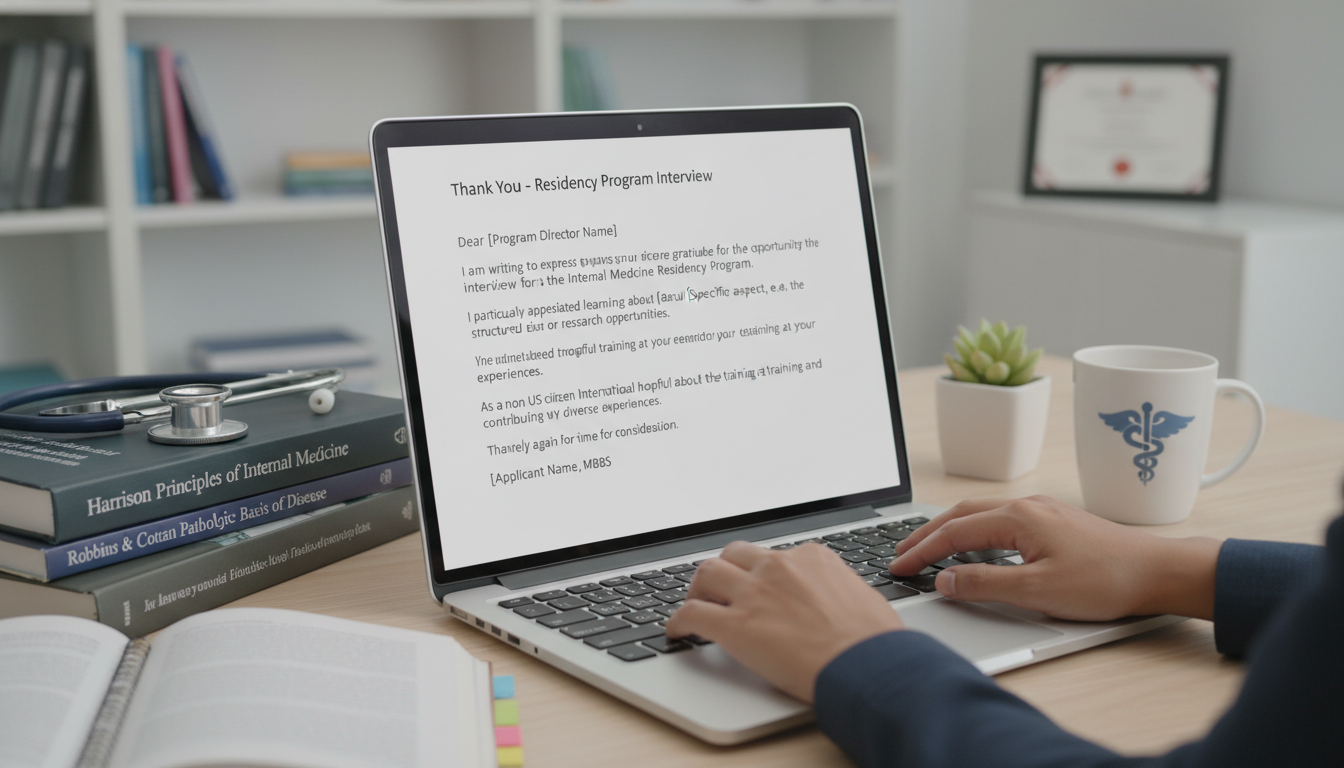
Special Considerations for Non-US Citizen IMGs
As a foreign national medical graduate, you face unique challenges and opportunities in this stage of the match process. Your communication style, cultural background, and visa status can all play a role—subtly or directly.
1. Cultural Style and Tone
In some cultures, written communication to a senior person may:
- Be very formal
- Use strong expressions of praise or humility
- Include long introductions or elaborate closings
In US academic medicine, the preferred style is:
- Polite but concise
- Respectful but not overly deferential
- Professional but not overly flowery
What to avoid:
Overly dramatic language:
- “It would be the greatest honor of my entire life…”
- “I am begging you to consider me…”
Excessive self-criticism or apologies:
- “I am just a weak candidate from another country…”
- “I am sorry for everything that I lack compared to others…”
Very long messages with multiple paragraphs about your life story
Aim for:
- Clear appreciation
- Confidence without arrogance
- 1–3 short paragraphs, well organized
2. Addressing Visa Status in Follow-Up
Your post interview follow up is usually not the best place to initiate visa discussions unless:
- The topic came up during the interview, or
- The program specifically asked you to clarify your status.
If visa issues were discussed:
- Briefly reaffirm your understanding
- Clarify any details they requested
- Do not turn the email into a legal explanation
Example sentence:
As we discussed during the interview, I am currently on an F-1 visa with OPT eligibility and would require J-1 sponsorship for residency training. I appreciate your program’s experience in working with non-US citizen IMG residents.
Never attempt to pressure them about visas (“I hope you will reconsider your policy and sponsor H-1B for me”). If their policy is not compatible with your situation, a thank you note will not change it.
3. Language Quality and Proofreading
Your thank you email after interview is a small but visible sample of your communication skills. To avoid misunderstandings:
- Use simple, direct sentences.
- Avoid idioms or slang you are not fully comfortable with.
- Run a spellcheck.
- If possible, ask a trusted friend, mentor, or US-trained colleague to quickly review one or two of your templates before you send.
Minor grammar mistakes are usually tolerated; confusing or unclear writing is not.
4. Avoiding Over-Contact and Desperation
It is tempting, especially if you are anxious about visas or limited interview numbers, to send multiple messages to a program. This can backfire.
Do NOT:
- Send repeated emails asking, “Where will you rank me?”
- Email every week “just to check in”
- Send long updates that do not significantly change your application
Reasonable contact pattern:
- 1 thank you email to each key person (within 1–2 days of interview)
- Optional: 1 later update/interest email to the PD if there is a major change (new USMLE score, new publication, visa status change) or if you want to express genuine high interest closer to rank list time—while still respecting NRMP rules and program policies.
Always check the program’s communication policy; some explicitly state they do not review or consider post-interview communication. Respect that wherever stated.
Beyond Thank You Notes: Strategic Post Interview Follow Up
Thank you notes are just one piece of your overall follow-up strategy. For non-US citizen IMGs, careful planning after each interview can improve how you present yourself and make future decisions.
1. Immediately After the Interview: Capture Details
On the same day (or evening) after your interview:
- Write down:
- Names and roles of people you met
- Specific topics each interviewer discussed
- Program strengths and concerns you noticed
- Notes about culture, workload, teaching, and location
This makes your thank you notes specific and accurate, and helps you later when ranking programs.
2. Crafting an “Interest Update” (If Appropriate)
Some applicants send a single, carefully worded follow-up email a few weeks after the interview or closer to rank order list certification, especially to programs that are among their top choices.
Before you send:
- Check if the program has a statement like “We do not accept or review post-interview communication.” If so, do not send such an email.
- Ensure you are not violating NRMP rules (you may express interest, but should not ask programs to disclose their rank position, and they should not ask you to disclose yours).
What this email might include:
- Brief reminder of who you are
- One or two reasons the program remains high on your list
- Any important updates:
- Step 3 passed
- New US clinical experience
- Accepted publication
- Visa status clarification
Keep it short (less than 200–250 words) and send it once to only a small number of programs that are truly among your top choices.
3. Handling Silence and Anxiety
Most programs do not send post-interview status updates. You may not hear from them until Match Day. This silence does not necessarily mean disinterest; many programs avoid any communication that might be interpreted as “recruitment.”
Use this time to:
- Continue improving your clinical skills or research
- Prepare for Step 3 if appropriate
- Plan for soap (Supplemental Offer and Acceptance Program) and backup options
- Maintain your emotional health and support network
Sending multiple extra emails will not reduce your anxiety—and may harm your candidacy.
Frequently Asked Questions (FAQ)
1. As a non-US citizen IMG, is it mandatory to send a residency thank you note after every interview?
It is not mandatory and many applicants match without sending any thank you notes. However, for a non-US citizen IMG, it is strongly recommended because it:
- Shows professionalism and cultural awareness
- Gives you a chance to reinforce your fit
- Leaves a positive last impression
If a program explicitly says “Please do not send thank you notes,” respect that instruction and do not send them.
2. Can I say that I will rank a program number one in my thank you email?
Be very cautious. You should only say “I will rank your program highly” or “You are among my top choices” if that is truthful. Some applicants choose to tell only one program “I intend to rank you first,” but this should be:
- Completely honest
- Sent close to rank list deadline
- Not used to pressure the program
Remember that NRMP discourages misleading or coercive communications. Never ask a program, “Where will you rank me?”
3. Should I mention my visa needs in the thank you note if it wasn’t discussed?
Generally, no. The thank you note is not the best place to introduce a complex topic that was not mentioned before. Most programs already know your citizenship and likely visa category from ERAS. If they need clarification, they will reach out.
You may briefly reference it only if it was already discussed or if the program requested additional information.
4. What if my English is not perfect? Should I still write individual thank you emails?
Yes. Programs understand that non-US citizen IMGs are often writing in a second (or third) language. A few small grammar mistakes are acceptable. Focus on:
- Clear structure
- Simple sentences
- Polite tone
- Accurate spelling of names and program
If possible, have a friend or mentor review one or two example emails so you can adjust your style and then reuse that structure for all your messages.
Follow-up after residency interviews will not single-handedly secure your match, but for a non-US citizen IMG, it is a valuable chance to highlight your professionalism, clarify your fit, and navigate cultural expectations wisely. Thoughtful, respectful, and well-timed thank you notes—and a disciplined, strategic post interview follow up plan—can help you stand out in a crowded field while honoring both US norms and your own authentic voice.