Understanding Post-Interview Etiquette as a US Citizen IMG
As a US citizen IMG or American studying abroad, the residency interview season is both exciting and high-stakes. You’ve invested years in your medical education overseas, navigated licensing exams, and now every interaction with programs feels critical. One area that causes particular anxiety is the thank you email after interview and overall post interview follow up strategy.
You might be asking yourself:
- Do programs really care about thank you notes?
- Will a residency thank you note help—or hurt—my chances?
- Is follow-up etiquette different as a US citizen IMG?
- What exactly should I say, and when?
This guide breaks down a practical, evidence-informed, and professional approach to thank you notes & follow-up strategies tailored specifically for US citizen IMGs. You’ll learn how to communicate professionally, avoid red flags, and use follow-up as a way to reinforce your fit—without overstepping NRMP rules or program boundaries.
Do Thank You Notes Really Matter?
The Real Impact of a Residency Thank You Note
Most program directors will tell you: a thank you note will not turn a weak application into a strong one. However, it can:
- Reinforce a positive impression from the interview
- Demonstrate professionalism and courtesy
- Clarify your interest in the program
- Help an interviewer remember you more clearly
- Provide context if there was something unique about your situation as an IMG
For highly competitive specialties, or for borderline cases, this extra touch can sometimes make a small difference at the margins. More importantly, it’s part of professional etiquette you’ll use throughout your career.
From multiple program director surveys (pre-2024), the consensus is:
- Some programs do not factor thank you notes into ranking.
- Others do look at them, especially to gauge interest and professionalism.
- A few programs explicitly state they do not want thank you notes.
As a US citizen IMG, being seen as professional, organized, and appreciative may carry additional weight, especially at programs less familiar with your medical school.
When Thank You Notes Can Backfire
Thank you notes become harmful when they:
- Are overly long, emotional, or repetitive
- Include spelling or grammar mistakes
- Make promises or statements that violate NRMP Match rules, such as:
- “I will rank you #1 if you rank me.”
- “Please rank me highly and I will rank you highly.”
- Try to negotiate or pressure the program
- Ignore clear program instructions not to send follow-up emails
The goal is professional courtesy, not persuasion or bargaining.
Crafting the Perfect Residency Thank You Note
Timing: When to Send Your Thank You Email After Interview
For most programs, ideal timing is:
- Within 24–72 hours after your interview day
- Avoid sending during the interview itself or while still at the program
- If interviews are on Friday, sending by Monday is perfectly fine
This window ensures:
- Details are still fresh in your memory
- You don’t look rushed or robotic
- You show prompt, but not desperate, interest
If you’re an American studying abroad and juggling time zones, draft your note the same day and schedule it to send during normal US business hours (if your email platform allows).
Who Should Receive a Thank You Note?
Common recipients:
- Your primary interviewer(s)
- Program Director (PD) – if you had a meaningful interaction or interview with them
- Associate Program Director or key faculty – if you had a designated interview
- Program Coordinator – optional, but often appreciated, especially if they were very helpful
If you had a panel interview, it’s acceptable to send one email to the group if they all share the same address, or one to the main interviewer acknowledging the team.
If the program explicitly says “Please do not send thank you notes” (some do on their websites or in pre-interview messages), respect that. Professionalism includes following instructions.
Email Structure: Simple and Professional
Your email should be:
- Short (200–300 words or less)
- Specific, not generic
- Polite and confident, not pleading
A clear structure:
- Subject line
- Greeting
- Thank you statement + reference to the interview
- Personalization: something specific you appreciated
- Brief statement of fit/interest
- Professional closing
Subject Line Examples
- “Thank You – [Your Name], [Specialty] Interview on [Date]”
- “Thank You for the Opportunity to Interview – [Your Name]”
- “Appreciation for Our Conversation on [Interview Date] – [Your Name]”
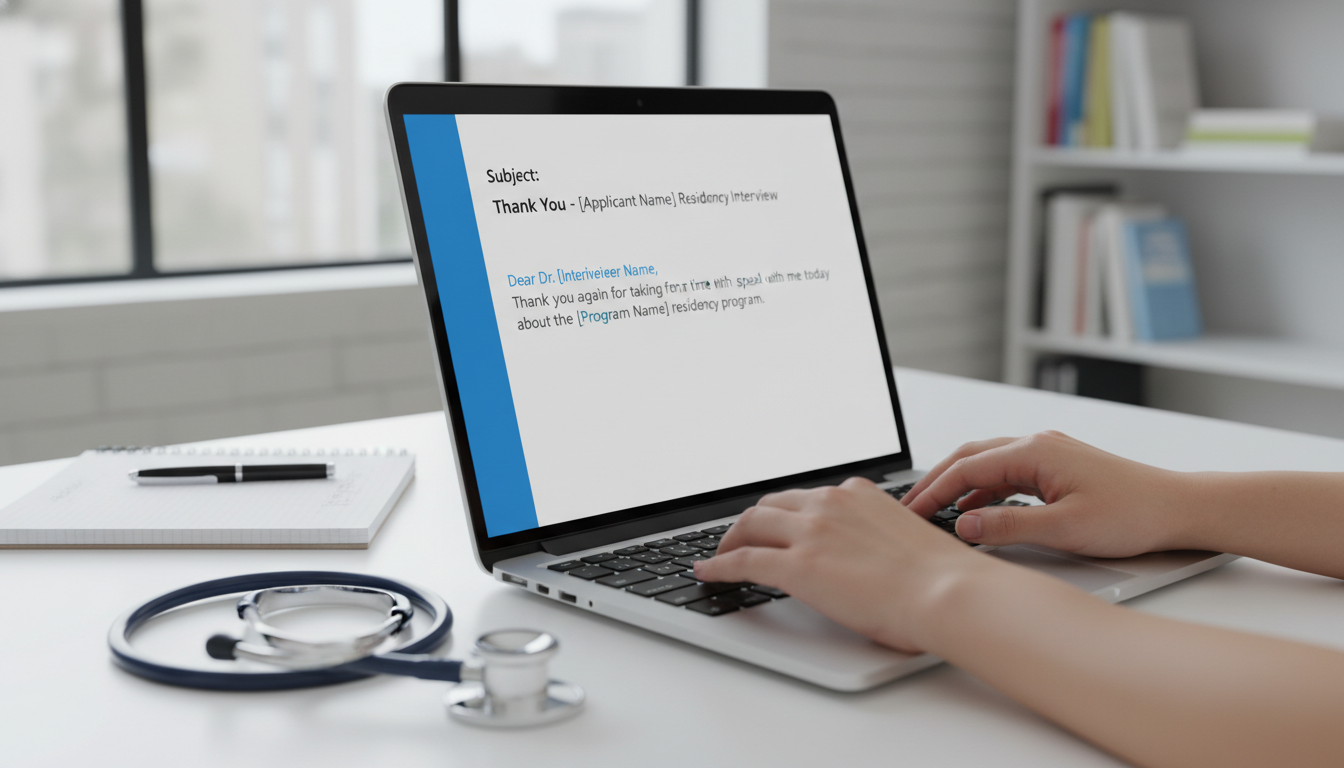
Sample Thank You Email (Program Director)
Use this as a template and customize it:
Subject: Thank You – John Smith, Internal Medicine Interview on November 10
Dear Dr. Rodriguez,
Thank you for taking the time to speak with me during my interview at [Program Name] on November 10. I appreciated the opportunity to learn more about your curriculum and the emphasis on resident autonomy within a well-supported environment.
As a US citizen IMG who completed medical school at [School Name] abroad, I was particularly encouraged by the way your program integrates diverse educational backgrounds into a cohesive resident team. Our discussion about the robust clinical exposure at your county hospital and the opportunities for research in quality improvement confirmed that your program aligns well with my training goals and interests.
I am very interested in [Program Name] and would be honored to train there. Thank you again for your time and for considering my application.
Sincerely,
John Smith, M.D.
AUA College of Medicine, Class of 2025
AAMC ID: 12345678
This example:
- Mentions your US citizen IMG status briefly and positively
- References specific program features
- Expresses genuine interest without making ranking promises
Sample Thank You Email (Faculty Interviewer)
Subject: Thank You for Our Conversation – Sarah Johnson, Pediatrics Interview
Dear Dr. Patel,
Thank you for the enjoyable conversation during my interview at [Program Name] on October 25. I particularly appreciated your insights into how residents are supported as they transition from international medical schools into the US healthcare system.
Hearing about your experiences mentoring trainees from varied backgrounds, including US citizen IMGs, reassured me that [Program Name] is a place where I could grow both clinically and professionally. I was especially interested in your description of the continuity clinic model and how residents are encouraged to take ownership of their patient panels.
I am grateful for your time and for sharing your perspective on the program.
Best regards,
Sarah Johnson, M.D.
University of Debrecen Faculty of Medicine, Class of 2025
AAMC ID: 98765432
Common Mistakes to Avoid
- Copy-paste emails to multiple programs without changing specifics
- Using informal language or shortcuts (e.g., “thx,” “u,” emojis)
- Overly personal comments (“I felt we had a special connection”)
- Attaching your CV or additional documents unsolicited
- Over-explaining weaknesses (e.g., “about my Step 1 attempts…”) in a thank you note
- Asking for feedback on your performance in the interview
The goal is a polished, respectful follow-up, not a second personal statement or plea.
Strategic Follow-Up Beyond Thank You Notes
Thank you notes are just one part of post interview follow up. As a US citizen IMG, you may worry more about “showing interest” to counter any perceived bias. It’s important to be thoughtful and measured.
Types of Post-Interview Communications
- Immediate Thank You Notes – within 1–3 days after interview
- Update Emails – later in the season, if you have meaningful new information
- Letters of Interest or Intent – cautious and rare, and must follow NRMP rules
- Administrative Follow-Up – clarifications about missing documents, second looks, etc.
When an Update Email Makes Sense
Appropriate reasons to send an update:
- You had a significant achievement since the interview:
- New first-author publication accepted
- Major award, honor, or scholarship
- New leadership role or impactful QI/clinical project
- You gained new objective experience directly tied to the specialty:
- Additional US clinical experience (USCE)
- New sub-internship or rotation with strong evaluation
- You need to correct something important or clarify a misunderstanding
Do not send updates for minor events like:
- A poster acceptance at a small meeting (unless research-heavy specialties)
- Routine coursework updates
- Repeated statements only about “continued interest” with nothing new
Sample Update Email
Subject: Application Update – New Publication – [Your Name], [Specialty]
Dear Dr. [Last Name],
I hope you are doing well. I interviewed at [Program Name] on November 18 and wanted to share a brief update regarding my application.
Since our interview, my manuscript titled “[Title]” has been accepted for publication in [Journal Name]. The project focuses on [1–2 concise lines about relevance, ideally tying into something you discussed or the program’s interests].
I remain very interested in [Program Name] and continue to feel that your program’s emphasis on [specific program feature] aligns strongly with my long-term goals.
Thank you again for your time and consideration.
Sincerely,
[Your Name, Credentials]
AAMC ID: [Number]
Letters of Interest vs. Letters of Intent
These terms are often confused, and misuse can create ethical issues.
Letter of Interest
- States that you are very interested in a program
- Does not promise ranking positions
- Can be sent to multiple programs
Letter of Intent
- States that you plan to rank this program #1
- Should only be sent to one program
- Must be genuine and consistent with your actual rank list
As a US citizen IMG, you may feel pressure to send strong letters to many programs. However:
- Overusing “intent” language is considered unethical and may harm your reputation.
- Programs talk to each other; misleading multiple programs can backfire.
- The NRMP Match Communication Code of Conduct discourages soliciting or making rank commitments.
When in doubt, frame your message as interest, not intent.
Sample Letter of Interest (Ethical and Professional)
Subject: Continued Interest in [Program Name] – [Your Name], Family Medicine Applicant
Dear Dr. [Last Name],
I wanted to express my continued interest in [Program Name] following my interview on December 5. The more I reflect on our conversations and the information shared on interview day, the more I feel that your program’s strong outpatient training, diverse patient population, and supportive teaching environment align with what I am seeking in a residency.
As a US citizen IMG, I especially value your program’s history of successfully training residents from a variety of educational backgrounds and helping them grow into confident, independent clinicians.
Thank you again for your time and for considering my application.
Warm regards,
[Your Name, M.D.]
AAMC ID: [Number]
Notice: no mention of rank order, no promises, no pressure.
Special Considerations for US Citizen IMGs & Americans Studying Abroad
Your context as a US citizen IMG or American studying abroad influences how you might approach thank you notes and follow-up.
Highlighting Your Unique Path Without Over-Explaining
In your residency thank you note or follow-up messages, you can:
- Briefly reference being a US citizen IMG to reinforce your connection to the US healthcare system.
- Emphasize how your international training broadens your perspective, especially with diverse patient populations.
- Reassure programs of your long-term commitment to practice in the US.
Avoid:
- Using the thank you note to defend your choice of school or explain every gap
- Focusing on perceived disadvantages rather than strengths
If you need to clarify something (a visa issue, exam timeline, etc.), that’s better addressed:
- In your initial application
- During the interview, if raised
- Or in a brief, focused follow-up only if necessary
Managing Programs’ Varied Experience With IMGs
Some residency programs have long histories with IMGs; others rarely train graduates from overseas schools. Your follow-up strategy should be sensitive to this.
If the program regularly accepts IMGs:
- You can reference how their track record reassures you about support and integration.
- Emphasize your readiness to hit the ground running with US clinical norms.
If the program rarely accepts IMGs:
- Highlight your US connections (family, prior US work, USCE, Step scores).
- Use follow-up to reinforce how your experiences match their patient population or educational style.
- Avoid sounding defensive or apologetic—focus on competence and fit.
Professionalism and Perception
For US citizen IMGs, every communication can either reinforce or challenge hidden biases. Aim for:
- Spotless grammar and spelling (have someone proofread if needed)
- Formal email structure (salutation, paragraphs, closing)
- Polite but confident tone
- Consistency: don’t tell one program they are your “top choice” and then send similar wording to ten others
Think of your post-interview communications as part of your professional brand.
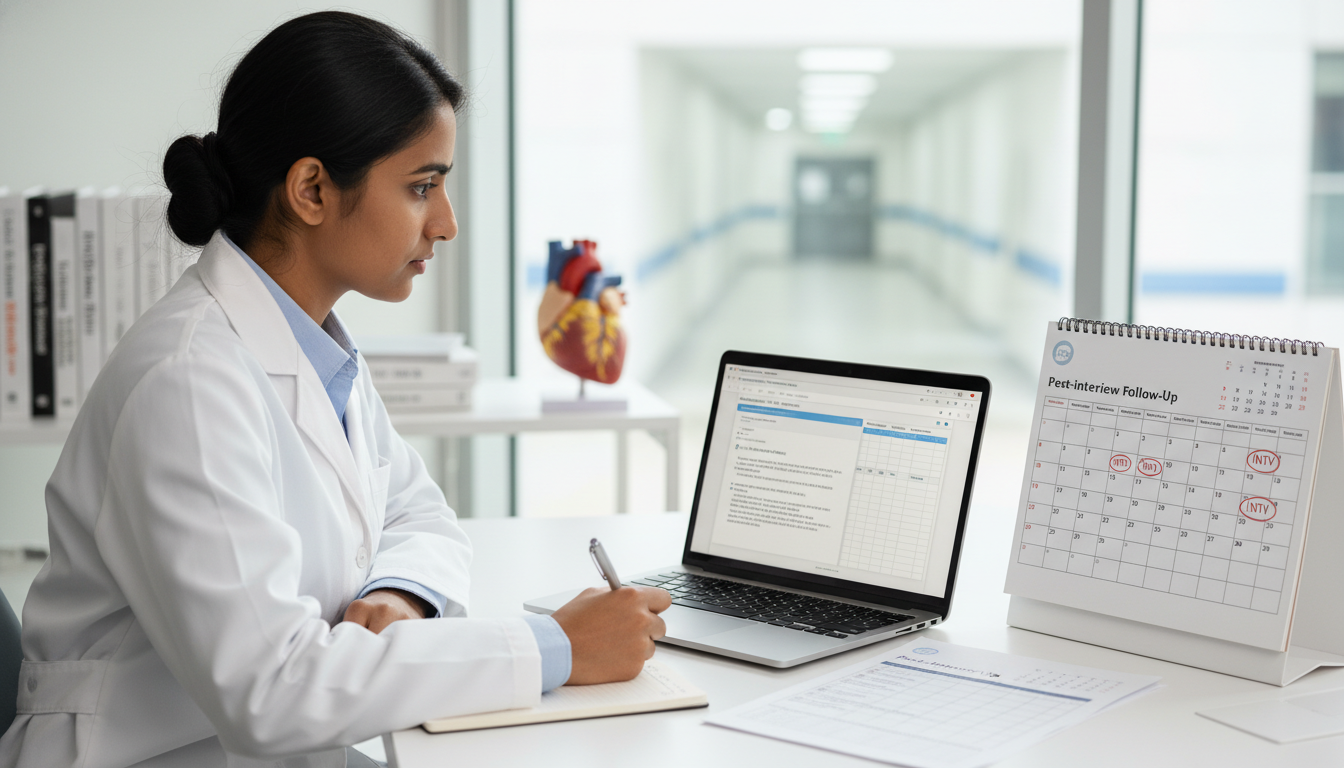
Practical System for Organizing Your Follow-Up
Interview season can be hectic, especially if you’re balancing rotations abroad. A disorganized approach can lead to:
- Forgetting to send a thank you
- Mixing up programs in your messages
- Double-emailing or sending to the wrong person
Create a Simple Tracking Spreadsheet
Include columns such as:
- Program Name
- Specialty
- Interview Date
- Interviewer Names & Titles
- Program Coordinator Email
- Thank You Sent? (Y/N + date)
- Notes for Personalization (unique features, discussion points)
- Updates Sent? (Y/N + date)
- Level of Interest (High/Medium/Low)
Update this daily during peak season. This small investment protects you from embarrassing mistakes.
Batch Your Thank You Notes
- Draft simple templates ahead of time.
- After each interview day, jot down notes about:
- Memorable discussions
- Specific features you liked
- Any questions they answered that were especially helpful
- Within 24–48 hours, customize and send.
This balances personalization with efficiency.
Respect Boundaries and Your Own Well-Being
While follow-up is important, constantly checking email or overanalyzing program silence is draining. Set limits:
- Designate 1–2 times per day to handle email.
- Avoid repeatedly emailing a program if they don’t respond; many programs simply don’t reply to thank you notes.
- Remember that silence ≠ disinterest; most programs are overwhelmed during interview season.
FAQs: Thank You Notes & Follow-Up for US Citizen IMGs
1. Do I have to send a thank you note after every residency interview?
You are not required to, and some programs explicitly discourage it. However, sending a concise, professional thank you email after each interview is considered good etiquette and is generally recommended—unless the program has clearly stated otherwise. For you as a US citizen IMG, it’s an easy way to demonstrate professionalism and reinforce genuine interest.
2. Should I mention that I’m a US citizen IMG or American studying abroad in my thank you note?
You don’t need to mention it in every thank you, especially if it was discussed in the interview or is obvious from your application. But it can be helpful to briefly reference it when relevant—for example, when appreciating the program’s support for diverse educational backgrounds or when highlighting how your international training shapes your perspective. Keep it positive and concise.
3. Is it okay to tell a program they are my “top choice” or that I will rank them #1?
You must be very careful here:
- It’s acceptable to tell one program (only if it is true) that they are your planned #1 choice in a “letter of intent.”
- It is not acceptable or ethical to make that claim to multiple programs.
- Never request that programs reveal or change their rank list, and don’t promise to rank them highly in exchange for anything.
When unsure, it’s safer to express “strong interest” without making explicit ranking promises.
4. How many follow-up emails are too many?
In most cases:
- One thank you email after the interview is enough.
- One update email later in the season is acceptable if you have a truly meaningful update.
- A brief letter of interest can be combined with an update if timed well.
Repeated follow-ups without new information (every few weeks asking for status updates or restating interest) can make a negative impression. The key is quality and relevance, not quantity.
Thoughtful thank you notes and a measured follow-up strategy will not guarantee a match, but they can polish your professional image, underscore your interest, and help you stand out as a mature, well-prepared candidate. As a US citizen IMG, your path is unique—but your communication can be just as polished and effective as any US graduate’s.