

Last week I was on the phone with a new MD who’d signed a full‑time research job for her gap year. Six weeks in, she was miserable—80% data entry, toxic PI, no time left for Step 2 or residency prep. Her exact words: “I feel trapped. I already signed. Am I screwed?”
If that feels uncomfortably familiar, you’re who I’m writing for.
You’re in a gap‑year job or contract you already signed. You hate it. You’re worried about burning bridges, money, and how this looks to residency programs. You’re not trapped—but you do need to be smart and deliberate.
Let’s walk through exactly how to evaluate, exit, and pivot without blowing up your application cycle.
Step 1: Get Extremely Clear on Your Situation (Not Your Feelings)
You might feel like quitting yesterday. Before you do anything, you need facts, not vibes.
Sit down with:
- Your signed contract / offer letter
- Your residency timeline (Match year, when you’ll apply)
- Your current financial numbers (rent, loans, runway, family help if any)
Then answer, in writing, three questions:
What exactly is wrong here?
Not “this sucks.” Be specific and concrete:- Hours way beyond what was promised
- No protected time for Step 2/CK or applications
- Toxic environment (yelling, harassment, retaliation)
- Work that doesn’t match what you were sold (pure scribing vs “clinical research with mentorship,” for example)
- Commute or schedule destroying your ability to study or sleep
Is this fixable with boundaries or adjustments?
Separate “I don’t love this” from “this is actively harming my career or health.” Big difference.- Annoying but survivable: Boring work, mediocre mentorship, light micromanagement
- Harmful: Unable to study at all, chronic 60–80 hour weeks, repeated mistreatment, unsafe conditions
What’s the real impact on your residency application?
Be blunt:- Are you too exhausted to prep for Step 2/CK or specialty‑relevant research?
- Are you missing key opportunities (letters, projects, leadership)?
- Are you so burned out you’re considering changing specialties or quitting medicine?
Once you have those written down, you’ll know if you’re in:
- “This is annoying but I can finish” territory, or
- “I need to get out” territory
Do not skip this. Your entire strategy depends on it.
Step 2: Read Your Contract Like a Lawyer (For 30 Minutes)
Next, you need to know what you actually agreed to—not what HR said in the hallway.
Open the contract and hunt for:
- Term / Duration
- Termination clause (this is the gold)
- Notice requirements
- Penalties / repayment language
- Non‑compete or moonlighting restrictions
You’re looking for wording like:
| Clause Type | What It Usually Means |
|---|---|
| "At-will" | Either side can end at any time, usually no cause |
| "Without cause" | Can terminate with notice (e.g., 2–4 weeks) |
| "For cause" | Only for specific bad behavior / breach |
| Early termination fee | You may owe if leaving before set end date |
| Non-compete | Limits where/what you can do next |
If you see “employment is at‑will,” you’re in a strong position. You can almost always leave with reasonable notice.
If you see a fixed term and only “for cause” termination (rare for gap‑year jobs, more common in some fellowships), you need more finesse. That’s when a quick consult with legal (your med school, union if any, or local employment clinic) becomes useful.
But most of you will discover: you actually can leave, they just didn’t emphasize that part during onboarding.
Step 3: Decide: Adjust and Survive vs Strategically Exit
Here’s the real decision point. Do not just “ghost and pray.” That’s how you end up with burned references and awkward ERAS conversations.
Path A: Stay and Restructure (If It’s Salvageable)
If the job is:
- Not abusive
- Rough but tolerable
- Interfering with your goals but might be fixable
Then the move is: deliberate boundary‑setting and renegotiation.
That conversation with your supervisor sounds like:
“I’m committed to doing good work here and finishing out the year, but I need to be honest about my situation. I’m applying for residency this upcoming cycle and I’m falling behind on Step 2 and application prep.
Right now I’m working X hours per week / late evenings / weekends, which is making it difficult. Can we adjust my schedule or responsibilities so I can protect 1–2 evenings for exam prep and a half‑day for application work?”
Be specific with your ask:
- Move to 4 days per week instead of 5
- Firm no‑weekends unless emergency
- Protected blocks for Step 2/CK or research writing
- Shift from pure grunt work to more meaningful tasks that could lead to a letter or an abstract
If they’re reasonable and they value you, they’ll usually work with you. If they act offended that you have career goals—make a note. That’s not a place you owe long‑term loyalty.
Path B: Exit Cleanly and Pivot (If It’s Doing Real Damage)
If you’re in one of these situations:
- You’re miserable to the point of dread every morning
- You have zero time or energy left for Step 2/CK or ERAS
- There’s clear toxicity, harassment, or unethical behavior
- The work is completely misrepresented
Then leaving is not “being flaky.” It’s protecting your long‑term career.
Here’s the sequence I recommend. In this order.

| Step | Description |
|---|---|
| Step 1 | Clarify problems & read contract |
| Step 2 | Decide stay vs exit |
| Step 3 | Request schedule/role changes |
| Step 4 | Quietly line up next step |
| Step 5 | Plan finances & timing |
| Step 6 | Give notice professionally |
| Step 7 | Transition responsibilities |
| Step 8 | Explain move on ERAS & interviews |
1. Quietly line up your next move first
Unless your situation is unsafe or clearly abusive, you don’t walk in and resign with nothing lined up. That just trades one kind of panic for another.
Start exploring:
- Part‑time clinical work: scribing, MA, clinic assistant, telehealth support
- Hourly per diem roles (ideal for study + flexibility)
- Short, discrete research projects with clear deliverables (abstract by X date)
- Tutoring (MCAT, Step 1/2) if you’re strong on exams
You want something that:
- Keeps money coming in
- Gives you more control over your hours
- Ideally still supports your narrative (clinical exposure, teaching, research)
Do this quietly. Update your CV, send feeler emails, talk to old attendings, residents, research mentors:
“I’m in a full‑time gap year role right now that’s not a great fit long term. I’m planning to apply to [specialty] this coming cycle and looking for part‑time or flexible work that better aligns with that. Do you know of any clinics, projects, or roles that might fit?”
You’d be surprised how often someone replies with, “Actually, our clinic needs a scribe,” or “We could use help on a short research project.”
2. Plan your financial runway
You need a basic, honest budget. No fantasy numbers.
- What’s your monthly bare‑bones cost (rent, food, transport, minimum payments)?
- How much do you have saved?
- Any family support you’re actually willing to use, not just hypothetically?
- How long can you realistically afford to pivot to part‑time or a cheaper role?
This isn’t a personal finance lecture. This is: don’t quit into a financial freefall two months before ERAS opens.
If your runway is tight, the target is a flexible, lower‑stress job, not “no job.” You want time to study, not three jobs just to stay afloat.
Step 4: The Actual Exit – How to Leave Without Blowing Yourself Up
Once you have:
- Read your contract
- Decided you’re leaving
- Identified your next step or at least a viable plan
Now you resign. Professionally. Calmly. No apologies for having a spine.
Check your notice requirement
If your contract says “two weeks’ notice,” give two weeks. If it doesn’t specify, two weeks is still standard and respectful. Four weeks is generous if you’re in a niche or critical role.
Write a short, clean resignation email
Something like:
Subject: Resignation – [Your Name]
Dear [Supervisor],
I’m writing to formally resign from my position as [Title], with my last working day on [Date, at least X weeks from now].
I’ve appreciated the opportunity to work with the team and have learned a great deal about [one or two neutral things]. Given my upcoming residency application timeline and career plans, I need to transition to a role that better aligns with those priorities.
I’m happy to help with a smooth transition over the next [X weeks], including training a replacement or documenting my workflows.
Thank you again for the opportunity.
Sincerely,
[Your Name]
Then you have the conversation in person or by video. The script is similar. Short, firm, polite.
You’re not asking for permission. You are informing them of a decision.
If they pressure or guilt‑trip you
This happens a lot with gap‑year roles. “We invested so much in training you.” “We were counting on you for the year.” “This will look bad on your record.”
You hold the line:
“I understand this creates extra work, and I don’t take the decision lightly. I’ve thought carefully about my residency timeline and what I need for the upcoming application cycle. That’s ultimately my priority. I’m committed to making the next [X weeks] as smooth as possible.”
If they threaten your residency future—“I won’t write you a letter,” “I’ll tell programs you’re unreliable”—that’s a red flag. But also: one supervisor rarely has that much power. Programs look at patterns, not one annoyed PI.
You do not owe them your mental health or your Match year.
Step 5: How to Explain This on ERAS and in Interviews
Residency programs care less about “you left a job” and more about:
- Are you thoughtful and self‑aware?
- Can you commit and follow through?
- Did you learn something or grow, or did you just run?
You don’t need to bury or hide your gap‑year role. You do need a clean, consistent story.
On ERAS (and CV)
You list the position with accurate start and end dates. If it’s only a few months, that’s okay. This happens.
If you’re worried, you can add a brief bullet that hints at the transition:
- “Full‑time research assistant in [field]; transitioned earlier than planned to a more flexible role to focus on residency application and Step 2 preparation.”
No drama. Just a fact.
In interviews
You’ll get the question: “Tell me about your gap year.” Or, “I see you transitioned positions—what happened there?”
A good structure:
- Start with what you were aiming for
- What you discovered was misaligned
- The deliberate decision you made
- What you moved to and what you gained
Example:
“I initially accepted a full‑time research position in [field] because I wanted more exposure to [specialty] and the chance to be involved in clinical projects. A few months in, I realized the role was heavily administrative with long hours and very limited time for Step 2 prep or substantive research.
Given my goal to apply in [specialty] this cycle, I decided to transition to a more flexible part‑time clinical role where I could both stay engaged with patient care and protect time for exam prep and applications. That move gave me better balance and actually clarified that [specialty] is where I want to be long term.”
Clean. Grown‑up. No trash‑talking your old employer.
What you do not say: “They lied to me, it was toxic, total waste of time.” Even if that’s true. You reframe it as misalignment and a course correction.
Step 6: Pivot to a Gap Year That Actually Serves Your Match
Once you’ve exited—or restructured—you don’t drift. You build a gap year that directly feeds your application.
Here’s what tends to work best, depending on your situation.
If you still need exam performance (Step 2/CK, OET, etc.)
Your primary job is a study schedule. Everything else is a support beam.
You want:
- 0.5–0.8 FTE (20–32 hours) of low‑stress, predictable work
- Routine hours (no rotating nights/weekends if you can avoid it)
- Minimal emotional carryover when you get home
Good options:
- Part‑time scribe in outpatient clinic
- MA/assistant roles with stable hours
- Remote chart review, QA work, or basic telehealth coordination
If you need stronger specialty exposure or letters
You want proximity and meaningful contact with attendings in your target field.
- Part‑time clinic staff in that specialty
- Research assistant on a focused project with clear authorship possibilities
- Short unpaid/paid observerships or shadowing blocks if you can afford it
Your script to potential mentors looks like:
“I’m applying to [specialty] this upcoming cycle. I have [X background]. I’m currently restructuring my gap year and would love to know if there are ways I could help your team—clinically or with short research projects—in a way that could realistically lead to a strong letter if I perform well.”
You’re not begging for a letter. You’re stating the goal and asking for a structure where that’s plausible.
Step 7: What If You Truly Have to Bail Fast?
Sometimes the situation is dangerous or truly abusive.
If there is:
- Harassment, discrimination, or retaliation
- Being forced to do something clearly unethical or unsafe
- Serious health decline (panic attacks, suicidal thoughts, etc.)
Then your duty is to get out, even if you don’t have a next job lined up yet.
You still try to:
- Give notice if it’s safe
- Send a brief written resignation (for the record)
- Avoid long email dumps; keep it factual
You then:
- Alert your med school’s student affairs / GME office—they’ve seen this before
- Use them as a reference instead of the toxic employer if needed
- Get medical / mental health support immediately
Residency programs will understand a short, factual explanation like:
“I was in a position during my gap year where there were serious concerns about [fit / ethics / environment]. After discussing with mentors, I made the decision to leave for my own well‑being and focus on preparing for residency. Since then I’ve been doing [X], which has been a much better fit and allowed me to [study / engage with patients / contribute meaningfully].”
You do not owe anyone the details of the worst parts unless there’s a formal investigation or legal process.
Quick Reality Check: How Programs Actually See This
Let me be blunt. Program directors don’t sit around dissecting your gap year job changes unless there’s a pattern of chaos.
One short gap‑year role that you left thoughtfully?
Not a big deal.
What matters a lot more:
- Your exam scores
- Your letters
- Your performance in clinical rotations
- Whether you have a coherent, honest narrative about your path
Leaving a bad situation is not a red flag. Staying in something that’s actively sabotaging your performance and then limping into ERAS with weak scores, no letters, and a burned‑out affect—that’s the problem.
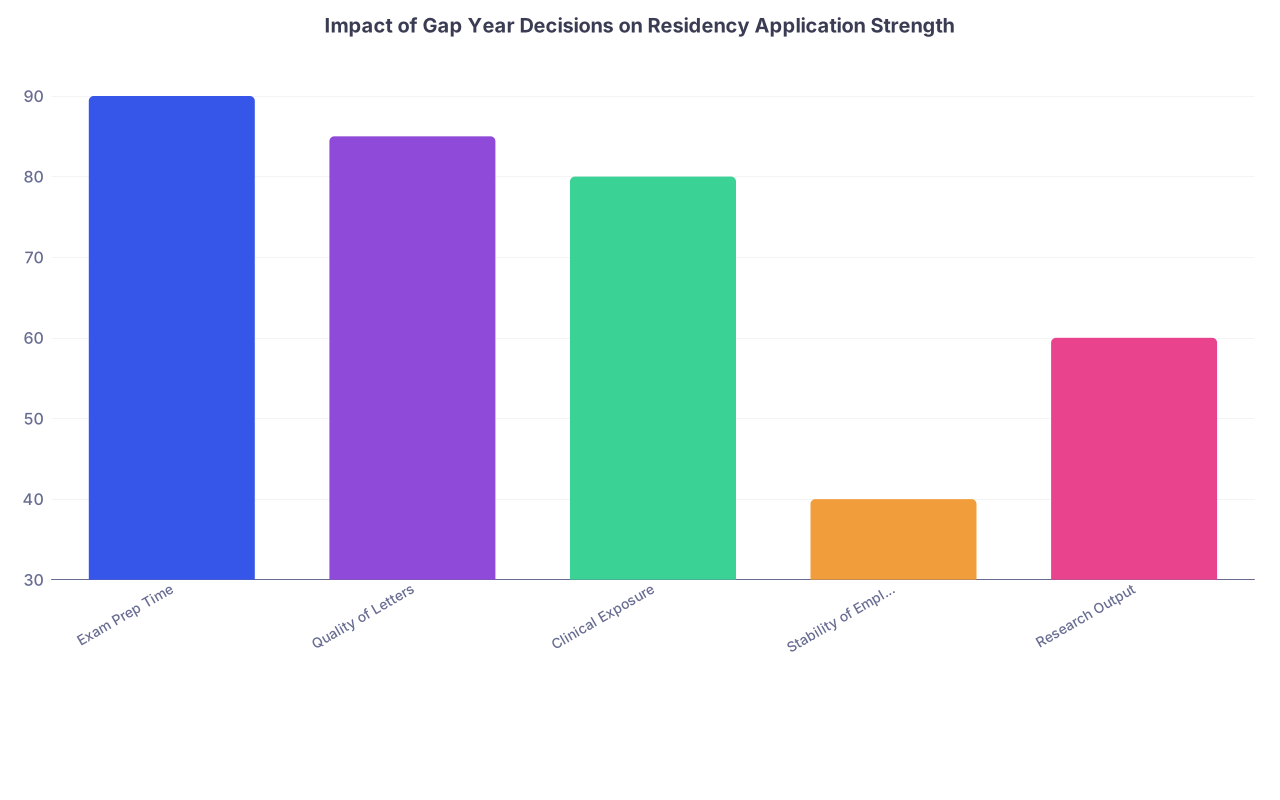
| Category | Value |
|---|---|
| Exam Prep Time | 90 |
| Quality of Letters | 85 |
| Clinical Exposure | 80 |
| Stability of Employment | 40 |
| Research Output | 60 |
(I’m exaggerating the numbers to make a point: exam prep, letters, and real exposure beat a “perfect” one‑year contract every time.)
FAQs
1. Will leaving a gap year job early ruin my chances at matching?
No, not by itself. I’ve seen plenty of applicants leave a bad position after 2–4 months and match just fine. What ruins chances is poor Step 2/CK performance, weak letters, or no coherent story. If leaving helps you fix those, it can actually improve your odds.
2. Do I have to list this short job on ERAS if I leave after a couple months?
If it was a formal position with pay and onboarding, yes, you should list it. Omitting it looks worse than a short stint with a sane explanation. You can describe it briefly and emphasize the transition to a better‑aligned role. ERAS isn’t the place to hide things and hope nobody notices.
3. Should I ask my current supervisor for a letter before I resign?
Only if:
- They actually know your work well,
- You’ve had a solid relationship, and
- You’d want them as a reference even after you leave.
Do not ask someone you barely work with or someone who’s clearly disappointed in you. A lukewarm letter from a big name is not better than a strong letter from someone who actually believes in you.
4. How much of the “truth” should I tell in interviews about hating the job?
You aim for professional honesty, not a venting session. You can say it was “not the right fit,” “overwhelmingly administrative,” or “misaligned with my exam and application needs.” You don’t unload about toxic personalities or incompetence. Programs are evaluating your judgment and maturity as much as your story.
5. What if my next role after leaving is non‑clinical (barista, retail, etc.) while I study?
You can own that. Programs care more that you used your time responsibly and prepared well than that every paycheck had “healthcare” in the header. You frame it as: “I took a flexible job outside medicine to support myself while focusing on Step 2 and applications. It gave me stable income and schedule, and I kept my clinical skills fresh through [shadowing, volunteering, PRN shifts].” It’s not ideal, but it’s absolutely survivable.
Key points: You’re not chained to a bad gap year contract; read your agreement, decide whether to renegotiate or exit, and line up a better fit before you walk. Be professional and brief when you leave, then pivot your time toward what actually moves your residency application: exams, letters, and meaningful exposure. Programs don’t punish thoughtful course corrections—they punish weak performance and chaos without a clear story.


