

A gap year before residency does not magically translate into more interviews. The belief that “taking a research year will fix my application” is one of the most persistent myths in the Match ecosystem—and it quietly burns a lot of time, money, and sanity.
Sometimes a gap year helps. Sometimes it does absolutely nothing. Sometimes it hurts you.
Let me walk through what actually moves the needle, based on the data, not the folklore you hear on r/medicalschool and in the call room at 2 a.m.
The Core Myth: “Gap Year = More Interviews”
The story you hear over and over:
- “My friend didn’t match, took a research year, and then got 20+ interviews.”
- “If you want derm/ortho/ENT, you basically have to do a research year.”
- “PDs love seeing dedicated research time.”
Sounds neat. It’s also wildly incomplete.
Here’s the real pattern: people who take gap years often change multiple variables at once:
- They improve Step 2 CK.
- They add meaningful home and away rotations.
- They get stronger letters.
- They apply to more realistic programs and more broadly.
- They fix red flags (fails, professionalism issues, weak personal statement).
Then they also do “a research year,” and everyone attributes the improved result to that one piece. Classic attribution error.
Gap year is correlation. Not causation.
What the Match Data Actually Shows
Let’s anchor this in numbers, not vibes.
The NRMP Program Director Survey and Charting Outcomes in the Match (for both MD and DO) give us repeated signals about what drives interviews.
If you strip away the noise, PDs consistently rank the following near the top:
- Step 2 CK score / COMLEX Level 2
- Grades in required clerkships
- Letters of recommendation in the specialty
- MSPE / Dean’s letter
- Audition/away rotations performance
- Class ranking / AOA / honors
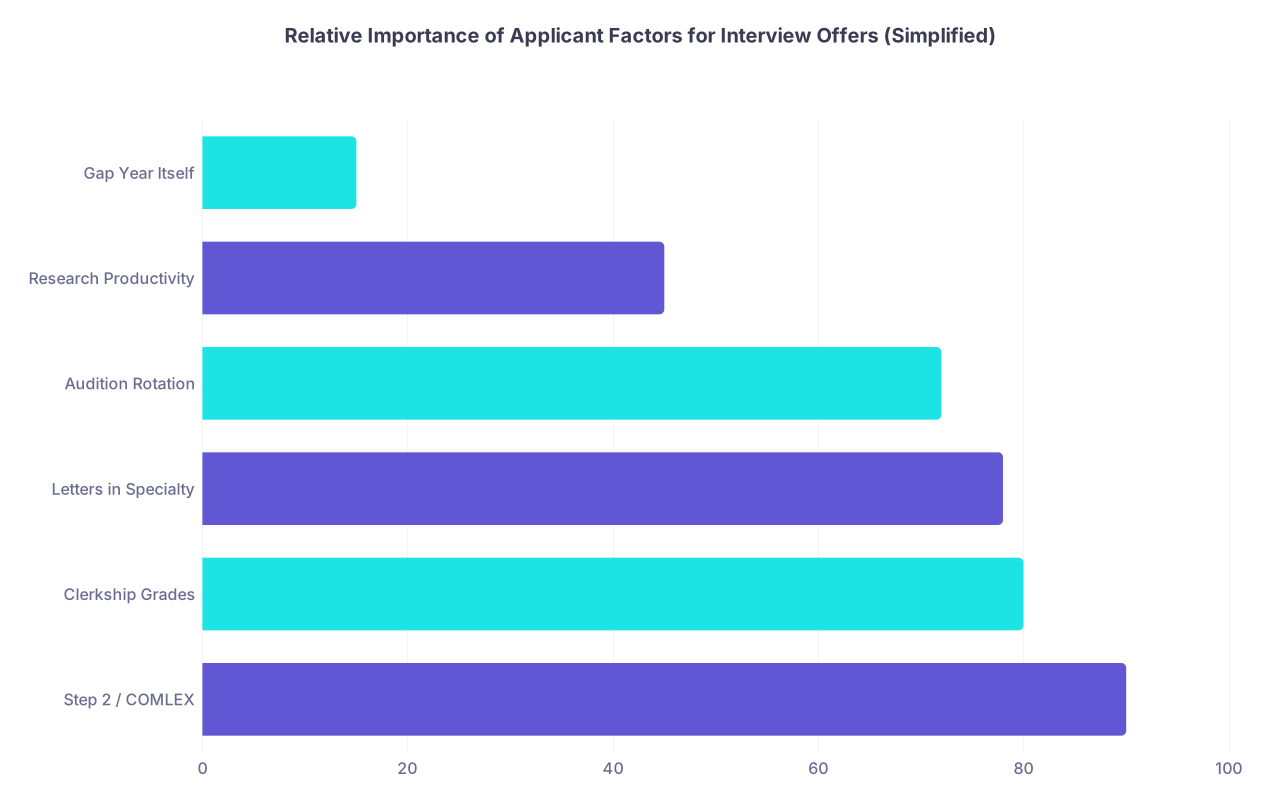
Research productivity shows up in the middle of the list. Helpful. Rarely decisive by itself.
| Category | Value |
|---|---|
| Step 2 / COMLEX | 90 |
| Clerkship Grades | 80 |
| Letters in Specialty | 78 |
| Audition Rotation | 72 |
| Research Productivity | 45 |
| Gap Year Itself | 15 |
No, those are not exact NRMP percentages. They are directionally consistent with what PDs actually report:
- Scores, clinical performance, and letters are primary filters.
- Research is a secondary enhancer—especially in competitive specialties.
- The fact that you did “a gap year” by itself is barely a factor. What you did during it is.
Programs aren’t filtering ERAS for “has_gap_year = true”. They’re filtering for scores, then for red flags, then for evidence you can function as an intern. That’s the hierarchy.
When a Gap Year Helps Interview Numbers (And When It Doesn’t)
A gap year is a multiplier, not a miracle. It amplifies whatever you’re already doing. If your foundation is weak and you do nothing concrete with that year, it just magnifies the weakness.
Here’s where it can actually increase interview invitations:
You’re targeting a hyper-competitive specialty (derm, ortho, plastics, ENT, neurosurgery, some radiology, increasingly EM in certain cycles) and:
- You land at a big academic center with high-yield projects.
- You get on papers/posters that are visible to PDs in your field.
- You develop tight relationships with “name” faculty who write powerful, detailed letters.
- You use that year to carve out a niche (e.g., 6+ derm pubs with a respected PI).
You had a late Step 2 CK, below-average, or borderline score and:
- You significantly improve Step 2 CK (or Level 2) and have it in before interview season.
- You can show trajectory, not stagnation.
You had application flaws you actually fix:
- You improve clinical evaluations through additional sub-I’s or home rotations.
- You repair professionalism concerns (real remediation, not just “time off”).
- You get a clear, coherent narrative: “Here’s why my path had a detour, here’s how I grew, here’s proof.”
Where a gap year does almost nothing for interview numbers:
- You join a random “research year” with no clear mentorship, spend 10 months half-writing one case report and a retrospective that never gets submitted.
- You do generic “clinical work” abroad or at some urgent care with no letters, no clear added skill, no change in your competitive metrics.
- You still apply to an unrealistic mix of programs (like 40 university neurosurgery programs with a 218 Step 2 and minimal research) and call it strategy.
The gap year didn’t fail. The plan did.
PD Reality Check: What They Care About When They See a Gap Year
Program directors are not dumb. They know what “gap year” can mean: focused growth or aimless avoidance.
They’ll usually ask themselves:
Did this year produce tangible output?
- Publications (submitted/accepted, not just “in progress”)
- Posters and presentations
- New letters from credible faculty
- Clear skills: teaching, QI, leadership, advanced clinical exposure
Does the timeline make sense?
- Failed Step 1 → gap year → no additional scores, vague “research”? Red flag.
- No Match → gap year → no new letters in the specialty, same weak personal statement? Also a problem.
Is there a coherent story?
- “I burned out, stepped away, got therapy, returned with better performance and reflection” can be a solid narrative if performance actually improved.
- “I wasn’t sure what I wanted so I traveled and found myself” may be great for your life, but it’s not exactly a selling point for a PD who needs someone to manage septic shock at 3 a.m.

If your gap year doesn’t change what a PD can see and measure in ERAS, don’t expect it to change your interview count.
Research Year: Overhyped, Misused, Sometimes Essential
Research years get idolized, especially in derm/ortho/ENT/plastics. Let’s separate fact from fantasy.
The Overhype
I’ve seen students brag: “I did a research year; I have 15 items on ERAS.” Then I actually look:
- Ten of those are middle-author abstracts for minor poster sessions.
- Two are “submitted” with no realistic chance of acceptance.
- One is a case report that’s been “in preparation” for a year.
Most PDs know how to read a PubMed entry. They know the difference between being the 7th author in a local study and first/second author on a meaningful paper in a mid-tier journal in their specialty. Quantity helps, but quality and relevance matter a hell of a lot more.
The Reality
In certain fields (derm, plastics, ENT, neurosurgery, sometimes ortho), a research year can be functionally expected if:
- You’re at a med school without a strong department in that specialty.
- You’re switching into that competitive specialty late.
- Your Step scores are solid but not stellar for that field.
In these cases, the gap year isn’t a magical ticket. It’s just you meeting the actual bar for that ecosystem.
| Scenario | Research Year Impact |
|---|---|
| Applying Derm with 235–245 Step 2 | Often helpful / quasi-required |
| Applying Ortho with limited home exposure | Can be important |
| Switching late from IM to ENT | Often critical |
| Applying FM/IM/Peds with avg scores | Usually low yield |
| Reapplicant with no new letters | High yield *if* letters improve |
Competitive vs Non-Competitive Specialties: Different Rules
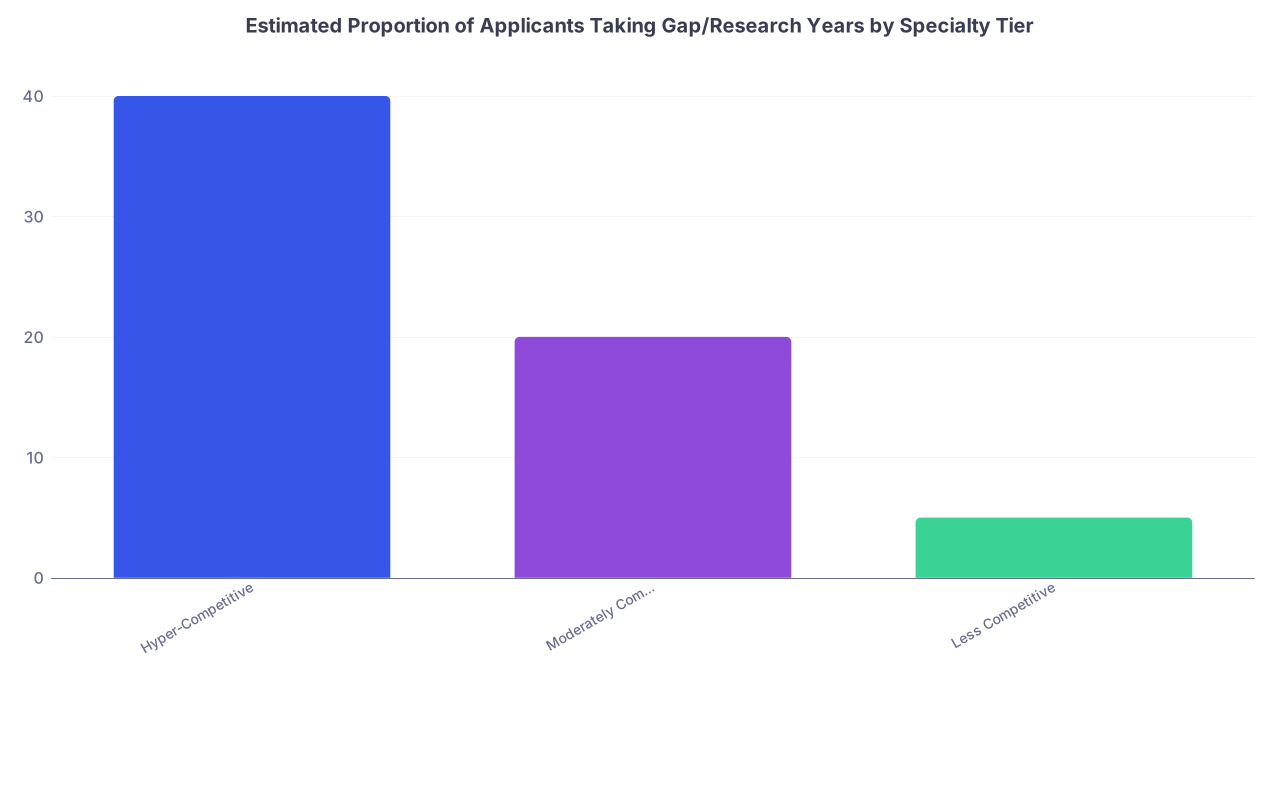
Lumping “gap year before residency” into one bucket is lazy. The field you’re entering matters.
| Category | Value |
|---|---|
| Hyper-Competitive | 40 |
| Moderately Competitive | 20 |
| Less Competitive | 5 |
Again, these are illustrative, but directionally true:
- Hyper-competitive (derm, ortho, plastics, ENT, neurosurgery, some radiology): Research years are common. Having one might bring you up to average, not above it.
- Moderately competitive (EM, anesthesia, gen surg, OB/GYN, neurology): Targeted productivity or a clear skill-building year can help, but it’s not expected.
- Less competitive (FM, psych, peds, most IM): A gap year rarely changes interview numbers unless it’s correcting a serious deficit (like a Step fail or missing clinical year).
If you’re applying FM with a 240 Step 2 and solid clinical grades, and you do a “research gap year,” you probably won’t see your interview count meaningfully change. You were already going to be fine.
The Reapplicant Trap: Same Application, New Year
Here’s the harsh pattern I’ve watched repeat:
- MS4 doesn’t match.
- Panic. Takes “a research year.”
- Does a little bit of everything: some clinic time, a couple of posters, minor QI work.
- Reapplies with nearly the same personal statement, same weak letters (“hardworking, pleasant to work with”), slightly more fluff on the CV.
- Applies to roughly the same program list.
Then they’re shocked their interview count barely moves.
If you were filtered out at the score/grades/letters stage last cycle, and you don’t change those dimensions, no amount of “gap year” branding will fix it.
Processing time isn’t the issue. Inputs are.

| Step | Description |
|---|---|
| Step 1 | Did not match |
| Step 2 | Improve Step 2/Level 2 or take Step 3 |
| Step 3 | Do new Sub-I or rotations |
| Step 4 | Risky generic gap year |
| Step 5 | Targeted reapplication |
| Step 6 | Likely similar outcome |
| Step 7 | Identify primary deficit? |
If your main problem is low Step 2, you’d get far more bang from a structured study period and a real score jump than from a superficial “research fellowship.”
What Actually Predicts More Interviews Better Than “Gap Year”
Let’s be blunt: if your only question is, “What gives me more interviews?” then the answer is not “take a gap year.” It’s this list:
- Get Step 2 CK / COMLEX Level 2 into a clearly stronger range for your target specialty.
- Fix your letters. This often means doing new Sub-I’s or aways where attendings can actually see you and write real, personalized letters.
- Repair and then clearly explain any red flags (failed exam, leave of absence, professionalism issue).
- Apply smarter: broader range, more realistic tiers, geographic flexibility, including community and low-profile academic programs.
- Improve your interview skills so the interviews you do get convert to higher rank positions.
A gap year can support some of this (time to study, time for more rotations, time to work with letter-writers). But the year itself isn’t the driver.
Think of it this way: PDs don’t care how long you’ve been out of school. They care what you can do on July 1 of your intern year and how much risk you bring.
How to Decide If a Gap Year Is Worth It—for You
Ignore the herd. Here’s the sharper decision framework I’d use if you were sitting across the table from me.
Ask yourself:
What’s my primary deficit for this specialty?
- If it’s scores: Will this year give me realistic time and structure to improve them?
- If it’s lack of research in a research-heavy field: Can I land at a place with real output potential?
- If it’s letters/clinical: Am I actually planning structured rotations and new evaluations?
What concrete deliverables will I have by next ERAS?
- Papers submitted/accepted (not just “ideas”)
- Named mentors willing to write strong letters
- New, better clinical evaluations
- A significantly better Step 2 / Level 2 score (or Step 3 if appropriate)
What happens if I don’t take a gap year?
- For FM/IM/Peds/Psych with decent stats: You might match just fine.
- For derm/plastics/ENT with no research and average stats: You might be functionally DOA without extra bolstering.
Am I avoiding discomfort or solving a real problem?
- “I’m scared of not matching, so I guess I’ll do a research year” is not a strategy.
- “My target field typically matches people with X profile; I’m at Y; this specific plan will move me closer to X” is a strategy.
If you cannot describe exactly how your CV will look different on the next application, you’re not planning a gap year. You’re procrastinating in formal attire.
The Bottom Line
A gap year before residency is a tool. Not a guarantee. Not a fix-all. Not a universal requirement.
It can:
- Boost interviews in hyper-competitive fields when used surgically and aggressively.
- Salvage a reapplication if it comes with real improvements in scores, letters, and output.
- Do almost nothing if it’s vague “research,” unstructured “time off,” or a cosmetic patch on deeper performance issues.
Years from now, you won’t remember whether your path had four years of med school or five. You’ll remember whether you were honest about your deficits, deliberate about your choices, and disciplined enough to change the variables that actually matter.


