

The usual advice about “staying productive” in your gap year is useless when you’ve just moved cities for someone else’s job.
You’re not designing a perfect CV year from a clean slate. You’re trying to keep your residency prospects alive while:
- You’ve followed a partner to a new city
- You may not know anyone
- You might not have a license or visa sorted
- And you’re staring at job postings that either require US citizenship, a license you don’t have yet, or 3–5 years of “prior experience”
I’m going to treat your situation like what it is: constrained. Here’s how you make smart, defensible moves on paper and still have a life with your partner.
Step 1: Get Clear on Your Constraints (Brutally, Not Aspirationally)
Before you start flailing at Indeed listings, you need a reality check on what you can and cannot reasonably do in the next 6–18 months.
Ask and answer these in writing:
- Do you already have: ECFMG certification (if IMG), Step 1/2 done, MSPE, final transcript?
- Do you have:
- A medical license or limited license in this new state?
- Work permission (for IMGs/visas)?
- A car / reliable transit?
- How long is this gap realistically?
- 6–9 months until Match?
- 1–2 cycles because you didn’t match or are switching specialties?
You also need to define your specialty target. The strategy for family med vs dermatology is very different. If you tell me “I’ll apply broadly and see what happens,” that screams unfocused applicant to program directors.
Here’s the honest rule:
- Competitive specialty (derm, ortho, plastics, ENT, ophtho, rad onc, some fellowships):
You need research, strong letters, and something clearly specialty-aligned during the gap. - Moderately competitive (EM, anesthesia, rads, OB, many IM programs):
You need ongoing clinical exposure, some scholarly activity, and meaningful responsibility. - Less competitive (FM, psych, peds, some community IM):
You still need recent clinical contact and narrative coherence, but you’ve got more flexibility.
Write down:
“Target specialty: _____. Gap length: _____. Legal/work constraints: _____, _____, _____.”
That page is your filter for what’s realistic, not Instagram-flex nonsense.
Step 2: What Program Directors Actually Care About in a Gap Year
They’re not sitting there counting shadowing hours. They’re asking four pretty simple questions:
Did you stay connected to medicine?
Not vanish for 18 months with nothing but “traveling and self-reflection.”Did you show responsibility and reliability?
Things like consistent work, leadership, teaching, project ownership.Does what you did fit your specialty story?
A psych applicant who spent a year in pediatric oncology research? Harder sell. Not impossible, but you’ll need to explain.Can you explain your choices without sounding like a passenger in your own life?
“I had to move because my partner got a job” is fine.
“So I just kind of waited around” is not.
You’re optimizing for: recency, relevance, and narrative. Not prestige.
Step 3: Pick a “Primary Anchor” for Your Year
You need one main activity that explains your time. Everything else is gravy. That anchor has to work around your constraints and your partner’s schedule.
Common anchors that actually play well on ERAS:
| Option | Best For |
|---|---|
| Research assistant / coordinator | Competitive or academic programs |
| Clinical research fellow | IMG / competitive specialties |
| Full-time clinical job | Any specialty, esp. primary care |
| Scribe / medical assistant | Those without license/visa yet |
| Formal non-clinical role (QI, public health, tech/health startup) | Flexible but must be explained |
Let’s be practical.
If you moved mid-cycle (already applied or just about to):
- Priority: find something you can start within 2–4 weeks
- Don’t obsess over perfect fit; focus on “recent, real, and stable”
- Good anchors:
- Scribe in ED / clinic
- Clinical research coordinator
- Medical assistant (if your background/visa allows)
- Hospital QI assistant position
- Full-time paid research in your specialty
If you’re sitting out a full cycle:
- You have time to be more strategic.
- Your anchor should ideally be:
- Specialty-aligned
- At a place that has a residency in your target field
- With someone who can write you a US letter if you’re an IMG
In the first 2 weeks after landing in your new city, your job is not “find the dream position.” It’s:
- Lock in one anchor that keeps you clinically or academically relevant
- Define your schedule bandwidth (so you can add side projects)
Step 4: How to Actually Find Work in a New City (Fast)
You’re not starting from zero, even if it feels like it.
Here’s the playbook I’ve seen work repeatedly for people in your exact situation:
1. Target institutions, not just job boards
Pick 4–8 hospitals/medical centers within commuting distance. For each:
- Search:
- “clinical research coordinator”
- “research assistant”
- “clinical assistant”
- “medical scribe”
- “patient care coordinator”
- “care navigator”
- Then cross-check: does this place have your target residency?
Even if a position looks generic, if it’s at a hospital with your specialty, that’s a foot in the door.
2. Send short, direct emails to PIs or program leadership
People overcomplicate this. You don’t need a 900-word life story.
Your email should say (in substance):
- Who you are (med grad/MS4, IMG/US grad, specialty interest)
- That you’ve relocated to CITY for partner’s job and are available immediately
- What you’re offering: full-time work / flexible hours / unpaid short-term while you look for paid work (if you can afford it)
- Exactly what you’re asking: “Do you have any ongoing projects, QI initiatives, or clinical roles where an extra set of medically-trained hands would help?”
Send 10 of these emails. Not 2. Not 3. Ten.
Most people don’t get jobs this way because they stop at one or two emails and decide “networking doesn’t work.”
3. Use your old institution to help in the new city
Ask your prior attendings or mentors:
“Do you know anyone at [New City Hospital A/B/C] in [specialty]? I just moved here for my partner’s job and I’m trying to set up something clinical or research-related this year.”
Mentor-to-mentor intros are gold. I’ve watched PDs pick up the phone and place someone into a research role within 48 hours because they trusted the referring attending.
Step 5: Build a Secondary Layer of CV Activities (Low-Friction, High-Yield)
Once you have your anchor, you add things that look good and don’t destroy your life.
Common add-ons that play well during gap years:
Remote or flexible research
Join a multi-institution chart review, data analysis project, or manuscript effort. You do not need to be physically onsite for a lot of this.Teaching/tutoring roles
- USMLE tutoring
- MCAT tutoring
- Teaching medical students at your alma mater via Zoom
These tell PDs: this person can explain, lead, and communicate.
QI projects tied to your day job
Example: You’re a scribe in a primary care clinic. You notice vaccine reminders are inconsistent. Join or start a tiny QI project with your clinic lead. That turns into: “Implemented a workflow that increased childhood vaccination documentation by X%.”Volunteer work that’s actually structured
Long-term, predictable volunteering (e.g., weekly free clinic, longitudinal mentorship program) beats one-off short bursts of “I helped at a health fair.”
You’re going for 2–3 lines on your CV that, together with your anchor, tell a coherent story:
“I moved for my partner’s job, but I stayed heavily engaged in [specialty/medicine/teaching] and took on real responsibility.”
Step 6: How to Explain the Move for Your Partner Without Sounding Apologetic
You’re going to have to talk about this. In your personal statement, ERAS experiences, maybe even in interviews.
You do not need to hide that you relocated for a partner. You just need to frame it as a decision, not a derailment.
Example framing for a personal statement paragraph:
“After graduation, my partner matched into a residency in [City], and I relocated with them. This move forced me to rebuild my professional network from scratch, but it also opened the door to joining the [Department] at [Hospital] as a [research coordinator/scribe/etc.]. Over the past year I’ve… [1–2 concrete outcomes].”
That hits what PDs care about: you made a life decision, you adapted, you were productive.
In interviews, a crisp answer sounds like:
“My partner started a position in [City], and we made a joint decision to relocate. Once here, I knew I wanted to stay clinically active, so I [did X]. It ended up being a great opportunity to [develop Y skills / deepen Z interest].”
Notice what you’re not doing:
- Over-explaining your relationship
- Apologizing
- Sounding like this was chaos you barely survived
Step 7: Making Your ERAS Look Continuous (So It Doesn’t Trigger Red Flags)
Program directors hate unexplained gaps. They don’t mind non-traditional paths if you can account for your time.
Your gap year ERAS should look like this:
- One big entry:
“Clinical Research Coordinator, Department of Cardiology, [Hospital], [Dates]” - Plus 1–3 smaller entries:
“Volunteer Physician Assistant at Community Free Clinic, [Dates]”
“USMLE Tutor, [Company/Independent], [Dates]”
“Quality Improvement Project Member, [Clinic], [Dates]”
If there’s an unavoidable blank (e.g., 3–4 months of pure chaos during the move/visa), you can still soften it:
- Frame it as “Transition period following relocation to [City]; completed [Step exam / certification / coursework] and initiated [job/volunteer applications].”
You’re not lying. You’re labeling.
Step 8: What If You Literally Cannot Work Clinically (Visa, Licensing, or Personal Limits)?
This is common for IMGs and for people in states with strict licensing rules. All is not lost, but you can’t be passive.
High-yield non-clinical options that still look strong:
Full-time (or near full-time) research
Preferably with:- At least 1 poster/abstract submitted
- A realistic shot at a publication or two
- A letter from the PI
Public health or health policy roles
E.g., local health department, outcomes research, epidemiology teams.Health-tech or digital health jobs
Minimum bar: your role touches patients, outcomes, or systems. Not random coding bootcamp unless you intend to pivot to informatics or something clearly connected.
If you do something totally outside medicine (say, you spend 9 months in a non-health startup because that’s literally what you got):
- Fine. But you absolutely must layer on:
- Remote research, or
- Consistent volunteer clinical exposure (free clinic, phone triage if legal, outreach programs)
The line you’re trying to avoid is: “I did nothing related to medicine for a year or more.”
Step 9: Protect the Relationship Without Sacrificing Your Future
You moved for your partner. Do not quietly start resenting them while your career drifts. That breeds disaster in both directions.
Basic rules I’ve seen actually work for couples in your shoes:
Set explicit boundaries early:
“I need X evenings per week and part of Saturday protected for [research/writing/shifts/interviews].”Communicate the Match timeline:
Show them when ERAS opens, when interviews hit, when you may need to travel or do Zoom calls at weird hours.Decide geography strategy a year ahead:
- Are you both okay with long-distance for a bit?
- Are you only applying near their job?
- Are you applying broadly then negotiating later?
If you’re anchoring your entire application around staying in this new city, you’d better say that deliberately in your personal statement and conversations:
“Given my partner’s residency in [City], my goal is to build a long-term life and career here. That’s why I’ve spent my gap year working at [local hospital/clinic], getting to know this community and health system.”
That kind of geographic loyalty is catnip to some program directors—if your application can back it up.
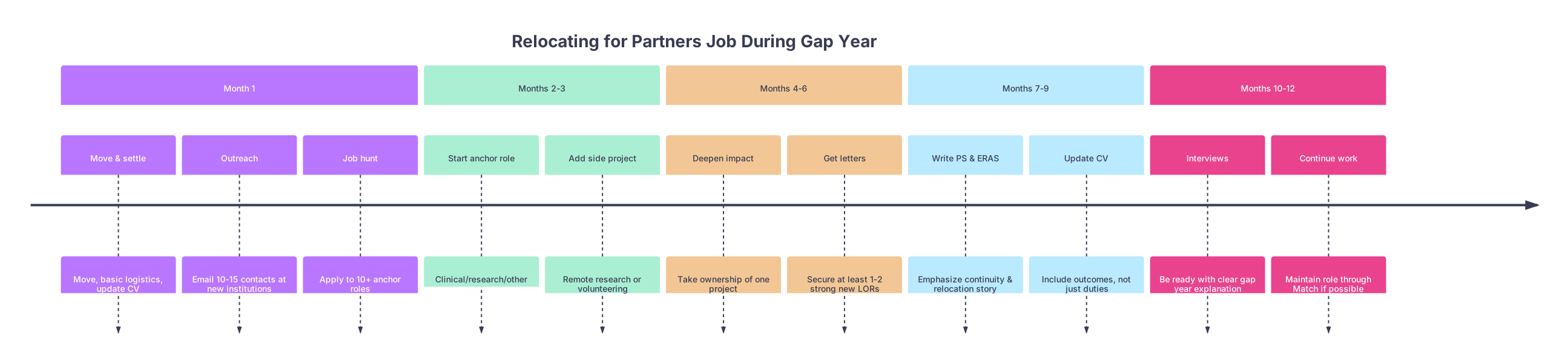
Step 10: Timeline If You’re 6–12 Months From Applying
People love vague advice. Here’s what a tight version looks like.
| Period | Event |
|---|---|
| Month 1 - Move & settle | Move, basic logistics, update CV |
| Month 1 - Outreach | Email 10-15 contacts at new institutions |
| Month 1 - Job hunt | Apply to 10+ anchor roles |
| Months 2-3 - Start anchor role | Clinical/research/other |
| Months 2-3 - Add side project | Remote research or volunteering |
| Months 4-6 - Deepen impact | Take ownership of one project |
| Months 4-6 - Get letters | Secure at least 1-2 strong new LORs |
| Months 7-9 - Write PS & ERAS | Emphasize continuity & relocation story |
| Months 7-9 - Update CV | Include outcomes, not just duties |
| Months 10-12 - Interviews | Be ready with clear gap year explanation |
| Months 10-12 - Continue work | Maintain role through Match if possible |
If you’re already halfway through that, compress it. Focus on what you can still change: now until ERAS submission, and how you frame what you’ve already done.
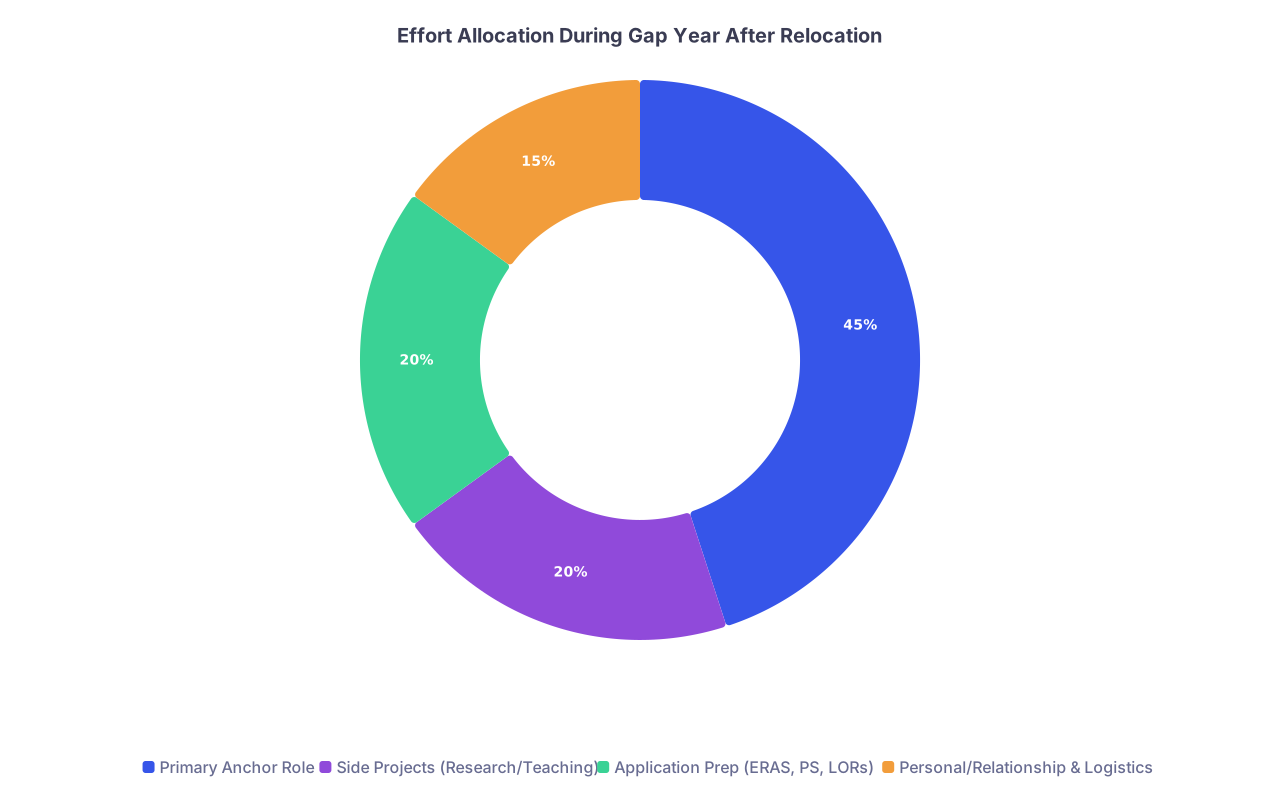
Visual: Where Your Effort Should Go in This Situation
| Category | Value |
|---|---|
| Primary Anchor Role | 45 |
| Side Projects (Research/Teaching) | 20 |
| Application Prep (ERAS, PS, LORs) | 20 |
| Personal/Relationship & Logistics | 15 |
This is the rough balance I’d aim for. If you’re spending 60–70% of your waking bandwidth on “figuring things out” and random job browsing, you’re wasting the year.
FAQs
1. What if I already spent 6–9 months doing almost nothing in the new city? Did I ruin my chances?
No, but you lost some easy points. Stop trying to rewrite the past and lock down the next 6–12 months. On ERAS, you’ll frame the idle stretch as a transition period: relocation, studying for Step/CS (if relevant historically), visa processing, family responsibilities. Then you overcompensate with strong, consistent activity from now until application. In interviews, your script is: “The first few months were rough—I was relocating, sorting out [visa/licensing/family]. Once that stabilized, I committed to [X role] and have been there since.” Then you pivot to what you’ve actually achieved.
2. I’m an IMG with no US experience yet, and I moved for my partner’s job. What’s the single best move I can make?
Get yourself into a research or observer-type role at a hospital that has your target residency. Even if it starts unpaid. Your goals: 1) a US letter from someone recognizable; 2) concrete involvement—data collection, chart review, manuscript drafts, presentations; 3) visibility to the residents and PD. Email faculty directly. Mention you’re in the city long-term because of your partner’s position and are looking to integrate into their system. If you can’t get in clinically at all, at least secure remote or local research with clear output and a letter.
3. Is it honest to emphasize my partner’s location as a “geographic preference” on my application?
It’s not just honest; it’s strategic. Programs love believable reasons you’ll stick around. So if your partner has a long training/employment commitment in that city, say so. Just don’t sound like you’re applying only because of them. Pair it with substance: “I’ve spent the past year working in [Hospital/Clinic] here, getting to know the patient population.” Geography alone is weak. Geography + actual engagement in the local system is convincing.
4. How do I decide if I should reapply now or wait another cycle to strengthen my application in this new city?
Look at three things: 1) Your objective metrics (Step scores, attempts, transcript). If those are significantly below your target specialty’s norms, another weak cycle isn’t going to fix that. 2) Your current and near-future activities—can you reasonably have strong letters and meaningful output within 6–9 months? 3) Your mental bandwidth—are you barely coping with the move and relationship stress, or can you realistically survive a full application cycle plus this adjustment? If your metrics are borderline and you have minimal activity, waiting one full, well-planned year in your new city—anchored to a substantial role—often leads to a far better shot than a rushed, half-baked application.
Two things to remember. You’re allowed to make life decisions—for love, for location, for sanity—without destroying your career. But you must own those decisions and build something coherent and active on top of them. And program directors do not expect perfection; they expect continuity, responsibility, and a story that makes sense. Build that, and your partner’s job move becomes part of your narrative—not the excuse for why it all fell apart.


