

What if taking a second gap year before residency quietly kills your chances…and nobody tells you until it’s too late?
That’s the kind of thing that keeps you up at 2 a.m. refreshing SDN threads and scrolling Reddit horror stories about “red flag” gaps and “death sentences” for competitive specialties.
You’re stuck in this awful place:
- One gap year already on your timeline.
- Thinking about a second.
- Terrified programs will look at your ERAS and think: “What were they doing all that time?”
Let me say this up front: more time off is not automatically fatal. But how you spend it—and how you explain it—absolutely can make or break you.
Let’s walk through this like we’re sitting in a call room at midnight and you’re about to click “withdraw” on ERAS or commit to a research year you’re not even sure you want.
The Ugly Truth: Yes, Residency Programs Notice Time Off
They do notice. They’re not blind. PDs and faculty literally scroll your CV looking for:
- “Chronological continuity” – did you disappear for a year?
- Any pattern of “stopping out” or quitting
- Clear explanation for big gaps
- Evidence you stayed clinically or academically engaged
What they don’t do is:
- Automatically reject everyone with >1 gap year
- Assume “second gap year = lazy / problematic”
- Treat every gap as the same (research vs “I was home doing nothing” are not equal)
I’ve seen people match with:
- 1–2 years of research between MS3 and MS4
- A year off for health reasons
- Time off for a failed match, then SOAP, then a new application cycle
I’ve also seen people get absolutely hammered for:
- Vague “time off to reflect and travel” with nothing else going on
- No US clinical experience for 2+ years
- Not being able to answer “What did you do during that time?” clearly in interviews
So yeah. The gap itself isn’t the problem. The story and the evidence are.
How Much Is “Too Much Time Off” Really?
Everyone wants a number. “Tell me: 1 year is fine, 2 years is borderline, 3 years is impossible.” I get why. Your brain wants a rule.
Reality is messier, but here’s the closest thing to actual thresholds I’ve seen.
| Total Time Off After Med School | Typical Program Reaction* |
|---|---|
| 0–1 year | Very common, usually no big deal |
| 2 years | Noticeable, needs a clear explanation |
| 3 years | Starts to raise real questions |
| 4+ years | Many programs get hesitant, some hard cutoffs |
*Assuming you’re not completely detached from medicine.
For U.S. MD/DO grads:
- 1 gap year? Very common, especially for research, couples match strategy, or personal reasons.
- 2 gap years? Not rare anymore, especially for people reapplying or doing serious research.
- 3+? You’ll get more pushback. Not impossible, but you need receipts: recent clinical work, strong letters, ongoing involvement.
For IMGs, the “time since graduation” thing is way more brutal. A lot of programs have hard filters like “within 5 years of graduation.” A second gap year may push you into that risky zone quicker.
Is a second gap year automatically “too much”? No.
Is a second gap year where you do almost nothing medically related too much? Pretty close to yes.
Why You’re Actually Thinking About a Second Gap Year
You’re not just bored and wanting “time to vibe.” Typically it’s one (or more) of these:
- You didn’t match and you’re reeling.
- Your application is weak for your chosen specialty (Step scores, research, letters, or all of it).
- You’re burnt out to ash and the idea of internship right now feels impossible.
- You’re changing specialties and need relevant experiences.
- You’ve got real-life stuff: illness (yours or family), immigration, finances, pregnancy, mental health crash.
The fear in your head sounds like:
- “If I apply this year and don’t match again, I’m toast.”
- “If I wait, I’ll be ‘too old’ or ‘too far out’ and then I’m toast.”
- “Programs are going to see 2 gap years and just auto-reject me.”
Here’s what I’d argue:
A strategic second gap year can be a better move than a panicked, undercooked application that just generates more rejections and more emotional damage.
The key word there is strategic. Not “stalling.” Not “avoiding.”
The Only Question That Actually Matters
Instead of obsessing over “Is 2 years too much?”, ask this:
“Will I be clearly stronger and more current as an applicant at the end of this second gap year than I am right now?”
If yes—and you can prove it with concrete stuff—then the second gap year is usually defendable.
If you’re honest with yourself and the plan is… fuzzy? “I’ll probably do some research maybe, and also rest, and maybe find some shadowing?” That’s where you get into trouble.
What a “Defendable” Second Gap Year Looks Like
You’re not going to like this part, because it means work. A defendable second gap year usually includes:
Clinical involvement
- U.S. clinical experience (prelim year, transitional year, observerships, hospitalist scribe, etc.)
- Volunteering in clinics, free health centers, telehealth roles if legit
- Anything showing you still know how to function around patients
Academic or professional productivity
- Real research, preferably with:
- Named mentors
- Concrete outputs (posters, abstracts, manuscripts, QI projects)
- Teaching roles (tutor, OSCE instructor, anatomy TA, etc.)
- Even working as a medical assistant or scribe if framed correctly
- Real research, preferably with:
Fresh letters
- New, recent letters from this gap-time work
- Mentors who can say: “They’re reliable, engaged, clinically sharp, and committed”
A clean, coherent explanation
- One to two sentences in your ERAS experiences and a tight, confident explanation for interviews
If you can’t sketch what that looks like for you, that’s your first red flag. Not the gap year itself. The lack of a plan.
How Programs Actually Judge “Time Off” (Not How Reddit Says)
Programs care less about the raw number of years and more about three big things:
Recency of clinical activity
They want you close enough to training that they’re not re-teaching “how to be around patients” from scratch.Trajectory
Are you moving toward residency? Or sideways/away?
Example:- 1st gap year: research in your field →
- 2nd gap year: chief role in a clinical trial + clinic volunteering
That’s movement towards the goal, not drifting.
Signal of risk PDs are allergic to risk. Unexplained time off, vague “personal reasons,” long gaps with no structure = risk.
A second year that’s obviously purposeful with strong mentorship? Less risky.
Here’s what that looks like in real life:
Applicant A: Two gap years. First was unplanned, loosely “studying for Step 2,” minimal documentation. Second year: heavy research, 2 publications, ongoing clinic volunteer, strong PD letter. They matched Internal Medicine at a solid program.
Applicant B: One gap year. No clinical or academic activity. Just traveling, “reflecting,” and doing gig work. No new letters. Applied to a moderately competitive specialty. Did not match, and honestly, it wasn’t mysterious why.
Pros and Cons of a Second Gap Year (Without Sugarcoating)
Let’s be blunt.
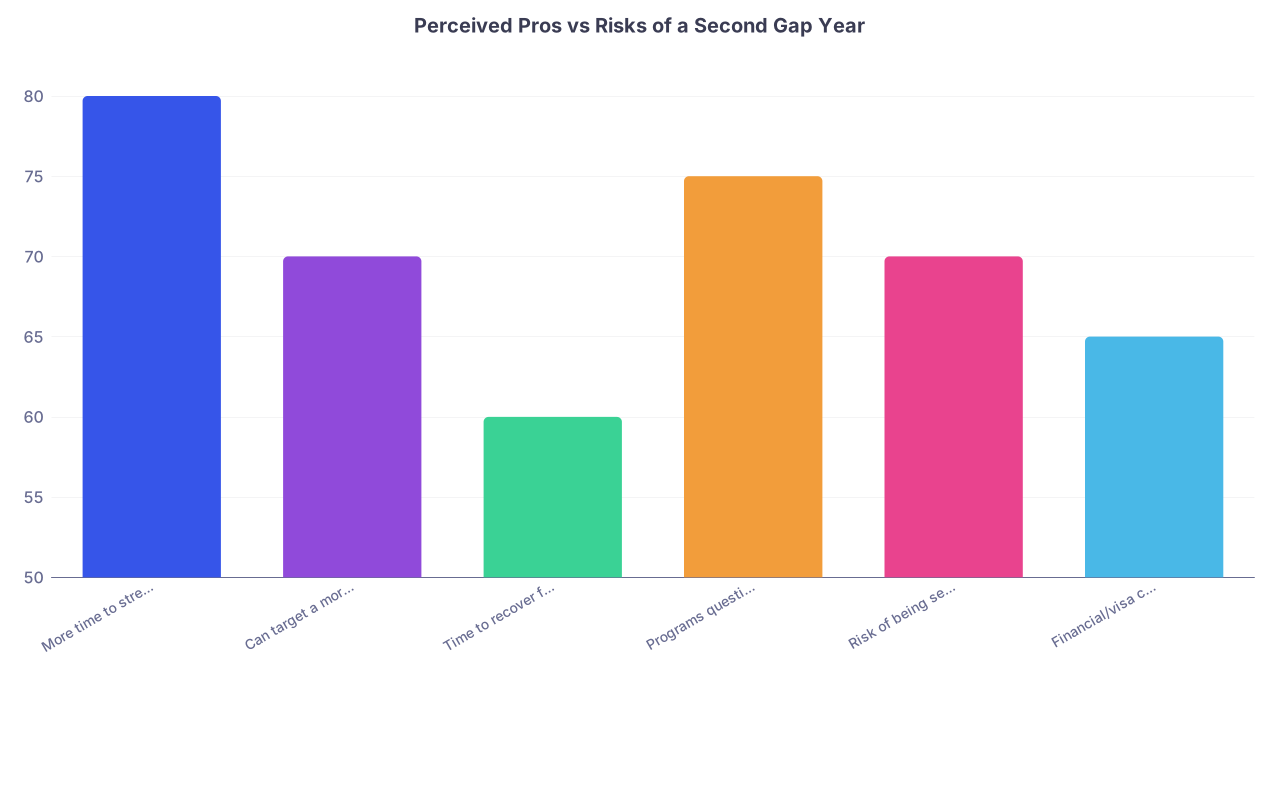
| Category | Value |
|---|---|
| More time to strengthen CV | 80 |
| Can target a more competitive specialty | 70 |
| Time to recover from burnout | 60 |
| Programs question long gaps | 75 |
| Risk of being seen as less current | 70 |
| Financial/visa complications | 65 |
These aren’t percentages; think of them as “how often I see this matter.”
Real pros
- You can actually fix things: Step 2, research output, letters, clinical gaps.
- You can avoid burning another application cycle when you know deep down your app isn’t ready.
- You get time to prove to yourself you still want this specialty (or medicine at all) instead of rushing blindly.
Real cons
- You’ll feel older, behind, and different from your peers. That’s just true.
- Some programs absolutely have internal bias against too much time off.
- Money, visas, health insurance—none of that is trivial.
- You risk drifting if you don’t lock in concrete commitments now.
So you can’t just ask “Will this hurt my chances?”
The better question is: “Will this hurt my chances less than applying half-baked this cycle?”
Special Cases: When a Second Gap Year Is Actually Smart
There are situations where a second gap year is not only reasonable—it’s probably your best move.
1. Reapplicant after a failed match
You applied, didn’t match, now what? If:
- Your scores are below average for your specialty
- You have weak or few letters
- Little/no research for a research-heavy field (derm, rad onc, ortho, plastics)
Then going again with the same profile is like submitting the same exam twice and expecting a different grade.
A second gap year can be smart if it’s built around:
- A structured research position in your specialty
- A prelim year or transitional year (for some fields)
- New clinical exposure in programs that could actually rank you
2. Switching specialties
Example: you were all-in on surgery, now you want psych. Your application screams “knife” and says nothing about “mind.”
A targeted year:
- Working in psych clinics, inpatient units, or community mental health
- Research or QI in the new specialty
- New letters from that field
That’s infinitely better than trying to convince programs you suddenly had an epiphany with zero evidence.
3. Legitimate health / family / personal crisis
Sometimes life just blows up:
- Major depressive episode
- Cancer treatment
- Parent with advanced illness
- Immigration/visa chaos
You can take time for that and still match later. I’ve seen it.
But again: two things matter:
- Documented, honest explanation (not graphic details, just real)
- A clear ramp back into clinical or academic life that shows you’re stable now
How to Explain a Second Gap Year Without Sounding Like a Walking Red Flag
Here’s the piece everyone panics about: “What do I say?”
You need a short, confident narrative. Not a defensive monologue.
Structure it like this:
- Brief reason
- Concrete actions you took
- Why you’re better prepared now
Example – research-focused second gap year:
“After my initial year of research, my mentors and I recognized I needed more robust scholarly output and clinical exposure to be competitive in internal medicine. I committed to a second structured research year where I led a QI project, co-authored two manuscripts under review, and spent one day a week in continuity clinic. The extra time has made me much more prepared clinically and academically for residency.”
Example – personal/health reason plus return:
“During my first year after graduation, I took time away from formal training to address a significant family health issue. Once that stabilized, I realized I needed a structured way back into medicine, so I spent the following year working in an outpatient clinic, updating my clinical skills, and earning strong letters from supervising physicians. I’m fully ready to commit to residency now.”
If your explanation is longer than 4–5 sentences, you’re overdoing it.
If it sounds apologetic, like you’re begging for forgiveness, rewrite it.
What You Should Absolutely Avoid Doing in a Second Gap Year
There are ways to poison your application with extra time off. Here’s what consistently hurts:
- Letting 6–12 months pass with zero clinical or academic engagement.
- Having no new letters for 2+ years.
- Failing Step exams and not addressing or remediating them.
- Writing vague fluff on ERAS like “self-directed learning,” “personal growth,” “time to reflect” with nothing concrete.
- Going totally non-medical without a specific, powerful story (and even then, it’s risky).
And the big one:
Applying this cycle “just to see what happens” with a half-repaired application because you can’t tolerate the anxiety of waiting.
That’s how people burn bridges and lock in more rejections that follow them into future cycles.
A Quick Reality Check: You’re Not Ruined
Let me guess. Your brain is giving you greatest hits like:
- “Everyone else went straight through.”
- “Programs will think I’m lazy or unstable.”
- “I’ve already wasted so much time. Another year is career suicide.”
- “I’ll be 30+ as a PGY-1. That’s embarrassing.”
Reality:
- Plenty of residents start at 30, 32, 35, even older. People notice for 5 minutes and then they’re too busy writing notes to care.
- PDs care much more about: will you show up, work hard, not melt down, not create drama, and take care of patients?
- A messy but explained path with growth beats a “perfectly linear” one where you’re burned out and miserable.
You are allowed to take time. You’re just not allowed (if you want to match) to vanish.

| Step | Description |
|---|---|
| Step 1 | Thinking about second gap year |
| Step 2 | Reconsider plan or seek advice |
| Step 3 | Build specific plan: clinical + research + letters |
| Step 4 | Second gap year likely defendable |
| Step 5 | Will I be stronger at the end of it? |
| Step 6 | Concrete activities lined up? |
What You Should Do Today (Not “Someday”)
If you’re seriously considering a second gap year, do this in the next 24–48 hours:
Write down your honest starting point.
Scores, attempts, research, letters, clinical experiences, specialty competitiveness. No sugarcoating.Answer this on paper:
“If I applied this cycle as-is, what are my 3 biggest weaknesses?”Then ask:
“Could a well-planned second gap year directly address these three?”
If yes, list specific: roles, positions, mentors, clinics, exams.Email 2–3 actual humans.
Mentor, PD, trusted attending, or dean. Subject line: “Need honest advice about taking a second gap year.” Attach your CV and be explicit.
Then decide: are you going to build a real second gap year or are you going to roll the dice this cycle?
Open a blank document right now and title it:
“Second Gap Year Plan – Concrete Commitments.”
If you can’t fill in at least three specific activities you’ll pursue, that’s your first problem to solve—before you worry about whether “two years off” is too much.
FAQ: Second Gap Year Panic Edition
1. Will a second gap year automatically keep me from matching?
No. It’s not an auto-fail. People match every year with 2+ years off, especially if those years are structured—research, clinical work, strong mentorship. The danger isn’t the number; it’s having long stretches with nothing to show that you stayed engaged in medicine.
2. Is a second gap year worse than applying now with a weak application?
Often, applying with a clearly weak application is worse. Rejections, especially after interviews, can follow you in future cycles, and some programs remember names. If another year would clearly improve your scores, letters, or experience, that’s usually smarter than gambling on a cycle you know is shaky.
3. How do I talk about my second gap year in interviews without sounding defensive?
Keep it short and structured: one line on why, two to three lines on what you did, one line on how it made you more prepared. Say it calmly, like a fact, not like a confession. Practice it out loud until it doesn’t sound like you’re begging for forgiveness.
4. I’m an IMG. Does a second gap year hurt me more?
For IMGs, “time since graduation” can be a real barrier because some programs have strict cutoffs. A second gap year is more dangerous if it pushes you beyond 5–7 years from graduation. That doesn’t mean it’s impossible, but it means your gap time must be packed with clinical experience and ideally U.S.-based activity to offset that bias.
5. What if my second gap year is mostly for mental health or burnout? Do I admit that?
You don’t have to share every detail, but lying is a bad idea. You can frame it as needing time to address personal or health issues and then emphasize what you did when you were able—therapy, gradual re-entry with clinical work, research, volunteering. Programs care less about the fact that you struggled and more about whether you’re stable and functional now.
6. What’s one concrete thing I can do this week if I’m leaning toward a second gap year?
Reach out to potential mentors or departments in your desired specialty and ask about a one-year research or clinical fellow position, observership, or consistent volunteer clinic role. Don’t wait for “later.” Send three emails this week with your CV attached and a short, clear ask. A real role on paper changes a second gap year from “gap” to “training-adjacent experience,” and that’s a huge difference.


