

The Myth That Gap Year Applicants Must Apologize in Every Interview
Why do so many smart future residents walk into interviews talking like they’ve just been paroled?
“I know I took time off…”
“I’m sorry my path isn’t traditional…”
“I realize this might be a red flag…”
Stop. That script is killing strong applicants far more than the gap years ever did.
You do not have to apologize for taking a gap year (or several) before residency. And if you keep acting like you should, you’re going to tank interviews you could’ve easily turned into offers.
Let’s dismantle this myth properly.
What Programs Actually Care About (Not What Reddit Told You)
Programs don’t sit around saying, “Anyone with a gap year is suspicious.” That’s a premed-level ghost story people carry into residency applications.
Interviewers care about three basic things:
- Can you do the work?
- Will you show up consistently?
- Are you on an upward trajectory or circling the drain?
Gap years intersect with those questions, but they’re not inherently negative. They’re neutral until your story makes them one.
Here’s what the data and real-world behavior show:
| Scenario | Typical Program Reaction |
|---|---|
| Structured research fellowship | Positive / competitive asset |
| Chief year / teaching fellowship | Strong positive |
| Clinically active (hospitalist, scribe) | Mild to strong positive |
| Non-clinical but intentional work | Neutral to mild positive |
| Unexplained inactivity | Concern, but not automatic no |
Notice what’s missing: “Gap year = bad.” It’s just not there.
Programs—especially in academic centers—like applicants who’ve done:
- Research years (T32, HHMI, NIH, department-funded positions)
- Chief years between med school and residency
- Global health work that’s actually supervised and structured
- Hospitalist/house officer roles in countries that allow that
- Post-bacc MPH, MEd, MBA with clear goals
Where do people get burned? When they:
- Sound defensive or apologetic
- Over-explain and raise more questions than they answer
- Come across as disengaged from clinical medicine
- Cannot show any growth or skill gain from that time
The problem is not the gap. It’s the confession vibe.
The “Apology Mindset” Is Your Real Liability
You’ve probably been coached with some version of:
“Make sure you address your gap year, show them you’re sorry, reassure them you won’t do it again.”
That’s garbage advice.
Here’s what happens when you walk in with apology energy:
- You frame yourself as a problem before they thought of you that way.
- You teach them to look for risk instead of value.
- You sound like you don’t trust your own decisions.
I’ve seen it in real interview rooms:
- Applicant A: Step 2 in the 240s, took a research year, 2 pubs. Starts answers with, “I know my path is a bit unusual…” and spends half the interview justifying decisions no one had questioned yet. Comes off timid and insecure.
- Applicant B: Very similar stats and same type of research year. Talks in terms of “This is what I chose and here’s the output.” Zero apology. Viewed as focused and deliberate.
Same background. Different posture. Different outcome.
Let me be clear:
Programs are not waiting for your apology.
They’re waiting for your explanation. Short. Coherent. Forward-looking.
When you start with “I’m sorry” you’re telling them, “You’re right, this is a problem.” Many of them didn’t think it was—until you insisted.
What the Data and Match Outcomes Actually Suggest
Is there hard data that “gap year = death to your application”? No. The NRMP data sets don’t say that, and faculty who actually read applications don’t behave like that.
But we do see patterns with non-linear paths.
Three realities:
- Multiple years completely away from medicine and academics without clear reason? Yes, people worry about knowledge decay and engagement. That’s not bias; that’s risk assessment.
- One or two structured years (research, degree, clinical work)? Often help, not hurt—especially in competitive specialties.
- Timing and context matter more than the raw number of years.
To put some structure to how programs mentally sort this stuff:
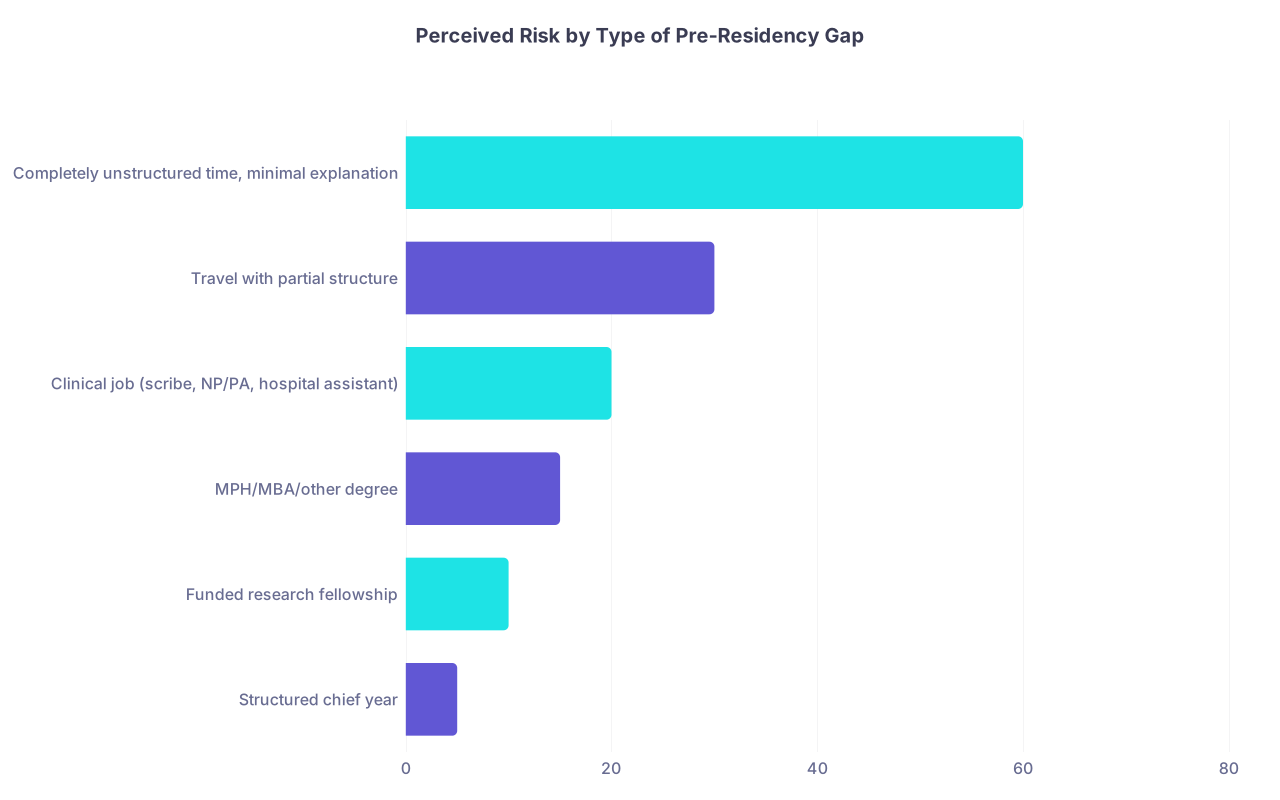
| Category | Value |
|---|---|
| Structured chief year | 5 |
| Funded research fellowship | 10 |
| MPH/MBA/other degree | 15 |
| Clinical job (scribe, NP/PA, hospital assistant) | 20 |
| Travel with partial structure | 30 |
| Completely unstructured time, minimal explanation | 60 |
The right side of that chart is where red flags start. Not “You took a year.” “You disappeared and can’t explain it well.”
Programs are pragmatic:
- If your gap year increased your skills, publications, teaching, leadership, or clinical maturity, they like it.
- If your gap year looks like you refused to move on from a prior failure, they get nervous.
- If your gap year looks like you were drifting and still kind of are, they pass.
None of these require you to apologize. They require you to demonstrate usefulness and stability.
How to Talk About Your Gap Year Without Sounding Guilty
You need a frame, not an apology.
The basic formula that works over and over:
- Brief context (1 sentence)
- Concrete activities (2–3 specific things)
- Growth and skills (2–3 takeaways connected to residency)
- Forward focus (1 sentence on why now is the right time)
Notice what’s missing: “I’m sorry”, “I regret”, “I know this is a concern”.
Here are some examples for different types of gap years.
Research Year Example
Bad (apology mode):
“I realize I delayed residency for a research year, and I’m sorry for that, but I really wanted to strengthen my application and make up for some weaker parts.”
Better (ownership mode):
“After third year I chose to do a one-year research fellowship in cardiology at [Institution]. I worked on two prospective projects—one on heart failure readmissions and another on device outcomes—and presented our data at ACC. That year sharpened my statistics skills, but more importantly it gave me a much better sense for how to ask clinically useful questions. Now I’m ready to bring that mindset into residency training.”
No apology. Clear why, what, and what you bring back.
Mental Health / Burnout / Personal Health Time
This is where people really default to apology. Programs are more open than you think—as long as you show insight and current stability.
Over-disclosure train wreck:
“I burned out completely and had a lot of anxiety and needed medication and time off and I’m really sorry I fell apart, but I promise I’m okay now.”
Tight, honest, adult version:
“During my fourth year I recognized I was struggling with burnout and some untreated anxiety, so I took a leave with my school’s support to address that and work with a therapist. Over that time I built much better habits around boundaries and stress management and have been stable and fully engaged back in clinical rotations for the last year. That experience changed how I think about resilience and how I relate to patients going through their own mental health challenges.”
Again—no apology. Just accountability and a clean arc from problem to function.
Non-Clinical Work (Industry, Startup, Family Business)
Bad:
“I know this doesn’t really relate to medicine and I’m sorry that I took this detour, but…”
Better:
“For two years after graduation I worked in health tech product management at a startup building tools for outpatient clinics. I led a small cross-functional team, had to manage priorities with limited resources, and spent many hours understanding clinic workflows. That time gave me a much clearer view of the system-level barriers my future patients face. I ultimately missed direct patient care, which is why I’m applying now, but I still think that operational lens will be useful in residency.”
The apology version makes you sound ashamed of real-world skills. The clean version makes you sound like a stronger, more interesting resident.
What Actually Raises Red Flags (Hint: Not the Year Itself)
Here’s what reliably freaks programs out about gap-year applicants, and none of it requires “saying sorry” to fix. It requires clarity.
Real red flags:
- You can’t cleanly explain why you took time and what you did.
- You seem to still be ambivalent about actually committing to residency.
- Your clinical skills feel rusty and you act out of your depth on basic patient discussions.
- You turn every answer into a confession about “my unconventional path.”
That last one is more common than you think. Applicant walks in with a 4th-author JAMA paper from their research year and somehow convinces everyone they’re a liability because they keep apologizing for “not going straight through.”
Let me be even more direct:
If you keep highlighting your gap year as a problem, interviewers will eventually agree with you.
Your goal is not to hide it. Your goal is to integrate it.
How to Prepare So You Don’t Panic-Explain in the Room
Write and practice one 30–45 second answer to each of these:
- “Tell me about the time between graduation and now.”
- “What made you decide this was the right year to apply?”
- “How have you kept up your clinical knowledge and skills?”
That third one is the one people ignore and then stumble through.
If you had any gap in direct clinical work, you need receipts:
- Visiting electives
- Per-diem clinical roles (scribe, MA, EMT, RN, NP, etc.)
- Consistent question-bank work or structured review
- Supervised clinic/ward exposure, even part-time
Map it:

| Step | Description |
|---|---|
| Step 1 | Gap Year |
| Step 2 | Clarify purpose |
| Step 3 | Document concrete activities |
| Step 4 | Identify skills gained |
| Step 5 | Connect to residency goals |
| Step 6 | Draft 3 core answers |
| Step 7 | Practice out loud |
You’re not writing a confession. You’re writing a professional summary.
The more you rehearse those three answers, the less likely you are to slide into self-blame when someone asks a mildly pointed question like, “Why didn’t you apply last year?”
When You Do Need To Be More Direct
There are situations where you shouldn’t pretend the gap was purely strategic:
- Academic difficulty or failure
- Dismissal or required leave
- Significant professionalism issues
- Major health or family crises
You still don’t need to apologize every five minutes. You need to:
- Name the issue once.
- Take responsibility for your part.
- Show, with evidence, that the issue is resolved or well-managed.
- Demonstrate current high functioning.
Example for academic difficulty:
“In my second year I failed two courses and had to remediate them, which delayed my schedule and ultimately pushed back my graduation. That was the result of poor time management and not asking for help early enough. Since then, I’ve completed all clinical rotations on time with strong evaluations and took a dedicated study period to bring my Step 2 score into a much stronger range. That experience forced me to build better systems, which I’m still using now.”
No performance of guilt. Just accountability and trajectory.
If an interviewer pushes—“Are you concerned this could happen again?”—you don’t grovel. You answer like a clinician:
“I was concerned enough then to change how I worked, and the last two years of performance reflect that. I’m confident in the systems I have now: built-in check-ins, earlier help-seeking, and a much more realistic approach to my limits.”
Manages risk without theatrics.
The Quiet Advantage of Gap-Year Applicants (That You’re Probably Ignoring)
Here’s the part you’re not being told: done right, gap years can make you more attractive, not less.
Programs like applicants who:
- Know why they’re applying to that specialty, not just “because it’s next.”
- Have done something harder than just passing exams.
- Bring extra skills: research, QI, curriculum design, leadership, operations.
- Have enough life experience not to implode the first rough month on nights.
Plenty of PDs quietly say, “Our best residents aren’t the straight-through, never-failed-anything robots. They’re the ones who’ve seen something, struggled with something, and came back stronger.”
Gap years are often where that growth happens. If you keep apologizing for it, you’re throwing away your edge.
Bottom Line
Stop treating your gap year like a crime scene.
Key points:
- Programs are not inherently biased against gap years; they’re assessing risk and trajectory, not your ability to follow a straight line.
- You don’t need to apologize; you need a clear, concise, forward-focused explanation that turns your gap year into a source of skills and maturity.
- The real red flag isn’t the time off. It’s the insecure, over-apologetic narrative you wrap around it.
Own the choice. Show the growth. Then talk about the future, not the detour.


