
Effective Time Management Strategies for IMG Applicants
Embarking on a U.S. residency journey as an International Medical Graduate (IMG) is exciting but demanding. Between exam preparation, credentialing, visas, research, clinical experience, and residency applications, it can quickly feel like a full-time job on top of your existing responsibilities.
Effective Time Management isn’t just a “nice-to-have” skill for IMG Applicants—it is a survival tool. Well-planned days and weeks directly impact your exam scores, application quality, interview performance, and stress levels. With deliberate planning and the right Study Strategies, you can move from feeling scattered to feeling in control of your Residency Preparation.
This guide breaks down practical, IMG-specific time management strategies to help you:
- Balance USMLE/COMLEX studies with application tasks
- Integrate Networking Tips efficiently into your schedule
- Navigate multiple time zones, obligations, and systems
- Build a realistic, sustainable plan from now until Match Day
Understanding the IMG Landscape and Its Time Pressures
Before diving into strategies, it helps to understand why time management is uniquely challenging for IMG applicants and how that shapes your planning.
Who Are IMG Applicants?
International Medical Graduates are physicians who completed their basic medical education outside the United States or Canada and now seek to enter U.S. residency programs. To be eligible, IMGs must typically:
- Obtain ECFMG certification (including primary source credential verification)
- Pass USMLE Step 1, Step 2 CK (and often Step 3 pre-residency for visa competitiveness)
- Secure valid clinical experience (e.g., observerships, externships) in the U.S.
- Prepare and submit ERAS applications and participate in the NRMP Match
Each of these milestones requires a substantial time commitment. Without a clear strategy, it is easy to lose months with little measurable progress.
Core Challenges That Affect an IMG’s Time
1. Credentialing and Documentation
- ECFMG certification, diploma/degree verification, transcripts, and translations often involve delays.
- Different countries’ administrative systems can add extra weeks or months.
- Time impact: Long lead times require early planning; last-minute requests can derail your residency timeline.
2. Understanding and Adapting to the U.S. Healthcare System
- Learning U.S. clinical workflows, documentation style, and patient expectations takes time.
- Orientation to electronic medical records, HIPAA, and team-based care often happens during clinical experiences.
- Time impact: You may need to allocate extra time to read about U.S. guidelines, terminology, and clinical norms.
3. Exam Preparation While Managing Life Obligations
- Many IMGs study while working clinical or non-clinical jobs, supporting families, or dealing with financial pressures.
- Study Strategies that work during medical school may need adjustment for this new phase.
- Time impact: You must be extremely efficient, using high-yield techniques and realistic schedules.
4. Networking in a New System
- Networking Tips often sound straightforward (email attendings, attend conferences), but for IMGs this is a new culture and language.
- Time zones, limited U.S. presence, and unfamiliarity with unwritten rules make networking slower.
- Time impact: Networking must be intentionally scheduled, not left for “when you have time.”
The bottom line: your biggest advantage is not more hours—everyone has the same 24—it is better planning and smarter allocation of your energy.
Setting Strategic Goals for Your Residency Journey
Time management starts with knowing exactly what you’re working toward. As an IMG, your goals should align with the residency application cycle and your personal obligations.
Clarify Your Overall Timeline
First, map your next 12–24 months at a high level:
- When you plan to take each USMLE exam
- When you expect to obtain ECFMG certification
- Which Match cycle you are targeting (e.g., 2026 Match)
- When you will do U.S. clinical experience or research
- Key ERAS and NRMP deadlines
Writing this out—ideally on a large calendar—helps you see where tasks overlap and where to build in buffer time.
Short-Term vs. Long-Term Goals
Break down your journey into:
Long-Term Goals (6–24 months)
Examples:
- “Achieve ECFMG certification by June 2026.”
- “Score 245+ on USMLE Step 2 CK before September 2025.”
- “Secure at least 3 strong U.S. clinical letters of recommendation before ERAS opens.”
Short-Term Goals (1–4 weeks)
Examples:
- “Complete 700 UWorld questions in the next 3 weeks.”
- “Schedule two informational meetings with IMGs who matched in my target specialty.”
- “Draft and revise my personal statement outline this month.”
Link your short-term goals directly to your long-term objectives. That way, each week’s work clearly moves you toward Match readiness rather than random activity.
Use SMART Goals for Precision
Transform vague intentions into SMART goals:
- Specific – Clear action: “Finish 60 UWorld questions/day”
- Measurable – A number or concrete output
- Achievable – Realistic for your schedule and energy
- Relevant – Directly supports Residency Preparation
- Time-bound – Has a deadline
Example of a strong SMART goal for an IMG:
“For the next 4 weeks, I will study 5 days/week, completing 60 USMLE Step 2 CK questions each day with full review, to reach 1,200 questions by the end of the month.”
This level of clarity simplifies daily decisions and makes it easier to avoid procrastination.

Prioritization: Making the Most of Limited Time
When there are more tasks than hours, prioritization is non-negotiable. For IMG Applicants, this often means choosing between extra study, research, work shifts, or Networking Tips implementation. A structured system prevents decision fatigue.
The Eisenhower Matrix for IMG Tasks
The Eisenhower Matrix helps you sort tasks into four categories:
Urgent and Important – Do these first
- ERAS submission deadlines
- Visa application or document expiry
- Exam registration deadlines
Important but Not Urgent – Schedule these
- Daily study blocks
- Networking emails and follow-ups
- Drafting personal statements and CV updates
- Research involvement or abstract preparation
Urgent but Not Important – Limit or delegate if possible
- Non-essential administrative emails
- Tasks others can help with (e.g., translation, appointment scheduling)
Not Urgent and Not Important – Reduce or eliminate
- Endless social media scrolling
- Watching low-yield study videos without active learning
- Unstructured internet browsing about “residency rumors”
For example, if you have an exam in eight weeks and ERAS opening in six months, your daily “Important but Not Urgent” focus is likely exam preparation. Personal statement brainstorming is also important—but it can be scheduled weekly, not daily, until the exam is done.
Align Time with Your Energy Levels
Not every hour is equal. Protect your highest-energy hours for your most cognitively demanding tasks:
High-energy blocks (often mornings):
- Qbanks, NBME practice exams
- Reading challenging topics (pharmacology, biostatistics)
Medium-energy blocks:
- Reviewing notes, flashcards (Anki)
- Editing personal statements or CV
Low-energy blocks (evenings):
- Responding to emails
- Exploring program websites
- Listening to podcasts about residency or U.S. healthcare
This approach increases your productivity without increasing total study hours.
Building a Comprehensive and Realistic Schedule
A powerful Time Management system combines long-term planning with detailed weekly and daily execution.
Monthly and Weekly Planning for IMGs
Monthly Planning (High-Level View)
Once a month, sit down with your calendar and answer:
- What are the 3–5 major outcomes I must achieve this month?
(e.g., finish UWorld Step 1, schedule USCE, complete ERAS personal info) - Which deadlines are approaching?
- Where do I need buffer time for unexpected delays (e.g., document processing)?
Weekly Planning (Operational Level)
Every week (e.g., Sunday evening):
List your tasks in major categories:
- Exams / Study Strategies
- Residency Preparation (ERAS, NRMP)
- Networking Tips and outreach
- Clinical or work commitments
- Personal and family obligations
Assign approximate time estimates to each task.
Place tasks into specific days and time blocks.
Example weekly view for an IMG preparing for Step 2 and ERAS:
Monday–Friday
- 8:00–12:00: Step 2 CK UWorld + review
- 13:00–15:00: Flashcards + reading weak topics
- 15:30–17:00: ERAS activities (program research, CV update, LOR coordination)
- 17:00–18:00: Exercise / break / family time
Saturday
- 9:00–13:00: Full-length NBME or practice block
- Afternoon: Social time or rest
Sunday
- Morning: Light review
- Afternoon: Weekly planning and reflection
Adapt this template to your personal circumstances (work shifts, family, different time zones).
Time Blocking: Protecting Your Focus
Time blocking means dedicating uninterrupted chunks of time to one task or category. For IMGs, this is especially useful to avoid multitasking between study and applications.
Examples:
- “USMLE Study Block” – 9:00–11:30 (no emails or messaging)
- “Residency Admin Block” – 15:30–17:00 (only ERAS, LOR tracking, document uploads)
- “Networking Block” – Tuesday and Thursday 18:00–19:00 (emails, LinkedIn, follow-ups)
Avoid splitting your focus: if you open ERAS in the middle of UWorld questions, you’re diluting your effectiveness.
Incorporating Flexibility and Buffer
Residency Preparation rarely follows a perfect schedule. Build in:
- Buffer days every 2–3 weeks: days with lighter tasks that can absorb spillover work.
- Recovery time after full-length practice exams—plan less intensive tasks the next day.
- Contingency plans for illness, family emergencies, or administrative delays.
A “rigid but brittle” schedule sets you up for guilt and burnout; a “structured but flexible” schedule sets you up for resilience.
Protecting Your Well-Being: Breaks, Downtime, and Burnout Prevention
Sustained high performance requires rest. Many IMG Applicants try to “outwork” the process by eliminating breaks, but this usually backfires.
Using the Pomodoro Technique Effectively
The classic Pomodoro pattern (25 minutes work + 5 minutes break) is a good starting point, but you can tailor it:
- 50/10 for deep Qbank sessions
- 30/5 for flashcards or admin tasks
- 90/15 for extended reading or writing sessions
During breaks:
- Stand, stretch, or walk
- Drink water
- Avoid mentally demanding tasks like social media debates or consuming stressful news
Every 3–4 cycles, take a longer break (20–30 minutes) to reset.
Building Recovery Into Your Time Management Plan
Practical ways to protect your well-being:
- Sleep: Aim for 7–8 hours whenever possible; chronic sleep deprivation impairs memory and test performance.
- Physical activity: Even 20–30 minutes of walking or home exercise 3–4 times per week increases focus.
- Mindfulness practices: Short daily sessions (5–10 minutes) of meditation, breathing exercises, or prayer can reduce anxiety.
- Digital boundaries: Set specific times for checking WhatsApp groups, forums, or social media—that way they don’t consume your entire evening.
Treat rest as a scheduled, non-negotiable part of your Residency Preparation, not as “optional.”
Leveraging Digital Tools and Systems for Efficiency
Smart use of technology can dramatically improve your Time Management as an IMG.
Task and Project Management Tools
Consider using one primary system for organizing your life:
Trello or Asana:
- Create lists like “Exams,” “Residency Application,” “Networking,” “Personal.”
- Add cards for tasks such as “Request LOR from Dr. X,” “Finish UWorld block,” “Email program coordinator.”
- Track progress using “To Do,” “In Progress,” and “Done” columns.
Todoist or Microsoft To Do:
- Simple daily/weekly task lists with due dates and recurring reminders.
- Create projects for “USMLE,” “ERAS 2026,” “USCE,” etc.
Use reminders for time-sensitive items like ERAS deadlines, fee payments, or scheduling exams.
Study Apps and Digital Study Strategies
Efficiency in studying is one of the best ways to “create more time”:
Anki (Spaced Repetition):
- Use or create decks for high-yield facts.
- Do your daily reviews during low-energy times (commute, breaks).
Question Banks (UWorld, AMBOSS):
- Treat question blocks as non-negotiable daily tasks.
- Schedule review time equal to or greater than question time.
Note Systems (Notion, OneNote, Evernote):
- Store your study notes, checklists for document requirements, and residency program comparisons in one searchable place.
The goal is not to use every tool, but to pick a small set and use them consistently.
Building Support, Accountability, and a Networking Routine
Time management is easier when you are not doing everything alone. Strategically incorporating support and Networking Tips into your schedule strengthens your entire Residency Preparation.
Study Groups and Accountability Partners
Study groups can be powerful when:
- Group members share similar timelines and goals
- Each session has a clear agenda (e.g., “Cardiology review,” “Biostatistics practice,” “Exam-style questions”)
- Time is protected from drifting into non-study conversations
Accountability partners can be especially helpful for IMGs who are studying in isolation:
- Schedule weekly check-ins (15–30 minutes) to review goals and progress.
- Share your study and application plans with each other.
- Celebrate small wins and troubleshoot obstacles.
Structured Networking for IMGs
Networking doesn’t need to be random or time-consuming if you systematize it:
Weekly Networking Routine Example
- Monday:
- Spend 20 minutes identifying 2–3 alumni from your medical school who matched in the U.S.
- Wednesday:
- Send 1–2 personalized emails or LinkedIn messages asking for brief informational conversations.
- Friday:
- Follow up on previous messages, send thank-you notes for any advice you received, and update your networking log.
Track your networking the same way you track Qbank progress—this keeps it from becoming vague and overwhelming.
Before you reach out:
- Prepare 3–4 focused questions (e.g., “How did you choose programs?” “What was most helpful in your application?”).
- Keep requests specific and time-limited (“Could we schedule a 15–20 minute call?”).
This kind of intentional networking saves time and generates higher-quality connections.
Real-World Application: An IMG Time Management Case Study
Meet Sarah: Transforming Overwhelm into Structure
Background:
Sarah, an IMG from Brazil, decided to pursue Internal Medicine residency in the U.S. She had completed medical school three years earlier and was working part-time while preparing for USMLE exams.
Initial Challenges:
- No clear timeline for exams and residency applications
- Struggled to balance Step 2 CK preparation with ECFMG paperwork and ERAS research
- Felt uncomfortable with networking and delayed it repeatedly
- Frequently stayed up late to “catch up,” leading to exhaustion
Strategies Sarah Implemented
Created a 12-Month Roadmap
- Targeted Step 2 CK in 6 months, Step 3 in the following 6 months.
- Identified the Match cycle she was aiming for and worked backward to set ECFMG and ERAS deadlines.
Set SMART Weekly Goals
- Committed to 300–350 UWorld questions per week with full review.
- Scheduled 2–3 hours per week for ERAS and document tasks.
- Set a goal to contact 2 new people per week for networking.
Used Time Blocking
- Protected mornings (8:00–12:00) for high-intensity study.
- Reserved late afternoons for administrative tasks and networking.
- Assigned Sunday evenings for weekly review and planning.
Implemented Accountability and Support
- Formed a small WhatsApp accountability group with two other IMGs.
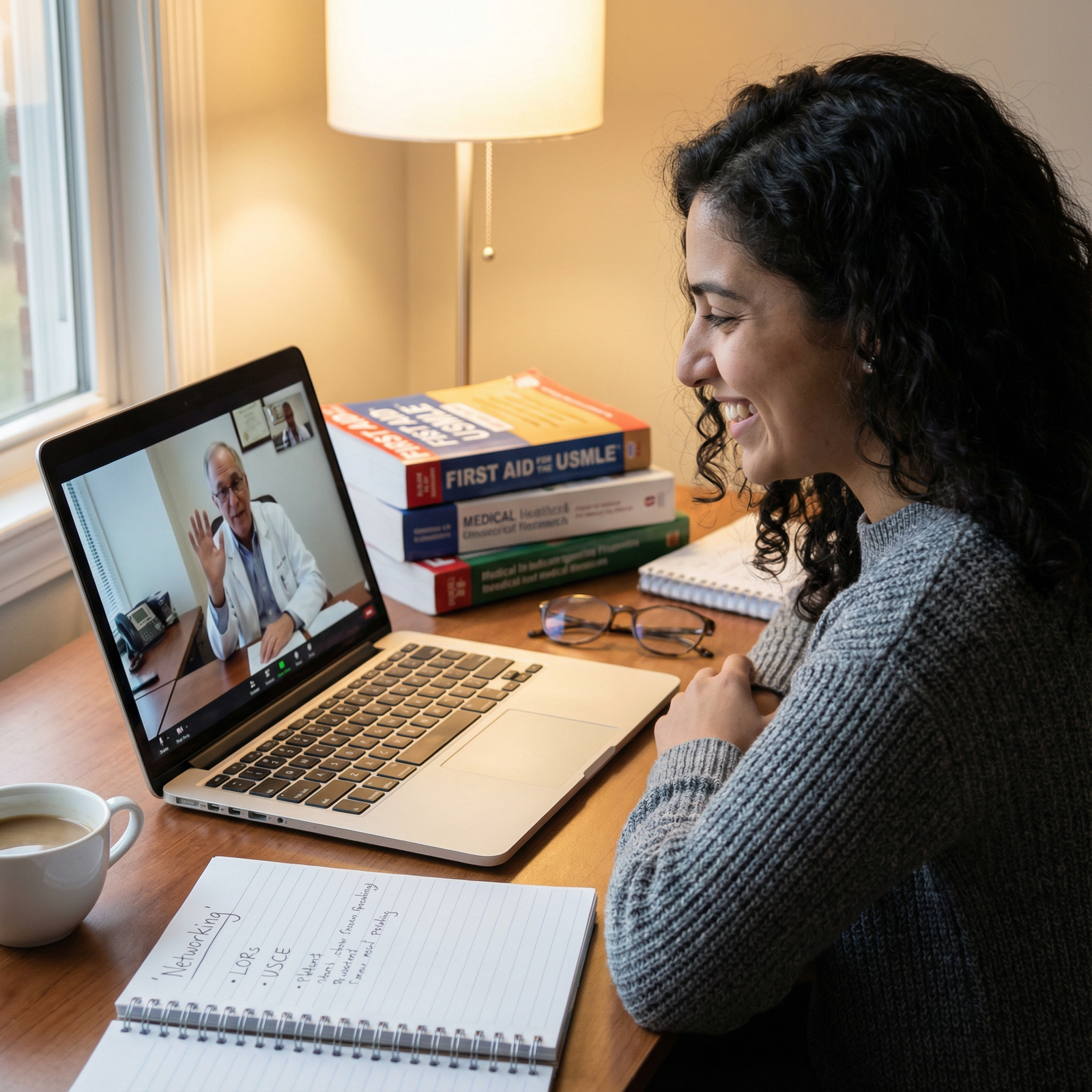
- Found a mentor (an IMG resident from her home country) who met with her monthly by video.
Prioritized Sleep and Breaks
- Set a firm cutoff time for studying at 22:30.
- Used 50/10 Pomodoro cycles for Qbanks.
- Scheduled one half-day each week for rest and non-medical activities.
Outcomes
Within nine months:
- Sarah passed Step 2 CK with a competitive score.
- She completed her ECFMG requirements ahead of schedule.
- She had multiple U.S.-based mentors and strong letters of recommendation.
- She submitted her ERAS application on opening day and received several interviews.
While her journey was still demanding, Sarah reported feeling more in control and less overwhelmed. The shift wasn’t magical—just systematic.
FAQs: Time Management for IMG Residency Applicants
Q1: How can I balance exam preparation with residency application tasks without burning out?
A1: Start by identifying which phase you’re in. If your exam is within 2–3 months, prioritize 70–80% of your time on Study Strategies (Qbanks, review, practice tests) and dedicate 20–30% to light application preparation (document gathering, basic ERAS profile setup). Once the exam is done, shift that ratio: spend more time on Residency Preparation—refining your personal statement, program research, and Networking Tips—while maintaining a smaller block for ongoing medical reading and Step 3 planning. Use time blocking to protect exam study in the mornings and application tasks later in the day.
Q2: I work full-time. Is it still possible to create an effective time management plan as an IMG?
A2: Yes, but you must be more intentional. Start by mapping your fixed commitments (work hours, commute, family responsibilities). Then identify 2–3 consistent daily study blocks, even if they are only 60–90 minutes each. Focus on high-yield tools (Qbanks, Anki) and avoid passive study methods. Use weekends for longer sessions, full practice tests, and residency admin tasks. Many working IMGs succeed by maintaining consistent smaller efforts over 9–12 months rather than trying to “cram” in a short period.
Q3: When should I start networking, and how much time should I spend on it?
A3: Start earlier than you think—ideally 9–12 months before the Match cycle you’re targeting. In the beginning, 1–2 hours per week is sufficient to: identify potential contacts (alumni, IMG residents, faculty), send introductory messages, and attend occasional online events. As you approach ERAS submission and interview season, you may increase this time slightly to follow up with programs and attend webinars. The key is consistency: brief, regular networking is more effective than occasional “marathon” efforts.
Q4: I often feel overwhelmed and don’t know which task to do first. How do I get unstuck?
A4: Use a simple three-step reset:
- Brain-dump everything on your mind onto paper or a digital note (exams, documents, emails, etc.).
- Sort tasks using the Eisenhower Matrix (urgent/important, important/not urgent, etc.).
- Choose one small “Important” task you can complete in 20–30 minutes and start a focused block (e.g., 25 minutes). Completing a small, meaningful task builds momentum and reduces anxiety. Repeat this process when you feel paralyzed by choice.
Q5: How do I stay motivated during a long, multi-year IMG journey?
A5: Break your path into visible milestones (e.g., finishing a Qbank, passing an exam, receiving ECFMG certification, submitting ERAS). Track your progress visibly on a calendar or progress chart. Celebrate each step with small rewards. Stay connected with other IMGs who share your goals—accountability groups and mentors help you see that progress is possible. Finally, reconnect regularly with your “why”: write down the reasons you are pursuing residency in the U.S. and revisit them monthly, especially when your motivation dips.
By approaching your journey with structured Time Management, focused Study Strategies, and intentional Networking Tips, you can transform a complex IMG path into a clear, stepwise Residency Preparation plan. You cannot control every factor in the Match, but you can control how you use your time—and that control is one of your greatest competitive advantages as an IMG applicant.