

You’re PGY-3/PGY-4. The emails just went out: “We’re selecting next year’s chiefs.” Your co-residents are suddenly “thinking about leadership opportunities.” Someone quietly asks you, “Are you going for chief? It’ll help for jobs, right?”
You’re asking the right question: does chief resident status actually matter for private practice jobs, or is it mostly ego and free food at noon conference?
Here’s the direct answer.
Short answer: It helps some, it doesn’t save you, and it’s not required
For private practice:
- Being chief is a nice plus, not a golden ticket.
- It will rarely be the deciding factor for a job offer.
- It matters much more for:
- People aiming for academic jobs
- People planning to be future leaders in a group (medical director, section chief, partner-track fast lane)
If all you want is: “I want a stable private practice job in a reasonable city, make good money, and go home,” then chief is optional. It’s not a mistake not to do it.
But. If you do it strategically, it can pay off for leadership roles and for standing out in competitive markets.
Let’s break it down properly.
What private practice actually cares about
Strip away the fluff. Here’s what most private practice groups really care about when hiring:
| Priority | Typical Importance |
|---|---|
| Clinical competence | Very High |
| Work ethic/reliability | Very High |
| Fit with group culture | Very High |
| Subspecialty/training | High |
| Reputation/references | High |
| Leadership titles | Low–Moderate |
Notice what’s missing: “chief resident” isn’t at the top of any real-world list.
What they’re thinking:
- Will this person be safe, efficient, and low drama?
- Will they cover call, show up on time, not trash colleagues to staff?
- Will they get along with partners, nursing, and administration?
- Can they help us grow (procedures, subspecialty, community presence)?
Chief resident status is just one tiny data point under “leadership/character.”
How chief resident status actually comes up in hiring
Picture a real scenario: a medium-sized private group in a midwestern city, hiring for general internal medicine or anesthesia or EM.
They’re looking at your CV.
What chief status does:
Gets a quick positive mental tick
“Oh, chief resident. Probably not a disaster. Probably reasonably responsible.”
That’s about the level of enthusiasm. Mildly positive.Gives them something to ask about
You’ve given them a hook:- “What kind of responsibilities did you have as chief?”
- “Did you work with scheduling or QI projects?”
Helps if your program has a strong reputation
Chief at MGH, Mayo, Stanford, etc. carries more weight than chief at a small, unknown community program. Fair or unfair, that’s reality.
What chief status does not do:
- Compensate for bad references
- Erase a reputation for being lazy, difficult, or flaky
- Turn a weak clinical resident into a good doctor
- Overcome major red flags (disciplinary issues, professionalism problems)
If your PD or faculty are lukewarm about you, chief won’t fix that. Private practice groups quietly ask around. That word-of-mouth beats titles every time.
Where chief resident status matters more (and less)
Let me be specific.
Situations where chief status does help
- You want to be a future leader in private practice
If you eventually want to be:
- Site director
- Medical director
- Section chief
- Partner in charge of scheduling, quality, or education
Then having been chief tells people: “This person has at least seen how leadership works.” It won’t make you medical director on day one, but it will make that trajectory easier.
- You’re in a saturated or highly desirable city
In cities where everyone wants to live (think San Diego, Denver, Austin, Boston suburbs), groups sometimes see stacks of very similar CVs. Chief can:
- Get your CV into the “interview” pile instead of the “maybe later” pile
- Push you over the line when two candidates are very close
Still not decisive every time, but now it actually moves the needle a bit.
- You did real, tangible projects as chief
If you can say things like:
- “As chief, I redesigned our night float schedule, reducing 80-hour violations by 40% and improving fill rates from 70% to 95%.”
- “I led a QI project that cut door-to-antibiotic times in half in our ED.”
That’s real. That sounds like someone who could sit on a practice management committee, negotiate with administration, or run quality initiatives.
That’s when being chief becomes more than a line on your CV.
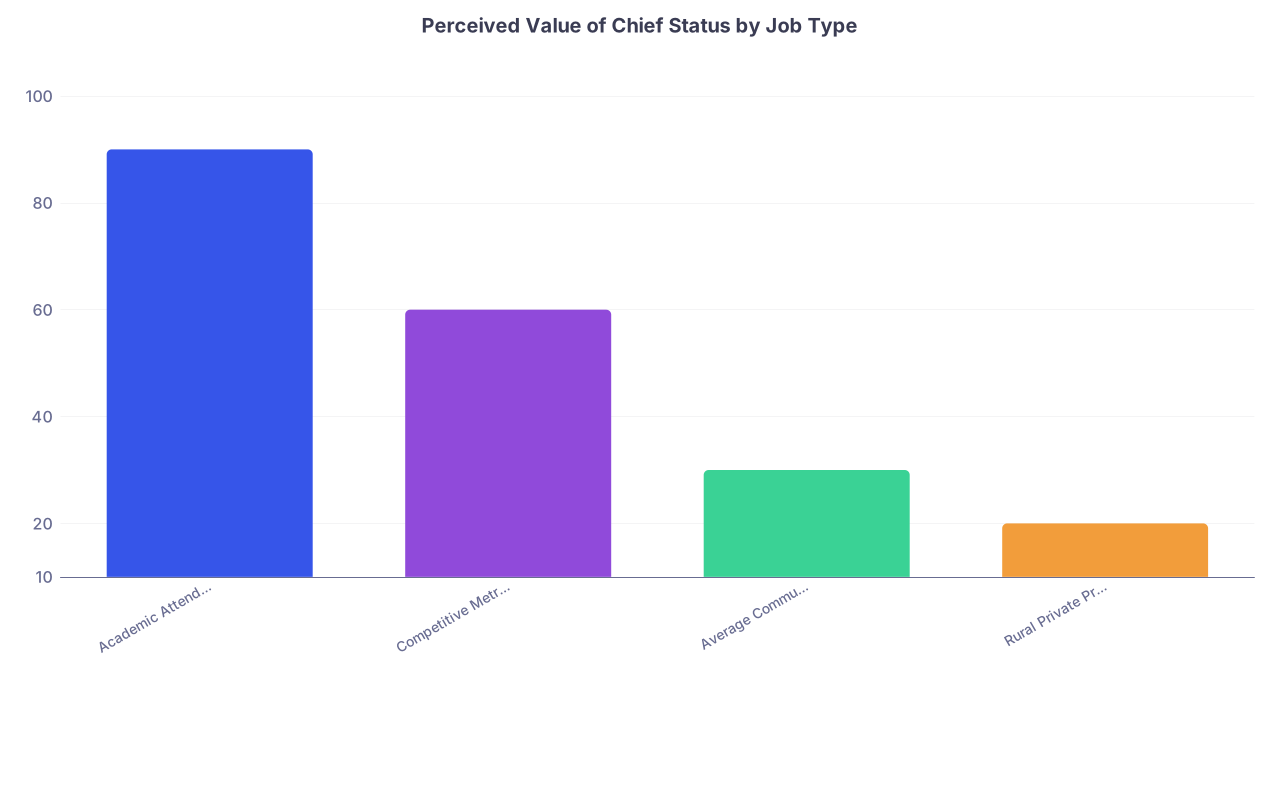
| Category | Value |
|---|---|
| Academic Attending | 90 |
| Competitive Metro Private Practice | 60 |
| Average Community Private Practice | 30 |
| Rural Private Practice | 20 |
(Values = rough “relative importance” out of 100, from how groups actually behave.)
Situations where chief status doesn’t matter much
- You’re applying to rural or less competitive areas
If a group has been recruiting for 18 months for someone to cover call in a rural hospital, your chief title is not what gets you hired.
They care that:
- You can do the work.
- You’re not going to leave in 6 months.
- You’re not clinically dangerous.
- You’re clinically below average
Harsh truth: some people become chief because they’re extremely organized, likable, and good at managing people… but just “okay” clinically. Some are great at both. Some are mid at everything.
If private practice hears, “Nice person, but I wouldn’t send my family to them,” your chief title is irrelevant.
- You don’t actually like leadership work
If in your interview you say:
- “Honestly, I hated dealing with schedules and complaints.”
- “Yeah, I was chief but I mostly just signed forms.”
You’ve basically admitted the title is hollow. It won’t impress anyone who’s been in leadership.
How chiefs are really viewed by practicing docs
Most attendings who’ve been out a while see “chief resident” like this:
- As a proxy for “probably responsible and organized”
- As proof you can at least tolerate some non-clinical tasks
- As neutral if you clearly slept-walked through the role
- As negative only if it’s clear you used it for ego and were horrible to work with
Nobody is sitting in a partnership meeting saying, “We can’t hire this person. They weren’t chief.”
More often you’ll hear:
- “I don’t care that they were chief, what’s their reputation?”
- “Did they get along with nurses and staff?”
- “How’s their work ethic? Are they going to dump on partners?”
If you want something that matters more than chief for private practice: strong, specific references and a clean reputation with nursing and staff.
When you SHOULD strongly consider being chief
Here’s when I’d tell you to go for it.
- You actually like leadership and systems problems
If you’re the resident who:
- Notices broken workflows and wants to fix them
- Doesn’t mind the politics of schedules and policies
- Likes teaching and being a point person
Then chief can be a meaningful leadership laboratory. It’s a fast way to learn how hospitals actually run.
- You want to keep academic and leadership doors open
Chief gives you:
- A stronger application for academic jobs or hybrid jobs (private group with academic affiliation)
- Early exposure to administrators, department chairs, and committees
- A story to tell about leading projects, not just following orders
- You’re at a solid program and already respected
If you’re already the go-to resident, attendings like you, juniors trust you — chief formalizes that. It lets you leave residency with a “leadership brand,” which follows you into any practice type.
When it’s absolutely fine not to be chief
On the flip side, I’d tell you not to force it in these scenarios:
- You’re burnt out and need a breather
Chief adds:
- More emails
- More meetings
- More conflict management
On top of your final clinical year. If you’re barely hanging on, this is not the year to “build your leadership profile.”
- You’re 100% sure you want straightforward private practice with no leadership
If your goal is:
- “3–4 days a week clinical, stable group, no committees, see my family”
You don’t need chief for that. Focus on being an excellent clinician and a pleasant colleague. That will carry you much farther.
- You want to moonlight and pay down loans hard
A heavy chief role can kill moonlighting opportunities. If finances are your top priority and being chief would significantly cut your ability to moonlight, it’s rational to say no.
How to make chief status actually count (if you do it)
If you decide to be chief, do it in a way that’s actually worth something later.
Do three things:
- Run at least one project that leaves a mark
Not vague “resident wellness.” Real, measurable impact. Examples:
- New scheduling template that improved coverage and reduced swaps
- QI project that reduced readmissions, ED length of stay, or complication rates
- Educational innovation that other programs asked to copy
- Get specific, high-quality letters
Ask your PD or chair to comment on:
- Conflict management
- Professionalism under pressure
- Initiative and follow-through
- How nurses and staff see you
Those details make your chief role real to a private practice group.
- Translate it into private practice language in interviews
Do not just say: “I was chief, so I did schedules and some admin.”
Instead:
- “I’m comfortable handling difficult conversations and aligning different stakeholders. For example, when we revamped our call schedule…”
- “I’ve led teams through changes that initially had pushback, like restructuring our ICU coverage model…”
You’re selling skills, not a title.
Reality check: signal vs substance
Here’s the core truth: Chief resident is a signal, not a guarantee.
- If your substance is strong (clinical skill, professionalism, good teammate), chief is a nice amplifier.
- If your substance is weak, chief is just a louder announcement of someone they don’t want.
So:
- Don’t chase chief just to “look good for private practice.”
- Do it if it aligns with who you are and where you want to end up.


| Step | Description |
|---|---|
| Step 1 | Interested in Chief Role |
| Step 2 | Skip Chief - Focus on Clinical Skills |
| Step 3 | Maybe Skip - Prioritize Wellbeing or Moonlighting |
| Step 4 | Strongly Consider Chief |
| Step 5 | Optional - Do Chief Only If It Feels Right |
| Step 6 | Enjoy leadership and admin work |
| Step 7 | Burned out or need money |
| Step 8 | Future leadership or academic interest |
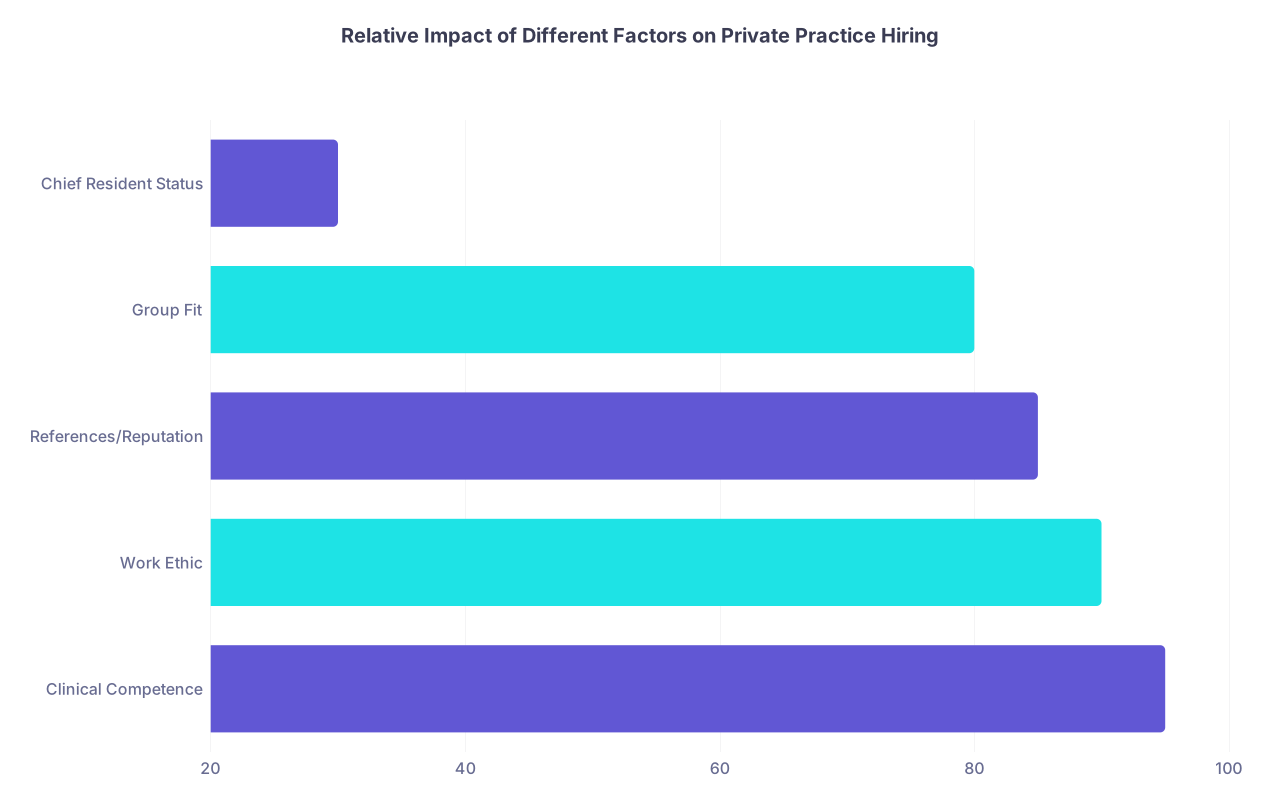
| Category | Value |
|---|---|
| Clinical Competence | 95 |
| Work Ethic | 90 |
| References/Reputation | 85 |
| Group Fit | 80 |
| Chief Resident Status | 30 |

FAQ (5 questions)
1. Will not being chief resident hurt my chances for private practice jobs?
No. Not being chief will not meaningfully hurt you for most private practice roles. Groups do not treat it as a requirement. They care more about your clinical strength, your reputation, and your references. I’ve seen many residents land excellent jobs in highly desirable locations without ever being in the conversation for chief.
2. Does being chief resident increase my starting salary in private practice?
Almost never. Private practice salaries for new hires are usually standardized by specialty, region, and work expectations (shifts, call, procedures), not by titles. You might indirectly earn more later if your leadership skills lead to roles like medical director or committee chair, which come with stipends. But the chief title itself doesn’t bump your starting number in most groups.
3. Is chief resident more important for some specialties than others?
It has slightly more weight in specialties that are naturally leadership-heavy and systems-focused, like internal medicine (hospitalist), emergency medicine, and anesthesiology, where you interact closely with hospital administration. It’s still a “nice plus,” not a requirement. For very procedural or volume-driven fields in pure private practice, it matters less than your technical skill and work ethic.
4. How should I list chief resident on my CV for private practice?
Simple and clean. Under your residency entry, add a separate line:
“Chief Resident, PGY-4, 2025–2026”
Under “Leadership/Activities,” list 2–3 short bullets with tangible outcomes, like “Led redesign of resident call schedule, decreasing uncovered shifts by 50%” or “Co-led QI project reducing ICU transfer delays by 30%.” Do not make it a paragraph of fluff.
5. If I want to do private practice now but maybe academic later, is chief worth it?
Yes, in that case chief is usually worth strong consideration. It keeps academic doors open, looks good on promotion files, and signals that you’ve already functioned in a leadership role. You can start in private practice, build your clinical chops, and still pivot toward academic or hybrid jobs later with “former chief resident” as part of your story.
Key points to walk away with:
- Chief resident is a bonus, not a requirement, for private practice. It helps a bit, especially for leadership-minded physicians and competitive markets, but it won’t make or break your job prospects.
- Your reputation, references, and clinical competence matter far more. If those are strong, chief status is a nice extra. If those are weak, chief will not save you.


