
You’re staring at your application planner. You’ve got multiple program types or tracks—maybe MD and DO schools, maybe research-heavy vs community-focused programs, maybe different specialty programs for a summer or post-bacc. And you’re wondering:
“Can my mentor just write one letter? Or do they need separate letters for each program or track? Am I even allowed to use the same recommender multiple times?”
Here’s the answer you’re looking for:
Yes, one mentor can absolutely write multiple letters for different programs or tracks. In fact, they’re supposed to. The real question is how to do this without annoying your mentor, screwing up logistics, or getting a generic letter that does nothing for you.
Let’s break this down like an adult and not like an anxious portal-refreshing premed.
1. The Core Answer: Yes, One Mentor Can Write Multiple Letters
Let me be blunt: schools and programs expect letter writers to write for multiple places and tracks.
Your mentor is not writing one sacred, single-use letter. They’re writing a professional evaluation of you that can be sent many times.
Here’s how it works in most common scenarios:
Applying to 20+ MD schools via AMCAS?
Your mentor writes one AMCAS letter. You assign that same letter to all the schools that accept it.Applying to DO schools via AACOMAS and MD schools via AMCAS?
They can:- Write one letter addressed generically (“To the Admissions Committee”), uploaded to both systems, or
- Customize slightly if they feel like it, but it’s not required.
Applying to a summer research program, a structured post-bacc, and a scholarship?
They can:- Write one base letter and tweak versions, or
- Write one strong general letter and you reuse it everywhere.
Bottom line: using the same mentor for multiple programs is normal, expected, and not a problem. The only time there’s a real “limit” is when a specific portal caps the number of letters total (e.g., a program allows 3 letters maximum), not how many programs they can submit to.
2. When You Actually Need Separate Letters vs Reusing One
The next question: should you reuse the same letter everywhere, or ask for slightly different versions?
Here’s the rule of thumb I use with students:
| Situation | Best Approach |
|---|---|
| Multiple MD schools via AMCAS | Reuse same letter |
| MD + DO schools | Reuse or minor wording tweak |
| Clinical vs research programs | Ask for tailored versions |
| Scholarship vs admission application | Usually separate versions |
| Specialty-specific track (e.g., primary care) | Tailored if possible |
Let’s walk through the logic.
You can reuse the same letter when:
- You’re applying to:
- Multiple MD schools via AMCAS
- Multiple DO schools via AACOMAS
- A broad range of programs with similar goals (e.g., various premed summer enrichment programs)
- The content is generally applicable:
- Talks about your academic ability, professionalism, work ethic, character
- Not tied to one specific institution or niche track
In those cases, your mentor usually writes one strong general letter and uploads it once per service.
You should consider separate versions when:
Track or focus is clearly different:
- One program is explicitly research-heavy (e.g., NIH, HHMI, summer research)
- Another is clinical/community-focused (e.g., primary care immersion, underserved community programs)
The target is very specific:
- A primary care or rural health–focused track wants evidence you’re truly interested in that path
- A research fellowship or honors thesis wants heavy emphasis on your scientific thinking and productivity
- A scholarship or award wants a different slant (leadership, service, financial need-related context, etc.)
Here, you’re still not asking them to write totally from scratch each time. You’re asking for:
“Same core letter, but could you emphasize my research for X and my clinical work for Y?”
That’s reasonable.
3. How Application Systems Actually Handle Multiple Letters
The mechanics matter because this is where people get scared they’re “breaking a rule.” You’re not.
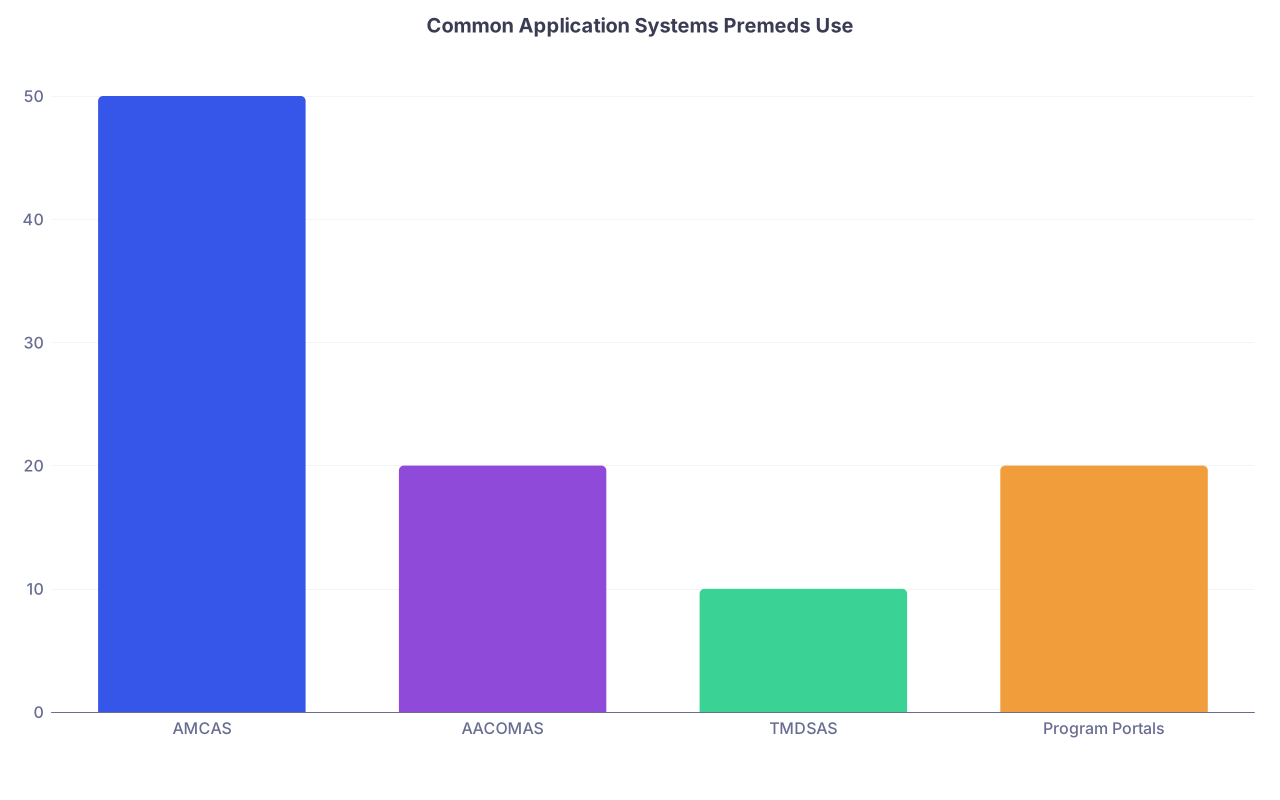
Common systems you’ll run into
| Category | Value |
|---|---|
| AMCAS | 50 |
| AACOMAS | 20 |
| TMDSAS | 10 |
| Program Portals | 20 |
Those numbers aren’t data; they’re just a rough sense of how often I see students use each.
Here’s how each typically works, from a letters perspective:
AMCAS (MD schools)
- Your mentor uploads one letter to AMCAS.
- You can assign that same letter to multiple schools.
- The writer doesn’t need to send separate letters to each school. In fact, they shouldn’t.
AACOMAS (DO schools)
- Same logic: one upload, multiple assignments.
- Your DO letter can be used for all DO schools you apply to.
TMDSAS (Texas schools)
- Centralized service again. Letter goes in once and is shared with all TMDSAS schools you choose.
Direct program portals (summer programs, post-baccs, research programs, scholarships)
This is where it gets messy. Each program might:- Email your recommender a unique link
- Use Interfolio or another service
- Ask your mentor to upload a PDF directly
Here’s the key:
Even if the mentor is uploading separate files to multiple portals, the content can still be the same core letter, adjusted or not. Multiple use of the same mentor = standard practice.
4. How to Ask a Mentor for Multiple Letters Without Being a Nuisance
The part students screw up is communication. They drip out requests over weeks. They bury mentors in scattered emails. Then wonder why letters are late or generic.
Don’t do that.
Here’s a clean way to handle it.
Step 1: Be transparent upfront
When you first ask, say something like:
“I’m applying to several programs this cycle: MD (via AMCAS), a few DO schools, and a summer research program. Would you be comfortable writing one or more letters that I can use across these applications?”
You’re signaling:
- There are multiple uses
- You understand they’ll be re-used
- You’re organized
Step 2: Group your requests
Within one email or document, list:
- All the programs/tracks
- The system (AMCAS, AACOMAS, direct link, etc.)
- Deadline for each
- What you’d like emphasized (if anything different)
Example structure (do not overcomplicate, keep it readable):
AMCAS – MD schools
- Upload via AMCAS letter service
- Deadline: June 15
- Emphasis: overall academic ability, clinical commitment
AACOMAS – DO schools
- Same letter is fine (addressed “To the Admissions Committee”)
- Deadline: June 20
- Emphasis: patient-centered care, professionalism
NIH Summer Research Program
- Separate letter upload link (will be emailed to you)
- Deadline: Feb 1
- Emphasis: my research skills, independence in the lab
That makes it painfully clear, which mentors actually appreciate.
Step 3: Make reuse easy
Offer this:
“I’m happy for you to use the same core letter and adjust the emphasis slightly where needed. I’ll send you a single CV and summary of my work with you that you can draw from for all versions.”
Most mentors will do exactly that: one main letter, slight tweaks if warranted.
5. MD vs DO vs Tracks: Do They Need Different Letters?
You’re probably wondering about specifics now. So let’s be precise.
MD vs DO letters
Can the same mentor write for both? Yes.
Should the content be exactly identical? Usually fine.
If you want to be a bit more tailored, you can ask them to slightly adjust language for DO schools, something like:
- Add a brief mention of:
- Your appreciation for holistic, whole-person care
- Osteopathic philosophy (if you’ve talked about it with them)
- Any DO mentors you’ve shadowed or experiences in that realm
But is it mandatory? No. Programs know letters are reused.
Different tracks (e.g., research track vs primary care track)
If you’re applying to:
- A regular MD program
- A primary care track
- A research honors or physician-scientist track
Using the same mentor for all is fine, but you’ll get the best results if you:
- Use a research mentor to emphasize:
- Your data analysis, critical thinking, perseverance, independence
- Use a clinical mentor for:
- Your bedside manner, teamwork, communication, compassion
If one mentor is doing multiple roles, just ask:
“For the primary care track, would you mind highlighting my work with underserved patients and interest in longitudinal care? For the research track, emphasizing my project and scientific skills would be most helpful.”
You’re not being needy. You’re giving them direction. That’s helpful.
6. Red Flags and Mistakes to Avoid
Some things will actually hurt you.
Letters that name the wrong program or school
Example: A letter that says “I strongly recommend Alex for admission to Harvard Medical School” and you send it to every school.
This makes you look sloppy, and some schools will notice.Fix: Ask mentors to use “To the Admissions Committee” or “for admission to medical school.”
Last-minute multi-letter requests
“Hey, can you do my AMCAS, AACOMAS, NIH program, and scholarship letters… all due next week?”That’s how you get:
- No letter
- Or a rushed, lukewarm one
Not telling them what’s different between programs
If they don’t understand that one is a research program and another is a clinical immersion, they’ll write a bland, one-size-fits-all letter. Which helps no one.Asking for separate letters when one would be fine
Don’t create work for no reason. If the programs are all similar (e.g., 25 MD programs), one good general letter is exactly what’s expected.
7. Quick Decision Tool: One Letter or Multiple?
Use this mental flow:

| Step | Description |
|---|---|
| Step 1 | Same general goal? MD/DO admission |
| Step 2 | Use one general letter |
| Step 3 | Ask for small tweaks only |
| Step 4 | Different type: research vs clinical vs scholarship |
| Step 5 | Ask for tailored versions |
| Step 6 | Different emphasis needed? |
| Step 7 | Same strengths relevant? |
If the core goal and required skills are the same, reuse.
If the programs demand different strengths, tweak or tailor.
8. How to Phrase the Ask (You Can Steal This)
Here’s a template you can adapt. Short, clear, adult.
Dear Dr. Smith,
I am applying to several programs this cycle and was hoping you’d be willing to write a letter of recommendation on my behalf. I’ve really valued our work together in the clinic, and I think you could speak well to my clinical abilities and work ethic.
The main applications are:
– MD programs via AMCAS (letter uploaded once, used by multiple schools)
– DO programs via AACOMAS (same letter is fine; addressed “To the Admissions Committee”)
– A primary care–focused track at [School] (if possible, a brief emphasis on my interest in primary care and working with underserved patients would be helpful here).I’m happy for you to use the same core letter for all of these and adjust the emphasis only if you feel it’s appropriate. I’ve attached my CV and a short summary of my experiences in your clinic for reference.
Deadlines:
– AMCAS/AACOMAS: June 15
– [Primary Care Track]: July 1Please let me know if you’d be comfortable with this or if any of these requests are too much. I really appreciate your time and support.
Best,
[Your Name]
That’s how you make multiple letters from one mentor feel manageable instead of overwhelming.
FAQ: Can One Mentor Write Multiple Letters for Different Programs or Tracks?
1. Will schools know if the same letter was used for multiple programs?
They can assume it, and they do not care. Centralized services (AMCAS, AACOMAS, TMDSAS) are literally built for that. What matters is quality, not uniqueness.
2. Is it bad if the letter is generic and not program-specific?
It’s not “bad,” but it’s less powerful. A strong general letter beats a weak “targeted” letter. If your mentor barely knows you, do not chase micro-customization. Focus on getting 2–3 genuinely strong, detailed letters.
3. Should my mentor write different letters for MD and DO schools?
They can use the same core letter. If they’re willing to slightly emphasize your fit with osteopathic values for DO schools, great. But no program is rejecting you because your MD and DO letters aren’t separately customized.
4. How many programs can one mentor reasonably write for?
There’s no formal cap. I’ve seen mentors write letters for 30+ schools in a single cycle because most systems reuse the same upload. What’s unreasonable is giving them 10 different portals, all with different formats and last-minute deadlines, and expecting custom versions for each.
5. What if a program specifically asks for a “confidential” or “program-specific” letter?
Follow the program’s instructions. Your mentor can still base it on the same core content, but they may need to upload a separate file or use a specific link. You can say, “This program requires a separate upload, but you’re welcome to reuse your prior letter as a base.”
Today, do this:
Make a single document listing every program/track you’re applying to, with system, deadlines, and what you want emphasized for each. That’s your script for talking to your mentor—and the difference between a chaotic letter process and a clean one.