
You’re walking into a hospital at 6:30 p.m. in a city you do not live in, badge on a temp clip, security still trying to figure out which door you are supposed to use. You are the locum tenens night hospitalist. The day team is already half checked out. The ED is full. The ICU fellow is “covering from home.”
And you are supposed to make all of this work.
If you are thinking about locums hospitalist work—especially nights—you need to understand three things cold:
- How night float is actually structured when you are the outsider.
- How codes and rapid responses get handled when you are “the hospital doctor” but not really on the inside.
- How hospital politics quietly shape your workload, your risk, and whether they invite you back.
Let me break this down specifically.
1. What “Locums Hospitalist Nights” Actually Means
Locums hospitalist nights sound simple on paper: “Admit 8–12 patients, cross-cover 60–80, respond to codes.” Reality is usually messier. You are dropped into someone else’s Frankenstein of a schedule and culture.
Common Night Coverage Models You’ll See
| Model | Patients Cross-Covered | New Admits | Typical NP/PA Support |
|---|---|---|---|
| Solo Nocturnist | 60–90 | 6–12 | None or 1 in ED |
| Nocturnist + APC | 80–120 (shared) | 8–16 (split) | 1–2 APCs |
| “Admit-Only” Nocturnist | 0–30 | 10–18 | Day team holds cross-cover |
| Hybrid Night Float | 40–70 | 4–10 | Variable |
What matters for you is how those numbers intersect with:
- Call responsibilities (codes? rapids? only on “your” patients?)
- Ancillary support at night (RT, phlebotomy, IV team, transport)
- Real ICU coverage (in-house intensivist vs “call from home” fantasy)
The recruiter and the contract will both be vague or optimistic. You need to ask pointed questions.
Questions You Must Ask Before Accepting a Night Locums Gig
Do not rely on “It’s pretty manageable” from anyone. That phrase is useless.
Ask, in clear language:
- How many patients will I be cross-covering solo?
- How many new admits are expected per night on average? On a bad night?
- Who responds to:
- Code Blue?
- Rapid Response / RRT?
- STEMI / Stroke alerts?
- Is there an in-house:
- ICU physician?
- Anesthesia?
- OB (if it is a hospital with L&D)?
- Are NPs / PAs:
- Writing their own notes and orders?
- Bringing all orders to me?
- Admitting independently or “with supervision” that actually means I re-do everything?
And then the big one, which almost nobody asks nearly hard enough:
“How many patients are on the service at night per full-time nocturnist?”
Not “per group.” Not “on the floor.” Per nocturnist. That ratio tells you exactly how they view you: clinician vs warm body.
2. Night Float Realities: Admissions, Cross-Cover, and Survival
Night locums hospitalist work is about mental triage. The risk is not usually a dramatic code. It is the slow bleed of 50+ cross-cover calls and 10 admissions while the ED is paging you every seven minutes.
Admissions: The Rules Change When You Are Locums
You are not there to fix the entire hospital’s broken daytime workflow. Yet you will be pressured, directly or indirectly, to:
- “Clean up” the day team’s incomplete notes.
- Finish workups the day team never really started.
- Admit “borderline OBS / inpatient” cases that day shift wanted to avoid.
As locums, you need a clear internal rule set:
You admit what meets criteria. Period.
If the ED is playing the OBS vs inpatient game badly, you document your reasoning. You do not twist reality to satisfy a CFO you will never meet.You do not redesign care plans on every complex train wreck at 3 a.m.
You stabilize and hand off clearly. Do not rewrite a 30-line med list for the 24th time this year because “nobody ever cleaned this up.”Your admission H&P must be:
- Focused.
- Clear on decision making.
- Not a novel. You do not have time.
You want charts that a plaintiff attorney will find boring. Not empty. Just boring and consistent.
Cross-Cover: The Noise Problem
Cross-cover as a locum is where you will be abused if you let yourself be.
Common patterns:
- Nurses page you for longstanding chronic issues because you are “the easiest to reach.”
- Consultants offload every non-urgent question to “the hospitalist on at night.”
- Day teams leave problems unresolved, explicitly saying on sign-out “The night doc can just handle it if X happens.”
You control this by:
Clarifying at sign-out:
“Which of these are you asking me to just observe versus actually intervene on?”
Force them to separate noise from true concern.Pushing back on clearly non-urgent issues:
Mild chronic anemia at 2 a.m.? Stable troponin drift in a non-symptomatic 90-year-old with CKD? Those are day team problems. Document that you deferred non-urgent workup to day shift.Recognizing the red flags:
- “We’ve been watching this for a few days.”
- “The family has been upset all day about X.”
- “The surgeon said to call medicine if anything changes.”
Those often predict an overnight escalation that lands in your lap with zero context.
Create simple algorithms for yourself:
- Chest pain + dynamic EKG change or symptoms → you act now.
- “Soft” blood pressures in a long-term CHF / cirrhotic / septic patient → you check trends, exam, urine output; you do not reflexively bolus 2 L at 3 a.m. just to clear a page.
Night work rewards pattern recognition and ruthless prioritization.
3. Codes and Rapid Responses: Who Owns the Room When You Are Locums
This is where locums hospitalists can get into real trouble: fuzzy role expectations in high-risk situations.

| Category | Value |
|---|---|
| Code Blues | 1 |
| Rapid Responses | 3 |
| Urgent Cross-Cover Issues | 15 |
Before Your First Shift: Clarify Code Structure Explicitly
Do this with the hospitalist director or CMO, not just another hospitalist who “thinks” they know.
Ask:
- Who is designated code leader during:
- Day shift?
- Nights?
- Is there a code team? Who is on it?
- Does anesthesia always come? Do they actually show up, or “in theory”?
- Are there standardized code roles (compressor, airway, recorder, meds, leader), or is it chaos?
Then you ask the practical question:
“As night locums hospitalist, am I expected to run all codes house-wide?”
If the answer is yes, then:
- You should see the code policy.
- You should know where the crash carts are and what they contain.
- You should know if they expect you to intubate, or if anesthesia / ED always handles airway.
Do not assume anything based on your training hospital. Community hospitals, especially those desperate enough to rely heavily on locums, often have thin night coverage.
Running Codes as a Locums Nocturnist
If you are the leader, act like it. Hesitation creates chaos and risk.
Your mental checklist:
Establish control fast:
“I’m Dr X, hospitalist. I’ll run the code. Who is giving meds? Who is documenting? Who is on compressions?”Simplify the noise. You do not need five people shouting random vitals and guesses.
Post-event:
- Document a brief but specific code note.
- Make sure DNR / goals-of-care conversations are addressed afterward if the outcome is poor or unclear.
As locums, code leadership exposes you, but refusing to lead when everyone expects you to is worse. Your safest path is clarity and competence, not avoidance.
Rapid Responses: Hidden Work and Politics
RRTs are where hospital politics really show.
Common patterns I have seen:
- Surgeons call RRT on their own patient so medicine will “own” a complication.
- Nurses use RRT because prior pages were ignored by a lazy or overwhelmed primary.
- Families demand “something” be done, and the RRT becomes a customer service event.
You need to know:
- Does RRT automatically trigger a hospitalist eval?
- Are you writing the primary note and assuming care, or co-signing on someone else’s mess?
- Is there a scoring system (MEWS, NEWS) driving calls, or is it totally subjective?
As locums, your default stance during RRT should be:
- Stabilize the patient.
- Decide clearly:
- Upgrade to ICU.
- Keep on floor with a clear monitoring plan.
- Clearly document: reason for the event, your assessment, and specific follow-ups.
And if a surgeon or consultant subtly tries to dump responsibility during a rapid? You say it out loud: “Given this is a clear post-op complication, you will remain primary. I will assist with medical issues and document our plan.” Then you actually write that.
4. Politics: You Are Walking Into Someone Else’s Cold War
Locum tenens hospitalists often underestimate how much their work is shaped by unstated local politics. You are not neutral. From day one, you are a piece in an ongoing game:
- Hospital administration vs physician group
- ED vs hospitalists
- Hospitalists vs specialists
- Day team vs night team
You must read the room quickly.
How Politics Changes Your Night
Here is what politics looks like at 2 a.m. for a locums nocturnist:
ED calls: “We really need this as OBS, the CMO is on us about LOS.”
Translation: They are under pressure, and they want you to help them game status.Surgeon: “Can you just admit this to medicine? I only operate; I do not manage medical stuff.”
Translation: They have carved out a protected existence and expect you to absorb the fallout.ICU “on call from home” says: “Why do you think this needs ICU? Try a little more fluid and see.”
Translation: They do not want to come in for a marginal case, and they will happily push that decision onto you.
Your job as locums is not to make everyone happy. Your job is to practice safe medicine with a defensible paper trail. That sometimes means saying no.
Common Political Traps Locums Fall Into
Becoming the dumping ground
Because you “will not be here next month,” people assume you are the easiest to push.Fix: Use policy language.
“Based on our sepsis protocol and vital sign instability, this patient meets ICU criteria.”
Or: “Per hospital admit criteria, this falls under surgical primary.”Undermining the day team unintentionally
If you write notes that say: “Day team did not address X,” or “No plan evident,” you just joined a war you did not understand.Fix: Document neutrally:
“Patient with ongoing X, team plans Y in a.m. Tonight I addressed Z due to [acute change].”Taking sides in ED vs hospitalist fights
You will hear this, verbatim:
“Our hospitalists always push back on admits.”
“The ED dumps anything they can on us.”Fix: You do not take the bait. You say: “I follow criteria and patient need. Let’s talk about this specific patient.”
Reading the Group Dynamics Fast
On your first day, talk less and observe more.
Clues that the group is politically toxic:
- They bad-mouth each other openly.
- They talk about admin as if it is an enemy army.
- They warn you: “Do not ever trust [consultant service].”
- They apologize constantly for “how things are here” without anyone doing anything to fix it.
On the flip side, groups that are functional:
- Have standardized sign-out structures.
- Have clear expectations for night coverage and day handoff.
- Defend each other in front of other services, even when they disagree internally.
You want to keep coming back to the second group. The first group is fine for a high-rate, short-term contract—but not long-term.
5. Practical Strategies to Protect Yourself (And Stay Sane)
Let us get very concrete. You are locums, post-residency. You want the money, the flexibility, maybe the geographic freedom. You also want to avoid the classic locums disasters.
Documentation Strategy for Night Locums
Your notes need to do three things:
- Establish that you were aware of key risks.
- Show that you took reasonable action.
- Clarify what you are handing off.
For an admission at 3 a.m.:
- Short HPI: why now, why admit, what you think is happening.
- Clear “Assessment and Plan” with:
- Differential diagnosis (no need for a textbook).
- What you are doing overnight.
- What you expect the day team to do.
For cross-cover events:
- If you change management meaningfully, write a brief note.
“Called by RN for hypotension, BP X/Y from baseline A/B…”
Show that you examined, thought, and decided.
If you do nothing, document why:
“No new intervention initiated – vitals within patient baseline, no new symptoms, labs stable, will defer to primary team.”
That kind of note saves you years later when someone rummages through the chart.
Personal Rules That Keep Locums Nocturnists Out of Trouble
I have seen these pay off over and over:
Refuse unsafe admits to floor
If the patient clearly needs ICU but bed control, ED, or ICU is hedging, write the reason you believe ICU is indicated. Push. You will anger someone. Good.Do not own other people’s ambiguous promises
If the surgeon told the family, “You’ll go home tomorrow,” and now they are septic? Document: “Discussed with family that discharge timing depends on recovery course and resolution of infection.”Don’t be the “hero” with no backup
Do not start high-risk drips on the floor that nurses are not trained to manage just to avoid escalation. Do not do bedside procedures you are rusty on at 3 a.m. with one nurse and no backup, unless it is truly life or death.Treat nurses as allies, not problems
At night, your best information comes from nurses who know their patients. If the “vitals look fine” but the nurse says, “He is just not right,” you go look. That phrase usually means something.
6. Pay, Schedules, and When Nights Are Actually Worth It
Let us talk money and structure, because this is where people either burn out or decide this is sustainable.
Locums hospitalist night work usually pays a premium. Rough pattern:
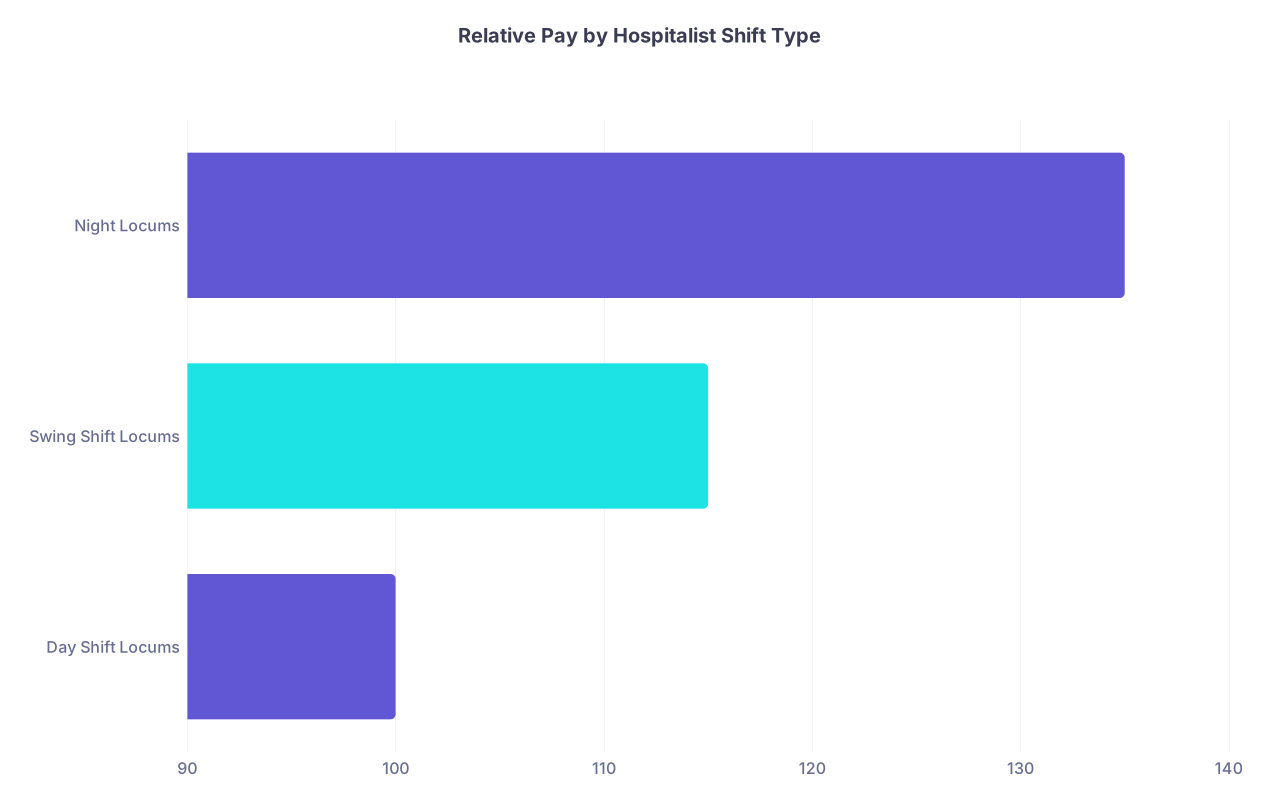
| Category | Value |
|---|---|
| Day Shift Locums | 100 |
| Swing Shift Locums | 115 |
| Night Locums | 135 |
Think of those as relative units, not dollars. Nights often pay 20–40% more depending on:
- Admission volume.
- Cross-cover load.
- Procedures or codes expected.
- Undesirability of location.
You need to weigh:
Rate vs volume:
A “high-paying” job where you are drowning in 20 admissions and 100 cross-covers is not actually high-paying if you are mentally wrecked and making errors.True schedule:
Are they quietly expecting pre- or post-shift sign-out off the clock? Are you getting slammed with day-team unfinished tasks at 6:45 p.m.?-
- Are there penalties for leaving “early” if your relief is late?
- Are you paid extra for unplanned extra hours?
- Are procedures separately compensated?
Locums agencies often gloss this over. You need numbers and explicit answers, not vibes.
7. How to Decide if Locums Nights Are Right for You Post-Residency
If you just finished residency, hospitalist locums nights can be:
- A great way to ramp up your skills quickly in real-world chaos.
- A fast path to burnout if you choose badly.
You probably should consider it if:
- You handled nights well in residency and did not crumble under volume.
- You are comfortable running codes and managing ICU-level patients, even in imperfect settings.
- You want high earning potential early to pay down loans or build a financial cushion.
You should be cautious or avoid it if:
- You need heavy supervision to feel safe with borderline ICU patients.
- You are conflict-avoidant to the point where you cannot say no to unsafe admits or dumps.
- You crumble when systems are disorganized and need everything to be protocolized.
Remember: as locums, there is no institutional memory protecting you. You do not have the political capital that long-term staff do. Your protection is your judgment and your documentation.
FAQs
1. Is it safe to do locum tenens hospitalist nights right out of residency?
It can be, but only if you trained at a place where you genuinely ran nights with significant responsibility. If you always had an attending physically present and rarely made independent triage decisions, jumping into solo nocturnist locums is risky. The less backup, the more you need strong personal comfort with codes, acute decompensation, and ICU triage. If in doubt, start with a site that has in-house intensivists and at least one other nocturnist or NP/PA at night.
2. How many admissions per night is “too many” for a locums nocturnist?
There is no magic number, but once you consistently exceed 10–12 admissions plus heavy cross-cover, quality drops and risk climbs. A job advertising “up to 18” is telling you they are either understaffed or unrealistic. Look at the combination: new admits + total cross-cover + resources. Eight admits with 40 patients and good nursing can be fine. Eight admits with 90 patients, poor staffing, and weak ancillary support is a setup.
3. Should I agree to run all codes as a locums hospitalist?
If that is part of the defined role and you are competent to do so, yes—but only after you understand the system. You must know who else responds, who owns airway, and what backup exists. If they expect you to both run the code and do all procedures with minimal support, and you are not comfortable with that, you should decline that assignment or limit your role explicitly in advance. Running codes blindly, without clear team structure, is where bad outcomes and bad litigation live.
4. How do I handle surgeons or consultants trying to dump patients on medicine at night?
You push back politely but firmly, and you use hospital criteria and policy language, not emotion. Ask: “Is there a hospital policy on primary service assignment for this scenario?” Document your discussion. If a patient is clearly a surgical complication, state that the surgical team remains primary, and you will manage medical comorbidities. Do not accept vague “medicine will just admit and manage everything” unless that is explicitly the hospital rule—and you are being paid accordingly.
5. What red flags should make me walk away from a locums hospitalist night contract?
A few clear ones: no in-house ICU support with large volumes of unstable patients; refusal to give concrete numbers for average admits and cross-cover load; chaotic or nonexistent sign-out process; multiple groups (ED, surgeons, hospitalists) openly hostile to each other; and a prior locums turnover history where “nobody ever stays long.” If two or three of those show up during your onboarding conversations or first week, you have your answer. Nights pay well, but no rate justifies a chronically unsafe setup.
Key points to keep in your head:
- Night locums hospitalist work lives or dies on clarity: your role in admissions, cross-cover, codes, and rapid responses must be explicit before you start.
- Politics are not abstract—they show up as admits, dumps, ICU avoidance, and RRTs at 3 a.m. Your defense is clear boundaries and clean documentation.
- The money is only “good” if the environment is safe enough that you can keep doing this for more than three months without burning out or making dangerous mistakes.