

It’s late at night after clinic. You’re a third-year med student on your FM rotation, or maybe a PGY‑1 in peds, staring at your loan balance on your phone. You keep hearing that primary care is “a calling,” that psychiatry has “great lifestyle,” that endocrinology is “intellectually rewarding.”
But you’re also thinking: I owe $280k at 7%. I’m about to do 3+ years of residency at a salary that barely beats a teacher’s.
You want the blunt answer: in the lowest paid specialties, how many years until you actually break even financially—meaning the decision to go to med school pays off compared to just getting a normal job out of college?
Here’s the answer you’re looking for.
Step 1: What “Break-Even” Actually Means
Break-even isn’t “when I can finally buy a house” or “when I feel less broke.”
Break-even, financially, is:
The year when your cumulative after-tax earnings as a physician (minus the cost of med school and residency years) finally surpass what you realistically could have earned if you’d stopped after college.
We’re comparing:
- Path A:
College → job at 22 → work and get normal raises - Path B:
College → 4 years med school (no earnings) → 3–4+ years residency → attending income in a low-paying specialty
We’re ignoring inflation noise and focusing on ballpark, realistic numbers.
Assumptions I’ll use (you can mentally tweak them for your own situation):
- Undergrad done at 22
- Med school: 4 years (22–26), $60k/year COA borrowed = ~$240k + interest → round to $300k–$350k debt by the time you start residency
- Residency: salary starts around $65k and rises to ~$75k
- Alternative career: $60k starting salary at 22, with ~3% raises
- Taxes: I’ll work in rough after-tax figures, not perfect marginal tax math
We’re not doing exact actuarial modeling here. We’re answering: are we talking early 30s, late 30s, or 40s?
Step 2: Who Are the “Lowest Paid Specialties”?
Right now (using data similar to recent Medscape and MGMA numbers), the usual bottom group:
- Pediatrics (general)
- Family Medicine
- Internal Medicine (general, non-hospitalist)
- Psychiatry
- Endocrinology
- Infectious Disease
- Rheumatology
- Geriatrics
Hospitalist IM, emergency med in certain markets, or outpatient-only cards in saturated areas can drift down too, but those core eight are your classic low-earners.
Rough average attending compensation (very broad):
| Specialty | Approx Annual Income |
|---|---|
| Family Medicine | $240k–$270k |
| General Pediatrics | $220k–$250k |
| General IM (clinic) | $240k–$280k |
| Psychiatry | $270k–$320k |
| Endocrinology | $230k–260k |
| Infectious Disease | $230k–260k |
| Rheumatology | $260k–300k |
| Geriatrics | $230k–260k |
You can absolutely beat these numbers in the right setting (rural, RVU-heavy, private groups, or high-demand psych markets). You can also earn less at an academic center. But these are usable ranges.
Step 3: Big Picture – When Do Low-Paid Specialties Break Even?
Let’s zoom out first, then drill down by specialty.
If you do:
- 4 years med school (22–26)
- 3 years residency (26–29) for FM, IM, Peds, Psych
- 2–3 year fellowship (29–31/32) for Endo, ID, Rheum, Geriatrics
Then:
- You’ll usually hit break-even somewhere between your mid-30s and early 40s, depending on:
- Debt level
- How aggressively you live during residency/early attending years
- How much your “Plan B” career would have made
In low-paid specialties with high debt, 36–42 is a realistic broad range. Lower debt, higher-paying niche, or rural/locum boosts can move you closer to mid-30s. Massive debt and academic salaries can push you to 40+.
Let’s get specific.
Step 4: Quick Baseline – College Grad vs Physician
First, the alt path.
Say you graduate at 22 with a decent major and get a $60k job.
- Year 1 after tax: roughly $45k (ballpark)
- With ~3% raises, by age 30 you’re making ~76k, by age 40 maybe ~102k
- Over 18 years (22–40), you might accumulate around $1.1M–$1.3M in gross earnings, maybe ~$800k–$900k after tax.
Nothing fancy. Just a normal path.
Now you versus that.
Step 5: Family Medicine, General IM, General Peds
These three are structurally similar in training length and pay bands, so I’ll group them.
Training:
- Med school: 4 years (no income, +debt)
- Residency: 3 years
- PGY1: ~$65k
- PGY2: ~$68k
- PGY3: ~$71k
After-tax ballpark per year: ~$45k–$50k
Post-training pay:
- FM: $240k–$270k
- Gen IM clinic: $240k–$280k
- Gen Peds: $220k–$250k
Let’s pick a middle case: Family med at $250k.
Approx after-tax: $160k–$165k depending on state and deductions.
Now compare cumulative:
Age 22–26 (med school):
- Physician path: $0 income, +$300k–$350k debt growing with interest
- College-grad path: maybe ~$180k–$200k after tax, plus early retirement savings
Age 26–29 (residency):
- Physician: say $150k after tax across 3 years
- College-grad: maybe $150k–$170k during those 3 years
So by age 29:
- College-grad is ahead by:
- ~7 years of income
- Plus you have negative net worth (student loans) as a resident
Then at 29+ as an attending:
- Physician FM: ~$160k after tax per year
- College-grad at 29: maybe ~$70k after tax
- Annual advantage for the physician: ~$90k
But you’re starting that from a deep hole—several hundred thousand dollars of “missed” income plus debt.
Very rough math:
- Income gap 22–29:
- College-grad earned maybe ~$350k–$400k after tax
- Physician path earned ~$150k after tax during residency
- Shortfall ~ $200k–$250k
- Plus loans: say $350k principal + interest = ~400k obligation to wipe out
So total “economic hole” ~ $600k–$650k relative to the college-grad.
At $90k per year net advantage as an attending, it takes:
- ~$600k / $90k ≈ 6.5–7 years after residency.
You finish residency at 29, add 7 years → age 36.
That’s a very plausible break-even age for an FM / IM / Peds doc with typical debt and a normal primary care job. Push it to 38–40 if:
- You have $400k–$500k debt
- You work academic at $210k–$230k
- Or your alt-career path would have exaggerated pay or promotions
On the flip side, you can pull it earlier (34–35) if:
- You work rural and earn $300k+
- Or you have low/no debt (military HPSP, NHSC, parent help, in-state tuition)
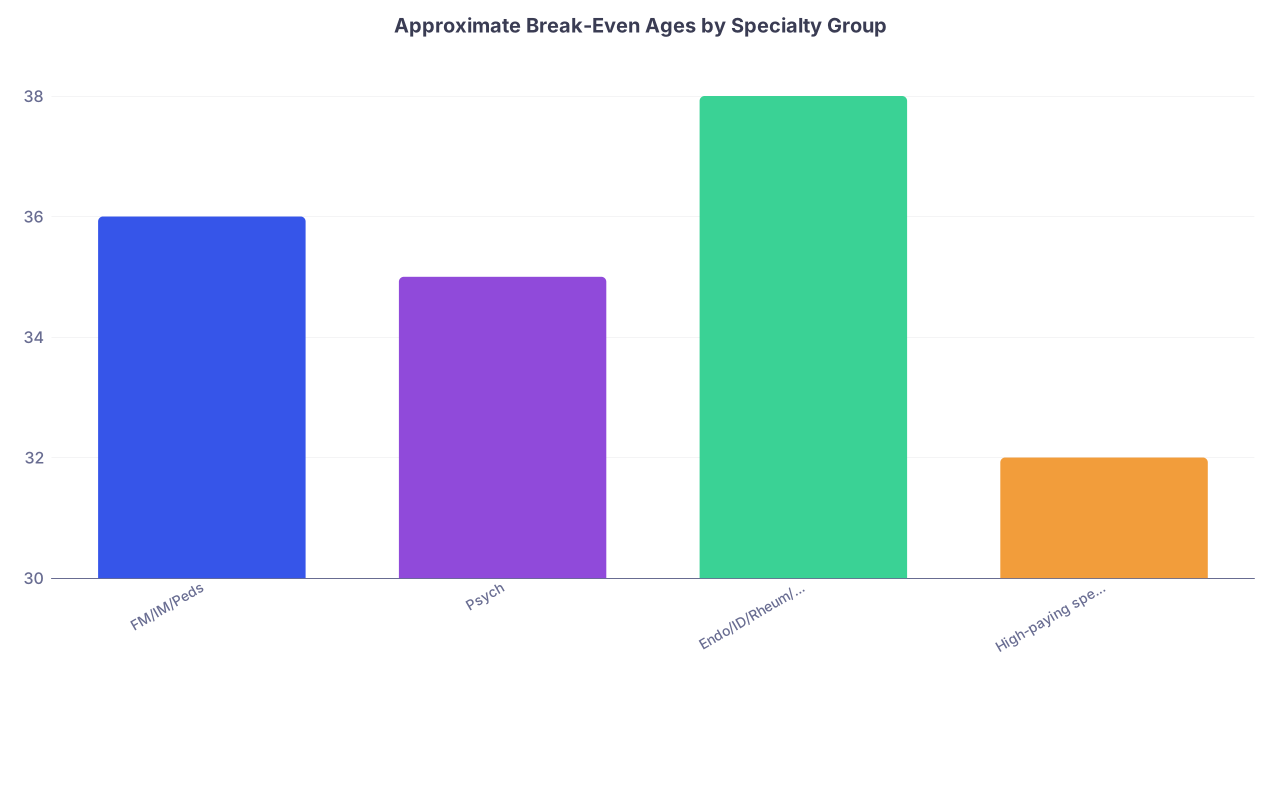
| Category | Value |
|---|---|
| FM/IM/Peds | 36 |
| Psych | 35 |
| Endo/ID/Rheum/Geri | 38 |
| High-paying specialties | 32 |
Step 6: Psychiatry
Psych is interesting because:
- Training: 4-year residency (many do just that; some sub-fellowship)
- Pay: often higher than core primary care, especially with demand and telepsych
Training:
- 4 years psych residency = 26–30
Similar pay track to other residencies
Attending income:
- Many psych attendings: $270k–$320k
- Locums, rural, C/L, or high-demand markets can push $350k+ without insane hours
Use $300k as a realistic non-superhero number.
After-tax, call it ~$190k.
Same framework:
- Income gap 22–26 (med school) = same deficit
- 26–30 (residency): 4 years of ~$50k = ~$200k after tax
- College-grad 22–30 might be at ~$450k–$500k after tax
So your “hole” is:
- Missed earnings + debt = still in that $600k–$700k range
But your annual advantage over the college-grad once an attending is now:
- Psych: $190k after tax
- College-grad at 30: maybe $75k
- Advantage: ~$115k per year
So break-even:
- $650k / $115k ~= 5.5–6 years post-training
You finish training at 30 → break-even ~ age 35–36 for many psychiatrists.
Again, more debt and low-paying academic jobs push you later, better pay / shorter med school debt push earlier. But psych, paradoxically, can beat FM/IM/Peds on break-even timing, even with an extra year of residency, because of pay.
Step 7: Endocrinology, Infectious Disease, Rheumatology, Geriatrics
These are where money gets… thin.
Training:
- 3-year IM residency (26–29)
- 2–3-year fellowship (29–31/32)
- So you’re 31–32 entering attending life
Pay:
- Endo / ID / Geri: ~ $230k–$260k
- Rheum: maybe $260k–$300k depending on RVUs and procedures
Let’s pick a middle-ish number for subspecialties like Endo/ID/Geri: $250k.
After-tax maybe ~$165k.
Now we redo the math.
Income and debt situation at 32:
- Med school: no income 22–26, +$300k–$350k debt
- Residency + fellowship: 6–7 years of trainee salary
Call it ~$50k after tax average for 6.5 years = ~$325k total
College-grad 22–32:
- 10 years of work, starting at $60k with 3% raises
- Ballpark after-tax cumulative earnings: easily ~$500k–$600k+
So your deficit at 32:
- Missed earnings versus alt path: ~$200k–$300k
- Debt burden: $350k–$400k all-in
- Total “economic deficit” ~= $550k–$700k
Annual attending advantage:
- You at $165k after tax
- Them at maybe ~$80k after tax at 32
- Advantage: ~$85k per year
So break-even:
- $600k / $85k ≈ 7 years post-fellowship
Start attending at 32 → break-even at roughly 39.
If you’re in Rheum at $280k and make ~$180k after tax, advantage over that same alt path is more like $100k–$110k/year → break-even ~6 years post-training, so 38-ish.
Academic endo at $220k and $150k after tax? You’re looking at early 40s for break-even if your debt is high.
Step 8: Comparing to High-Paid Specialties (For Context)
You didn’t ask, but the contrast helps.
Ortho, derm, GI, cards, radiology, anesthesia—typical private-practice incomes in the $450k–$800k+ range. Training is longer, but the economic engine is bigger.
Even with fellowship, many of these folks hit break-even in their early to mid-30s:
- Finish training at 32–34
- Make $300k–$400k more per year than an average college-grad alternative
- Wipe out that $600k–$800k “economic hole” in 3–5 years
So when you pick endo over GI, or gen peds over anesthesia, you’re not just choosing lifestyle. You’re literally pushing your break-even several years later.
That’s not a reason to avoid them. It’s a reason to be eyes-open.
Step 9: What Actually Moves Your Break-Even Up or Down?
Here’s where you have control.
Huge factors that matter more than people admit
Total debt
- $450k vs $150k is the difference between late 30s and mid 40s break-even.
- PSLF or substantial scholarships radically change this calculus.
How you live from PGY‑1 to first 5 attending years
- If you live like a resident for 3–5 years as an attending and throw $80k–$100k/year at debt, you break even much earlier.
- If you instantly scale up lifestyle—big house, new Tesla, private school—your “invisible deficit” just lingers.
Academic vs community vs rural vs private
- Endo at $220k in a coastal academic center vs $280k–$300k in community or rural? That might be a 5-year difference in financial comfort, not just $60k on a spreadsheet.
Side income and smart choices
- Psych doing a couple days of telepsych or weekend locums
- FM doing urgent care shifts, medical directorships, or aesthetics
- These can compress the break-even window significantly.

| Step | Description |
|---|---|
| Step 1 | Choose Specialty |
| Step 2 | Break even likely mid 30s |
| Step 3 | Break even mid to late 30s |
| Step 4 | Break even late 30s to 40s |
| Step 5 | Debt over 300k |
| Step 6 | Low paid specialty |
| Step 7 | High paying niche or rural? |
Step 10: Should Break-Even Timing Change Your Specialty Choice?
I’ve watched this play out with residents:
- The peds intern who realizes at 28 that she’ll be 40 before she truly “catches up” to her college friends—and still chooses peds because she actually loves it.
- The IM resident who pivots from ID fellowship to hospitalist medicine after seeing what $240k ID jobs look like in the real world.
- The psych resident who leans hard into telepsych and quietly earns more than most surgeons by year 3 out.
Here’s my blunt take:
- If you genuinely love a low-paid specialty and can tolerate a break-even in late 30s or early 40s, do it. But plan your finances like an adult, not like a martyr.
- If you’re neutral between, say, hospitalist IM and ID fellowship, the extra years of training and lower pay absolutely do not “work” financially. You’d be better off clinically and economically as a strong hospitalist in most markets.
- If you’re carrying enormous debt ($400k+), you don’t have the luxury of ignoring income. You don’t need to chase derm, but you should think twice before low-paying, long-fellowship routes unless you have a solid forgiveness plan.
| Factor | Impact on Break-Even |
|---|---|
| Total loan balance | Biggest driver |
| Specialty income level | High vs low swings by 5+ yrs |
| Practice setting | Academic vs rural vs private |
| Extra work/side gigs | Can move break-even earlier |
| Lifestyle inflation | Delays effective break-even |

FAQ: Lowest Paid Specialties and Break-Even
1. If I go into family medicine with $300k of loans, when will I likely break even?
With median FM pay (~$250k) and typical resident/attending lifestyle, expect break-even around age 36–40. Closer to 36 if you keep expenses tight and/or work higher-paying settings, closer to 40 if you choose academic or low-RVU jobs and inflate lifestyle early.
2. Does doing a low-paid fellowship (like endo or ID) usually make financial sense vs hospitalist?
Financially, usually no. A hospitalist can start earning $280k–$350k right after residency with no extra years at trainee pay. Endo/ID often adds 2–3 years at ~$70k and then lands at ~$230k–$260k. From a strict dollars standpoint, the hospitalist path wins by a wide margin unless you have a strong non-financial reason for the fellowship.
3. How much does PSLF change the break-even calculation?
A lot. If you’re in a qualifying job for 10 years of payments and reliably heading toward PSLF, your loan burden can drop by hundreds of thousands versus standard repayment. That can pull your break-even age several years earlier—especially in primary care and psych, where nonprofit/academic jobs are common.
4. Is psychiatry actually a “low-paid” specialty anymore?
On paper it’s still grouped with primary care in some surveys, but in reality psych often out-earns FM/IM/Peds. With demand for mental health, telepsych, and locums, many psychiatrists earn $300k–$350k+ without soul-crushing hours. Because of that, psych’s break-even is often mid-30s, sometimes earlier if debt is low and work is plentiful.
5. Should big debt automatically push me toward a high-paying specialty?
Not automatically, but it should absolutely influence your thinking. Massive debt plus a very low-paying, long-training specialty is a rough combo. If you’re equally happy in a moderately-paying field that trains faster and pays more (e.g., hospitalist instead of ID), that’s usually the smarter move. If you’re obsessed with a low-paid niche, then pair it with aggressive loan strategies and realistic expectations.
6. If I live like a resident for 5 years after training, how much earlier can I break even?
A lot earlier. If you’re clearing an extra $50k–$100k per year to debt and savings instead of lifestyle, you can cut multiple years off your break-even timeline. For a typical FM or psych doc, that can move you from 39–40 down to 34–36. It’s probably the single most powerful lever you control once you’ve chosen your specialty.
Key takeaways:
- In the lowest paid specialties, realistic break-even is often mid-30s to early 40s, depending on debt and practice type.
- Debt size, specialty income, and how you live in your first 5 attending years matter more than anything else.
- If you choose a low-paid specialty, do it with eyes open—and pair it with a ruthless, grown-up financial plan.


