

It’s PGY-2 in pediatrics. You just finished another consult for a complex kid, charting at 7:45 pm, and your co-resident casually mentions: “Yeah, our attendings here make like $230K. Tops.”
On your phone, a recruiter email is pitching pediatric cardiology starting at $420K in the Midwest.
You’re staring at those two numbers and the question is loud:
Should I do fellowship just to escape the low-income ceiling of my specialty?
Here’s the answer you’re looking for.
The Core Question: Is Fellowship a Good “Raise Strategy” in Low-Paid Fields?
If you’re in one of the lowest paid specialties—think:
- Pediatrics (general)
- Pediatric subspecialties (some, not all)
- Psychiatry
- Family medicine
- Internal medicine primary care
- Geriatrics
—then you’ve probably heard some version of:
“Just do a subspecialty. They make way more.”
Sometimes that’s true. A lot of the time it’s half-true. And occasionally it’s flat-out wrong.
Let me be blunt:
Doing fellowship solely to increase income is often a bad trade, especially in already low-paid fields.
But there are specific situations where it does make financial sense.
To make a good decision, you need to look at three things:
- Income delta: How much real extra money does the fellowship path produce over a career?
- Time and opportunity cost: How many years of lower pay and more training are you trading for that?
- Lifestyle and leverage: Does the fellowship give you better hours, geography options, or negotiation power?
Let’s put some numbers and structure around this instead of vague “fellowship = more money” talk.
Where Fellowship Actually Moves the Needle (and Where It Doesn’t)
Here’s the short version: Not all fellowships are created equal financially, especially when you start in a low-paid specialty.
1. Peds, FM, Psych, IM: The “Low-Paid Core” and Their Common Fellowships
Let’s run through the usual suspects.
| Base Specialty | Typical Generalist Range | Common Fellowship Path | Typical Fellowship Range |
|---|---|---|---|
| Pediatrics | $190K–$260K | Cards, ICU, Heme-Onc | $300K–$550K |
| Family Med | $210K–$260K | Sports, Geri, Palliative | $240K–$320K |
| Psychiatry | $260K–$330K | Child, Forensic, Addiction | $280K–$420K |
| IM (PC) | $220K–$280K | Cards, GI, Pulm, Endo | $280K–$700K+ |
Numbers vary by region, call burden, and practice model, but the pattern is clear:
- Some fellowships barely move the needle.
- Some double your income.
- Some increase income but crush lifestyle and years of training.
If you’re only thinking “I’m in one of the lowest paid specialties, I should sub-specialize,” that’s too simplistic.
The Math You Actually Need to Do
Forget vibes. Do the math.
The question isn’t “Does fellowship pay more?”
The question is “Does fellowship pay enough more, for long enough, to justify 2–3 years of lower-paying training?”
Step 1: Understand the Basic Trade
You’re choosing between:
- Path A: Become an attending now.
- Path B: Do 2–3 extra years of fellowship, earn less now, maybe more later.
Let’s use a clean example.
You’re finishing peds residency.
- Option A: General peds job at $230K starting this year.
- Option B: 3-year fellowship in pediatric cardiology.
- Fellowship pay: say $75K/year (call it $80K to be generous).
- Post-fellowship job: $450K as a pediatric cardiologist.
What you’re giving up during those 3 fellowship years:
- General peds attending income: $230K x 3 = $690K
- Minus what you actually make as a fellow (say $80K x 3 = $240K)
- Opportunity cost of going to fellowship: $690K – $240K = $450K lost income in those 3 years
Now the question is:
Does the extra $220K/year ($450K – $230K) post-fellowship make up for that $450K gap?
Yes—over time.
Roughly, $450K (lost) ÷ $220K (extra per year) ≈ 2 years to “break even,” after fellowship.
After that, it’s net gain territory.
So pediatric cardiology as a peds resident? Financially defensible, assuming you actually like the work and can tolerate the lifestyle.
Now contrast that with a much weaker income spread.
Say you’re family med:
- FM job: $230K
- Fellowship in sports med (1 year), then job at $270K
Cost:
- 1 extra year at $70K instead of $230K = $160K lost
- Post-fellowship income bump: $40K/year
Break even:
- $160K ÷ $40K = 4 years to break even
- After that, you’re ahead… but only by $40K/year
Financially? Meh. That’s not a slam dunk. Especially if sports jobs are concentrated in saturated markets and you lose geography flexibility.
Where Fellowship Makes Financial Sense from a Low-Paid Base
Here’s where I’d say fellowship can be a smart income play if you’re coming from a lower-paid specialty.
1. The Delta Is Huge and Long-Term Demand Is Strong
Examples:
- Peds → Pediatric cardiology, PICU, neonatology (in many markets)
- IM → Cards, GI, pulm/critical care
- Psych → Forensic psychiatry in some legal-heavy markets, or certain high-demand inpatient roles
- IM/FM → Palliative and hospice in certain systems (not always big money, but good leverage)
In these, you’re often adding $150K–$300K+ per year over generalist pay.
Do the math:
If fellowship costs you ~$300–500K in lost income, and you make $200K more per year for 20 years, that’s a clear win.
2. The Fellowship Gives You Scarce Skills and Negotiation Power
When you’re the only pediatric epileptologist within 200 miles, or the only addiction psych comfortable with complex dual-diagnosis patients in a large system, you gain leverage:
- You can push for higher base or productivity.
- You can negotiate protected time, flexible schedule, or part-time setups.
- You get approached instead of begging for offers.
In a low-paid field, this leverage can matter more than just the base number.
Where Fellowship Is a Bad Pure-Income Strategy
Now the flip side: a lot of fellowships from low-paid bases are… financially underwhelming.
1. Fellowships With a Small or Marginal Pay Bump
Examples:
- FM → Sports med, geriatrics, academic-type fellowships
- Peds → Many “soft” subspecialties where RVUs are limited and outpatient-heavy
- Psych → Child psych in some urban markets (pay bump has compressed as demand has exploded for general psych too)
- IM → Endo, rheum in some markets relative to hospitalist work or nocturnist gigs
If you’re doing 1–3 more years of training to add $20K–$60K per year to your salary, that’s not an income-maximization move. That’s a “I really like this niche” move.
Honestly, that’s fine. But say that out loud to yourself:
“I’m doing fellowship because I love the field, not because it’s the best financial play.”
If you can’t say that? Don’t do it.
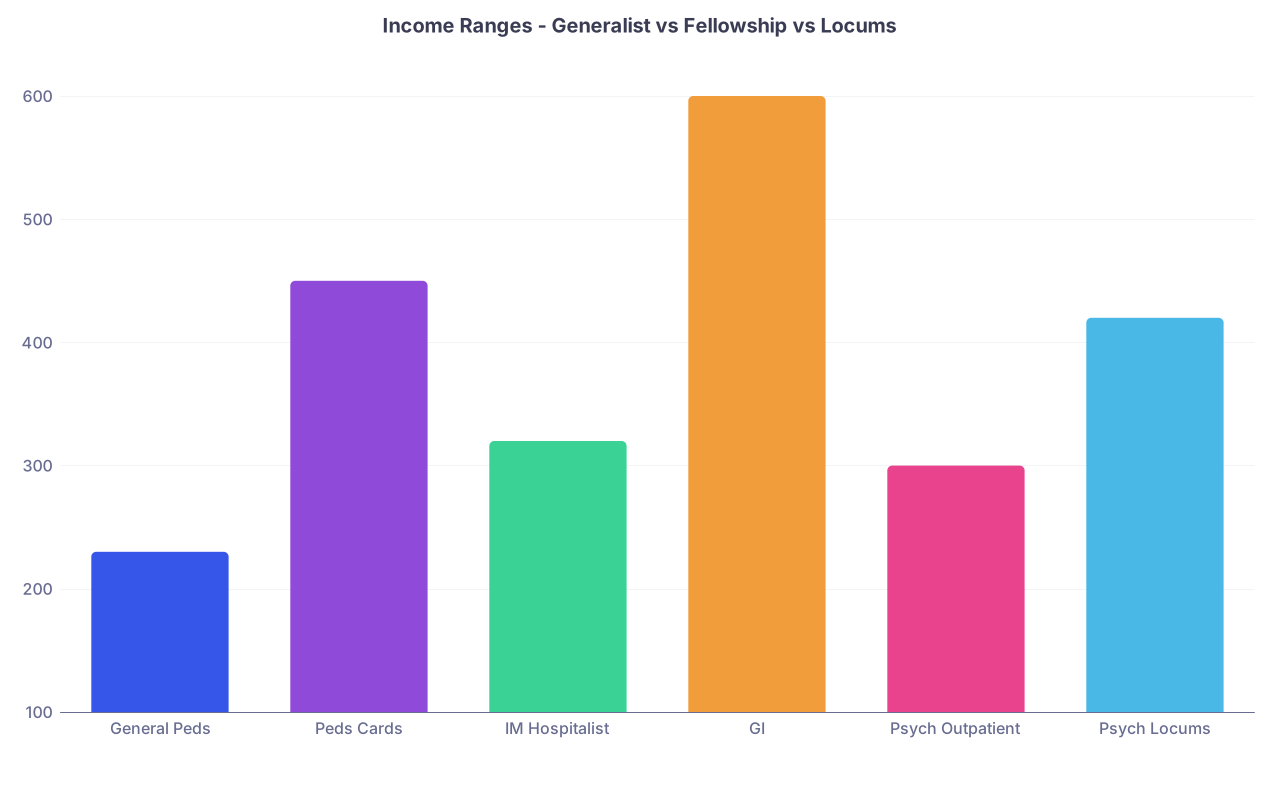
2. When Hospitalist/Locums Options Already Pay as Much or More
This one’s underappreciated.
From IM, peds, or FM, you can often:
- Work hospitalist gigs at $300K+ with 7-on/7-off.
- Layer in some locums and push into $350K–$400K without extra fellowship.
From psych, you can:
- Do telepsych or locums and clear $350K–$450K without fellowship, especially if you’re willing to work nights/weekends or less “desirable” settings.
In that world, 2–3 more years of low-pay training for a niche that maybe pays $350K–$380K with worse call doesn’t make sense.
| Category | Value |
|---|---|
| General Peds | 230 |
| Peds Cards | 450 |
| IM Hospitalist | 320 |
| GI | 600 |
| Psych Outpatient | 300 |
| Psych Locums | 420 |
This is why a lot of smart residents quietly pivot to:
- Hospitalist work
- Locums-heavy lifestyles
- High-RVU primary care with bonuses
…and skip fellowship entirely.
Don’t Forget the Hidden Cost: Lifestyle and Burnout
If your starting point is a low-paid specialty, odds are you chose it for some combo of:
- Liking the patient population.
- Wanting decent hours.
- Tolerating lower pay in exchange for better life.
So if you do fellowship just for income, but you end up with:
- More call
- Night/weekend coverage
- Sicker, more stressful patients
- Academic pressure for research/teaching
…you may have just bought yourself a higher-paying job that you hate.
Concrete example I’ve seen:
- General peds: $230K, clinic 4 days/week, one evening, minimal call.
- PICU: $400K, 14 shifts/month, nights, holidays, constant acuity, long emotional tail.
Some people thrive on that. Some absolutely burn out.
Money helps—but it does not fix hating your day-to-day.
A Simple Framework: Should You Do Fellowship to Boost Income?
Here’s a brutally direct decision tree.

| Step | Description |
|---|---|
| Step 1 | Finishing or in Residency in Low Paid Specialty |
| Step 2 | Skip fellowship, pursue high paying generalist or locums |
| Step 3 | Stay generalist in current field |
| Step 4 | Strong case for fellowship |
| Step 5 | Consider fellowship for lifestyle, not just money |
| Step 6 | Do not do fellowship just for income |
| Step 7 | Do you genuinely like a specific subspecialty? |
| Step 8 | Is your main goal higher income? |
| Step 9 | Does that fellowship add 150K or more per year? |
| Step 10 | Are lifestyle and hours clearly better? |
Ask yourself these questions and answer honestly:
- Do I actually love a subspecialty enough to add 2–3 more years of training?
- Does this fellowship realistically add ≥$150K/year long-term vs my best non-fellowship strategy (including locums)?
- Does the lifestyle align with how I want my weeks, nights, and holidays to look?
- Am I okay working until at least my mid-60s in this niche? (Because switching later is harder.)
If you’re:
- Weak “yes” or “no” on interest,
- Marginal income delta,
- And ambiguous on lifestyle improvement,
—then fellowship as a “raise strategy” is probably a bad move.
Alternatives to Fellowship If You’re in a Low-Paid Specialty but Want Higher Income
If the honest answer is “I like my field but I don’t like the pay,” you have options that don’t require more training.
Here are a few that actually work:
Geographic arbitrage
Live in the middle of the map, not the coasts.
A rural pediatrician or psychiatrist can out-earn an urban subspecialist in some cases.Practice model shift
- RVU-heavy employed role with good bonus structure
- Direct primary care (for FM) in certain markets
- Telepsych or hybrid models
Locums stints
Especially psych, IM, peds hospitalist.
You can add $50K–$200K/year without more training, just by doing a few weeks or weekends.Niche within generalist practice
Become the go-to ADHD doc in psych, the breastfeeding expert in peds, or the procedures-heavy FM doc. You can tilt your mix toward more billable or higher-demand work.Business or side income
I’m not talking about vague “side hustles.” I mean clinics, ASC ownership, consulting, or telehealth contracts. Many attendings add 6-figures outside of fellowship via this route.
Fellowship is one lever. It’s not the only one.
Bottom Line: How to Think About This Without Lying to Yourself
Here’s where I land:
- If you’re in a low-paid specialty and truly love a high-paying subspecialty, fellowship can absolutely be a smart financial and career move.
- If you’re lukewarm on the field and mostly chasing dollars, it’s usually not worth the years of extra training, stress, and lifestyle cost—especially when hospitalist and locums paths exist.
- “Low paid specialty” doesn’t doom you. You can often out-earn low-end subspecialists by being strategic with geography and practice model as a generalist.
Be honest about two things:
- Would you do this fellowship if it paid the same as generalist work?
- Have you actually run the numbers (lost income vs projected gain over 10–20 years)?
If the answer to #1 is no, and you haven’t done #2, you’re not making a rational decision—you’re just reaching for escape.
Do the math. Then decide.
FAQ (6 Questions)
1. I’m a PGY-2 in pediatrics and don’t love any subspecialty. Should I still consider fellowship for income?
No. If you don’t genuinely like a subspecialty, doing 3 more years of training just to escape a general peds salary is a bad idea. You’re better off looking at higher-paying general peds setups (rural, hospital-based, urgent care, or peds hospitalist) and potentially doing locums to boost income.
2. Is it ever smart to choose a fellowship I don’t love if the money is huge (like cards or GI)?
Short-term, it might look smart. Long-term, working 25+ years in a field you don’t like is a trap. Burnout, mental health problems, and early exit from medicine will erase that financial “win.” If you can’t stand the work, the extra pay isn’t worth it.
3. How much income bump makes a fellowship “worth it” financially?
Rule of thumb: if the fellowship adds at least ~$150K/year over your best realistic generalist or hospitalist/locums option, and you work 15–20+ years post-fellowship, it’s usually a good financial trade. Under $75K/year difference? It’s more about interest and lifestyle than money.
4. I’m in psychiatry—does child psych or addiction fellowship pay off?
It depends heavily on your market. In many places, general adult psych demand is so wild that you can hit $350K–$450K with no fellowship. Child psych can pay more, but not always dramatically more. Addiction can be financially strong in certain systems or private setups, but not guaranteed. Don’t assume “more training = more money” in psych; compare actual job offers.
5. What if I want academic medicine—does that change the income logic?
Yes. Academic tracks often pay less, regardless of fellowship, but fellowship becomes more or less mandatory for promotion and niche credibility. If your primary goal is research, teaching, or being “the expert” in a narrow field, fellowship makes sense even if the salary bump is modest. Just be honest that you’re doing it for academic career, not maximizing income.
6. How late is too late to do fellowship if I start as a generalist?
Logistically, you can match into fellowship years after residency, but it gets harder: you’re used to attending pay, you may have a mortgage or kids, and the pay cut hits harder. If you’re even 30–40% sure you’ll want a subspecialty, it’s better to explore it seriously during or right after residency. Waiting 5–10 years and then going back to trainee pay is rough for most people.
Key takeaways:
- Fellowship from a low-paid specialty only makes financial sense when the income delta is big and you actually like the subspecialty.
- Don’t ignore hospitalist and locums pathways—they often beat “soft” fellowships financially with less training.
- If you wouldn’t do the fellowship for the work itself, skip it and rethink your practice model instead of hiding in more training.


