

It’s 9:30 p.m. You just finished another shift as an FM or pediatrics resident. Your co-resident is joking about saving for a Tesla; you’re opening Western Union on your phone because your mother’s medications back home just went up in price.
You look at your paycheck. Then at your visa status. Then at the spreadsheet where you track how much you need to send abroad each month just to keep your family stable.
And the question is blunt:
Did I make a mistake choosing one of the lowest paid specialties as an immigrant with family depending on me?
If you’re here, you’re probably in one of these buckets:
- You’re an IMG/immigrant in med school or early residency, leaning toward FM, peds, psych, PM&R, geriatrics, or outpatient-focused IM.
- You already chose one of these “low-paying” specialties and now you’re panicking about long-term finances and remittances.
- You have dependents abroad (parents, siblings, sometimes spouse and kids) and you’re basically the “American ATM” for your entire extended family.
Let me be direct:
No, you did not automatically ruin your life by choosing a low-paid field.
But you also cannot afford to be naive or romantic about this. You need a hard, numbers-based and strategy-based plan.
This is what you do now.
Step 1: Get Real About the Numbers (Not the Myths)
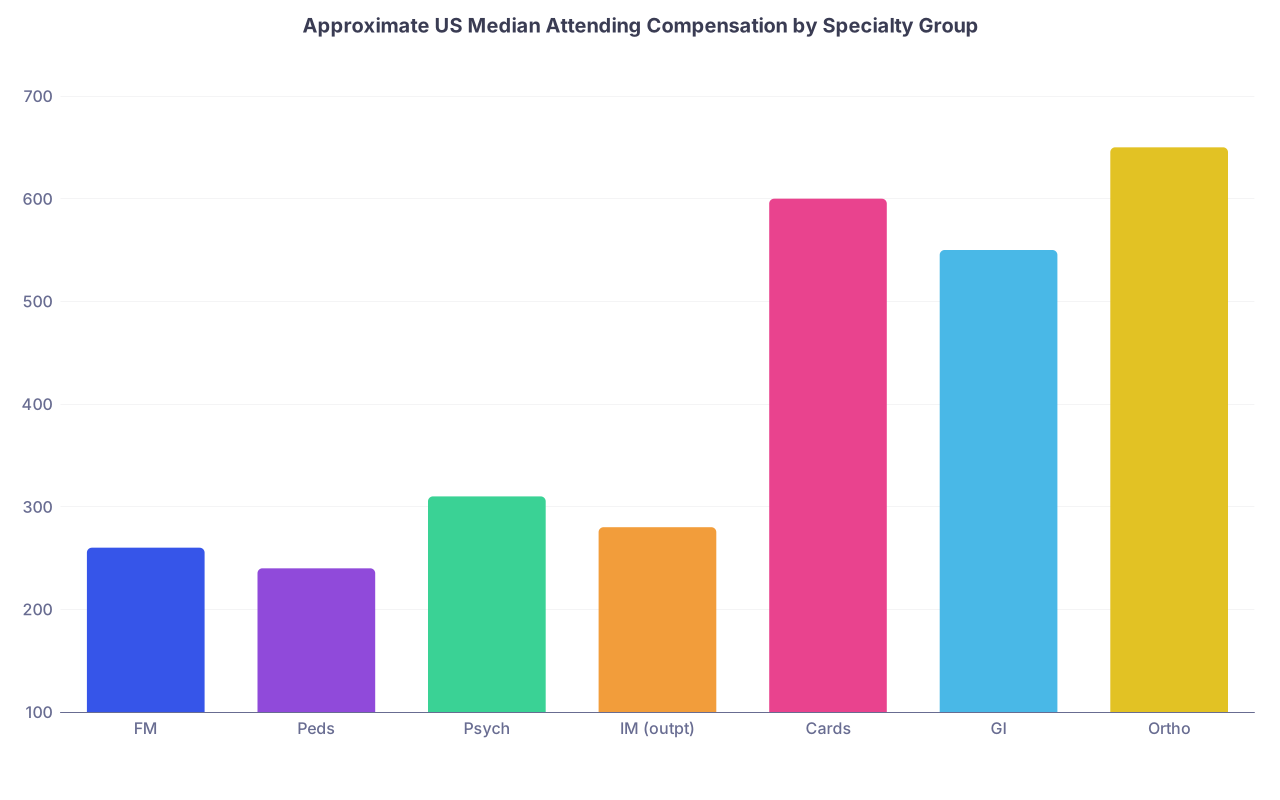
Most people throw around “low paid specialty” without actual data. Let’s ground this quickly.
| Category | Value |
|---|---|
| FM | 260 |
| Peds | 240 |
| Psych | 310 |
| IM (outpt) | 280 |
| Cards | 600 |
| GI | 550 |
| Ortho | 650 |
You’ll see slightly different numbers depending on the survey (MGMA, Medscape, Doximity), but the order is consistent: FM, peds, outpatient IM, and some cognitive specialties sit at the bottom.
Now add the “immigrant with family abroad” tax:
- Regular US cost of living
- Plus:
- Monthly remittances
- Visa/immigration fees (lawyers, USCIS, travel)
- Sometimes supporting adult siblings’ education or parents’ healthcare
If you send, say, $800–$1,200/month abroad from a low-paying field, that’s not pocket change. That’s basically a mortgage payment.
But here’s the part almost nobody tells you:
Within every “low-paid” specialty, there is a 2x difference between a smart job choice and a naive one.
You can be the FM doc making $200k working 5 days a week in a coastal academic clinic.
Or the FM doc making $350k–$400k in a slightly rural, high-need community with some urgent care shifts and maybe a medical directorship.
Same degree. Same specialty. Completely different life.
So before you mentally throw away your field, you need to understand levers you can pull within that field.
Step 2: Map Your Constraints As an Immigrant With Dependents
You’re not a US grad with no dependents and rich parents. Stop comparing yourself to them.
Your situation has constraints and opportunities that are specific. Let’s spell them out.
| Factor | Constraint | Lever You Can Use |
|---|---|---|
| Visa status | Limits job locations/types | Use shortage areas that sponsor visas |
| Family abroad | Fixed monthly remittances | Lower their local costs, not just send more |
| Specialty | Lower average salary | Choose higher-paying niches, locations |
| Debt | US loans or foreign debt | Aggressive payoff strategy & side income |
| Time | Residency hours | Monetize skills post-residency, not during |
If you don’t acknowledge these, you’ll make soft, vague decisions. You cannot afford that.
You need to ask yourself, on paper:
- How much do I have to send monthly for the next 3–5 years?
- Am I sponsoring anyone’s education abroad? For how long?
- What is my visa path? H-1B? J-1 with waiver? Green card plan?
Write that out. Literally. Because that determines what jobs you can take and what income targets you must hit.
Step 3: Reality Check by Specialty – What’s Possible, Not Theoretical
Let’s talk about a few of the classic “low paid” fields and what they look like when optimized for money, not prestige.
Family Medicine
If you are in FM and you have family abroad, you cannot be casual about your first job.
Real examples I’ve seen:
- FM in a midwestern rural town, 4.5 days/week clinic, inpatient call 1:4, loan repayment eligible, H-1B sponsorship, $320k base + RVU bonus realistically pushing to $370k.
- FM in coastal academic center, mostly clinic, some teaching, great colleagues, $210k–$230k, little to no bonus.
Same specialty. One supports a family abroad and crushes loans. The other suffers.
Where FM shines if you’re strategic:
- Rural/underserved communities (especially FQHCs and independent groups)
- Urgent care shifts on top of clinic
- Medical director roles in SNFs or small clinics
- Locums after a couple of years of experience
- Side work: telemedicine, occupational health, prison medicine
Pediatrics
Peds is brutally underpaid relative to training. But again, nuance.
If you choose:
- Academic peds, coastal city, heavy teaching, complex patients → often $180k–$220k. Brutal if you’re sending money abroad.
- Community pediatrics in high-need or lower-cost areas, some inpatient or newborn coverage → $230k–$280k, sometimes more with call.
- Subspecialties like peds cards, PICU, neonatology → much higher, but longer training and limited jobs, and visa sponsorship may be trickier.
You cannot be the “I love teaching, I’ll just work anywhere” pediatrician if you are paying your parents’ rent in another country. You can still teach. But base job has to be chosen for stability and income.
Psychiatry
Psych used to be “mid-low,” now it’s crept up because of insane demand.
But your choices still matter:
- Outpatient community job with salary-only, no productivity → maybe $260k–$300k.
- Private group or hybrid salary + RVU, telepsych options → $320k–$420k is not fantasy in many markets.
- Inpatient with weekend coverage, moonlighting → it adds up.
Immigrant plus psych can be a strong combo if:
- You’re okay living in non-coastal, mid-size cities
- You’re willing to do some evenings / weekends, and
- You don’t get sucked into the lowest-paying academic offers “for the resume.”
Outpatient Internal Medicine / Geriatrics
Pure outpatient IM in big academic centers can be sad from a compensation standpoint. But:
- Primary care in high-need communities, value-based care organizations, or groups that reward panel size and quality metrics is different.
- Geriatrics as a niche can open doors to SNF medical directorships, ALF consults, and home-visit programs with higher RVU or bonus structures.
You can engineer:
- A base IM clinic job paying $250k–$280k
- Plus SNF directorships or consults adding $30k–$60k
- Plus telehealth or weekend work if absolutely needed
You are not capped at a sad number if you hustle early and then stabilize.
Step 4: Use Location and Visa Laws to Your Advantage (Not Just Survival)
This is one of the few places being an immigrant can actually help you financially. The job market that wants you the most often pays the best.
J-1 waiver / H-1B friendly areas tend to be:
- Rural or semi-rural
- Underserved urban pockets
- Health Professional Shortage Areas (HPSA)
Those areas:
- Offer loan repayment (federal/state programs)
- Often pay above median to recruit
- Are more likely to sponsor H-1B and eventually green card
You might be thinking:
“I didn’t leave [India/Nigeria/Brazil/Philippines/etc.] to live in a town with one Walmart and a cornfield.”
Fine. But consider:
- 3–5 years in a high-paying, low-cost area
- Crush loans, build emergency fund, support family, start investing
- Then move to a more desirable city with a stronger financial base
What you do right after residency as an immigrant physician matters more than the specialty label. The first contract can set or break your next decade.
Step 5: Design a Post-Residency Money Plan Around Your Reality
Now we’re getting to the actual “what do I do” part.
Let’s say:
- You’re PGY-2 FM or IM, immigrant, on visa, supporting parents + maybe a sibling’s school.
- You can’t go back and choose GI or ortho. That ship sailed.
Your next moves should look something like this:
1. Income Target
Decide a minimum realistic target for your first attending job:
- FM / Peds: Aim ≥ $260k–$280k as a floor, and only go lower if location is strategic (e.g., spouse job, major academic goals).
- Psych / Outpt IM / PM&R: Aim ≥ $300k as a floor in most non-coastal markets.
If an employer offers you way below these numbers and tells you “but great lifestyle” — that’s not “lifestyle,” that’s underpayment. You can get lifestyle later once your financial baseline is solid.
2. Load-Bearing Years
Accept that your first 3–5 years post-residency are load-bearing years:
- You will likely work more than your ideal future schedule.
- You’ll choose jobs based on money + visa + experience, not vibes.
- You may do extra shifts, moonlighting, locums, or side telehealth.
This is not forever. This is so that:
- Your parents have a stable cushion.
- You’re not drowning in loans or credit card debt.
- You can afford to say no later.
Step 6: Squeeze More Out of a “Low-Paid” Specialty
Inside these fields, several levers can drastically change your outcome.
Lever 1: Procedure and Skill Mix
If your specialty allows procedures, use that. Examples:
- FM / IM: Joint injections, skin procedures, IUD/implant placements, simple derm, point-of-care ultrasound.
- Peds: Circumcisions, minor procedures, ADHD management with efficiency, some clinics pay more for certain services.
- Psych: Interventional psych (TMS, ketamine) in some settings.
Procedures often pay more per unit time than a routine 20-minute visit. If your residency isn’t teaching them well, find elective time, workshops, or local mentors.
Lever 2: Work Setting
Academic hospital vs:
- FQHC with loan repayment and solid salary
- Private group with productivity bonuses
- Integrated primary care networks that reward panel value
Your specialty doesn’t condemn you to academic underpay. If you love academia, fine. But understand you’re making a financial trade-off. Do it consciously, not by default.
Lever 3: Strategic Side Work (Post-Residency)
For most immigrants, side work is survival, not a hobby. But you must do it in a way that does not burn you out or risk your visa.
Options:
- Telemedicine (primary care, urgent care, psych) — after you have a full-time stable job and licenses.
- Locums in weekends/blocks — especially as psych, FM, IM in rural areas.
- SNF / nursing home / home visit programs — often high yield hourly or per-patient pay.
If you’re in your first attending year, pick one side pathway and learn it well. Do not scatter into five poorly paid side gigs that drain you.
Step 7: Protect Yourself From Being the “Forever ATM”
This is delicate, but I’ll say what many are afraid to:
If you never set boundaries, your extended family will expand their expectations to match your income. No amount of specialty choice will keep up.
You need rules like:
- A fixed monthly amount for parents’ essential needs
- One-time, clearly defined contributions for big events (weddings, siblings’ schooling)
- A cap on your annual remittance that you do not exceed, even if guilt is thrown at you
Your primary responsibility:
- Keep yourself solvent and mentally intact.
- Build a stable base in the US.
- Support family abroad within that structure.
You going into depression or burnout because you’re working 70-hour weeks in a low-paid field trying to support 6 adults abroad helps no one.
Step 8: If You Haven’t Chosen a Specialty Yet
If you’re still MS3/MS4 or pre-residency and you’re reading this with a knot in your stomach, here’s the blunt version:
- If you genuinely love FM/peds/psych/PM&R and you know you can tolerate a few years in a less “glamorous” location to earn more, you’re fine. These fields are survivable and even comfortable with a smart plan.
- If you’re indifferent between, say, FM and anesthesiology, but family abroad is financially fragile, you’d be foolish not to at least seriously consider the higher-paying options.
Do not martyr yourself into the lowest-paying field out of vague “calling” if you’re also planning to be the primary economic engine for two households across continents. Calling is real, but so is burnout when your mom calls crying because she cannot pay rent and you’re maxed out.
Step 9: Emotional Reality Check
Let’s acknowledge the emotional layer here:
- Watching co-residents plan Euro trips while you wire your entire “fun” budget overseas stings.
- Saying no to your father when he asks for money for a cousin’s wedding feels cruel, even though it’s rational.
- Choosing a job in a town you’d never heard of before med school just because it offers $80k more and visa sponsorship can feel like failure.
It isn’t failure. It’s long-game sacrifice.
I’ve seen immigrants in FM, peds, and psych:
- Pay off six-figure loans in 4–6 years
- Buy modest homes in safe areas
- Continue sending money abroad
- Still have manageable work hours
The difference wasn’t brilliance. It was:
- Hard boundaries around money
- Smart job choice (comp heavy, low COL, not seduced by “prestige”)
- Willingness to use the first 3–5 years as a financial launchpad, not a lifestyle sample platter
Step 10: Concrete Moves You Can Make This Month
You do not fix this with “someday I’ll…” You fix it with actual steps.

| Step | Description |
|---|---|
| Step 1 | Today |
| Step 2 | Write monthly remittance and debt numbers |
| Step 3 | Set minimum attending salary target |
| Step 4 | Identify visa friendly high pay regions |
| Step 5 | Adjust CV for those jobs |
| Step 6 | Plan one side income path post residency |
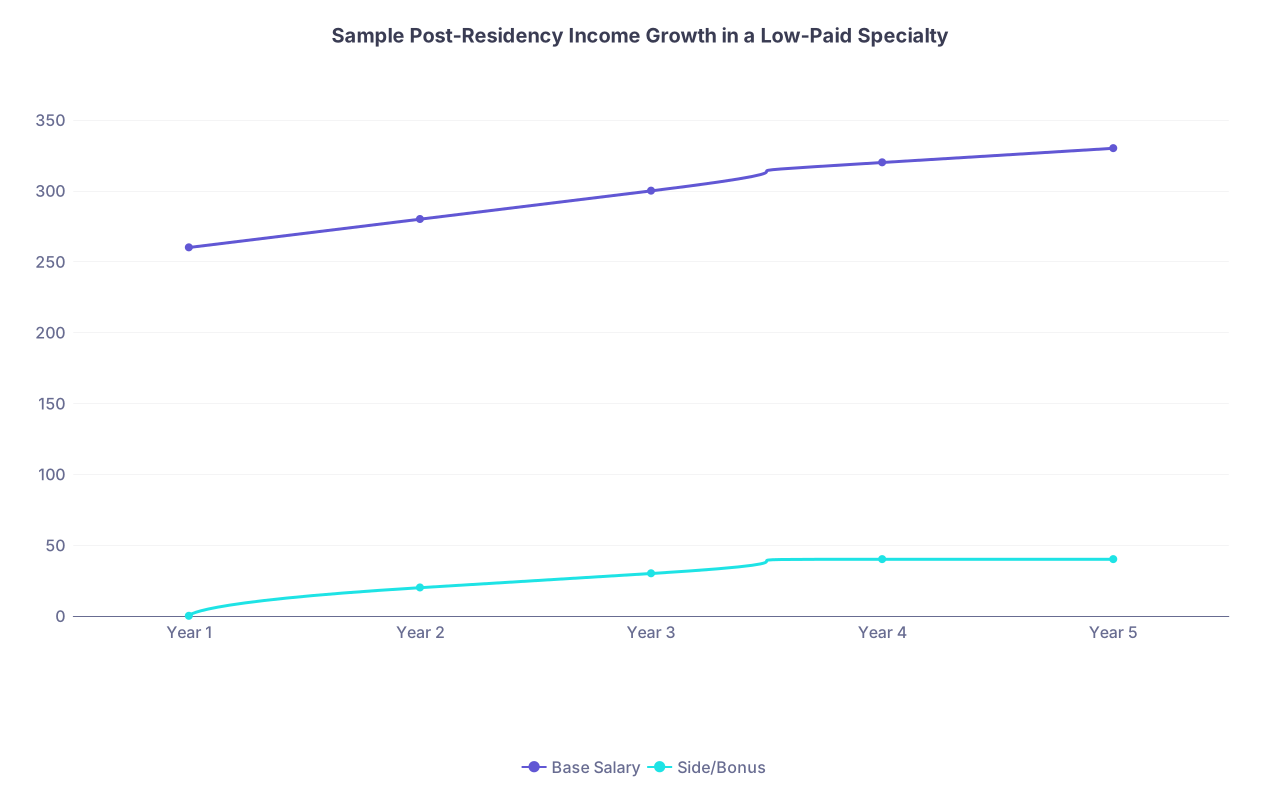
Also, get a quick visual for how your first years could look:
| Category | Base Salary | Side/Bonus |
|---|---|---|
| Year 1 | 260 | 0 |
| Year 2 | 280 | 20 |
| Year 3 | 300 | 30 |
| Year 4 | 320 | 40 |
| Year 5 | 330 | 40 |
This is not fantasy. This is exactly what happens when you:
- Pick the right first job
- Negotiate small raises and responsibilities
- Add smart, sustainable side income after you’re settled
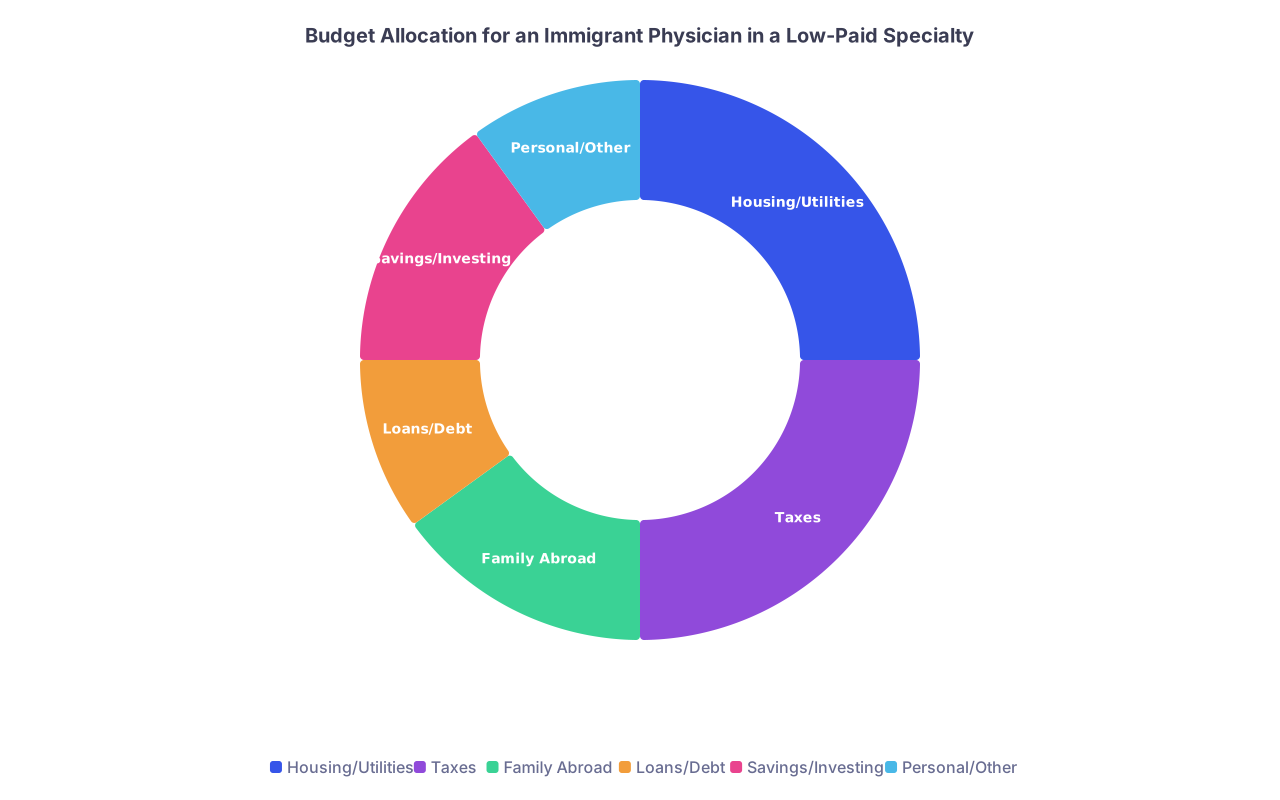
And yes, you can do this in FM, peds, psych, outpatient IM, or PM&R.



| Category | Value |
|---|---|
| Housing/Utilities | 25 |
| Taxes | 25 |
| Family Abroad | 15 |
| Loans/Debt | 10 |
| Savings/Investing | 15 |
| Personal/Other | 10 |
Your Next Step Today
Do this today, not “sometime this month”:
Open a blank page (paper or digital) and write three numbers:
- How much you send abroad per month right now (or realistically will need to).
- The minimum annual take-home pay you need to cover US life + that remittance without using credit cards.
- The minimum starting salary that implies, given taxes in your state (ballpark is that you take home ~60–65% of gross as an attending).
Then ask:
“Can my current specialty hit that if I choose location and job wisely?”
If the answer is yes — good. Start researching actual job postings that meet or beat that number in visa-friendly areas and adjust your CV toward them.
If the answer is no — not “I feel like no,” but actual math no — then you either:
- Reduce your expected remittance with your family (hard conversation, but sometimes necessary), or
- If you’re still pre-residency: re-open your specialty decision while you still can.
Do that exercise now. No new apps, no fancy software. Just those three numbers and one honest look at them.


