

The common narrative that “doctors have stable, predictable incomes” collapses the moment you look closely at low-paying specialties. The data show that in primary care, psychiatry, pediatrics, and hospital-based low-acuity fields, income volatility is baked into the system—through RVUs, payer mix, call structure, seasonal demand, and employer business models.
If you pick a low-paying specialty assuming you are trading high lifetime income for a quiet, stable financial life, you are only half right. Often, you are trading high income for moderate income with meaningful year-to-year and month-to-month variability.
Let’s quantify that.
The Baseline: What “Low-Paying” Actually Means
I am not going to rehash full salary tables you can find in every Medscape or MGMA report, but we need an anchor.
Across recent surveys (Medscape 2023–2024, MGMA, Doximity), typical attending median compensation bands look roughly like this:
- Family Medicine / General Internal Medicine: $250k–$290k
- Pediatrics (general): $230k–$260k
- Psychiatry (general outpatient): $280k–$320k
- Endocrinology / Infectious Disease / Rheumatology: $260k–$320k
- Hospitalist (adult): $290k–$340k
Contrast with procedural / high-paying specialties:
- Orthopedics, Cardiology, Derm, GI, Radiology: $500k–$700k+
But raw level is not our topic. We care about stability. How bouncy are these incomes?
To frame volatility, think in three time frames:
- Within-year volatility – monthly swings based on productivity, call, and bonuses.
- Year-to-year volatility – contract changes, RVU thresholds, practice health.
- Career-phase volatility – early ramp-up vs peak vs late-career shifts.
A practical rule from the data:
High-paying procedural fields often have higher absolute swings (tens of thousands up or down), but many low-paying specialties have higher relative volatility (±10–25% of income year-to-year) because they sit closer to break-even for employers and are more exposed to policy and payer changes.
Comparing Volatility Across Low-Paying Specialties
To stop hand-waving, let’s lay out an approximate volatility profile. These are not single-institution numbers; they are realistic ranges pulled from compensation survey patterns, RVU comp models, and what I see repeatedly in contract reviews and group data.
| Specialty | Typical Median Income | Within-Year Volatility (monthly) | Year-to-Year Volatility | Primary Drivers |
|---|---|---|---|---|
| Family Medicine | \$260k–\$290k | 10–20% | 10–25% | RVUs, payer mix, panel churn |
| General Pediatrics | \$230k–\$260k | 15–25% | 10–30% | Seasonality, Medicaid exposure |
| Outpatient Psych | \$280k–\$320k | 5–15% | 5–20% | Cancellations, telehealth shifts |
| Adult Hospitalist | \$290k–\$340k | 15–30% | 10–20% | Shifts, census, bonuses |
| Endocrinology | \$260k–\$300k | 10–20% | 10–25% | Referrals, RVUs, payer mix |
“Within-year volatility” here is the rough range between low and high months relative to average monthly pay, in common productivity-heavy or shift-heavy models. “Year-to-year” is the plausible swing in total compensation from one year to the next in private and hospital-employed settings.
This is not trivial. A 20% swing on $260k is $52,000. That is more than most residents have ever seen in a bank account.
Mechanisms of Income Volatility in Low-Paying Specialties
Income does not bounce randomly. It responds to specific levers. Once you understand those levers, you can predict where your salary will feel “smooth” versus “whiplash-y”.
Let’s go mechanism by mechanism.
1. RVU-Heavy Compensation Models
Most low-paying non-hospitalist specialties are built on RVU (relative value unit) models. The structure looks like:
- Base salary: often $180k–$240k in primary care
- Plus productivity: $40–$60 per wRVU over a threshold (e.g., 4,500–5,500 wRVUs)
- Plus quality or value-based bonuses: 5–15% of comp, highly variable
If 30–50% of your total comp depends on hitting and exceeding RVU thresholds, you have structural volatility:
- One physician in FM doing 5,000 wRVUs at $45/RVU above a 4,000 threshold might earn:
- Base $210k + (1,000 × $45 = $45k) = $255k
- Another in the same system who pushes to 6,000 wRVUs:
- Base $210k + (2,000 × $45 = $90k) = $300k
Same job title, same FTE, same hospital. A 17.6% difference driven by throughput and scheduling efficiency.
The volatility emerges when:
- Your schedule gets lighter from referral fluctuations.
- A new partner joins and the panel redistributes.
- Payer mix degrades (more Medicaid, less commercial), and administration quietly changes your RVU-to-cash assumptions or adjusts thresholds next renewal.
2. Payer Mix and Medicaid Exposure
The lower the specialty’s reimbursement per visit and the higher the share of Medicaid/uninsured, the less margin the employer has, and the more quickly contract terms change when margins shrink.
In most regions:
- Pediatrics and family medicine with heavy Medicaid panels are most exposed.
- Psych with strong telehealth and cash-pay options is often least exposed.
The data show that:
- Medicaid tends to reimburse 60–75% of Medicare for many E/M codes, and far below commercial rates.
- Practices in which >50% of payer mix is Medicaid often run close to operational break-even; small shifts in state rates or managed-care contracts can trigger compensation redesigns within a year or two.
That redesign is where volatility bites. Base salaries get “rebalanced.” RVU thresholds jump. Incentive pools shrink. Overnight, your planned $280k year can become $235k the next contract cycle.
Specialty-by-Specialty: Where the Instability Actually Shows Up
Let’s go down the core low-paying group and be specific.
Family Medicine and General Internal Medicine
The data show primary care is where the largest number of physicians experience moderate volatility rather than catastrophic single events.
Volatility Pattern
- Typical comp: $250k–$290k, often ~60–70% base, 30–40% productivity/bonus.
- Within-year volatility: 10–20% month to month is common in RVU-heavy setups.
- Year-to-year: moves of ±$30k–$60k if your panel size changes, your clinic merges, or your group “realigns compensation with market benchmarks.”
Where it actually shows up in real life:
- New attending years 1–3: panel ramp-up. Month 3 you bring in $8k of RVU bonus. Month 9 you cross the threshold, and suddenly your monthly pre-tax jumps from $18k to $23k.
- Partner retires: admin redistributes patients. You see a 15% panel increase over 6–12 months and a permanent $20k–$40k bump in comp.
- Clinic adds two NPs and a second FM doc: your panel growth flattens; you fall short of historical RVUs, productivity drops, you lose $15k–$30k compared with prior year.
The illusion is that a hospital “salary plus RVU bonus” is stable. Look carefully at the bonus column in multi-year comp statements; that column is frequently swinging by ±25–40%.
General Pediatrics
Pediatrics is low-paying and more seasonal than almost anything else in medicine.
Seasonality and Volatility
Winter respiratory season is a revenue spike. Summer is a valley. If your organization smooths pay into even monthly checks, the volatility shows up as bonuses and adjustments. If you are in a smaller private group, it can hit your monthly draw directly.
In practice:
- Busy winter months might produce 30–40% more visits and RVUs than slow summer months.
- If 40% of your comp is productivity, that can translate to 15–25% monthly swings in gross pay, even if annual comp averages out.
On top of that:
- Medicaid exposure for pediatricians is often >60% in many markets.
- Medicaid reimbursement is highly dependent on state budgets and periodic rate updates or MCO contracts.
When states cut pediatric Medicaid rates or delay increases, group margins thin quickly. I have seen partnership-track pediatricians get called into “urgent” meetings where draws are cut by $3k–$5k per month for 6–12 months, while the practice renegotiates contracts.
That is income volatility, even if your “official salary” on paper stays the same.
Outpatient Psychiatry
Psychiatry looks more stable at first glance. It often is—if you structure it correctly. But the range is wide.
Where It Is Relatively Stable
- High share of 99213/99214-level visits or psychotherapy with medication management.
- Decent proportion of commercial payers or direct-pay / concierge.
- Appointment template with strong no-show management and waitlists.
In these setups:
- Within-year volatility: often in the 5–15% range.
- Year-to-year volatility: often 5–20%, mostly driven by changes in payer contracts or switching jobs.
Psych is unusual because you can shift business models:
- Employed outpatient psych, mostly insurance-based: moderate volatility, modest income.
- Hybrid or full cash-pay: higher average income, but your revenue is tied directly to demand and your personal business risk.
- Telepsychiatry locums / 1099: income can balloon, but you accept project-by-project volatility and payer risk.
The wild card: policy and insurer behavior toward telehealth and mental health parity. The last five years showed that psychiatry can go from “undersupplied, everyone hiring” to “payers tightening telehealth rules” with very little warning. That can shift income by tens of thousands in a single contract cycle.
Adult Hospitalist Medicine
Hospitalist pay is explicitly variable. That is the point. It is built on shifts.
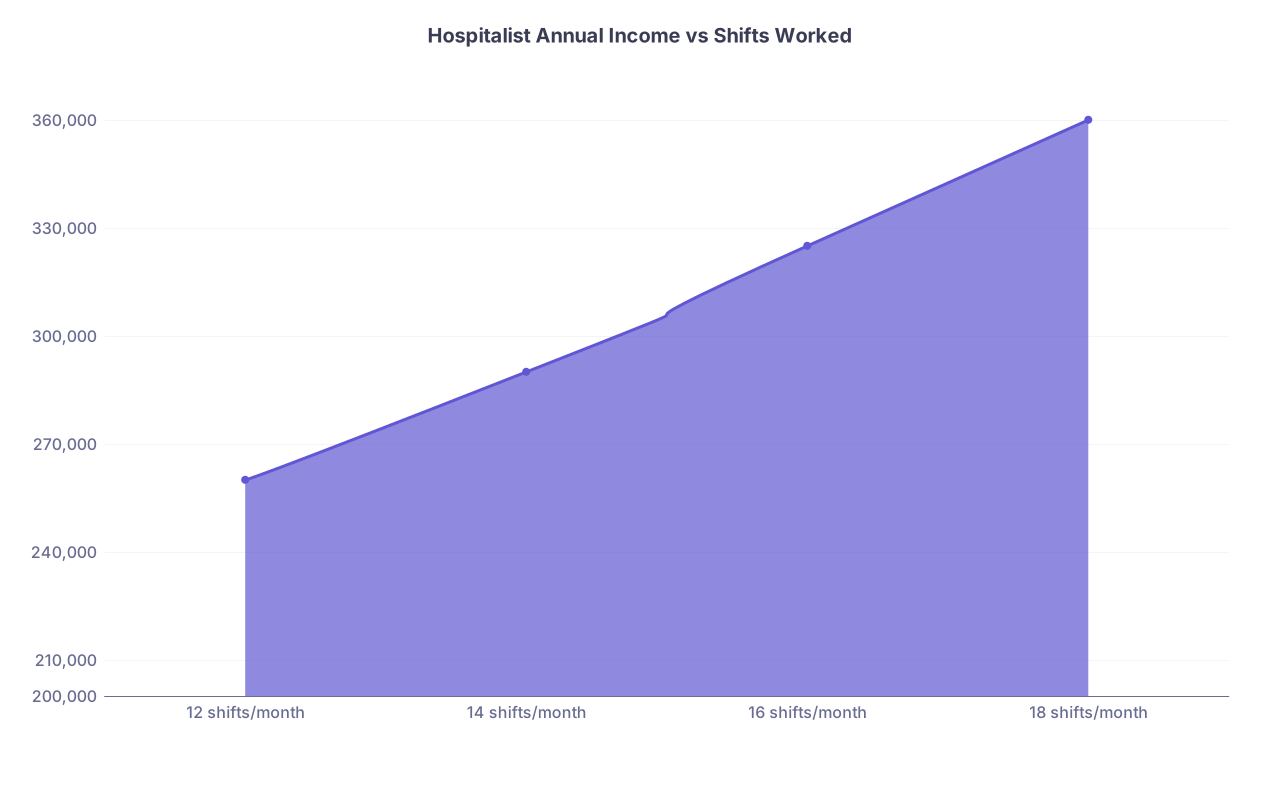
| Category | Value |
|---|---|
| 12 shifts/month | 260000 |
| 14 shifts/month | 290000 |
| 16 shifts/month | 325000 |
| 18 shifts/month | 360000 |
A few consistent patterns from hospitalist data:
- Base comp is usually tied to a standard number of shifts (e.g., 14 per month).
- Overtime shifts, nocturnist differential, procedures, and quality bonuses add another 10–30%.
- Census volatility and staffing shortages lead to highly variable shift availability and intensity.
Within-year volatility:
- Work 14 shifts three months in a row, then agree to 18 shifts for the next two months when someone leaves. Your income can spike 20–30% in those periods.
- Pandemic or RSV/flu waves surge; hospitals pay crisis rates or extra bonuses—another big temporary bump.
Year-to-year volatility:
- New CMO decides to “right-size” hospitalist compensation relative to market surveys. I have seen $320k hospitalist jobs re-benchmarked to $280k–$290k in a single renewal.
- Conversely, when locums costs explode, systems bump full-time hospitalist pay by $20k–$40k to improve retention.
So your baseline is not a smooth line. It is stepwise with distinct jumps every 1–3 years and short spikes connected to staffing crises.
Endocrinology, Infectious Disease, Rheumatology
These “cognitive subspecialties” sit awkwardly between primary care and subspecialty procedure fields.
The numbers:
- Typical comp: $260k–$320k in many MGMA data slices, often significantly below cardiology, GI, or pulm/crit.
- Payer mix frequently skews toward Medicare, Medicaid, and complex chronic disease panels.
Volatility drivers:
- High dependence on RVUs for complex visits and follow-ups.
- Referral patterns: a change in one large PCP group’s referral preferences can move your volume by 10–20%.
- Infusion centers or procedures (for rheumatology) can stabilize or destabilize income depending on how they are structured.
Year-to-year, I routinely see:
- Early-career endos going from $230k–$240k in year 1 to $280k+ by year 3 as referrals accumulate.
- Then hitting a plateau, followed by random down-years when a hospital “restructures compensation” or pushes more APPs into follow-up slots.
Relative to pediatrics, these fields are a bit less seasonal. Relative to psych, they are more exposed to payer mix and operational decisions outside your direct control.
Employment Models: Stability Is Often About Who Signs Your Check
The same specialty can feel financially quiet or chaotic depending on whether you are:
- Hospital employed
- Academic employed
- Private group partner or associate
- 1099 locums or contractor
Let’s quantify the stability differences.
| Model | Typical Starting Income | Income Stability | Common Volatility Sources |
|---|---|---|---|
| Academic (faculty) | Lowest (e.g., \$180k–\$230k) | High | Rare step changes, grant supplements |
| Hospital employed | Moderate | Medium | RVU thresholds, payer mix, system cuts |
| Private group partner | Higher ceiling | Medium-Low | Collections, overhead, partner votes |
| 1099 / Locums | Variable | Low | Contract availability, rates, travel |
Patterns from the data:
- Academic roles have the lowest volatility but also the lowest pay. Year-to-year swings are often under 5–10% unless you add or lose leadership stipends or major grants.
- Hospital employment smooths some cashflow but exposes you to organizational “rebalancing” every few years. Call it medium stability.
- Private groups push volatility toward you. Collections dip? You feel it. New competitor opens nearby? Partners get smaller distributions.
- 1099 / locums are effectively entrepreneurs. You can have $450k psych years and $250k psych years if demand or contracts shift.
If you want income stability in a low-paying specialty, the numbers point clearly toward academic or conservative hospital-employed roles, even if that means giving up $30k–$70k per year compared with aggressive RVU models.
Residents’ Reality vs Attending Volatility
Residency warps your sense of money. You live on $60k–$80k with essentially zero volatility. The paycheck is the same every two weeks. You do not see:
- How much RVU you generated.
- What your payer mix looked like.
- What the group collected or lost on your work.
Then you exit residency, sign an FM or peds contract for $260k, and unconsciously project that same stability forward. That is a mistake.
In most low-paying specialties:
- Your first 12–24 months have hidden volatility—often sheltered by guaranteed base for year 1.
- The sharp edges appear when the guarantee rolls off and you are fully on the comp formula.
I have seen this pattern dozens of times:
- PGY-3 FM resident signs offer: $260k guaranteed year 1, RVU comp year 2.
- Year 1: stable, feels rich compared with residency.
- Year 2: actual formula would support $235k; group “blends” to soften the cut.
- Year 3: productivity improves, crosses 5,500 RVUs, comp jumps to $285k.
- Year 4: system changes RVU threshold; now needs 6,000 RVUs for same bonus. Effective income falls back to $265k, despite working harder.
Same specialty. Same person. Within 4 years they have seen an implicit range of $235k–$285k on what is nominally the same job. That is nearly ±10% around a notional center of $260k.
Managing and Mitigating Income Volatility
You cannot remove all volatility from a low-paying specialty. The payment system is structurally designed that way. But you can choose your exposure and build buffers.
Key data-driven levers:
Read the actual comp formula and run scenarios.
Take the RVU threshold, rate per RVU, and your expected clinic schedule. Model:- 80% volume scenario
- 100% volume scenario
- 120% volume scenario
If your comp varies by more than ~15–20% across those, you have substantial built-in volatility.
Ask directly about payer mix and panel composition.
If Medicaid is >50% and the group seems tight financially, assume higher volatility over the next 5–10 years. That is not doom; it just means be more conservative with fixed expenses.Avoid over-reliance on one volatile income component.
If 40–50% of your take-home is call, overtime shifts, or bonuses, you are effectively in a shift-worker / contractor hybrid model, even if HR calls you “employed.”Build a 6–12 month cash buffer early.
The math is unromantic. If your annual income can reasonably swing by $40k–$60k, you want at least that much in liquid savings so a down year does not trigger lifestyle or debt panic.Use side roles to smooth.
Certain low-paying specialties—psych especially—lend themselves to relatively stable side income (small telehealth panels, consulting, forensic evals). Even a consistent $2k–$3k per month side stream can materially flatten your total volatility profile.
Visualizing Career-Phase Stability
One last picture: how income and volatility typically evolve as you progress through a low-paying specialty career.
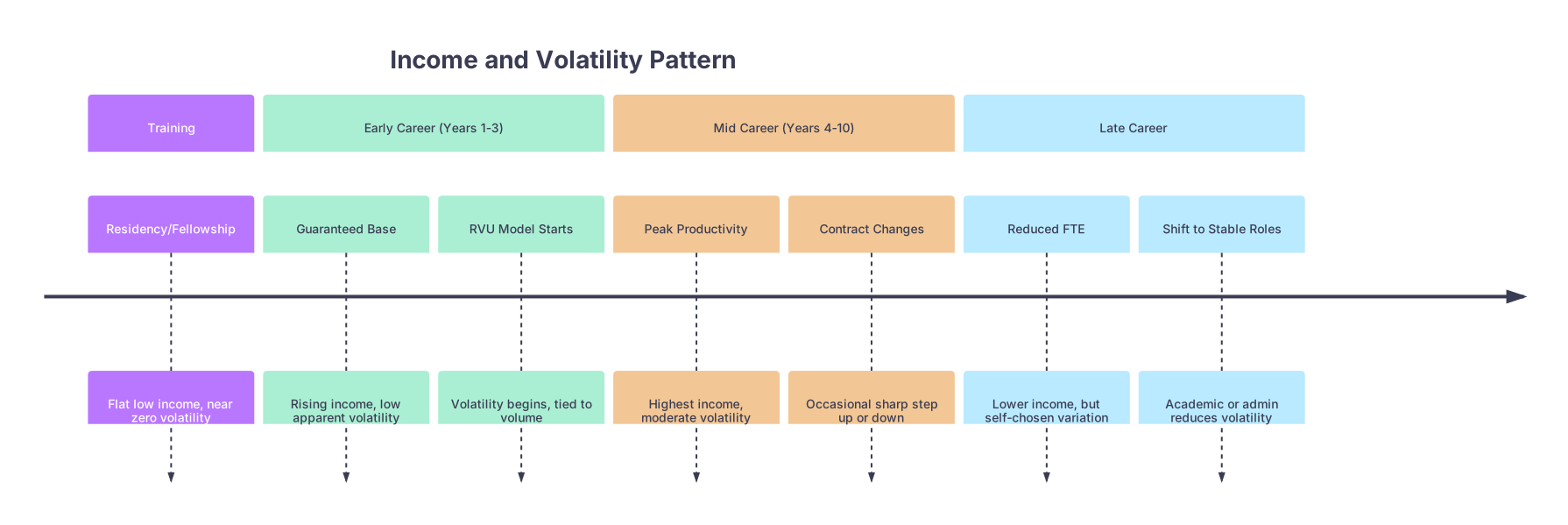
| Period | Event |
|---|---|
| Training - Residency/Fellowship | Flat low income, near zero volatility |
| Early Career (Years 1-3) - Guaranteed Base | Rising income, low apparent volatility |
| Early Career (Years 1-3) - RVU Model Starts | Volatility begins, tied to volume |
| Mid Career (Years 4-10) - Peak Productivity | Highest income, moderate volatility |
| Mid Career (Years 4-10) - Contract Changes | Occasional sharp step up or down |
| Late Career - Reduced FTE | Lower income, but self-chosen variation |
| Late Career - Shift to Stable Roles | Academic or admin reduces volatility |
This is what you are actually signing up for: not a single stable “salary,” but a moving band that responds to how you work, how your employer is doing, and how policy shifts.
Key Takeaways
- Low-paying does not mean low-volatility. Many primary care, pediatric, and hospitalist jobs show 10–25% swings in real income across months or years.
- Employer model and payer mix matter as much as specialty choice. Academic and conservative hospital-employed roles trade lower pay for smoother income; Medicaid-heavy or RVU-aggressive setups amplify volatility.
- If you understand the comp formula and build buffers early, you can absorb the inevitable swings without financial stress—and then focus on the parts of the specialty you actually chose it for.


