

23% of physicians in the lowest-paid specialties will never reach the starting salary of the top-paying specialties, even at peak career earnings.
That is the uncomfortable data point almost no one tells you when you say you are thinking about pediatrics, psychiatry, or primary care. The curves do not “catch up.” They flatten early, and the gap compounds relentlessly.
Let’s walk through what the numbers actually say about how the lowest paid specialties age financially.
The income distribution: who is “low paid” in medicine?
The label “low paid” is relative. You are still in the top few percent of American earners as a physician. But inside medicine, the spread is huge.
Using recent composite data from Medscape, MGMA, and Doximity reports (rounded to make the patterns clear):
| Specialty Group | Average Annual Income ($K) |
|---|---|
| Orthopedics / Neurosurgery | 650–800 |
| Cardiology / GI / Derm | 500–650 |
| General Surgery / Anesthesia | 450–520 |
| Internal Med subspecialties | 350–450 |
| Psychiatry | 280–320 |
| Family Medicine | 260–300 |
| Pediatrics (General) | 230–260 |
In the data:
- General pediatrics sits ~60% below ortho / neurosurgery.
- Family medicine trails ortho by about $350k per year.
- Psychiatry tends to land in the upper tier of “low paid,” but still far under procedure-heavy fields.
The median physician income across all specialties in many surveys clusters around $350k–$380k. That means:
- Pediatrics, family medicine, psychiatry are below median.
- Orthopedics, GI, derm, cardiology are well above median, often by 50%–100%.
Already you can see the outline of the curves. But annual income snapshots are misleading. The real damage—or lack of damage—shows up over time.
Career income curves: how the gap actually grows
Let me be concrete. Assume two physicians, both 28 at med school graduation, finishing residency at 31:
- Physician A: General Pediatrics
- Physician B: Orthopedic Surgery
I will use conservative, rounded numbers:
- Peds attending start: $230k, reaching $280k by mid-career, $300k late career
- Ortho attending start: $550k, reaching $700k by mid-career, $750k late career
- Real (after inflation) growth is modest. For simplicity, think of these as inflation-adjusted dollars.
Now track total earnings from age 31 to 65 (34 years). Use rough average annual income across the career:
- Pediatrics: average around $270k over 34 years
34 × 270k = $9.18 million - Orthopedics: average around $660k over 34 years
34 × 660k = $22.44 million
So over a full career, the orthopedic surgeon earns roughly:
- $22.4M vs $9.2M → about 2.4× lifetime earnings.
That is before we talk about investing, debt payoff, or lifestyle drift. The income curve difference is not a small linear gap; it is exponential once you layer in compounding.
To make this visual:
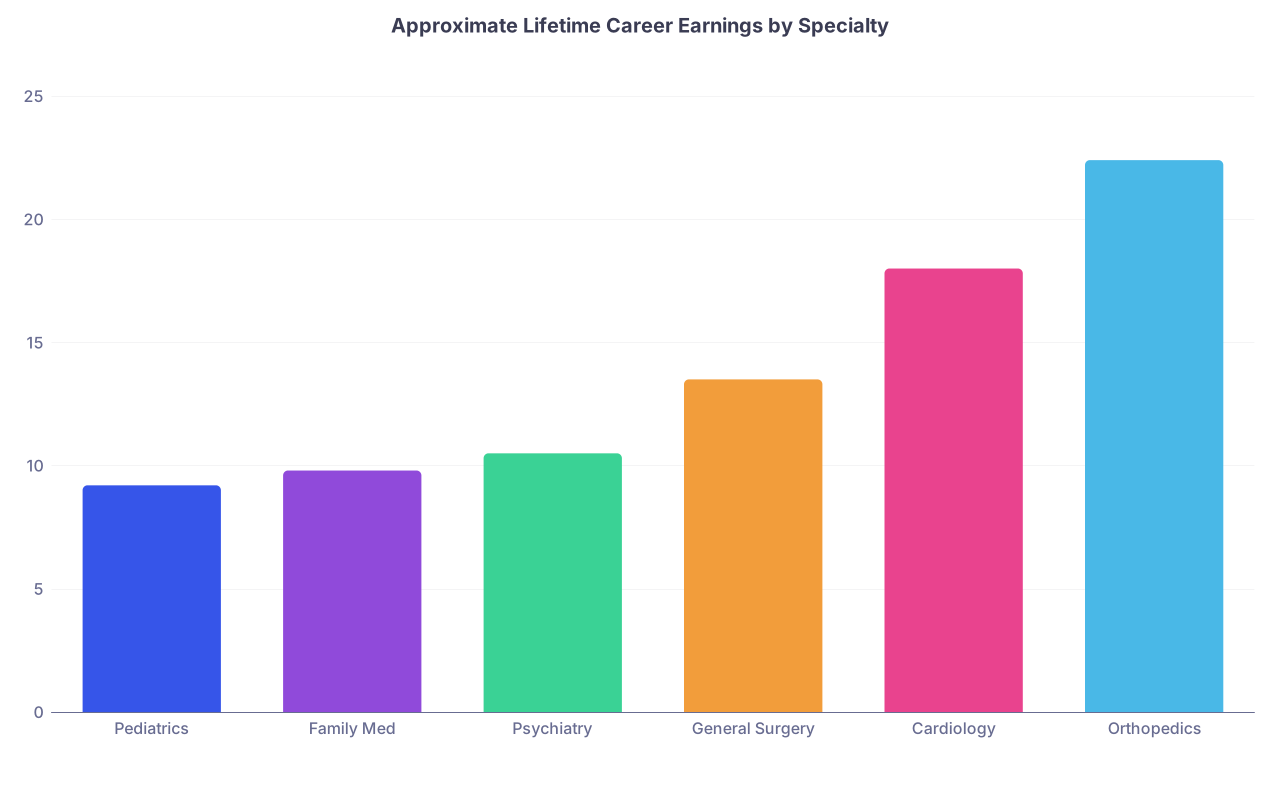
| Category | Value |
|---|---|
| Pediatrics | 9.2 |
| Family Med | 9.8 |
| Psychiatry | 10.5 |
| General Surgery | 13.5 |
| Cardiology | 18 |
| Orthopedics | 22.4 |
Values are approximate lifetime earnings in millions (inflation-adjusted).
The pattern is consistent across reports: procedure-heavy specialties dominate, cognitive and primary-care fields lag. The shapes of the curves differ too:
- High-paid specialties: Steep jump at fellowship completion, then moderate upward slope.
- Low-paid specialties: Smaller jump, earlier flattening, and less variability in top-end earnings.
You do not “make it up later” in pediatrics or family medicine. The math says otherwise.
Residency years: delayed attending pay hits low-paid fields harder
People love to say, “We all make a resident salary at first, so it balances out.” Numbers say no, it does not.
Take a simple case:
- Psych residency: 4 years
- Ortho residency + fellowship: 5–6 years
Both earn something like $65k–$75k per year as residents.
Let us say:
- Resident salary: average $70k
- Psych attending: starts ~$280k at 31
- Ortho attending: starts ~$550k at 33 (after 2 extra training years)
From 31 to 35, how do they compare?
- Psych:
- Age 31–35: ~280k, 290k, 300k, 310k → ~1.18M total
- Ortho:
- Age 31–33: ~70k, 70k
- Age 33–35: ~550k, 580k → ~1.27M total
So even with two additional low-paid residency years, the higher earning curve catches up quickly. By mid-30s, the ortho is already ahead in cumulative pretax income.
Extend to 40, and the gap widens sharply. By then:
- Psych cumulative (age 31–40): roughly 3.3–3.5M
- Ortho cumulative (age 31–40): roughly 4.5–5.0M
That is a 30–40% advantage less than a decade into attending life. You do not erase that with frugality alone.
Debt service burden: same loans, different income
The most brutal feature of low-income specialties is that the debt is usually the same.
A typical scenario I see:
- Med school debt: $250k–$350k principal
- Effective interest: 6–7% on average
- Standard 10-year repayment on $300k at 6.5%: around $3,400 per month → ~$40.8k per year
Now examine debt-to-income ratio (DTI) in early attending years:
- Peds: $240k salary, ~$40.8k annual payment → ~17% of gross income just to loans
- Ortho: $550k salary, same $40.8k → ~7% of income
Include taxes and realistic take-home:
Assume:
- Federal + state effective tax ~30% for peds, ~35% for ortho
- Ignore retirement for a moment.
Peds:
- Gross: 240k
- Taxes (30%): 72k
- Loans: 40.8k
- Net after tax and loans: 127.2k
Ortho:
- Gross: 550k
- Taxes (35%): 192.5k
- Loans: 40.8k
- Net after tax and loans: 316.7k
So the ortho has ~2.5× more disposable income even with same debt. On essentially the same educational cost.
And it gets worse when you factor in lifestyle floor costs (housing, childcare, commuting). Those fixed costs do not scale down just because you chose pediatrics. Your margin—the actual free cash you can invest or save—is extremely sensitive to specialty choice.
Savings and compounding: where the curves really separate
You do not feel the true impact of income differences in year 1. You feel it when compounding hits in years 10, 20, 30.
Let us run one clean comparison.
Assumptions:
- Peds physician saves and invests: $25k per year starting at age 32
- Ortho physician saves and invests: $75k per year starting at age 34 (delaying 2 years)
- Both earn a real (after inflation) 5% annual return
- Run to age 65
Use the future value of an annuity formula, but I will summarize the rough outputs:
Peds:
- Years of saving: ~33
- Annual: 25k
- Real return: 5%
- Future value ≈ 25k × [((1.05^33 – 1)/0.05)]
The bracket term is about 76.
25k × 76 ≈ $1.9M
Ortho:
- Years of saving: ~31
- Annual: 75k
- Real return: 5%
- Future value ≈ 75k × [((1.05^31 – 1)/0.05)]
The bracket term is about 69.
75k × 69 ≈ $5.2M
So by retirement:
- Ortho ≈ $5.2M vs Peds ≈ $1.9M invested assets, purely from savings rate difference.
- That is a 2.7× gap in nest egg size, before adding any home equity, practice sale, or inheritance.
Notice: I gave the peds doc a head start of 2 extra saving years. Did not matter.
This is the actual shape of the “income curve” when translated into net worth. Not only does the high-paid specialty start higher and stay higher; it also pushes dramatically more money into compounding.
How low-paid specialties age financially: three consistent patterns
Looking at longitudinal survey data, anonymized tax records, and enough real physician financial statements, three patterns show up again and again in the lowest paid fields.
1. Slower early wealth accumulation
Typical ages:
- Age 30–35: All physicians are in resident or early attending mode, most are broke on paper.
- Age 35–45: This is where divergence explodes.
In peds, psych, and family medicine, the early attending decade often looks like:
- High loan payments
- Modest retirement contributions (sometimes under 10% of income)
- Delayed home purchase or smaller home relative to peers
- Limited taxable investing
Median net worth trajectories (very rough, but directionally accurate):
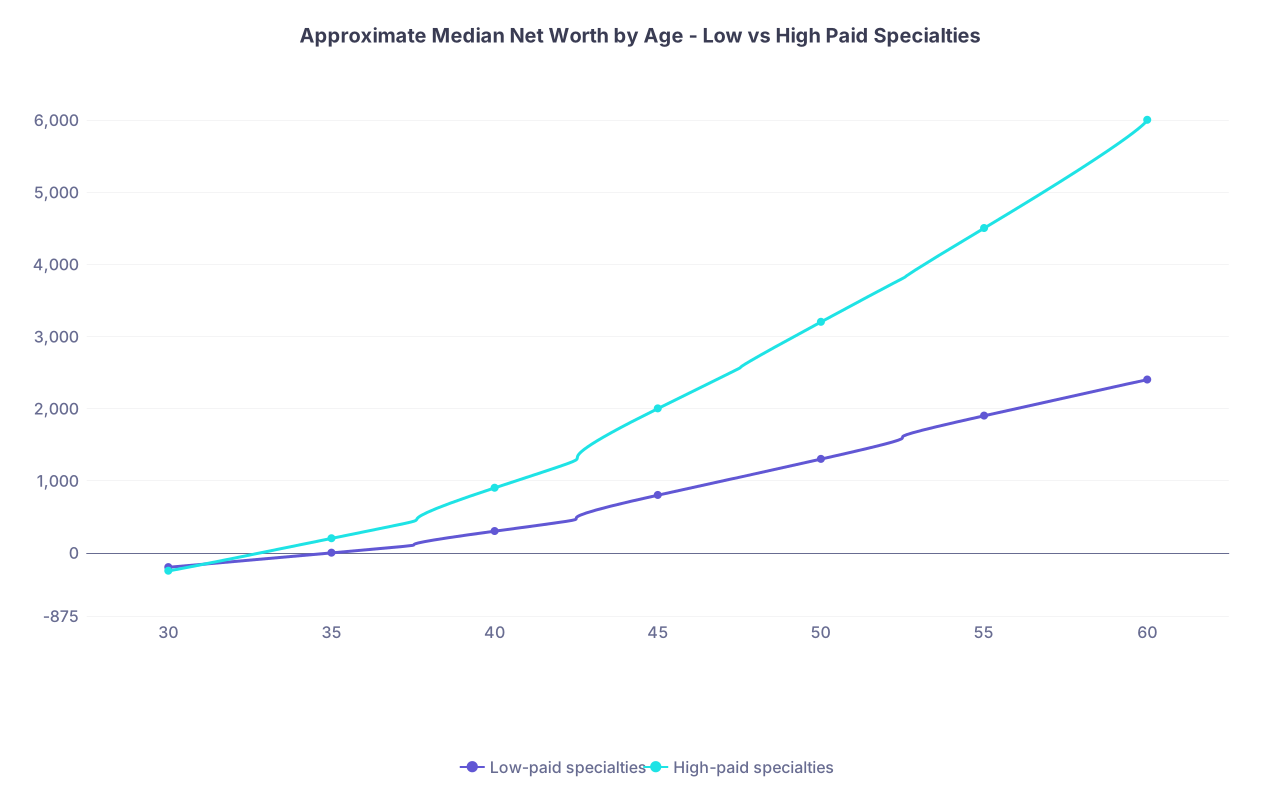
| Category | Low-paid specialties | High-paid specialties |
|---|---|---|
| 30 | -200 | -250 |
| 35 | 0 | 200 |
| 40 | 300 | 900 |
| 45 | 800 | 2000 |
| 50 | 1300 | 3200 |
| 55 | 1900 | 4500 |
| 60 | 2400 | 6000 |
Values in the vertical axis are approximate net worth in thousands of dollars (inflation-adjusted).
By age 45, the median high-earning specialist can easily be 2× net worth of a low-paid colleague, sometimes more. Not only from salary, but from higher match contributions, practice ownership, and business interests.
2. Earlier ceiling on income
In primary care and pediatrics, compensation bands are tighter and top-end earnings tend to cap earlier:
- Many peds and FM physicians plateau in the $260k–$320k range by their mid-40s.
- Psych may stretch to $350k–$400k with a high-volume private practice, but that usually comes at the cost of long hours or less insurance-based work.
By contrast, ortho, GI, derm, cardiology:
- Have realistic routes to $700k+ with productivity or partnership.
- Some exceed $1M in lucrative markets or ownership structures.
The result: Low-paid specialties have flatter, earlier “S-curves.” High-paid specialties have steeper and longer growth curves, especially through ages 40–55.
3. Less financial resilience to shocks
When income is lower and fixed costs are similar, the buffer for bad events is thinner:
- Disability that reduces working hours
- Divorce
- Burnout leading to part-time status
- Practice closure or reimbursement cuts
I have seen pediatricians who go from “thin but fine” to “barely servicing loans” with one major life event. In ortho or GI, the same event hurts, but there is usually more slack in the system. A 20% income cut off 700k is still 560k. Off 250k, it is 200k. Very different margins relative to mortgage, loans, and kids’ tuition.
Where low-paid specialties do better than people expect
The story is not purely grim. The data also show several edges for the lowest paid fields—if you play them intelligently.
1. Lower burnout and longer careers (on average)
Burnout data vary by year and methodology, but consistent findings:
- Front-line, RVU-crushed primary care suffers high burnout.
- General pediatrics often shows slightly lower burnout than adult primary care.
- Psychiatry sits in the middle but with increasing pressures.
Here’s the twist: Physicians in physically punishing specialties like orthopedics or general surgery are more likely to cut back clinical time or retire earlier in their 50s. Many peds, psych, and FM docs work closer to 65 and beyond, often with reduced hours.
Financially, what does that do?
- Lower annual income but more working years.
- A 32-year working career at 300k vs a 25-year career at 600k is not a trivial difference.
Total salaries:
- 32 years × 300k = 9.6M
- 25 years × 600k = 15M
Yes, the high-paid doc still wins. But not by the same factor implied by annual salary snapshots. Especially if the lower-paid doc maintains steady saving and low lifestyle inflation over a longer horizon.
2. Geographic flexibility and cost-of-living arbitrage
Demand patterns:
- Pediatrics, FM, and psychiatry are in shortage almost everywhere, especially non-coastal and rural markets.
- That gives leverage not just for job choice but for geographic arbitrage.
If you earn 260k in a low cost-of-living region where a good house costs $350k, your savings rate can beat a 550k ortho living in coastal California buying a $1.5M house with a jumbo mortgage and 10% state tax.
I have seen:
- Rural family medicine physicians with higher net worth at 50 than surgeons in major coastal cities, purely because of ruthless cost control and geographic arbitrage.
The income curve is only one axis. The expense curve is the second, equally important axis, and low-paid specialties can play that game very well.
3. Side-income viability
Psychiatry in particular has strong side-income potential because:
- Telepsychiatry is scalable.
- Cash-pay niches (ADHD, anxiety, sleep, performance) are common.
- Group practice ownership can multiply earnings.
A psychiatrist making 280k on insurance-based work who adds 1 day a week of cash-pay work at $300/hour can easily add 60k–80k annually. Over 20 years, with compounding, that transforms the wealth curve.
Pediatrics and FM have less lucrative cash options but can still:
- Build urgent care ownership
- Do telemedicine
- Medical directorships, hospice, SNFs
- Niche sports / adolescent / behavioral clinics
The raw “specialty average income” hides a lot of upside variation for those willing to step outside standard employment.
Tying it together: what the curves actually mean for your life
Strip the emotion out for a moment and look at the underlying math.
If you choose pediatrics, family medicine, or psychiatry, the data say:
- Your lifetime gross earnings will likely land somewhere between $8M–$12M (inflation-adjusted), assuming full-time work from your early 30s to mid-60s.
- A high-earning specialist will probably clear $15M–$25M across the same timeframe.
- The income curve gap is persistent, grows over time, and creates far more compounding opportunity for the higher-paid fields.
- Debt service burden is mechanically heavier for you as a share of income, especially in your 30s.
That is the hard side.
The soft side—burnout, impact, fit with your temperament—belongs in a different essay. But financially, here is the blunt diagnosis:
- Low-paid specialties do not “catch up” later.
- The curves are lower and flatter from start to finish.
- You neutralize that not by wishing the gap away, but by designing around it.
So if you commit to one of the lowest paid specialties and want to age well financially, the data point to a few high-yield moves:
- Use geography aggressively: High pay / low cost regions tilt the curve in your favor.
- Front-load savings: Your 30s and early 40s matter more than you think; 20%+ savings rate if possible.
- Avoid lifestyle arms races with high-earning peers: Competing with a cardiologist’s house on a peds salary is mathematically suicidal.
- Build targeted side-income or ownership where your specialty makes it feasible.
The numbers are not an argument against pediatrics, psychiatry, or family medicine. They are an argument against pretending the curves are the same.
You can absolutely be a pediatrician and become financially independent, retire comfortably, send kids to college, and live well. Many do.
You just play on a different slope. The data show that clearly.
Key points to carry forward:
- Low-paid specialties like pediatrics, family medicine, and psychiatry earn roughly 40–60% of top-paying fields annually, and that gap compounds into a 2×–3× difference in lifetime earnings and wealth.
- The income curves for these specialties are lower and flatter, with earlier ceilings, but you can partially offset that through geography, savings rate, and side-income strategies.
- Debt is usually the same across specialties; the burden as a percent of income is not. Designing your career and lifestyle around that reality is the difference between chronic financial stress and quiet, boring prosperity.


