

The data is unambiguous: several U.S. medical specialties are structurally incapable of supporting today’s typical med school debt without serious lifestyle sacrifice or extended repayment horizons.
The baseline math: what “unsustainable” really means
Before calling any specialty “unsustainable,” you need a numeric definition. I am going to use three.
Debt-to-Income Ratio (DTI) at graduation
DTI = Total educational debt / PGY‑1 salary“Normal life” affordability ratio
Percent of gross attending income required to:- Pay off loans in 10 years
- Cover federal/state taxes
- Fund basic retirement (≈15% of income)
- Leave at least 25–30% of gross for housing, food, family, etc.
Payback period in years at realistic saving rate
Years to pay off loans if you devote 20% of gross attending income to loans.
To anchor the numbers, I will use conservative, mainstream estimates.
- Median MD educational debt (AAMC): ≈$200,000–$220,000
- Common for private/DO/extended training: $300,000–$400,000+
- Resident PGY‑1 salary: ≈$65,000–$72,000
- Federal loan interest: 6–7% blended
- Effective combined tax rate for attendings: 30–38% depending on state and income
I will use $300,000 of debt at 6.5% as the “high but common” scenario and $400,000 as the “this is not rare anymore” scenario, because those are the numbers I keep seeing in actual financial consults with residents.
Now look at DTI at graduation:
- With $300,000 debt / $70,000 PGY‑1 salary → DTI ≈ 4.3
- With $400,000 debt / $70,000 PGY‑1 salary → DTI ≈ 5.7
Anything above 2–3 is already considered “high risk” by non-medical financial standards. Medicine normalized 4–6. That is the core problem.
Income by specialty: where the pressure really lands
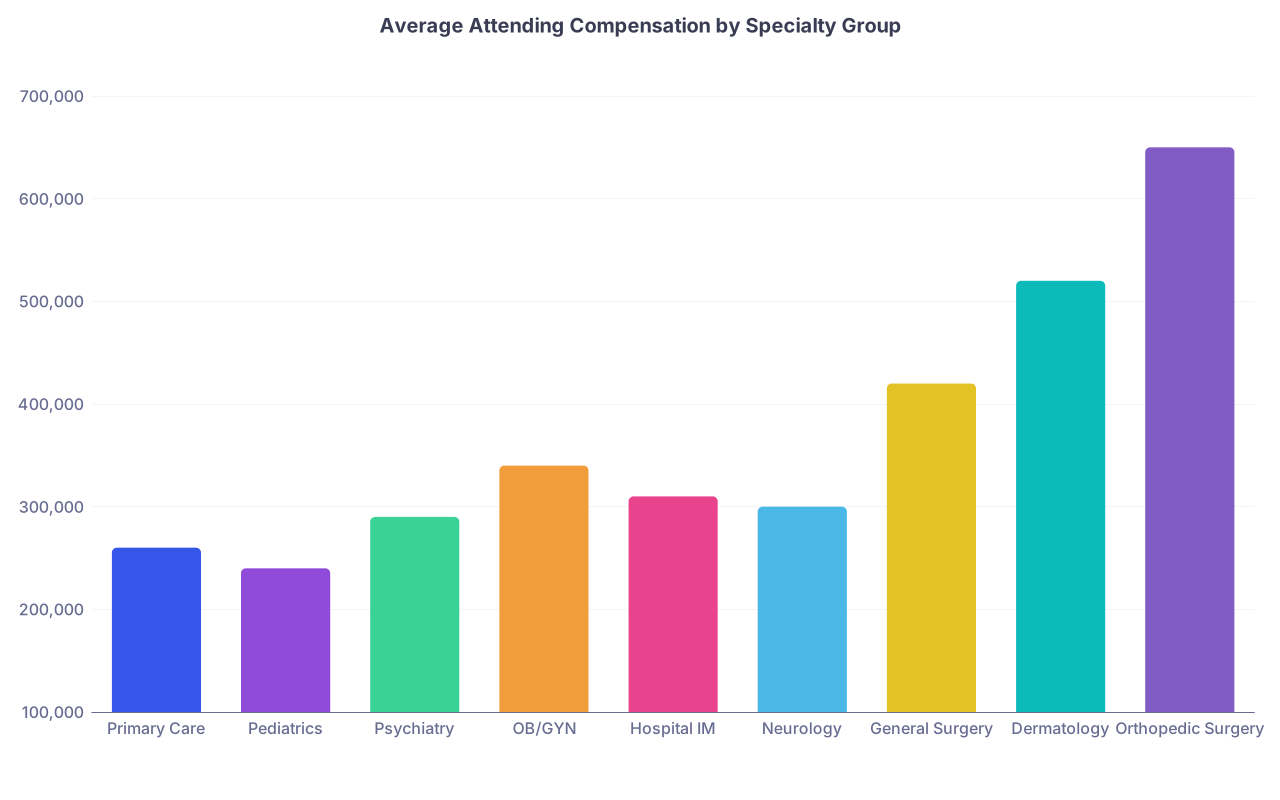
Let us start with the attending income landscape.
| Category | Value |
|---|---|
| Primary Care | 260000 |
| Pediatrics | 240000 |
| Psychiatry | 290000 |
| OB/GYN | 340000 |
| Hospital IM | 310000 |
| Neurology | 300000 |
| General Surgery | 420000 |
| Dermatology | 520000 |
| Orthopedic Surgery | 650000 |
The broad pattern is clear:
- Low-paid cognitive specialties cluster between $220,000 and $320,000.
- Procedure-heavy specialties (surgical, interventional, some radiology) can easily double that.
When debt is fixed but income floats between $230k and $650k, the same $350k debt load produces radically different lived realities.
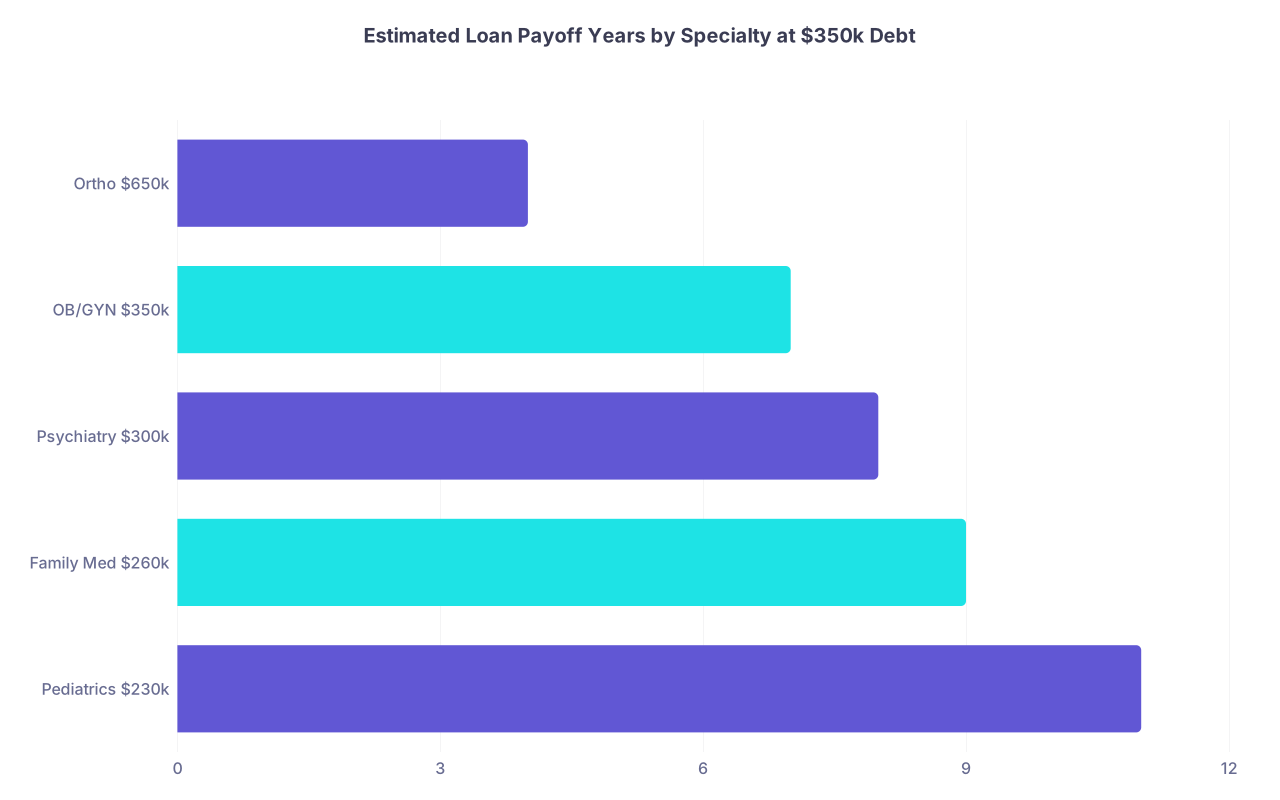
To make that explicit, look at a simple payback calculation:
Assume:
- Debt: $350,000 at 6.5%
- Attending devotes 20% of gross income to loans
- Ignore IDR quirks and PSLF for now (we will address them later)
Annual payment = 0.20 × income
You can approximate payoff time by iterating amortization, but a quick heuristic works:
- Required annual payment to clear $350k in 10 years at 6.5% ≈ $47,500–$50,000
- That is about 16–18% of a $280k income, or 9–10% of a $520k income.
So:
- At $250k income, 20% to loans ($50k/yr) barely hits the 10-year mark.
- At $500k income, 20% to loans ($100k/yr) clears it in ≈5–6 years.
Same debt, totally different financial burden.
The specialties that become structurally questionable are the ones where:
- Typical income ≤ $275k, and
- Typical debt ≥ $300k, and
- The job market is tightening or regionally constrained.
That is the unsustainable corner of the matrix.
Debt-to-income stress by specialty: where ratios explode
Let us put some concrete specialties on the table. These are approximate national averages, rounded, drawn from Medscape, MGMA ranges, and published AAMC debt data.
| Specialty | Typical Attending Income | Common Debt Range | Debt-to-Income (median debt / income) |
|---|---|---|---|
| Pediatrics | $230k–$250k | $250k–$400k | 1.0–1.6 |
| Family Medicine | $250k–$270k | $250k–$400k | 0.9–1.5 |
| Internal Med (outp) | $260k–$290k | $250k–$400k | 0.9–1.5 |
| Psychiatry | $280k–$320k | $250k–$400k | 0.8–1.4 |
| Neurology | $290k–$330k | $250k–$400k | 0.8–1.3 |
| OB/GYN | $330k–$380k | $250k–$400k | 0.7–1.2 |
Now compare to high-paying procedure-heavy fields:
- Orthopedic surgery: $600k–$750k, same $250k–$400k debt → DTI 0.4–0.7
- Dermatology: $500k–$600k → DTI 0.4–0.8
- Cardiology (invasive): $550k–$650k → DTI 0.4–0.7
The data shows a clear dividing line. When DTI (using attending income) is ≥ 1, debt is not a small background variable. It becomes a core constraint on life choices: where to live, whether one partner can step back, how many children, etc.
Now the uncomfortable analysis: which specialties are actually on the wrong side of the line?
Specialty-by-specialty: who is underwater at $300k–$400k debt?
1. Pediatrics: the classic negative ROI case
Pediatrics usually sits at the absolute bottom of the pay scale among physicians.
- Typical general peds income: $220k–$250k
- Some hospital-employed roles under $210k, especially in academic children’s hospitals
- Debt for many pediatricians is not lower than average; if anything, DO + private/Caribbean grads skew higher
Run the numbers for a pediatrician at $230k with $350k at 6.5%.
Approximate take-home breakdown:
- Gross: $230,000
- Taxes (fed + state + payroll, moderate state): ≈32% → $73,600
- Net: ≈$156,400
If they allocate a very aggressive 20% of gross to loans:
- Payment ≈$46,000 per year
- That will barely pay the loan off in ≈10 years
- Remaining after loans: ≈$110,400 per year (≈$9,200/month)
Now map fixed costs for a modest family in a reasonably expensive metro (since peds jobs cluster in urban/suburban systems):
- Housing (mortgage or high-rent area): $3,000–$3,500/month
- Childcare for two kids: easily $2,000–$3,000/month
- Insurance, transportation, food: $2,000–$2,500/month minimum
You are left with almost no slack. And this is assuming a surprisingly high 20% of gross to loans, which many cannot realistically sustain with dependents.
For pediatricians with $400k+ debt, even a 15-year payoff can feel tight without some version of PSLF or academic/VA qualifying employment. The cold reality: peds without a forgiveness plan and with $350k+ of debt is, financially, a bad trade under U.S. tuition levels.
2. Family Medicine: better than peds, still mathematically stretched
Family medicine looks “ok” on paper at $250k–$270k. In practice, it is fragile.
A common scenario I see:
- Income: $260k
- Debt: $320k–$380k
- Location: medium-cost area, hospital-employed, RVU pressure
At $260k with $350k debt, 20% to loans ($52k/yr) clears in ~9–10 years. Reasonable. But several structural risks make it less stable than the raw math suggests:
- Reimbursement compression: FM has ongoing downward pressure; many systems squeeze panel sizes and visit times to hit bonuses.
- High burnout and part-time drift: A significant fraction of FM docs eventually cut back to 0.6–0.8 FTE, dropping income 20–40% and blowing up the payoff math.
- Geographic mismatch: The best-paying FM jobs are rural/out-of-the-way, but many residents and partners are tied to urban areas for family or dual careers.
So is family medicine “truly unsustainable”? Not universally. But for a new grad with:
- $400k debt
- Desire to work 0.8 FTE in a big coastal city clinic
- No PSLF
The numbers tilt toward “this will be tight for 15–20 years.”
| Category | Value |
|---|---|
| Pediatrics $230k | 11 |
| Family Med $260k | 9 |
| Psychiatry $300k | 8 |
| OB/GYN $350k | 7 |
| Ortho $650k | 4 |
(Assumes 20% of gross to loans, 6.5% interest, rough amortization.)
You can see FM is not quite as bad as peds, but it is absolutely on the high-stress edge for any graduate over $300k in loans.
3. Outpatient Internal Medicine / Hospital IM
Pure outpatient IM and non-procedural hospitalist roles typically fall between $260k and $310k. Slightly better than FM, but with similar tension.
The difference is optionality. Internal medicine has more feasible routes to higher pay:
- Nocturnist roles with premium pay
- Procedural add-ons (stress tests, TEE, etc.) in some settings
- Transition to cardiology, GI, pulm/crit through fellowship (if done early)
Even so, pure outpatient IM at $270k with $400k of debt is not an obviously good deal without forgiveness. You can make it work, but your margin for error is thin.
Mathematically:
- $270k income, 20% to loans → $54k annual payment
- Payoff ≈9 years (if you start promptly as attending)
- Net of tax (~33%): $180,900
- Net after loans: ≈$126,900 (≈$10,575/month)
This is workable in low-to-moderate cost-of-living markets. In the Bay Area or NYC, that same IM doc will feel poor next to software engineers paying off $60k in loans.
4. Psychiatry: mid-tier income, but lifestyle often offsets risk
Psychiatry sits around $280k–$330k for many generalists, with better upside for those who tolerate cash-pay or high-intensity work (e.g., TMS, ketamine clinics, forensic work).
For debt:
- $300k–$350k is extremely common.
- Private/DO grads with $400k+ are not rare.
At $300k income with $350k debt, 20% to loans ($60k/yr) is a relatively safe 8–9 year payoff. Where psych stays out of the “truly unsustainable” bucket is that:
- Many psychiatrists can flex hours up or down and raise rates.
- Outpatient private practice can leap to $350k–$450k+ in higher-paying markets with cash/concierge models.
- Geographic arbitrage is powerful: high-need areas pay more and have extremely low living costs.
So while the raw ratio is similar to IM, the flexibility makes psych less dangerous long term. The data says: not ideal with $400k debt, but salvageable via income optimization.
5. Neurology: often overlooked but financially middling
General neurology incomes often fall between $290k and $340k, with stroke/ICU or procedural niches a bit higher. It is not as low as peds or FM, but the gap is not huge.
At $300k income with $350k debt, the neurology profile resembles psychiatry. The problem is that neurology has:
- Less straightforward private-practice upside than psych.
- Heavy cognitive load and documentation burden that pushes many toward reduced FTE later in career.
For a neurologist with $400k debt, full-time W‑2 employment at ~$300k in an expensive city is mathematically uneasy. They can still pay off the loans, but not without sacrificing lifestyle and savings for a long stretch.
6. OB/GYN: high workload, borderline income for very high debt
OB/GYN looks better on paper:
- Many jobs: $330k–$380k
- Some private groups: $400k+ with call-heavy schedules
- But malpractice, call intensity, and burnout drive part-time shifts
Let us check a $350k income with $400k debt scenario.
- Gross: $350k
- 20% to loans: $70k/yr
- Rough payoff: ≈7–8 years
- Taxes (35%): $122,500
- Net after tax: $227,500
- Net after loans: $157,500 (≈$13,125/month)
That is actually sustainable in most markets if you remain full time. The risk is behavioral: OB/GYN has one of the highest burnout rates, and many physicians I have seen move to GYN-only or part-time laborist roles later, cutting income by 20–40%.
So OB/GYN sits on the line. Numerically sustainable for a 1.0 FTE doc with $350k debt. Much less so for someone cutting to 0.6–0.7 FTE with $400k of loans.
The real cliff: debt load, not just specialty choice
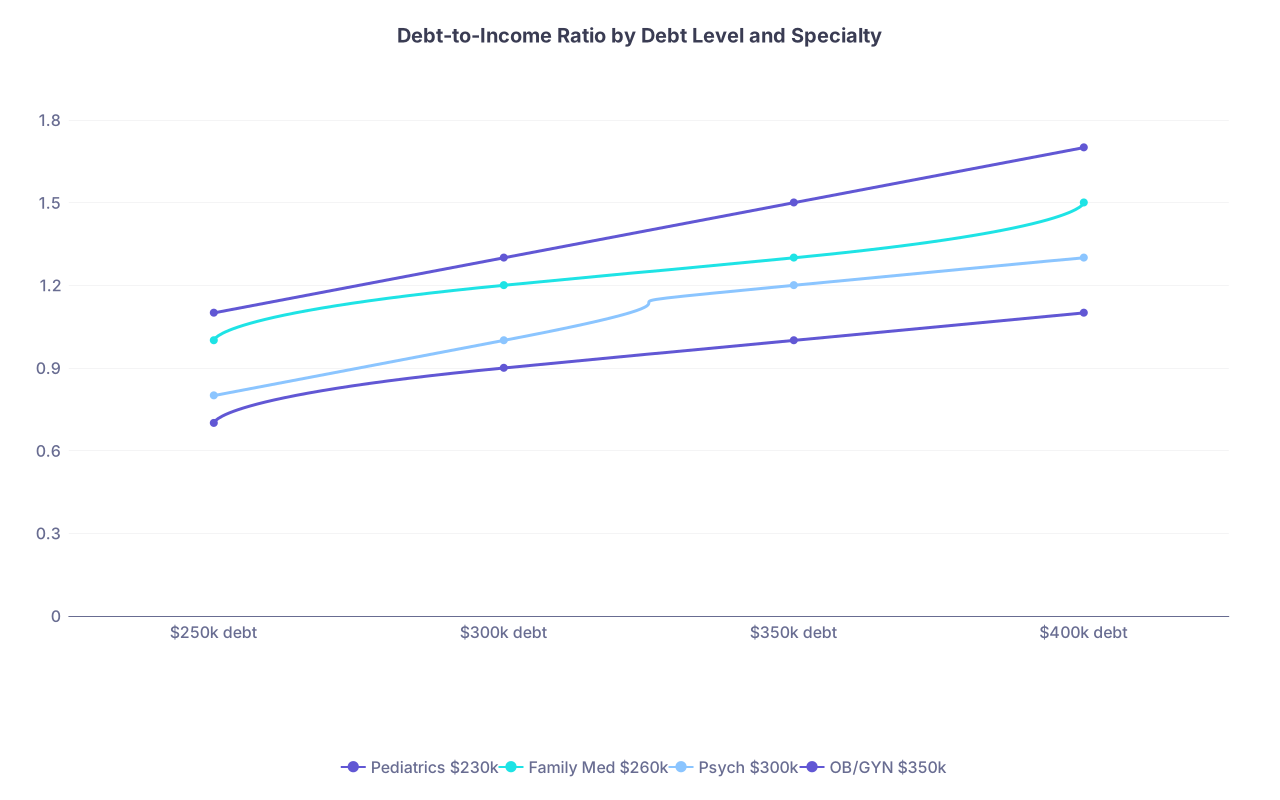
Specialty alone does not determine sustainability. The real story is the interaction between debt and income.
| Category | Pediatrics $230k | Family Med $260k | Psych $300k | OB/GYN $350k |
|---|---|---|---|---|
| $250k debt | 1.1 | 1 | 0.8 | 0.7 |
| $300k debt | 1.3 | 1.2 | 1 | 0.9 |
| $350k debt | 1.5 | 1.3 | 1.2 | 1 |
| $400k debt | 1.7 | 1.5 | 1.3 | 1.1 |
Once total debt crosses $350k–$400k, peds and FM are basically locked into one of three paths if the physician wants a “normal” middle-class life within 10–15 years:
- Public Service Loan Forgiveness (PSLF) or other forgiveness programs
- Extended income-driven repayment and acceptance of 20–25 year payoff with a tax bomb
- Significant lifestyle constraint and/or geographic arbitrage (high pay, low cost of living)
I have seen pediatricians with $500k of loans making <$220k. At that point, the math breaks. Even with 20% of gross to loans, you are staring at 15+ years of serious repayment, and the mental burden is enormous.
PSLF and IDR: why “unsustainable” is different for academic and community doctors
You cannot talk about sustainability without mentioning federal programs. They change the equation, but only for certain practice patterns.
PSLF
PSLF essentially caps the relevance of raw DTI for those who:
- Work full-time for a qualifying nonprofit or government employer
- Use an income-driven plan
- Make 120 qualifying payments (10 years)
Peds, FM, IM, psych, and OB/GYN are all heavily represented in:
- Academic medical centers
- Nonprofit hospital systems
- FQHCs and community clinics
For these physicians, a high DTI is emotionally stressful but financially survivable. They effectively:
- Pay 10% (or a bit more, under new SAVE rules) of discretionary income
- Obtain forgiveness at year 10, tax-free
The problem: many residents assume they will stay in PSLF-eligible jobs, then pivot to private, for-profit groups mid-career. That move can instantly convert “manageable” into “crushing,” because they exit right before the payoff or forgiveness peak.
Income-Driven Repayment (IDR) without PSLF
IDR alone (SAVE, PAYE holdouts, etc.) still helps, but the end-of-term forgiveness (20–25 years) is currently taxable under existing law. That creates a deferred “tax bomb” which must be planned for.
For high DTI peds/FM docs in non-PSLF jobs, IDR can keep cash flow workable—monthly payments might be a few thousand dollars instead of the full amortized amount—but total lifetime repayment plus tax can exceed principal by a wide margin.
In data terms: cash flow sustainable. Lifetime ROI questionable.

| Step | Description |
|---|---|
| Step 1 | High Debt >300k |
| Step 2 | Standard payoff reasonable |
| Step 3 | PSLF path |
| Step 4 | IDR long term |
| Step 5 | Geographic or lifestyle sacrifice |
| Step 6 | Specialty payout low? |
| Step 7 | Nonprofit job? |
| Step 8 | Willing to extend payoff 20y? |
The specialty becomes “truly unsustainable” when you combine:
- Low to mid income
- High debt
- For-profit employment
- No willingness to move or aggressively downsize lifestyle
Where the line actually falls: specialties at genuine risk
Let me be blunt: not every low-paying specialty is a financial disaster. The data points to a narrower set that is truly misaligned with current tuition levels for many graduates.
Clearly high-risk for unsustainability at $350k–$400k debt
- General Pediatrics (particularly academic and urban jobs under $230k)
- Family Medicine in high-cost urban markets, especially part-time or academic roles under $240k
- Outpatient Internal Medicine under ~$260k in expensive cities with no PSLF
- Some academic subspecialties (e.g., pediatric endocrinology, adolescent medicine) where extra fellowship years do not yield meaningful pay bumps
These are the specialties where a typical debt load from a private MD/DO or Caribbean route cannot be justified purely on financial grounds unless:
- PSLF is achieved, or
- The physician is comfortable with 20+ years of IDR plus a tax bomb, or
- Lifestyle and location choices are aggressively optimized for low cost.
Borderline but salvageable with optimization
- Psychiatry
- Neurology
- OB/GYN
- Hospitalist IM (with some nights or high need geography)
For these, $300k–$350k debt is tough but not insane. $400k+ starts to bite heavily unless you either:
- Push compensation up (extra call, procedures, private practice)
- Or take advantage of PSLF/IDR strategically
Rarely “unsustainable” unless debt is extreme or lifestyle is rigid
- Dermatology
- Orthopedic surgery
- Radiology (diagnostic, interventional)
- Cardiology, GI, anesthesia, surgical subspecialties
Even at $400k–$450k of debt, the payoff horizon at $500k–$700k income is short if you allocate 15–20% of gross to loans. The true risk here is not unsustainability, it is mismanagement—overspending early, failing to refinance when appropriate, ignoring taxes.
The uncomfortable conclusion: some combinations simply do not pencil out
If you want a simple rule of thumb from all this, here it is.
For most physicians, long-term financial stress explodes when:
- Total educational debt > attending income
- AND attending income < $275k
- AND there is no reliable path to PSLF or substantial private-practice upside
Translate that:
- Peds/FM/academic primary care with $400k+ debt is, on a purely financial basis, a bad investment by 2024 tuition standards unless you plan strategically from MS1.
- If your heart is set on those fields, the data says you must be deliberate about one (or more) of:
- Lower-cost schools
- PSLF-eligible employment
- Geographic arbitrage (high pay / low COL)
- Temporarily higher work intensity (extra shifts, leadership roles) in early attending years

I am not saying “do not do pediatrics” or “avoid family medicine.” I am saying: if you are walking into those fields with $350k–$500k of loans and vague hopes that “it will work out,” the numbers disagree with you.
Three takeaways that actually matter
Debt level matters more than specialty label. Peds at $180k debt is fine. Peds at $450k is a financial cage unless PSLF is baked into your career path.
The specialties most at risk of being truly unsustainable under current tuition are low-paid cognitive fields—especially pediatrics and family medicine—when paired with $300k–$400k+ debt and no forgiveness or geographic flexibility.
“Sustainable” means more than being able to make the minimum payment. It means being able to pay loans down in under 15 years while also saving 15% for retirement and living a normal life. A surprising number of primary care and pediatric physicians with high debt do not clear that bar without sacrifice that never shows up in the glossy match-day photos.
If you match into a lower-paid specialty with high debt, the data is clear: you must treat financial strategy as seriously as you treated Step 1. Otherwise, the DTI will own you for decades.


