

The geography of physician pay is brutally uneven, and low-paid specialties feel the pain most intensely.
High-paying surgeons can absorb a $30,000 regional swing. A pediatrician making $210,000 cannot. A 15–20% geographic gap there is the difference between feeling stable and quietly wondering why you spent a decade training.
Let me walk through where the data say low-paid specialties actually earn the least, and why “coastal academic plus high cost of living” is often a financial trap if you are in primary care, pediatrics, psychiatry, hospital medicine, or neurology.
I will reference composite data from recent Medscape, Doximity, and MGMA reports (2022–2024 ranges), plus cost-of-living indices. Every number you are about to see is approximate, but the patterns are very stable.
The Baseline: What “Low-Paid” Means in 2024
We need a baseline before we talk geography.
Across broad national surveys, average U.S. physician compensation clusters roughly like this:
| Group | Approximate National Mean |
|---|---|
| Highest paid specialties | $550,000–$700,000 |
| Mid-range cognitive/procedural | $350,000–$450,000 |
| Core low-paid specialties | $220,000–$320,000 |
Within that lowest band, the usual suspects:
- Pediatrics (general): ~$220,000–$240,000
- Family medicine: ~$250,000–$275,000
- Internal medicine (outpatient): ~$260,000–$290,000
- Psychiatry: ~$280,000–$320,000
- Hospitalist (IM/FP): ~$300,000–$340,000
- Geriatrics, endocrinology, infectious disease, rheumatology, and neurology also typically sit on the lower half of medicine.
The raw spread between a low-end pediatrician and a mid-level orthopedic surgeon is often $300,000–$400,000 per year. Now layer geography on top of that.
We are not just asking “Who gets paid the least?” The better question is: “Where does low nominal pay collide with high living costs and weak incentives?” That is where the real financial damage happens.
Regional Pay Patterns: Who Loses on the Map
Start with the broad regions. Multiple surveys converge on the same structure: the South and some Midwest states pay more; the Northeast and West Coast pay less.
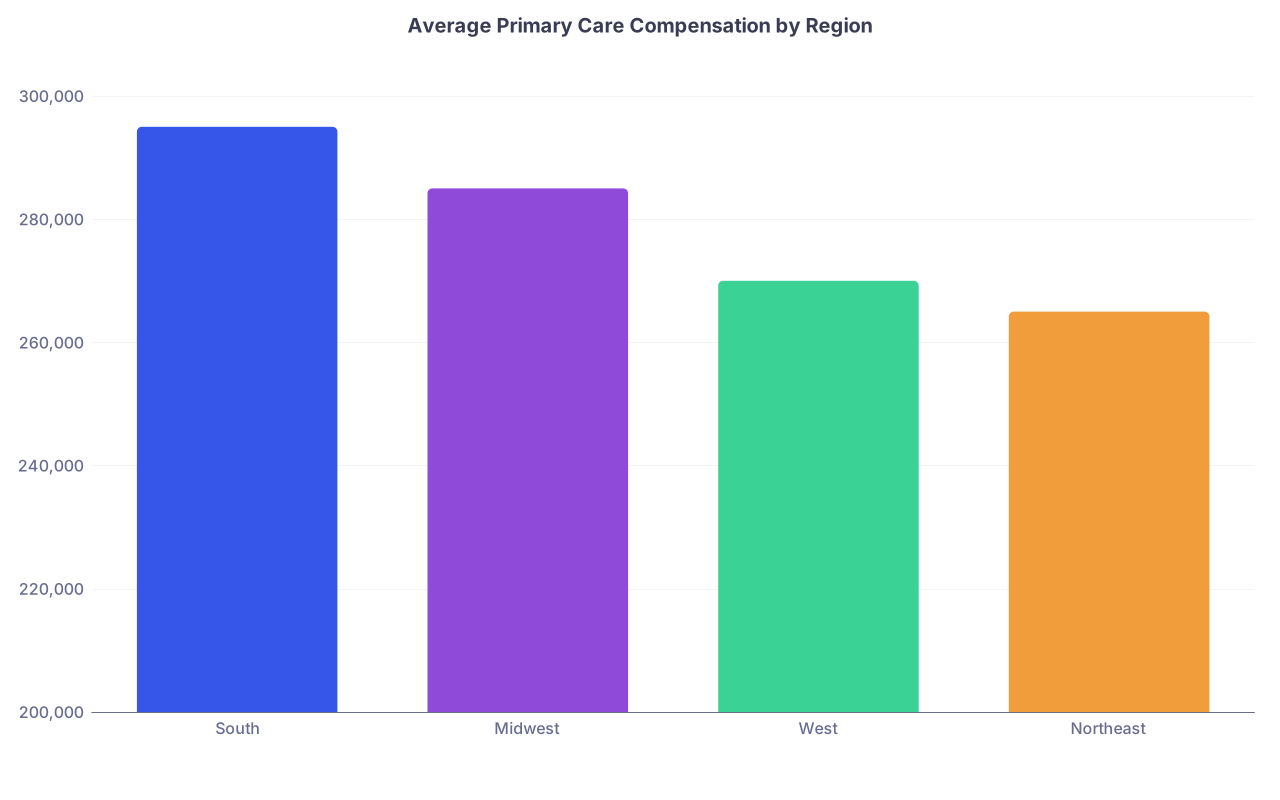
| Category | Value |
|---|---|
| South | 295000 |
| Midwest | 285000 |
| West | 270000 |
| Northeast | 265000 |
For primary care (FM, IM, peds), the data tend to look like this:
- South: ~$290,000–$300,000 average
- Midwest: ~$280,000–$290,000
- West: ~$265,000–$275,000
- Northeast: ~$260,000–$270,000
On paper the difference is “only” $25,000–$40,000 between extremes. For a cardiothoracic surgeon making $650,000 that is a rounding error. For a pediatrician, it is 10–15% of total compensation.
Now layer on rent and cost-of-living.
Cost of Living vs Compensation: The Real Story
Nominal salary is the wrong metric. Real, cost-adjusted income is what matters.
Take a simplified comparison of low-paid specialties in three archetypal environments:
- Coastal urban academic (think Boston, San Francisco, NYC)
- Large Midwestern metro (e.g., Columbus, Minneapolis, St. Louis)
- Smaller Southern city (e.g., Birmingham, Tulsa, Knoxville)
| Setting | Pediatrician | Family Med | Psychiatrist | Cost of Living Index* |
|---|---|---|---|---|
| Coastal urban academic | $220,000 | $245,000 | $270,000 | 130–150 |
| Large Midwestern metro | $235,000 | $265,000 | $295,000 | 95–105 |
| Smaller Southern city | $250,000 | $285,000 | $310,000 | 85–95 |
*Index relative to ~100 national average (varies by source).
If you adjust these for cost of living, the picture flips even more dramatically. A pediatrician making $220,000 in San Francisco (COL index ~175) is probably worse off financially than a pediatrician at $240,000 in Nashville (COL index ~95–100) by a large margin.
Specialty by Specialty: Where the Floor Is Lowest
Now let’s go specialty-specific. Because the pain points are not identical.
Pediatrics: The Poster Child for Underpayment
Every data set agrees: general pediatrics is at or near the bottom of the pay scale.
Typical ranges (attending, not fellowship):
- Coastal academic centers: $185,000–$225,000
- Large private or community groups in Midwest/South: $230,000–$260,000
- High-demand rural / underserved: sometimes $260,000–$280,000 with bonuses
So where do pediatricians earn the least in a meaningful way?
Northeast academic hospitals in high-cost cities
Think Boston, NYC, Philadelphia, DC. You see starting offers in the low $200s, occasionally high $100s for strictly academic, non-RVU-heavy roles.West Coast coastal metros
Bay Area and Los Angeles frequently cluster around $210,000–$230,000 for general peds in academic or large system roles, often with limited productivity upside.Prestige-branded children’s hospitals
Top-name children’s hospitals often trade on reputation. The salary discount can be real: $10,000–$30,000 less than a no-name community hospital 2 hours away, with higher housing costs thrown in.
The line I hear from pediatric residents in Boston and San Francisco is depressingly consistent: “I did the math. My co-resident who went to a midwestern hospital is taking home more real money and has a house.”
Family Medicine: Wide Range, But Watch the Coasts
Family medicine shows one of the largest geographic spreads, because:
- It is the backbone of rural and community care.
- It responds strongly to local supply-demand and payer mix.
You can see something like this across the country:
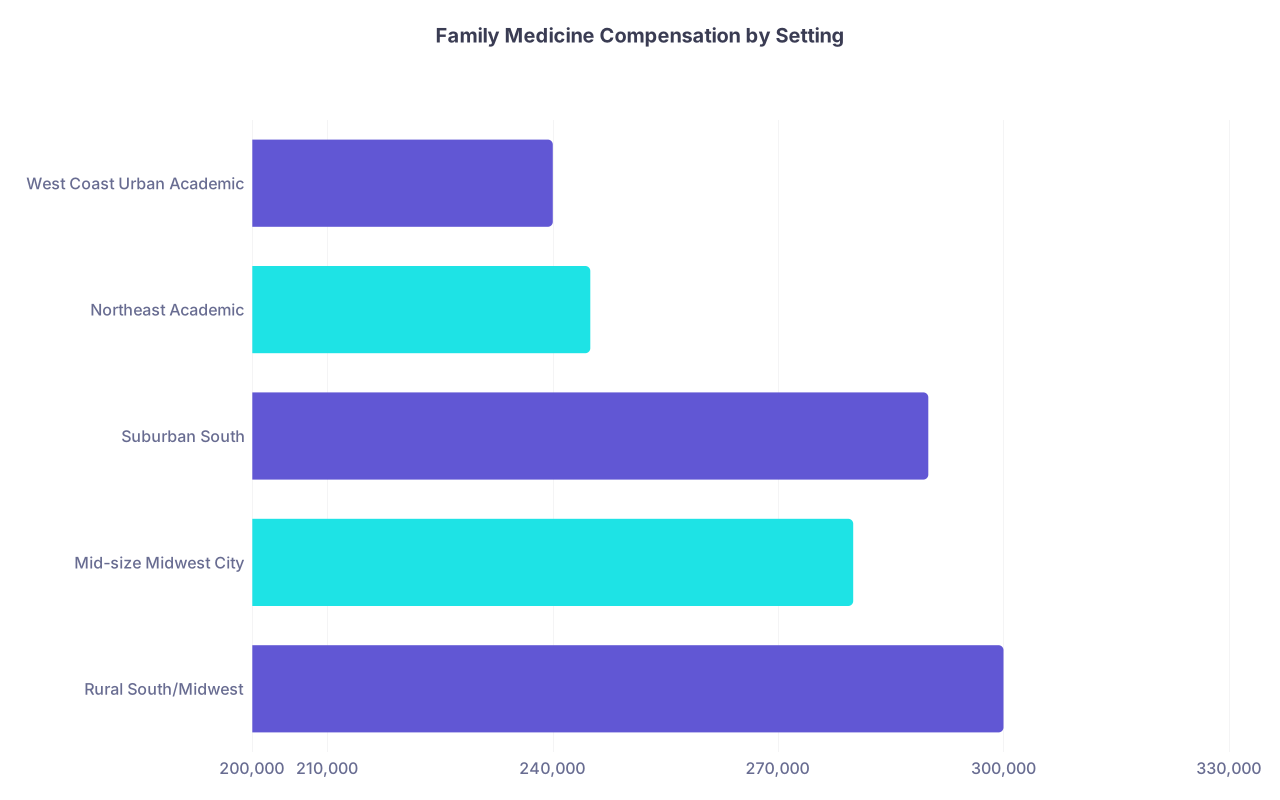
| Category | Value |
|---|---|
| Rural South/Midwest | 300000 |
| Mid-size Midwest City | 280000 |
| Suburban South | 290000 |
| Northeast Academic | 245000 |
| West Coast Urban Academic | 240000 |
Practical translation:
- Rural South/Midwest: $290,000–$320,000 with loan repayment, signing, and RVU bonuses.
- Mid-size cities (Midwest/South): $260,000–$290,000 on average.
- Northeast academics: often $220,000–$250,000 for a heavily clinic-based job, with plenty of non-billable administrative or teaching time quietly stuffed in.
- West Coast academic / large integrated system: $230,000–$255,000 is common.
Where is family medicine worst off?
- High-cost East and West Coast academic medical centers.
- Dense urban clinics in poor payer markets where Medicaid is dominant and FQHC/academic models cap compensation.
The paradox: family medicine is absolutely essential in urban underserved areas, but Medicaid-heavy payer mixes and salary-capped safety-net funding keep physician income at the bottom of the range.
Psychiatry: Demand Is High, but Geography Still Cuts
Psychiatry is the one “low-ish” specialty where demand has started to push pay up significantly. Telepsychiatry and private practice have changed the game. But system-employed psychiatrists still see regional cliffs.
System-employed psychiatry numbers tend to look like this:
- Midwest/South (hospital-employed or CMHC with incentives): $300,000–$340,000
- Large, non-academic systems in lower-cost Western or Mountain states: $300,000–$330,000
- Northeast academic or pure CMHC in coastal cities: $250,000–$290,000
- West Coast academic: $260,000–$300,000 (occasionally more, but cost of living wipes it out)
Where psychiatrists earn the least in practice:
Urban academic psychiatry in coastal metros
Residents I talk to in New York and Boston consistently get offers in the $260,000–$290,000 band with heavy call and teaching obligations.Public sector / county psychiatry in ultra-high-cost areas
You might see a base of $250,000–$280,000 with a “great pension.” On a spreadsheet, that looks fine. In San Jose housing dollars, it hurts.Some community mental health centers
Especially those that pay on a “public service” scale instead of a physician market scale. I have seen offers below $240,000 in high cost-of-living regions.
The delta between a psychiatrist in Oklahoma at $330,000 and one in Brooklyn at $270,000, when you adjust for rent, is massive. You are effectively giving up six figures of real annual buying power.
Hospitalists: Geography Drives the 7-on/7-off Math
Hospital medicine sits on the edge of low and mid-range pay. But many internal medicine hospitalists still cluster close enough to the low-paid group that regional swings matter.
Typical full-time equivalents (standard 7-on/7-off model):
- Midwest / South community hospitals: $310,000–$350,000
- Smaller markets with staffing shortages: up to $360,000+
- Northeast and West Coast academic centers: $260,000–$300,000
- Large urban coastal community hospitals: often $280,000–$320,000
So where is hospitalist pay “worst” for the work?
Northeast teaching hospitals with high resident coverage
The common structure: lower base pay, high cost of living, and the vague promise of “academic advancement” that rarely moves your salary needle.California coastal markets with high competition
Systems know they can fill jobs in San Diego or the Bay Area from people wanting location. The pay may be $280,000–$310,000 while inland hospitals offer $340,000+.Hybrid nocturnist roles without real nocturnist pay
I see some coastal markets offer “nocturnist” at $290,000–$310,000, which is barely above a day hospitalist in the Midwest.
Per shift, the data show that the cheapest place to be a hospitalist is an academic hospital on the coasts.
Neurology and Cognitive Subspecialties: Quietly Underpaid
Neurology, rheumatology, endocrinology, infectious disease, geriatrics. The data pattern is similar: a lot of complex thinking, not nearly as much billing power as procedures.
Nominal salaries often fall roughly here:
- Midwest/South: $280,000–$320,000 (sometimes up to $340,000 for neuro)
- Northeast/West Coast: $250,000–$290,000, with academic roles dipping into the $230,000s
Where are these specialties effectively lowest paid?
- Academic neurology on the East and West Coasts, especially in reputation-heavy institutions.
- Academic ID and rheum in major metros, where $230,000–$260,000 is still common.
No surprise: many ID and rheum fellows quietly pivot to hospital medicine or industry in these regions once they see the offer sheets.
Academic vs Community: The Prestige Discount
Strip away region for a moment. Academic vs community is its own axis of pay variation, and it hits low-paid specialties harder.
Across multiple surveys and contract reviews I have seen, the “academic discount” usually sits somewhere between 10% and 30%. In low-paying fields, 20–25% is common.
Take primary care or pediatrics as an example:
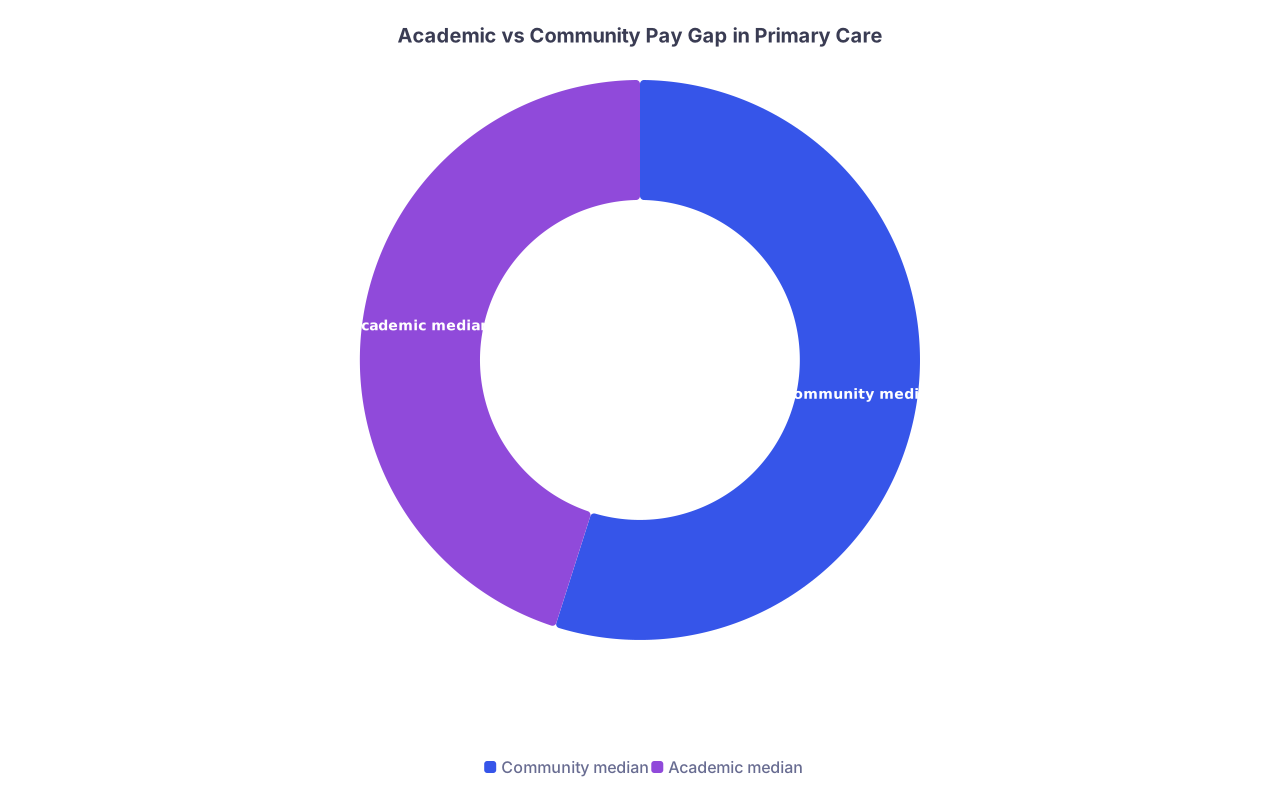
| Category | Value |
|---|---|
| Community median | 280000 |
| Academic median | 230000 |
Rough, but realistic:
- Community pediatrics in mid-cost region: $240,000–$260,000
- Academic pediatrics in same region: $200,000–$230,000
The absolute gap ($30,000–$40,000) is not small. When your total income is in the low $200s, that is a real standard-of-living hit.
For psychiatry, similar pattern:
- Community psych (non-coastal): $320,000–$350,000 possible
- Academic psych (coastal urban): $260,000–$300,000, sometimes lower base with “incentives”
Residents routinely overestimate how much “protected time,” “title,” and “teaching” will compensate for that dollar gap.
Here is the blunt version: for low-paid specialties, prestige and academics usually extract the highest relative financial tax. Especially in high-cost cities.
Where the Math Is Worst: Cost-Adjusted View
If you combine geography, setting, and specialty, you can sketch a rough “real income” ranking. Conceptually, it looks like this:
| Scenario (Attending Level) | Nominal Pay | COL Index | Real Income Index* |
|---|---|---|---|
| Peds – Coastal academic children’s hospital | $210,000 | 150 | 0.70 |
| FM – Northeast academic center in major city | $240,000 | 130 | 0.74 |
| Psych – West Coast academic in Bay Area | $280,000 | 175 | 0.64 |
| Hospitalist – NYC/Boston academic | $285,000 | 150 | 0.76 |
| FM – Midwestern community hospital, mid-size city | $275,000 | 100 | 1.00 |
| Peds – Southern community group, mid-size city | $250,000 | 90 | 1.23 |
*Index is a simple illustration: (Salary / COL index normalized to 100). Higher is better.
If you normalize the Midwestern FM job to 1.0, that Bay Area academic psychiatry job with a COL index of 175 has maybe 60–70% of the real purchasing power. You feel that discrepancy after about 3 months of paying rent.
Residency and Early Career: How This Hits You in Real Time
You are in residency or fellowship, trying to choose a first job or even a subspecialty. Where does this data actually matter?
Here is the recurring pattern I watch play out:
Resident in a coastal academic program in a lower-paid field (peds, FM, psych, neurology).
They interview at:
- One “dream” academic job in the same city.
- A few community jobs 2–4 hours away in lower-cost regions.
- Maybe one rural or midwestern out-of-state job.
Offer sheets:
- Academic in city: lower base, high rent, intangible perks.
- Community or midwestern role: $30,000–$60,000 higher, lower COL, sometimes loan repayment.
Resident chooses the academic coastal job “for now” thinking they will move later.
Life happens. Kids. Partner’s job. Roots. The move never happens. The gap compounds.
Run the math:
- $40,000 annual difference over 5 years = $200,000 before tax.
- If you had invested even half of that annually with modest returns, the long-term spread is closer to $300,000–$400,000+.
For low-paid specialties, that is the difference between fast-tracking to financial stability versus spending extra years catching up.
Where Low-Paid Specialties Earn the Least: The Short List
If you want the concentrated answer, here it is. Across recent data sets and contracts I have seen, the worst pay environments for low-paid specialties share three features:
High cost of living
Especially the coastal urban corridors:- Boston / NYC / DC corridor
- Bay Area / LA / Seattle
Academic or prestige-heavy institutions
Large university hospitals, big-name children’s hospitals, elite teaching centers. They pay you in brand value and trainees.Poor payer mix or constrained reimbursement
Urban safety-net systems, Medicaid-heavy catchment areas, public systems that set pay scales for “doctors” without truly adjusting for market rates.
Combine all three, and you get:
- General peds at $200,000–$220,000 in a city where a one-bedroom rents for $3,000.
- Family medicine at $230,000 with a 130–150 COL index.
- Psychiatry at $270,000 in a housing market where starter homes are $1 million.
- Academic neurology in the $250,000 range while community neuro two states over pays $320,000.
The data are not subtle. The outliers are rare. The pattern holds.
Final Takeaways
Three core points stand out from the numbers:
- Low-paid specialties take the hardest hit in high-cost coastal academic environments; the combination of lower nominal pay and high cost of living can cut real income by 25–40% compared with community roles in the Midwest or South.
- Within pediatrics, family medicine, psychiatry, hospital medicine, and other cognitive fields, the “prestige discount” of academic centers is typically 10–30%, and that discount is magnified when housed in expensive cities.
- If you are in a low-paid specialty, geography is not a minor detail. It is one of the largest controllable levers of your financial trajectory in the first 5–10 years after training.
The data show this clearly. Whether you let it shape your decisions is up to you.


