

The myth that “all doctors are rich” collapses quickly when you look at the lowest paid specialties. The data shows a brutally simple truth: academic jobs in already low‑paid fields are often financially punishing compared with private practice—sometimes by six figures per year.
Let me walk you through the actual numbers, not the anecdotes.
The Landscape: Which Fields Are Actually “Lowest Paid”?
Every survey looks slightly different, but the same cohort clumps at the bottom year after year. Using recent national survey data (Medscape, AAMC, MGMA and large group benchmarks), the consistent low earners—on a median total compensation basis—look like this:
- Pediatrics (general)
- Pediatric subspecialties (especially endocrinology, infectious disease, rheumatology, adolescent medicine)
- Family medicine
- Internal medicine (general)
- Geriatrics
- Endocrinology (adult)
- Infectious disease (adult)
- Psychiatry (less “low” now, but still below many procedural fields)
To quantify the bottom tier, think in crude bands for private practice or non‑academic employed settings:
- Family medicine, general IM, general pediatrics: often in the $240k–$280k range median, higher with call/rural
- Cognitive subspecialties (endo, ID, rheum, geriatrics): typically $230k–$280k median, sometimes lower in pure academic roles
- Psychiatry: often $290k–$330k, but with rising demand and strong locums options
Academic compensation in the same fields often trails by $40k–$150k per year.
Let us make that gap concrete.
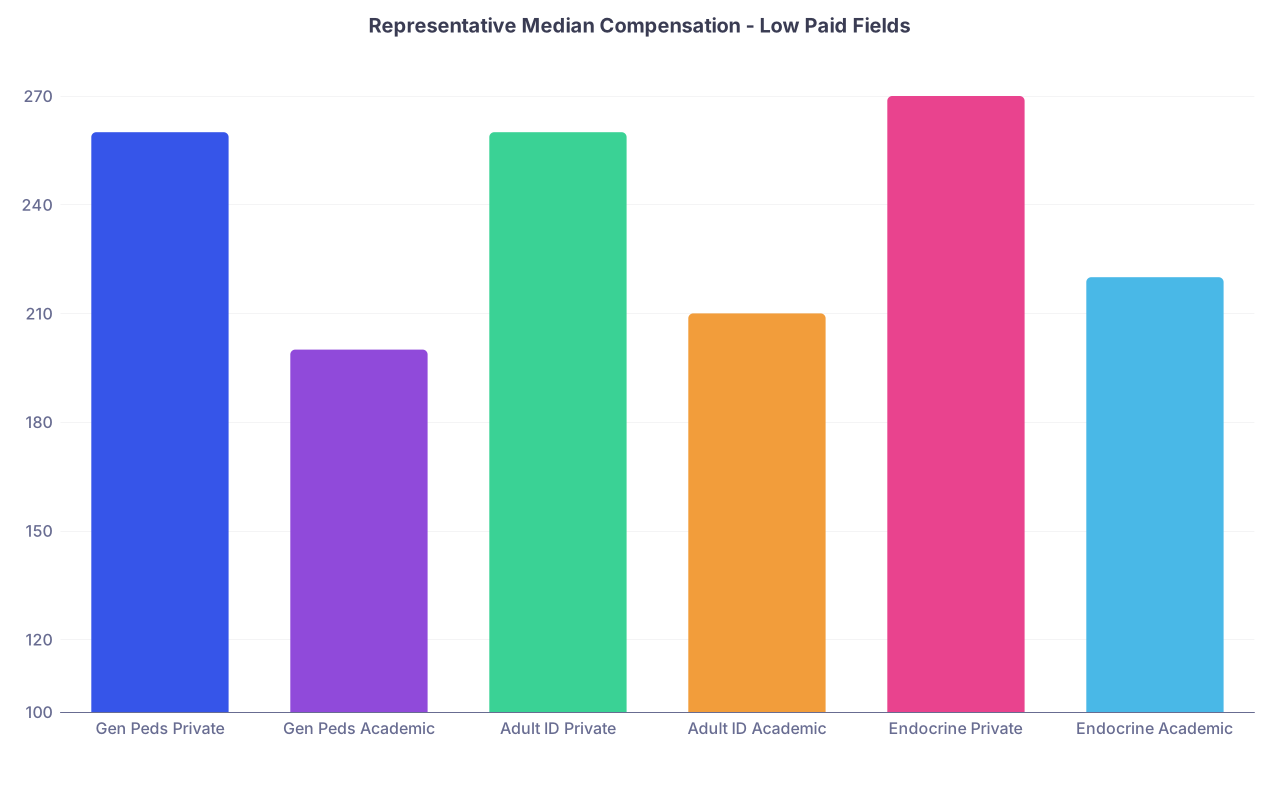
| Category | Value |
|---|---|
| Gen Peds Private | 260 |
| Gen Peds Academic | 200 |
| Adult ID Private | 260 |
| Adult ID Academic | 210 |
| Endocrine Private | 270 |
| Endocrine Academic | 220 |
Those are not cherry‑picked extremes. Those are very plausible mid‑career, full‑time, all‑in numbers.
Core Comparison: Academic vs Private in the Bottom Tier
You are in residency trying to choose a specialty and practice type. You should treat this like a multi‑year financial model, not a vibes‑based decision.
Here is a simplified but realistic comparison across some of the lowest paid specialties, assuming mid‑career (7–10 years post‑residency), full‑time clinical load. Numbers are rounded and region‑agnostic, but directionally accurate.
| Specialty | Academic Median (\$k) | Private / Non‑Acad Median (\$k) | Typical Gap (\$k) |
|---|---|---|---|
| General Pediatrics | 190–220 | 250–280 | 60–80 |
| Pediatric Endocrinology | 180–210 | 230–260 | 50–70 |
| Adult Infectious Disease | 200–220 | 240–280 | 40–60 |
| Adult Endocrinology | 210–230 | 260–300 | 50–70 |
| Geriatrics | 200–230 | 240–280 | 40–60 |
Translate that into a 20‑year horizon:
- A consistent $50k annual gap ⇒ $1,000,000 gross difference over 20 years
- A consistent $80k annual gap ⇒ $1,600,000 gross difference over 20 years
That is before compounding if the higher earner saves and invests the difference.
You are not choosing between $300k vs $310k. You are often choosing between “upper‑middle‑class with some slack” and “permanently tight budget with big student loans.”
Where the Gap Comes From: Revenue vs Mission
The underlying economics are not mysterious. They are baked into the structure of academic centers.
1. RVU and payer mix reality
Low‑paid cognitive specialties share several characteristics in academic settings:
- High proportion of Medicaid and underinsured patients
- High complexity per visit, but low RVU yield compared with procedural work
- Poor reimbursement for time‑intensive care (e.g., managing complex endocrine or ID cases, prolonged counseling, multidisciplinary coordination)
Academic hospitals often carry the sickest, most complex patients. That makes the workload heavier while the pay per unit of time is weaker.
Private practice, by contrast, can:
- Optimize scheduling for higher RVU density (fewer no‑shows, more commercially insured patients, more follow‑ups that bill cleanly)
- Avoid most of the uncompensated teaching and administrative work
- Negotiate better pay from hospitals for call coverage or service lines
So the same board‑certified endocrinologist or pediatrician can generate more billable revenue per clinical day in a well‑run private practice than in a mission‑heavy academic clinic, even if they see just as many complex patients.
2. Teaching and research are rarely fully funded
In academic medicine, your time is carved into:
- Direct clinical care
- Teaching (students, residents, fellows)
- Research / quality improvement / admin
The brutal part: the hospital’s financial model usually only fully values one of those—clinical RVUs.
Protected time sounds attractive. But “0.7 FTE clinical, 0.3 FTE academic” often means:
- Your cash salary is tied almost entirely to the 0.7 FTE clinical
- The 0.3 FTE is underwritten by a small institutional stipend, partial grant support, or nothing sustainable
- The total W‑2 often ends up well below what a 1.0 FTE private clinician earns with no teaching
I have seen pediatric subspecialists at major academic centers with “50% research time” earning under $200k all‑in while their private peers in the same city clear $275k–$300k seeing bread‑and‑butter clinic and some call.
3. Overhead and cross‑subsidization
Academic centers carry enormous fixed costs:
- GME programs
- Research infrastructure
- Specialist backup for every possible scenario
- Social work, case management, interpreters, etc.
Those costs are real. The institution backfills them by:
- Paying lower salaries in non‑procedural, less revenue‑dominant fields
- Using faculty effort to cross‑subsidize training programs and research that are only partially grant‑funded
In simple terms: the hospital makes cardiothoracic surgery and GI endoscopy money, and some of that surplus is used to maintain pediatrics, ID, endocrine, geriatrics, psychiatry, and their fellowship programs. That is not “bad,” it is just the math.
Specialty‑Specific Patterns: Who Gets Squeezed the Hardest?
Let us drill down into a few representative low‑paid specialties and how the academic vs private gap behaves.
General Pediatrics: lovable, underpaid, especially academic
General pediatrics is consistently at or near the bottom of compensation tables.
Representative figures:
- Academic general pediatrics: $180k–$220k
- Private/community pediatrics: $240k–$290k (higher in high‑cost or underserved areas, sometimes with bonuses and partnership tracks)
The gap often reaches $60k–$100k by mid‑career.
Complicating factors:
- Peds practices are heavily dependent on Medicaid. Reimbursement varies wildly by state. A private pediatrician in a Medicaid‑stingy state might not out‑earn academic peers by much. In generous states, the private physician can substantially out‑earn academics.
- Lifestyle tradeoffs: academic pediatrics might offer more predictable schedules, better sick leave, and more ancillary support, but this is far from universal. I have seen private pediatric groups with 4‑day workweeks that still beat academic comp by $80k.
Pediatric subspecialties: intense training, thin margins
Many pediatric subspecialists complete 3 extra years of fellowship only to earn similar or less than general peds colleagues—especially in academia.
Think pediatric endocrinology, ID, rheumatology, adolescent med.
- Academic pediatric endocrine: $180k–$210k is common
- Private pediatric endocrine (large groups, high‑need metro areas): $230k–$270k
- Call pay is often modest, and inpatient work does not dramatically change the picture
The data here is especially painful: 6 years postgraduate training (peds residency + fellowship) and a compensation level that often barely matches a strong outpatient internal medicine doctor who stopped after 3 years.
Academia exacerbates that problem because these divisions are research‑heavy, grant‑dependent, and frequently “subsidized” by the department. Translation: salaries are constrained.
Adult Infectious Disease: critical to a hospital, poorly rewarded financially
Infectious disease is the poster child for “mission outweighs money.”
- Academic adult ID: $200k–$230k is typical
- Private / hospital‑employed ID: $240k–$300k (and sometimes higher with heavy call, outreach, or hospitalist hybrids)
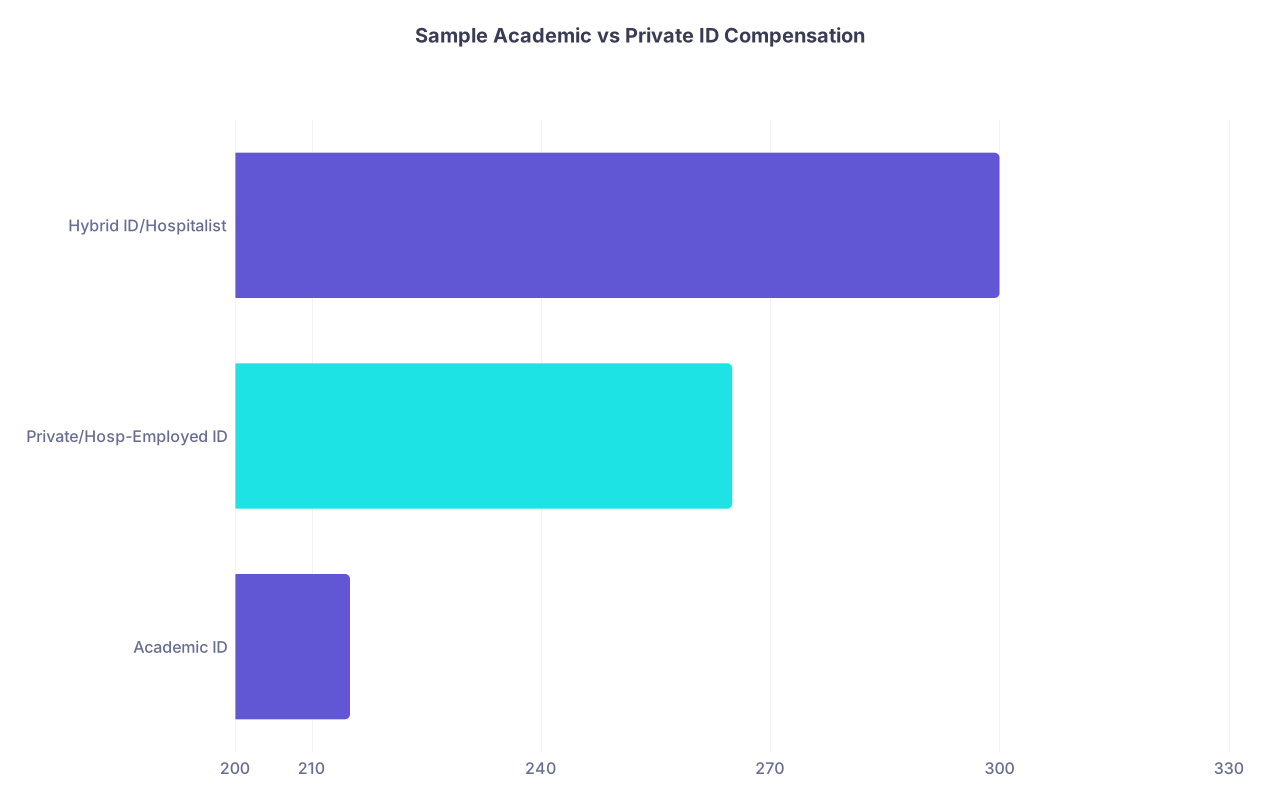
| Category | Value |
|---|---|
| Academic ID | 215 |
| Private/Hosp-Employed ID | 265 |
| Hybrid ID/Hospitalist | 300 |
Why the spread?
- Pure consultative ID (the classic academic model) generates middling RVUs per hour, especially when doing stewardship, infection control, and long‑complex notes.
- Hybrid models—half ID, half hospitalist, or ID plus wound care / infusion center / HIV clinic with good payer mix—can push income into the $280k–$320k zone. This is far more often seen outside traditional academic departments.
When you look at the data, the ID physician who insists on a pure academic role, heavy on stewardship, research, and complex consults, usually takes the deepest permanent pay cut.
Adult Endocrinology and Geriatrics: similar math, slight variations
Endocrinology:
- Academic: $210k–$240k
- Private: $260k–$310k (more if doing obesity medicine, procedures, or high‑volume diabetes care with good payer mix)
Geriatrics:
- Academic: $200k–$230k
- Private / SNF‑heavy practice: $240k–$300k, but often at the cost of brutal visit volume or nursing home rotation schedules
In both, the purely academic track—especially where research and teaching demand is high—pulls compensation down.
Non‑Salary Components: Benefits, PSLF, and Stability
If you stop at W‑2 salary, you miss half the equation. Academic roles sometimes claw back a bit of competitiveness through non‑salary elements.
Public Service Loan Forgiveness (PSLF)
Many academic hospitals are 501(c)(3) nonprofits. That matters.
If you have:
- $250k–$500k in federal student loans
- Are on an income‑driven repayment (IDR) plan
- Can reliably accumulate 10 years of qualifying payments
Then PSLF can be worth $100k–$300k+ in forgiven principal and interest.
This can partly offset an annual salary gap. A rough heuristic:
- A $50k/year salary gap over 10 years = $500k gross
- PSLF benefit might be $150k–$250k, depending on debt and payments
- Net disadvantage of academic route narrows but does not disappear
But you have to stay in qualifying employment and manage your loans correctly. One job move to a for‑profit system at year 7, and the math implodes.
Retirement and benefits
Academic centers often offer:
- Solid 403(b) or 401(a) matches (3–8% of salary, sometimes more in combined plans)
- Better defined benefit or supplemental retirement in older systems
- Lower but more predictable bonuses
Private practice:
- Sometimes weaker retirement matches in small groups
- Sometimes better profit‑sharing in large groups or after partnership
The net: retirement benefits typically narrow the academic–private gap by maybe $10k–$20k a year in value, not $80k.
Job security and institutional risk
Academic jobs feel more stable—until divisions are cut, grants dry up, or RVU thresholds ratchet up. Private jobs feel riskier—but high‑demand fields like psych, primary care, and hospital medicine now have enormous job liquidity.
In the lowest paid fields, true job loss is not the main risk. The real risk is being locked into a chronic under‑earning trajectory due to:
- Weak negotiation leverage as “another pediatrician / ID doc” in a saturated academic department
- Limited alternative employers in a given city that can support your subspecialty work
Lifetime Earnings Modeling: How Big Is the Hit, Really?
Let us use a simple, conservative model for a hypothetical pediatric endocrinologist.
Assumptions:
- Academic path: starts at $190k, grows to $230k by mid‑career, average $210k across 25 years
- Private path: starts at $240k, grows to $280k by mid‑career, average $260k across 25 years
- Difference: $50k per year on average (many real‑world cases are worse)
Total gross earnings over 25 years:
- Academic: $210k × 25 = $5.25M
- Private: $260k × 25 = $6.50M
Gap: $1.25M gross.
If the private physician invests just $15k/year of the extra $50k at 5% real return, you are looking at an additional $700k–$900k in retirement assets by age 65.
So the true financial gap (income + asset difference) easily crosses $2M in many scenarios.
Now overlay student loans:
- If PSLF saves the academic doc $200k in forgiven loans while the private doc aggressively pays loans off, that narrows but does not erase the gap.
That is the scale of what you are trading for the academic environment.
Strategic Choices: How To Use This Data As a Resident
If you love pediatrics, ID, geriatrics, or endocrine, the answer is not “just pick ortho instead.” But you should handle this like a serious analyst, not an idealist.
A few practical, data‑driven rules:
If you choose a bottom‑tier pay specialty, be very cautious about long‑term academic careers unless:
- You are genuinely committed to research/education as a core life goal
- You have or expect much lower than average educational debt
- You are in a high‑cost, high‑pay city where your institution is unusually generous on salary
Hybrid models are financially superior in most data sets.
ID + hospitalist, endocrine + obesity med/procedures, peds subspecialist with some locums or telemedicine on the side. Keeping one foot outside the strict academic silo usually boosts total income 20–40%.Negotiate your FTE and expectations explicitly.
“0.8 FTE with 1.0 benefits” and protected clinic days used optimally can change the economics. I have seen junior faculty in low‑paid specialties add $30k–$50k by structuring their contract rationally and doing side work that does not violate non‑competes.Location multiplier matters.
The same academic job in a low‑cost Midwest city with $210k salary and cheap housing can be less financially damaging than $225k in coastal academia with $3,000/month rent.Do the 10‑year pro‑forma for yourself.
Put your actual debt, likely starting salaries, state tax, federal tax bracket, and realistic savings rates into a spreadsheet. The gap between “academic pediatric ID” and “community general pediatrics” is often larger than you think.
What This Means For Your Specialty Decision
If you are in residency and drawn to one of the lowest paid specialties, the data pushes you to answer a blunt question:
Are you choosing this specialty and academic medicine? Or this specialty in the most financially rational practice setting?
Because those are different decisions.
- General pediatrics in private practice: underpaid compared to ortho, yes, but you can still reach a solid upper‑middle‑class lifestyle, especially in the right market.
- General pediatrics in academia with no side income and heavy teaching: often a permanent struggle with loan payments, childcare costs, and housing.
Same for ID, endocrine, geriatrics, pediatric subs.
The intellectually honest route is not to deny that reality. It is to decide whether the academic trade‑offs are worth a 6‑ or 7‑figure lifetime hit.
You can absolutely still choose the academic track. Many do. But if you are going to donate $1–2 million of lifetime value to your institution’s mission, you should at least do it on purpose.


