

The prestige fantasies about psychiatry evaporate fast in a community mental health center.
You are not running 45‑minute psychotherapy with well‑insured professionals. You are managing 250+ severely ill patients, fighting prior authorizations, and trying not to drown in documentation for a salary that often lags behind your peers by six figures.
Let me break this down specifically: outpatient psychiatry in CMHCs (Community Mental Health Centers) is its own ecosystem. Different caseload realities. Different burnout patterns. Different pay structure logic. If you are a med student or resident thinking “I like psych but I want to serve underserved populations,” you need to understand exactly what you are signing up for.
What CMHC Outpatient Psychiatry Actually Looks Like
First, clarify the setting. “Outpatient psychiatry” is a broad term. CMHC work is a narrow, very specific slice.
Typical CMHC features:
- High proportion of Medicaid / Medicare / uninsured
- Severe and persistent mental illness: schizophrenia, schizoaffective, bipolar I, recurrent severe MDD, SUD comorbidity
- Heavy involvement with social services, housing, courts, probation, CPS
- Team‑based model: case managers, therapists, peer specialists, nurses, sometimes NPs/PA-Cs
- Productivity targets tied to RVUs or “billable hours”
This is not “boutique” outpatient. This is safety‑net psychiatry.
The Patient Mix
Day‑to‑day, your panel might look like:
- 30–40% schizophrenia / schizoaffective
- 20–30% bipolar I/II
- 20–30% severe recurrent depression / PTSD
- 20–40% co‑occurring substance use disorders
(and yes, that math overlaps; almost everyone has multiple diagnoses) - Significant cluster B traits and trauma histories
Socioeconomically: unstable housing, unemployment, disability applications, food insecurity, legal issues. A lot of your “psychiatric” visit quietly becomes social work and crisis prevention.
Caseload: Numbers, Visit Length, and “Invisible” Work
Here is where people get blindsided. CMHC outpatient caseload and scheduling is aggressive compared with private practice or salaried academic clinics.
Typical Caseload Ranges
Let me give you realistic numbers I have seen repeatedly across states:
- New full‑time psychiatrist:
- Panel: 200–300 active patients
- 0.8–1.0 FTE clinical time
- Experienced psychiatrist or “high producer”:
- Panel: 300–450+ active patients
- Clinics that are frankly abusive:
- Push 450–600+ patients per psychiatrist
(usually with high NP turnover and chronic understaffing)
- Push 450–600+ patients per psychiatrist
“Active” means they are supposed to be seen at least every 3 months, often more frequently for unstable cases or controlled substances. Now do the math.
Daily Schedule Reality
A very common template:
- 8‑hour workday (on paper)
- 6.5 hours of “face‑to‑face” scheduled time
- 1.5 hours blocked for admin (which is rarely enough)
Slot distribution might look like:
- New intakes: 60 minutes (some places 45, very rare to get 90)
- Routine follow‑ups: 15–20 minutes
- Depo injections: nurse visit with brief MD/DO check (or none)
- Crisis/same‑day: squeezed into lunch or “double booked” slots
Many CMHCs run:
- 20–24 patient encounters per day
with a mix of 2–4 intakes and the rest follow‑ups
Now add:
- 10–30 patient‑portal or telephone messages daily
- 5–15 refill requests
- 3–10 documentation requests (FMLA, disability, housing, court letters, CPS)
- Constant EHR “tasks” from nursing and case management
That “1.5 hours admin time” evaporates. You start doing notes at home or pulling them into patient time.
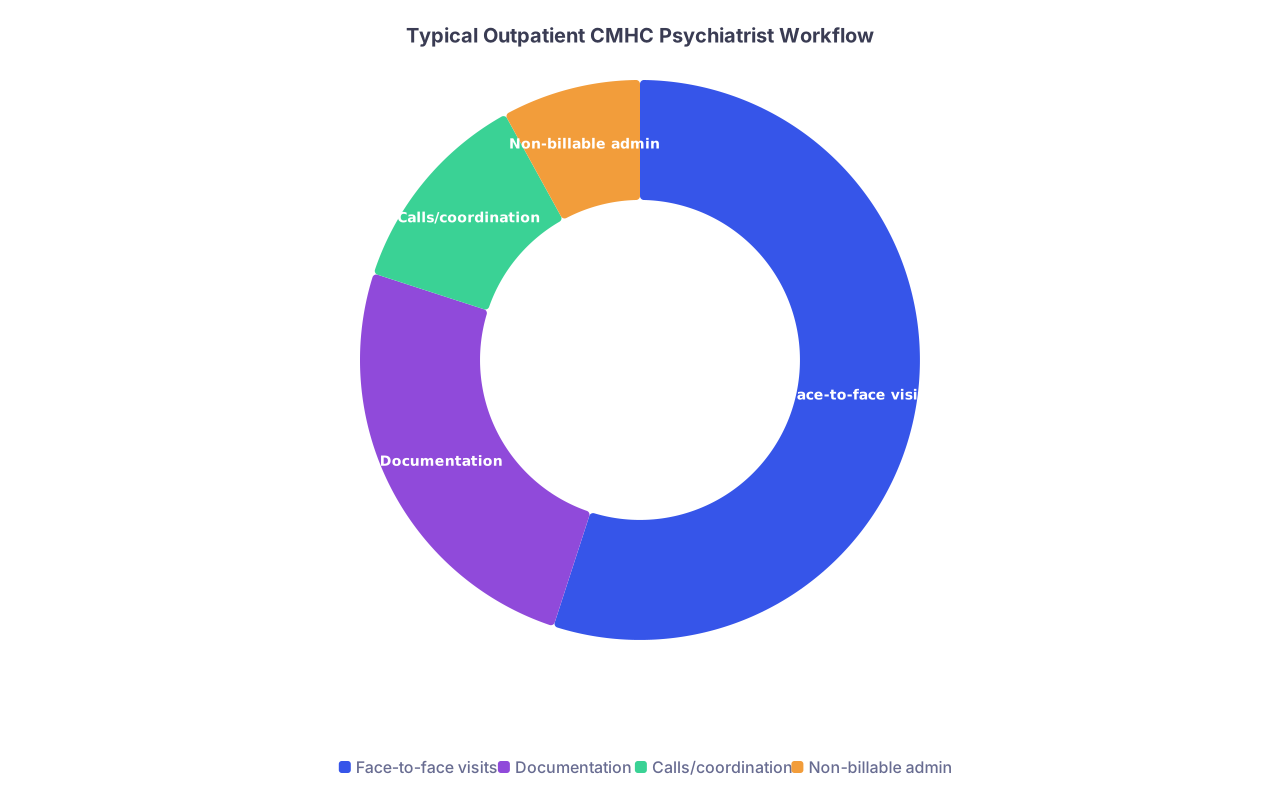
| Category | Value |
|---|---|
| Face-to-face visits | 55 |
| Documentation | 25 |
| Calls/coordination | 12 |
| Non-billable admin | 8 |
The Hidden Caseload: Messages and Collateral
The real caseload is not just who is “on your schedule.” It is who is in your inbox and who other systems expect you to manage.
You will routinely:
- Speak to family members about decompensation, medication side effects, and housing crises
- Call inpatient units about recent discharges
- Talk with probation officers, CPS workers, and disability lawyers
- Coordinate with therapists, substance use counselors, primary care
All of that is rarely well‑compensated in RVUs. Yet it adds hours and cognitive load.
Burnout: Why CMHC Outpatient Is a Pressure Cooker
Psychiatry has burnout everywhere, but CMHC outpatient has a unique flavor: high acuity + low control + low pay. That combination is toxic if you do not go in with eyes open.
The Core Burnout Drivers
I see four big ones repeat over and over:
Caseload and throughput pressure
Clinics are often underfunded and understaffed. Administrators respond by increasing per‑prescriber productivity requirements: more visits per day, shorter follow‑ups, limited no‑show protections. You are pushed to see “more patients” instead of redesigning systems.Clinical complexity without adequate support
You are managing clozapine, LAI antipsychotics, polypharmacy, treatment‑resistant mood disorders, and heavy trauma histories. If nursing or case management is thin, all that falls on you.Misaligned expectations
Clinicians expect to “do good” and “change trajectories.” Systems are designed to keep people barely afloat for as low a reimbursement as possible. That mismatch wears people down.Low relative pay
Watching your co‑residents in anesthesiology, EM, or private psych earn double your salary with half the paperwork corrodes morale, especially in year 3–5 post‑residency.
How Burnout Shows Up Day to Day
It does not show up as “I hate my patients.” It looks more like:
- You start cutting corners on documentation because you are constantly behind
- You resent unscheduled calls and crises because your day is already overbooked
- You feel numb after hearing the 50th trauma history of the month
- You silently pray people will no‑show when you open the schedule each morning
- You start fantasizing about “easy” work: TMS clinics, PP med checks, telepsych
I have watched really good, patient‑centered psychiatrists start counting weeks to contract end by month 18 in a high‑pressure CMHC.
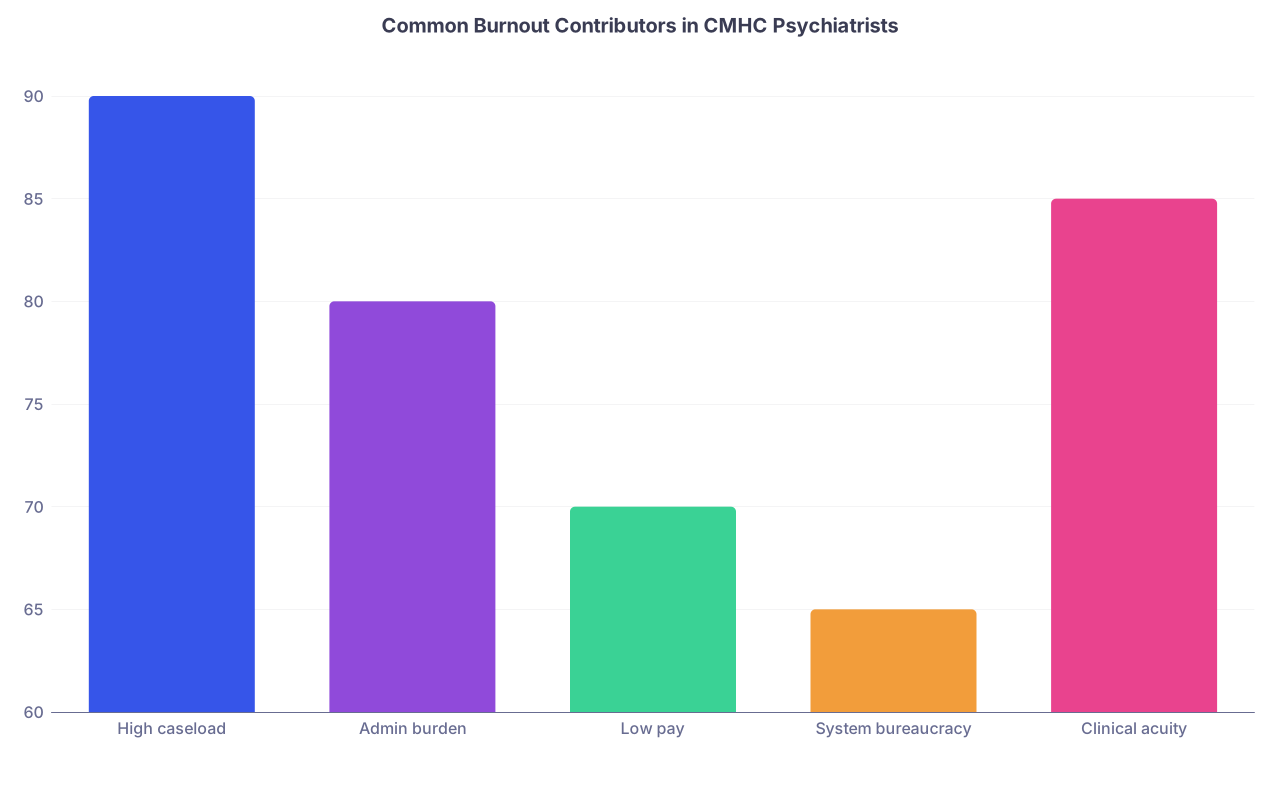
| Category | Value |
|---|---|
| High caseload | 90 |
| Admin burden | 80 |
| Low pay | 70 |
| System bureaucracy | 65 |
| Clinical acuity | 85 |
What Actually Helps (Realistically)
No magic bullet, but a few structural things matter a lot:
- Reasonable panel caps: 250–300 max for full‑time MD/DO with stable support staff
- Protected admin time: at least 2 hours per full clinic day, truly protected
- Strong nursing and case management: they handle injections, labs, calls, coordination
- Leadership that understands: Clinical directors who still carry a patient panel and fight back against fantasy productivity targets
Individual strategies (boundaries, therapy, vacations) help, but if the system is broken, no amount of mindfulness is going to fix a 450‑patient panel with 15‑minute visits.
Pay Structure: Why CMHC Psychiatrists Are Often Among the Lowest Paid
This is where people get confused. Psych is considered a “ROAD” lifestyle specialty in some circles, yet CMHC outpatient pay is often near the bottom of the physician salary distribution.
Let me be direct: you get punished for serving the poorest, sickest patients because reimbursement is garbage and leverage is low.
Typical Salary Ranges
Here is the pattern I have seen across multiple states (not academic, not VA; straight CMHC or FQHC‑like outpatient):
| Region Type | Common Range (USD) |
|---|---|
| Urban, coastal | 210k – 240k |
| Urban, mid‑market | 230k – 260k |
| Suburban | 240k – 280k |
| Rural / frontier | 250k – 320k |
| High-need + loan repay | 240k – 300k + programs |
Now compare that with:
- Private outpatient psych in many markets: 280k–400k+ (often higher with cash pay)
- Locums outpatient psych: equivalent of 300k–450k+ for full‑time hours
- Inpatient psych with weekend call: 280k–350k in many systems
So yes: CMHC outpatient psychiatry is almost always in the “lowest paid specialties” tier, especially when you adjust for intensity and paperwork.
Why The Pay Is Low
It is not because you are less valuable. It is because:
Payer mix
Heavy Medicaid and uninsured. Medicaid reimbursement for psych med management is often poor. Clinics survive on volume, grants, and razor‑thin margins.Weak bargaining position
CMHCs are often non‑profits or government‑affiliated. HR structures are rigid. Salaries are standardized and slow to respond to market pressures.RVU games
Many CMHCs use internal productivity models that under‑value complex visits, collateral work, forms, and multi‑disciplinary coordination. You are not actually paid proportionally to your cognitive labor.Mission discount
Administrators implicitly (and sometimes explicitly) expect a “mission discount”: you accept less money because you are “serving the underserved.” That logic is convenient for budgets, less convenient for your student loan balance.
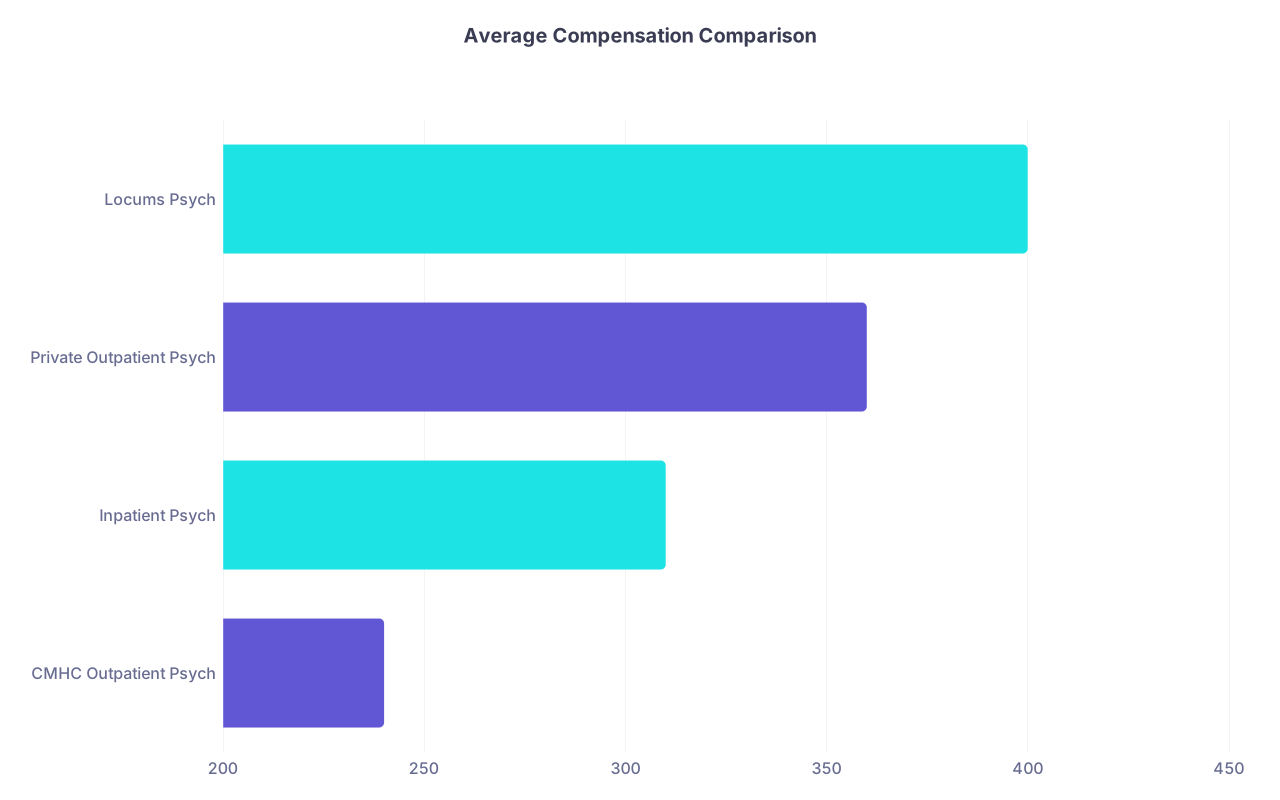
| Category | Value |
|---|---|
| CMHC Outpatient Psych | 240 |
| Inpatient Psych | 310 |
| Private Outpatient Psych | 360 |
| Locums Psych | 400 |
(Values above are rough mid‑range annual compensation in thousands.)
Common Pay Models in CMHCs
You will see a few basic structures:
Straight salary
- Fixed annual salary, minor COLA raises
- Sometimes small quality or retention bonuses (2–5% range)
- Advantage: predictable income
- Disadvantage: no reward for working faster/harder; often capped
Salary + RVU/“productivity” bonus
- Base salary at lower end of range
- Additional pay if you exceed a certain RVU or encounter threshold
- Problem: benchmarks are often unrealistic, and “bonus” becomes expected norm
Public / county pay scale
- Stepwise increases based on years of service
- Strong benefits (pension sometimes, excellent health insurance)
- Can be attractive long term but slow early career
Contractor with hourly rate (less common in true CMHCs, more in contracted community agencies)
- Hourly 130–200+/hr, no benefits
- You eat your own malpractice/benefits costs
- More autonomy, but admin burden can be similar
Compensation rarely fully reflects time spent on non‑billable tasks. That is the quiet killer.
How This All Feels in Residency and Early Career
You do not fully understand CMHC outpatient until you run a panel yourself. But your training rotations will give you a few hints—if you know what to look for.
Residency Rotations in CMHCs
As a resident, you usually see:
- Lower caseload than attendings
- Longer visit times (30–60 min follow‑ups)
- More supervision & debriefing after heavy cases
- Less direct exposure to productivity pressure
So you walk away thinking, “This is busy but manageable. I like the team‑based care. The patients need me.” You are not wrong. But the structure changes when you become the attending.
Watch these on rotation:
- How many patients is your attending actually responsible for on paper?
- How often are they double‑booked or overbooked?
- How much charting do they still have at 5 p.m.?
- How many after‑hours calls or messages are they doing?
Those are your future conditions, not your resident clinic bubble.
Early Career: Years 1–3
Very common trajectory:
Year 1:
- You say yes to almost everything. Committees, new program pilots, extra patients.
- You learn the system, tweak meds nonstop, take clinical responsibility seriously.
- You are exhausted but still idealistic.
Year 2:
- You realize your “temporary” high caseload is now the baseline.
- You see how administration reacts when you voice concerns: “We all have to pitch in.”
- You notice you are doing charts at home 3–4 nights a week.
Year 3:
- You start paying attention to your friends’ pay and lifestyle.
- You seriously consider jumping to telepsych, private, or locums.
- You either negotiate your role down to something sustainable or you leave.
Note: the people who stay long‑term tend to have either unusually good CMHC setups (strong leadership, reasonable caseload, solid support) or strong personal reasons to stay in that community.
When CMHC Outpatient Is Actually a Good Fit
It is not all doom. There are situations where CMHC outpatient psychiatry is a genuinely excellent choice—even with the lower pay.
Good Fits
You might be a good match if:
- You care more about population impact than personal income ceiling
- You like working on teams: therapists, case managers, nurses, peer specialists
- You handle chaos reasonably well and can prioritize fast
- You are comfortable with chronic illness, partial improvement, and harm reduction rather than neat “cures”
- You want loan repayment and are willing to trade that for lower cash salary
A well‑run CMHC can be professionally satisfying. You will see severe illness, complex pharmacology, and genuine transformation when patients respond to coordinated care.
What a “Well‑Run” CMHC Actually Looks Like
Common features of clinics where psychiatrists are not constantly updating their CVs:
- Reasonable productivity expectations with explicit panel caps
- True team support: case managers actually manage cases, not just carry a title
- Nursing support that handles most routine calls, injections, and refill workflows
- Administrative leadership that pushes for psychiatrists to have input in scheduling templates, EHR changes, and policy
- Serious attention to safety: clear protocols for threats, weapons, domestic violence, and high‑risk cases
If you find that combination plus loan repayment and a livable cost of living, you can have a long, meaningful career there. But you need to be aggressive and clear‑eyed in evaluating offers.

| Step | Description |
|---|---|
| Step 1 | CMHC offer received |
| Step 2 | Ask for expected caseload numbers |
| Step 3 | High burnout risk |
| Step 4 | Negotiate template or walk |
| Step 5 | Clarify hiring plans and roles |
| Step 6 | Consider pay vs lifestyle |
| Step 7 | Panel size defined? |
| Step 8 | <= 300 patients? |
| Step 9 | Admin time protected? |
| Step 10 | Support staff adequate? |
How To Evaluate CMHC Caseload, Burnout Risk, and Pay Before You Sign
You cannot rely on job ads. They are optimistic at best, misleading at worst. You need to interrogate the structure.
Here are the concrete questions I would ask as a resident looking at CMHC outpatient roles:
Caseload and Schedule Questions
- “How many active patients does a full‑time psychiatrist typically manage here?”
- “What is the usual daily schedule template—how many intakes, how many follow‑ups?”
- “How long are new patient and follow‑up visits?”
- “What is your no‑show rate, and are those slots backfilled or just lost time?”
- “Is there protected admin time on the schedule? How much? Is it truly protected?”
If they cannot answer with specific numbers, that is a red flag.
Support and Workflow Questions
- “How many nurses and case managers per prescriber?”
- “Who handles:
- Routine refill requests
- Lab reminders and tracking
- Prior authorizations
- Disability/FMLA/housing paperwork drafts?”
- “How are after‑hours calls covered? Is there call pay?”
Look for a structure where you are not taking every phone call and PA yourself. That is the difference between sustainable and not.
Pay and Expectations Questions
- “What is the base salary, and what was the average total compensation for psychiatrists last year?”
- “Is there an RVU or productivity component? What percentage of psychiatrists actually hit the bonus?”
- “Is there loan repayment—NHSC, state, or internal?”
- “What is your psychiatrist turnover over the last 3–5 years, and why did people leave?”
If they dodge turnover questions, assume the worst.

Where This Fits in the “Lowest Paid Specialties” Landscape
Psychiatry itself is mid‑tier pay on national averages. But CMHC outpatient psychiatry slides toward the bottom because of payer mix and structure.
You are closer to:
- Pediatrics outpatient
- General internal medicine in underfunded FQHCs
- Some academic primary care roles
than you are to:
- Anesthesiology
- Derm
- Radiology
- Procedural subspecialties
But the difference is this: your skills are highly portable. If you burn out or simply want more pay, you can jump to:
- Telepsych (often fully remote, 1099)
- Private practice (solo or group)
- Hybrid inpatient/outpatient models
- Specialty clinics (TMS, ketamine, addiction, etc.)
So CMHC outpatient does not trap you. It is just a choice with a clear trade‑off: lower pay, higher complexity, higher burnout risk, higher impact on some of the sickest patients you will ever treat.

Quick Comparison: CMHC Outpatient vs Other Outpatient Psych
To anchor expectations, here is a simple comparison.
| Feature | CMHC Outpatient | Private Outpatient Psych |
|---|---|---|
| Typical panel size | 250–400+ | 100–250 |
| Visit length (FU) | 15–20 minutes | 20–30+ minutes |
| Payer mix | Mostly Medicaid/uninsured | Commercial, Medicare, cash |
| Annual compensation | 210k–300k | 280k–400k+ |
| Admin burden | High | Moderate (varies) |
| Clinical acuity | High | Mixed, often lower acuity |

FAQs
1. Is starting my career in a CMHC a bad financial decision?
Financially, it is not optimal compared with private practice or higher‑paying systems. You will likely earn 50k–150k less per year than you could with other outpatient psych roles. That said, if you leverage loan repayment programs (NHSC, state LRPs, PSLF through a qualifying employer), the effective gap shrinks. Starting in a CMHC for a few years to gain experience and loan relief can be a rational move, as long as you do not convince yourself it is your only option forever.
2. How many patients is “too many” in CMHC outpatient psychiatry?
Once your active panel climbs past 300–325 patients with 15–20 minute follow‑ups and limited support staff, you are in burnout territory. Beyond 350–400, quality almost always suffers unless the case mix is unusually low acuity (which is rare in CMHCs). If someone expects 450–600 active patients on your panel, that is not a serious clinical job; that is a throughput machine. I would walk.
3. Can you actually “do therapy” as a CMHC outpatient psychiatrist?
Realistically, no. Not as a major component of your job. You might integrate brief supportive, CBT‑informed, or motivational work into 20‑minute visits, but weekly 45‑minute therapy is almost never sustainable or supported in the schedule template. Therapists, LCSWs, LPCs, and psychologists do most of the formal psychotherapy. If you are dead‑set on doing lots of therapy long‑term, CMHC med management roles will frustrate you.
4. Are there CMHC jobs that pay competitively with other psych positions?
Occasionally. Rural or frontier CMHCs, or those in very hard‑to‑recruit regions, sometimes offer 280k–320k plus loan repayment, strong benefits, and relocation. County or state systems with unionized or step‑scale pay can also hit the higher end over time. But these are not the norm in large coastal urban centers, where CMHC salaries tend to be depressed and cost of living is high. Always compare the “total package”—loan repayment, pension, benefits, COL—against other offers.
5. How dangerous is CMHC outpatient work in terms of personal safety?
Risk is not zero. You will see patients with histories of violence, substance use, and severe psychosis. However, good CMHCs have panic buttons, security staff, clear protocols, and room setups that protect exits and visibility. Most psychiatrists do not experience serious physical harm, but verbal aggression and threats are not rare. Ask directly in interviews: “What has your experience been with workplace violence, and how is it handled here?” Evasive answers are not a good sign.
6. If I burn out in a CMHC, can I easily transition to another psych job?
Yes. That is one of the advantages of psychiatry. CMHC experience makes you very competent with severe illness, polypharmacy, and system navigation. Private clinics, telepsych platforms, and hospital systems will absolutely hire you after CMHC work. The main risk is staying too long in a toxic environment and letting cynicism harden. If you feel yourself slipping into that state, start planning an exit to a more sustainable setting rather than trying to “tough it out” indefinitely.
Key points, stripped down:
- CMHC outpatient psychiatry usually means large panels (250–400+), short visits, heavy admin, and high acuity for relatively low pay.
- Burnout risk is high when caseload, support, and pay are misaligned; structure matters more than your personal resilience.
- As a career move, CMHC work can be meaningful and strategically smart if you secure reasonable caseloads, real support staff, and either strong loan repayment or long‑term benefits—otherwise, you are subsidizing a broken system with your time and health.


