

You did not “just get unlucky.” And “I’ll just apply to more programs next year” is the laziest, most dangerous plan you can make after going unmatched.
The comforting lie: “I’ll cast a wider net”
Let me be blunt: the data do not support the fantasy that simply applying to more programs magically fixes an unmatched outcome.
Most people who go unmatched do not have a volume problem. They have a profile problem, a strategy problem, or both. And if you do not change those, all you are doing is paying more ERAS fees to collect more rejections.
Look at what actually happens:
- Year after year, the NRMP reports that re-applicants match at lower rates than first-time applicants—especially in competitive specialties.
- A re-applicant with 80 applications and a re-applicant with 180 applications often have exactly the same result: a handful of interviews or none at all. The difference is one of them is just more broke.
The “more applications next year” plan is so popular for one reason: it lets you avoid looking directly at what went wrong. You get to blame the algorithm, the timing, the “bad year,” the “overly competitive class.” Anything except your actual file.
That might protect your ego short-term. It absolutely torpedoes your odds long-term.
What the data actually say about unmatched re-applicants
Let’s ground this in numbers, not feelings.
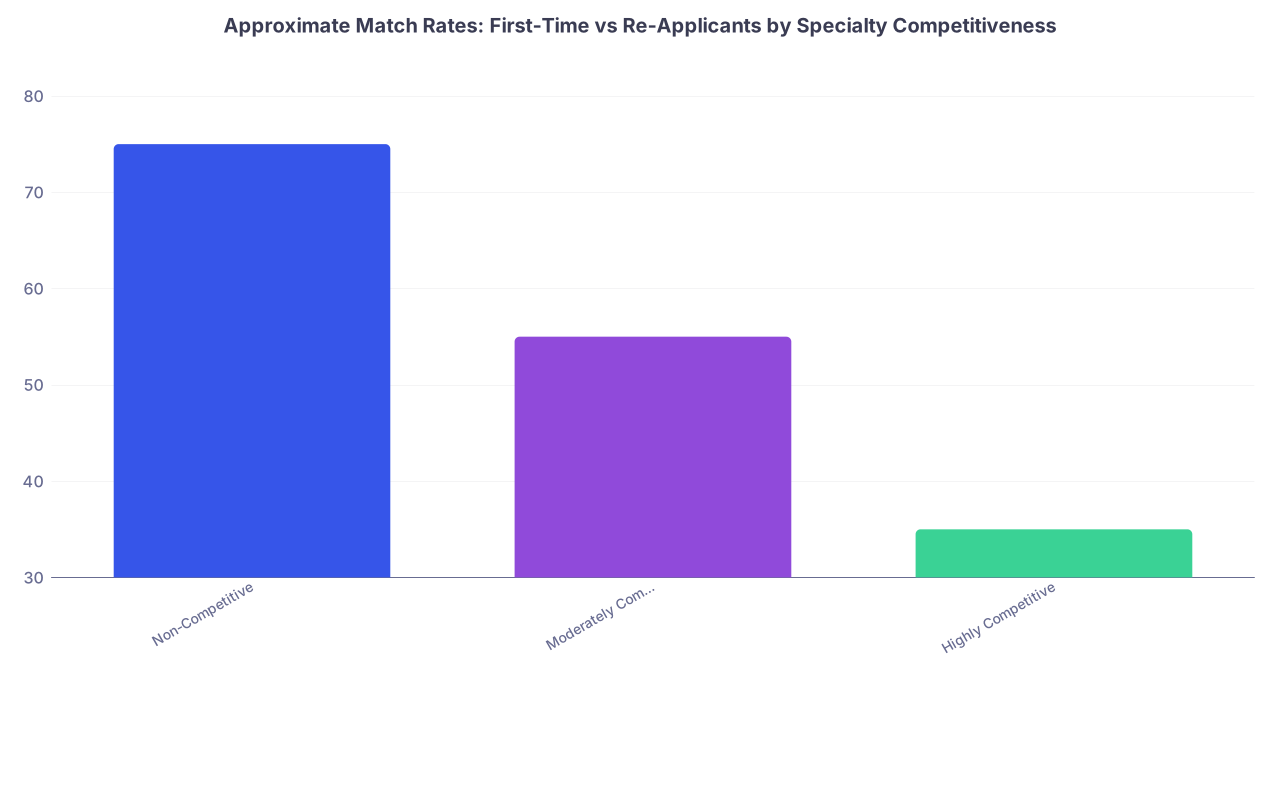
NRMP data over multiple cycles show a consistent pattern: once you have one failed attempt, your odds on a second round are worse, not better, unless you’ve substantively changed your application.
| Category | Value |
|---|---|
| Non-Competitive | 75 |
| Moderately Competitive | 55 |
| Highly Competitive | 35 |
These are ballpark, specialty-group ranges, but the pattern is real:
- First-time U.S. grads in non-competitive fields (FM, psych, peds) often have 70–90%+ match rates.
- Re-applicants in those same fields typically drop 10–20 percentage points.
- In competitive areas (derm, ortho, plastic, ENT, integrated plastics, some IM subspecialty tracks), re-applicant match rates are often brutal unless you’ve done something major (dedicated research year at a big-name place, new high Step 2, actual in-field publications, strong institutional advocates).
And no, “I applied to 200+ programs this time” is not what moves those numbers.
Programs see your previous attempts. They see your graduation year aging. They see if nothing meaningful changed. If your file looks like “same person, just older and more desperate,” they act accordingly.
Why “just apply more” fails in the real world
When you say, “Next year I’ll just apply more broadly,” what you usually mean is: “I’ll send the same product to more buyers and hope someone bites.”
Imagine a startup whose product flopped. Their big strategic pivot? “Let’s spam more customers with the same pitch.” You’d laugh. Or invest somewhere else.
Residency is no different.
Here’s what “more applications” actually buys you:
- More auto‑screens if your Step 1/2 are below cutoffs.
- More rejections from programs that don’t interview your school, your year, or your profile.
- More programs where you have zero geographic, academic, or personal connection.
- More chaos in your head trying to track 100+ places you genuinely know nothing about.
I’ve watched applicants send 120, 150, 200 applications and end up with 3–5 interviews. That is not a volume problem. That’s a conversion problem: your application is not converting applications into interviews.
Until you fix that, adding volume is like stepping harder on the gas when your car is in neutral.
Step one: brutal diagnostic, not magical thinking
Before you even whisper the words “next cycle,” you need a post‑mortem that would make a trauma surgeon proud. Not excuses. Not vague theories. Specific, evidence-based analysis.
Use a simple framework: qualifications, strategy, and signal.
1. Qualifications: were you actually competitive?
Look at your numbers like a PD would, not like a hopeful applicant.
- Are your Step 2 CK and preclinical performance competitive for the field you chose, not just “passing”?
- Did you fail or repeat anything—courses, clerkships, exams?
- How old is your graduation year? Programs care, especially for certain specialties.
- Do you have any professionalism concerns, gaps, or red flags?
If your Step 2 is 216 and you applied to radiology with 80 programs, your issue is not “too few applications.” It’s that you’re misaligned with the field. Doubling to 160 will not magically override dozens of programs’ screen thresholds.
2. Strategy: did you apply like someone who understands the game?
I see the same patterns over and over:
You aimed for a competitive specialty with:
- No home program.
- No significant research in that field.
- Few or no away rotations.
- Generic letters from people who don’t know you, or from unrelated fields.
- Zero realistic parallel plan.
That’s not “it was a tough year.” That’s a bad strategy.
Or:
You applied to a less competitive specialty (say, neurology or psych) but:
- Only to “name brand” coastal programs.
- Ignored community programs or non-major cities.
- Didn’t consider your geographic ties.
- Had an essay and experiences that read like you were unsure or ambivalent.
Again, not a volume problem. You were playing a competitive game with a poor map.
3. Signal: what did you actually tell programs?
Look at your application from the outside.
- Personal statement: generic, cliché, or unfocused? Did it actually match your CV or does it read like ChatGPT wrote it after being fed “I want to help people”?
- Letters: were they strong and specific, or the dreaded lukewarm “performed at the expected level” type? You’d be surprised how obvious weak letters are to a PD.
- MSPE / Dean’s letter: were there subtle (or not so subtle) warnings? Many applicants have never really read theirs critically.
- Interview performance: did you consistently undersell yourself, ramble, or come off robotic? Interview “vibe” is real, and no, you usually will not get explicit feedback about it.
If you do not rigorously interrogate each of those buckets, you are not preparing for next year. You are reacting emotionally to this year.
The only re-applicants who move the needle
Let’s talk about the small group that actually converts a no‑match into a successful reapplication.
They don’t just “try again.” They rebuild.

Common patterns among successful re‑applicants:
- They change something big, not cosmetic. New, significantly higher Step 2 CK score. A completely different specialty that actually matches their metrics and experiences. A dedicated research year with serious output and mentors who will actually pick up the phone.
- They gain structured, recent U.S. clinical experience in the target specialty—sub‑I’s, observerships that became hands‑on, prelim/transitional positions, clinical research roles with patient contact.
- They fix glaring narrative problems. That can mean confronting a failed exam attempt openly and maturely, or reframing a non-linear path without sounding defensive or evasive.
- They ruthlessly target where they are actually wanted. That might mean shifting from coastal academic powerhouses to solid community or mid‑tier programs in regions that historically like grads from your school or your demographic.
Here’s the key: for these applicants, the number of applications is almost an afterthought. They could go from 120 to 140 and it would not be the driver. The driver is that PDs now look at their file and say, “Oh, this person actually did something about their weaknesses and clearly wants this field.”
The role of a prelim year and SOAP—used well or wasted
Another myth: “I’ll just scramble into anything now, it doesn’t matter, I’ll reapply next year.”
That can work. It can also backfire spectacularly.
A prelim or transitional year is leverage only if you:
- Perform strongly and get real, enthusiastic letters.
- Maintain or build a credible link to your target specialty.
- Avoid imploding under stress, because bad evaluations during a prelim year will haunt you harder than a mediocre med school transcript.

| Step | Description |
|---|---|
| Step 1 | Unmatched |
| Step 2 | Take Fit Prelim/Transitional |
| Step 3 | Research/Gap Year |
| Step 4 | Reapply With New Letters |
| Step 5 | Reassess Specialty & Timeline |
| Step 6 | Strengthen Application Profile |
| Step 7 | SOAP Option? |
| Step 8 | Strong Performance? |
What does not count as “leveraging a prelim year”?
- Doing a surgery prelim while telling every attending how you actually want derm.
- Being mediocre, late with notes, checked out, and then asking for “a strong LOR, if you don’t mind.”
- Failing to line up parallel experiences in your target field (research, clinic days, conferences, case reports).
SOAP is not a consolation prize. It is an on‑the‑job, year‑long audition with far more eyes on you than any away rotation. Treat it that way or don’t be surprised when your “second try” looks worse, not better.
Alternatives that actually change your trajectory
“More applications” is lazy. These are not.
1. Reality-based specialty pivot
If you applied to ortho with 225 CK, no ortho research, and tepid letters, someone needs to say it: you were set up to fail.
A rational pivot—say, to IM, FM, psych, neurology, pathology—can transform your odds if you:
- Get real exposure in the new field (shadowing, observerships, electives, or a research position embedded in that department).
- Earn new letters from people who actually know you in that context.
- Rewrite your personal statement and experiences to tell a coherent story that does not sound like “I’m just here because ortho said no.”
Programs aren’t stupid. They know people pivot. They just want to be convinced you’re not going to bail the second you see an opening in your original dream field.
2. Targeted research or clinical year (not “gap year vacation”)
There’s a massive difference between “I took a year off” and “I worked as a clinical research fellow in cardiology at XYZ program, co‑authored two abstracts, and obtained a letter from the division chief.”
Programs know the difference instantly.
During a research or clinical year, you should be:
- Embedded in a department that matches your target field.
- Showing up on time, being annoyingly reliable, and making your boss’s life easier.
- Seizing low‑hanging academic fruit: case reports, QI projects, abstracts, poster presentations.
These roles often turn into interviews at that home institution and, critically, into phone calls from your mentor to their friends at other programs. That kind of advocacy dwarfs the impact of simply adding another 40 anonymous ERAS submissions.
3. Geographic and institutional realism
Some of you are handcuffed by geography—family, visas, finances. Understood. But most of you are more rigid than your situation actually demands.
Look at where applicants from your med school actually match. Not where you want to go. Where they go. There’s usually a pattern.
| Approach | Program Types (Illustrative) |
|---|---|
| Fantasy | Big coastal academic, all top-30 names |
| Realistic | Mix of community, mid-tier university, places with prior grads from your school |
| Desperate | Literally every program, no pattern, no geographic logic |
The realistic middle is where most unmatched applicants should live next cycle. Not just “more anywhere.” More where you actually have a shot.
The uncomfortable truth: sometimes the answer is “not now” or “not this”
There’s one more myth: that persistence alone always wins. It doesn’t.
If your exam history is catastrophic (multiple failures, no improvement), your graduation year is getting older, and you have not been able to secure meaningful US clinical or research roles, there is a point where you’re not being “determined.” You’re being stubborn in a way that hurts your life.
Alternative paths—non‑residency clinical roles, public health, informatics, industry, research careers—are not admissions of failure. They are valid careers that sometimes align better with your real strengths than a forced march through a program that never wanted you.
But you cannot get to that clarity if you’re clinging to “Next year. More applications. That’s the fix.”
How to know if your “next year” plan is real or delusional
Here’s a litmus test.
If you describe your plan for the next 12 months and it only contains:
- “Apply earlier”
- “Apply to more programs”
- “Maybe rewrite my personal statement”
…you do not have a plan. You have a wish.
A serious plan looks more like:
- “I’m starting a one‑year clinical research fellowship in nephrology at X institution in July, will have 2–3 new letters, and I’ve already discussed my reapplication strategy with my PI who knows several PDs.”
- “I pivoted from radiology to internal medicine, have two new sub‑I’s scheduled, and have arranged to attend the IM department’s weekly conferences and resident didactics.”
- “I accepted a prelim medicine spot where the PD knows I’m planning to reapply in IM, has connected me with their fellowship-trained faculty, and I’ve committed to being in the top third of the class on evaluations.”
Those are trajectories programs can respect. They may still say no. But at least they will see a different applicant than last year.
Years from now, you won’t remember the exact number of ERAS submissions or the spreadsheet colors you used to track them. You’ll remember whether you had the guts to stop hiding behind “more applications” and actually rebuild the parts of your story that were not good enough the first time.


