
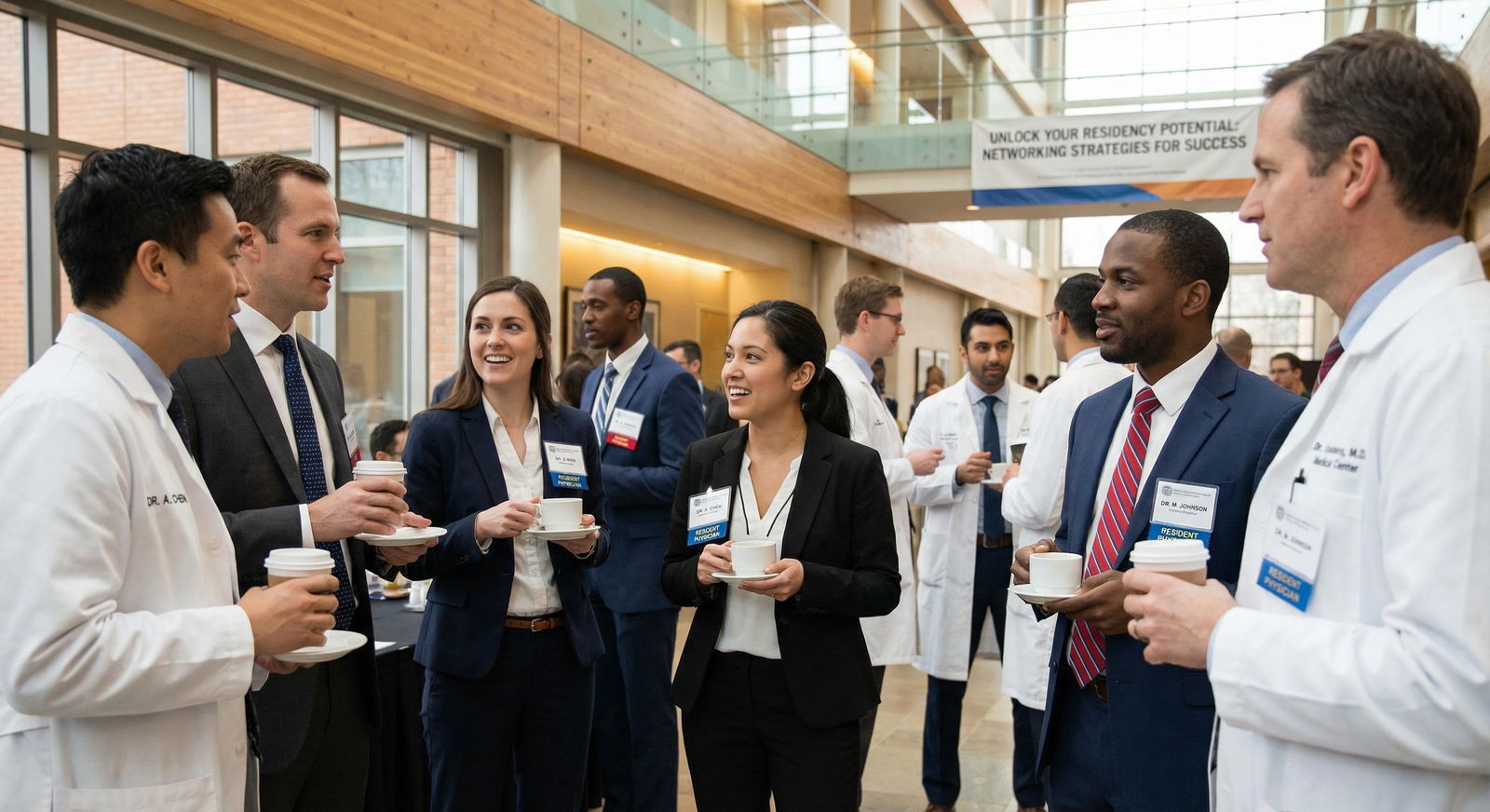
Networking will not erase an unmatched year. No matter how many “coffee chats” you schedule or how many PDs know your name, the SOAP and the Match still run on risk, numbers, and institutional self‑protection, not vibes.
That’s the part almost no one tells you when you’re panic-emailing faculty after going unmatched.
Let’s dismantle this properly.
The Myth: “If I Just Network Hard Enough, Someone Will ‘Pull Me In’”
I hear versions of this every year from unmatched grads and reapplicants:
- “Everyone says it’s all about who you know.”
- “My attending told me, ‘Don’t worry, we’ll take care of you.’”
- “If I’m on good terms with PDs and chiefs, someone can slide me into a spot.”
This myth has three embedded fantasies:
- Connections can override a weak or risky application.
- Program directors have secret discretionary spots they can fill for “their” people.
- Once someone “advocates” for you, the rest of the process becomes a formality.
Reality is much colder.
Programs are tightly regulated. NRMP rules, GME oversight, institutional HR, visa constraints, funding caps. For most PDs, “we’ll help you” means “we’ll write you a good letter and maybe send an email.” Not “we’ll manufacture a position and ignore our rank list.”
Networking matters. But as an amplifier of a viable application, not a magic wand for a bad one.
What Programs Actually See When They See “Unmatched”
Unmatched ≠ doomed. But it is a yellow flag that everyone reads the same way: risk.
Here’s what faculty quietly say in committee rooms that they rarely say to your face.
- “Why didn’t anyone rank them high enough?”
- “Is there something we’re not seeing on paper?”
- “If they already went once and didn’t match, what’s changed now?”
- “Will they pass their boards? Are we inheriting problems?”
Unmatched status is not a moral judgment; it’s Bayesian reasoning. The prior probability something is off goes up. Your job is to bring new, strong evidence that updates that probability back in your favor.
Networking, by itself, is weak evidence. Program directors have been burned before by “good kid, everyone likes them” who then fails Step 3 or implodes on service.
What actually shifts that risk calculus?
- A substantially stronger Step 2 CK (or equivalent) or fresh exam success
- Proven clinical performance recent and relevant to the target specialty
- Observable reliability and work ethic over months, not a lunch conversation
- A coherent story that explains the previous non‑match and what’s changed
- Letters from people the PD actually trusts, not just “big names”
Networking can help transmit those signals. It cannot substitute for them.
The Data: What Happens to Reapplicants (With and Without Real Changes)
There is not a perfect, neat dataset on “networking quality,” but we do have decent data on reapplicants and unmatched grads.
NRMP and specialty‑specific reports show roughly this pattern:
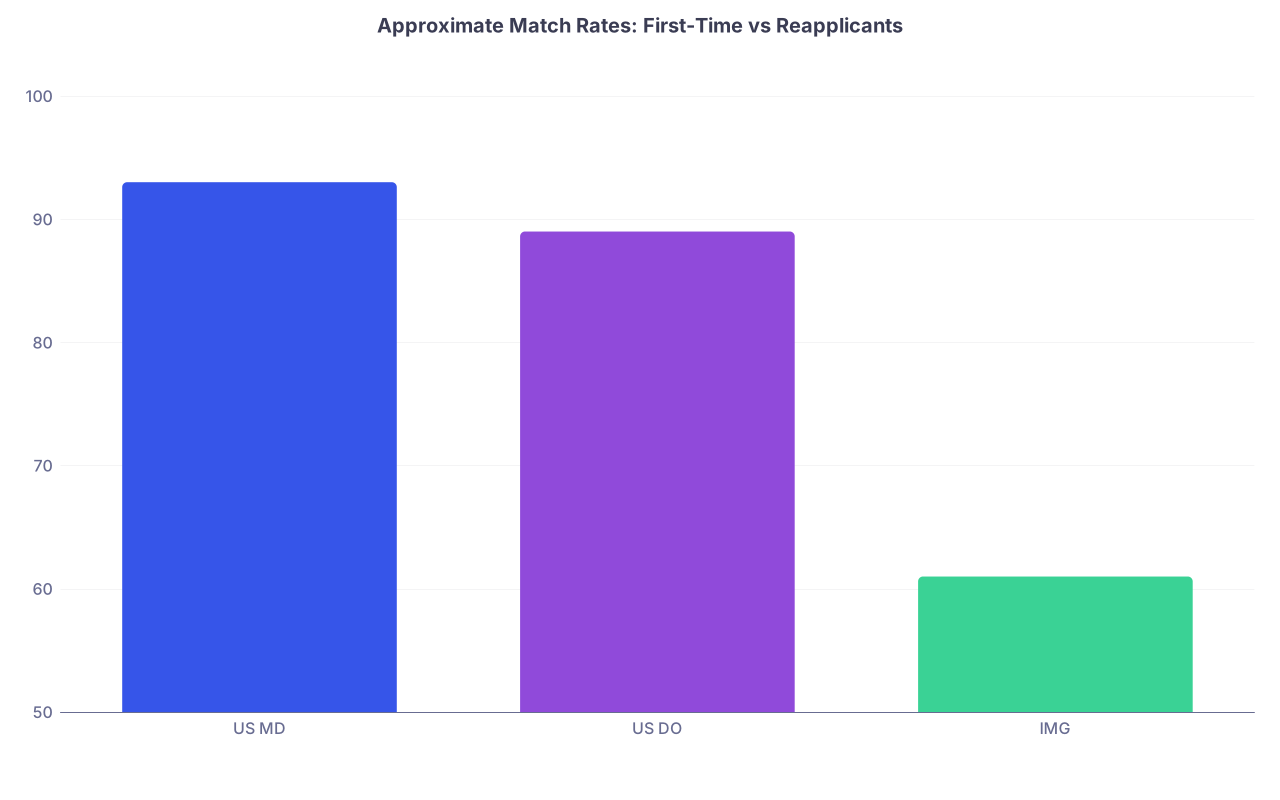
| Category | Value |
|---|---|
| US MD | 93 |
| US DO | 89 |
| IMG | 61 |
Those numbers are for first-time applicants in many core specialties (ballpark figures, not exact; the exacts vary by year and specialty). Reapplicants, especially those who’ve sat out a year or more, do worse on average. Depending on specialty, reapplicant match rates can drop 10–30 percentage points compared with first-time applicants.
Here’s what I’ve seen over a decade of watching this play out in medicine:
- Reapplicants who just “network harder” but change nothing substantive (same exam profile, no fresh clinicals, no new achievements) usually get the same or slightly worse result.
- Reapplicants who make visible, quantifiable improvements plus build relationships at specific programs often recover, especially in non-hypercompetitive specialties.
- The further you get from graduation without solid, recent clinical experience, the harder it gets. Networking doesn’t fix staleness.
So when someone says, “I know a guy who went unmatched and then just networked his way into a top program,” probe the story. In almost every real case, there’s more going on: significantly improved scores, a strong research year with that program, a pre‑existing connection plus a gap‑filling role like prelim year or research fellowship.
“Networking alone” almost never means just networking.
How Networking Actually Works in the Match Ecosystem
Let’s talk about what networking does well, and where its limits are.
Think of networking as signal delivery, not signal creation.
You need something worth transmitting: strong performance, clear improvement, work product, specific value. Then networking gets that in front of someone who can act on it.
When it works, it looks like this:
- You do a research year or post‑doc with a department.
- You show up, on time, every day. You handle grunt work without whining. You help the team look good.
- Over months, attendings see: this person is reliable, teachable, clinically decent, and not a professionalism risk.
- Those attendings then email or call the PD: “We’ve worked with X closely. They’re a solid citizen. We should seriously look at them for our program.”
- The PD doesn’t “hand you” a spot. But you get a closer read, maybe an interview invitation pushed up the pile, and a more generous reading of small red flags.
Notice what’s missing: no coffee chats with strangers asking them to “keep you in mind.” No mass LinkedIn spam. No “networking event” alchemy.
Real networking in medicine is proximity plus performance over time.
The Harsh Reality: What Strong Networking Cannot Do
Let me be blunt about some specific fantasies I see every cycle.
1. Networking will not hide failing or missing exams
If you have:
- Multiple Step failures
- No Step 2 CK when the specialty expects it
- A barely passing or borderline score for a competitive field
No amount of “I know the PD well” will make most programs ignore those. They have institutional boards pass rate targets. Their own jobs depend on not graduating residents who fail boards.
At best, strong advocates may convince the PD to take a chance if you’ve subsequently crushed a retake or shown exam remediation. But someone still has to sign off on that risk in a committee room.
2. Networking will not erase significant professionalism issues
If there’s:
- A formal professionalism write‑up
- A leave of absence with unclear documentation
- A documented pattern of conflict, boundary issues, or dishonesty
You can be the most charming person in the room. Programs are still terrified of lawsuits, patient safety issues, and the nightmare of trying to fire a resident. “But we really like them” does not beat “will this end up in legal or on social media?”
3. Networking will not override chronic unreliability
I’ve watched this exact scenario:
Student goes unmatched. Well-liked. Very personable. Faculty feel bad. They bring the student into a research or observer role “to help them recover.”
Three months in: late to meetings, half‑finished projects, poor communication. Same patterns that likely contributed to the non‑match.
By application time, those same faculty quietly pull back their support. They’ll write a neutral letter, not the glowing one the student assumes they’re getting.
Networking got them in the door. Performance closed the door.
When Networking Actually Does Change Outcomes
Now the hopeful side. Because yes, I’ve also seen formerly unmatched applicants turn things around, and networking played a real part.
Here’s what’s different about the ones who succeed.
They pair networking with strategic positioning
They don’t just go back to the same oversubscribed specialty with the same CV. They reassess competitiveness and adjust.
For example:
- Unmatched in categorical general surgery with mid‑220s score → research year with the surgery department + strong performance → matches prelim surgery there → uses that year and internal networking to pivot to categorical somewhere realistic.
- Unmatched EM after Step 1 pass/low Step 2 → does a solid transitional year + intensive Step 3 prep → strong Step 3 + new EM rotations + letters from current program faculty → backs up with IM/FM realistically and openly.
Networking with PDs then has something solid to work with: a defensible story, recent behavior, improved numbers.
They become known quantities, not “cold asks”
Cold emails to PDs asking to “chat about opportunities” rarely move the needle.
Long‑term, embedded roles do:
- Research fellow in their department
- Dedicated sub-internship where you function like an intern
- Chief prelim year where you show leadership and maturity
- Hospitalist or equivalent role (for some IMG paths) with close faculty oversight
People on selection committees trust their own direct experience more than anything written on paper. They’ve seen too many inflated letters and polished personal statements.
They align their ask with program reality
This part is underappreciated.
There’s a world of difference between:
“Can you give me a categorical PGY‑1 in your competitive specialty even though I’ve already gone unmatched once and my scores are mediocre?”
vs.
“I’m strongly interested in your field but recognize I’m a non‑traditional candidate. If a prelim or research‑fast‑tracked path opens up, I’d be grateful to be considered. In the meantime, here’s what I’m doing to strengthen my profile.”
The second shows insight, humility, and awareness of risk. PDs respond better to that than to entitlement wrapped in networking language.
Where Networking Fits Among All the Levers You Can Pull
Let’s put networking in its proper place.
| Strategy | Relative Impact | Dependency on Networking |
|---|---|---|
| Improved exam performance | Very High | Low |
| Recent strong clinical experience | Very High | Medium |
| Targeted specialty switch | High | Low |
| Research with department | Medium-High | High |
| Generic “networking events” | Low | N/A |
If you do absolutely nothing but “network”—no new rotations, no new exam scores, no concrete productivity—your odds of dramatically different results are low.
If you:
- Boost your measurable metrics
- Accumulate fresh, strong, supervised clinical work
- Adjust targets realistically
Then networking becomes a force multiplier. It can get your updated story in front of the right eyes, shorten the distance between “risky” and “worth a chance,” and sometimes open unconventional paths (prelim, research‑to‑residency, off‑cycle spots).
How to Use Networking Intelligently After Going Unmatched
I’m not telling you to abandon networking. I’m telling you to stop using it like a superstition.
Here’s a sane approach.
Start at home. Your own med school, your own prior rotations, your own attendings. These are the people with real data on you. Ask for honest feedback first, not favors. Let them tell you what they would worry about as a PD reading your file.
Embed, don’t just meet. If a department expresses interest, ask about ways to work with them: research, observerships (less powerful, but sometimes all that’s possible), non‑ACGME fellowships, or post‑doc roles. Aim to be around long enough for them to see who you are on a Tuesday in November, not just on a 20‑minute Zoom.
Be ruthlessly reliable. Show up early. Reply to emails. Finish what you start. If you say you’ll have a draft by Friday, send it Thursday. In the current environment, “this person just quietly handles business” is more valuable than another “charismatic” resident.
Let others bring up advocacy. You don’t need to constantly ask, “Can you help me get a spot?” If you’re doing good work, the right people will naturally say, “We should see what we can do for you.” When they do, then be clear about your target specialties and realistic options.
Use networking to get honest intel, not just favors. Ask PDs, “If you saw my file as it stands right now, what would be your concerns? What would I need to change in the next 12 months to be seriously considered here or at similar programs?” Most will give you at least a partial, candid answer.
The Subtle Trap: Emotional Dependence on Networking
One last uncomfortable truth.
Networking can become a psychological crutch. It feels like you’re making progress: lots of calls, messages, meetings. People express sympathy. Some even say, “We’ll try to help.”
That can distract you from the painful, lonely work of actually fixing the parts of your application that triggered the non‑match in the first place.
Studying alone for a Step retake. Grinding through another rotation as essentially an extra pair of hands. Doing the boring work of a research year. That’s not glamorous. There’s no LinkedIn update that captures, “I stopped being flaky and started doing what I said I’d do.”
But that’s what changes reputations. And reputations drive advocacy far more than one coffee with a big‑name chair.
Reality Check
So, can strong networking alone fix an unmatched history?
No. Categorically no.
Networking can:
- Get your improved file an extra look.
- Translate your day-to-day reliability into strong advocacy.
- Surface unconventional pathways that aren’t on public websites.
It cannot:
- Erase exam failures or chronic performance issues.
- Make a PD ignore their own risk thresholds.
- Turn a fundamentally unchanged application into a different outcome.
If you went unmatched, your energy is finite. Spend the bulk of it on making yourself undeniably stronger on paper and in the clinic. Use networking to broadcast that transformation, not to compensate for its absence.
Years from now, you will not remember every forced small talk at some “networking night.” You will remember whether, in that raw post-unmatch year, you chose comforting illusions—or did the hard, unglamorous work that made you the kind of physician people actually fight to have on their team.


