

You didn’t miss your chance at medicine. You hit one wall in a maze nobody warned you was this brutal.
I’m going to say the quiet part out loud: not matching feels like public failure. It feels like there was this one door you had to get through, you didn’t, and now everyone else is walking into residency while you’re… just stuck. Staring at your inbox. Refreshing. Replaying every interview answer, every “thank you” email you did or didn’t send.
And the fear underneath all of it:
“What if this was it? What if I just ruined my entire career at 26 years old?”
Let’s walk through this like someone who can’t just “stay positive” and move on. Because if you’re anything like me, your brain is already doing:
- “Programs will see I didn’t match and immediately trash my file.”
- “If I didn’t match once, that means I’m fundamentally not good enough.”
- “Taking a gap year means I’ll fall behind and never catch up.”
- “Everyone else will be a resident; I’ll be the weird failure who couldn’t make it.”
I’m not going to hand you inspirational fluff. I’ll tell you what actually happens to people who don’t match, how many come back and succeed, and what realistic alternatives don’t destroy your chances forever.
First: No, One No-Match Doesn’t Automatically End Your Career
Let’s get some numbers down, because our anxious brains are great at catastrophizing and terrible at stats.
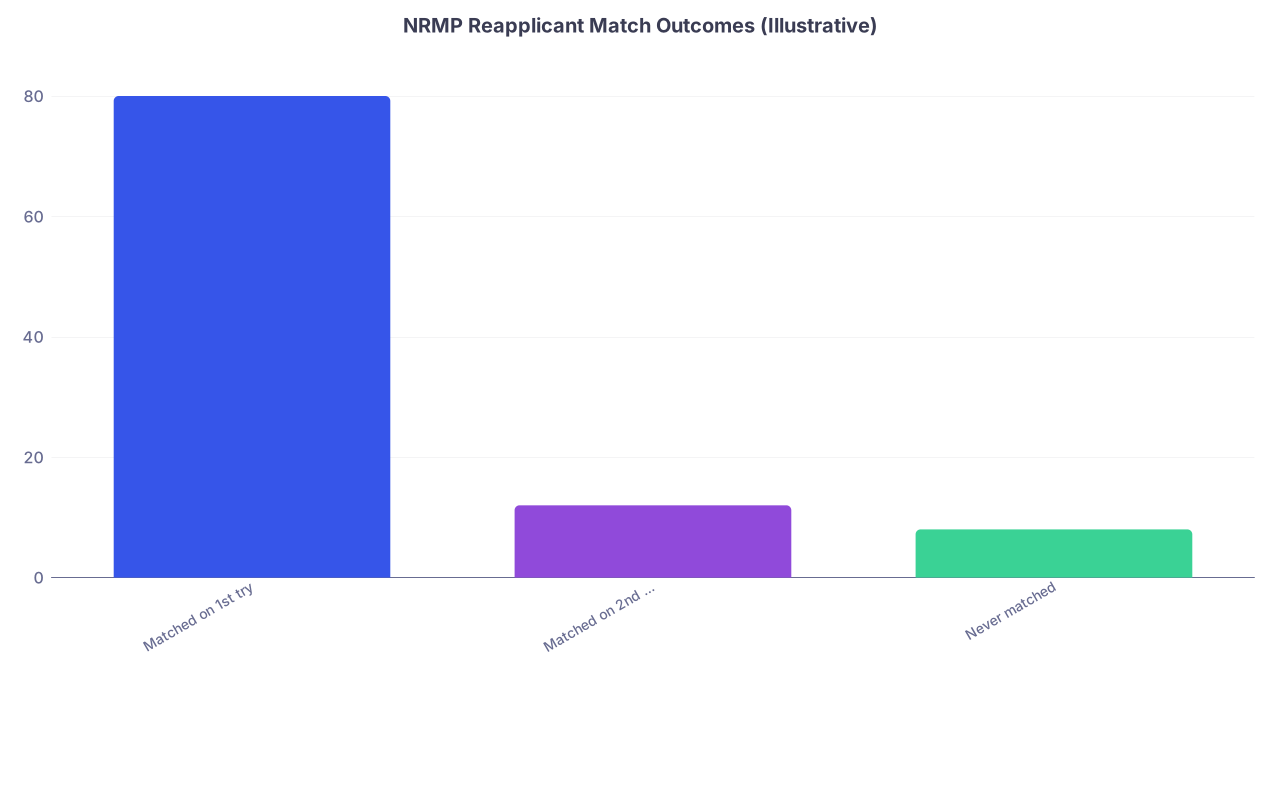
| Category | Value |
|---|---|
| Matched on 1st try | 80 |
| Matched on 2nd try | 12 |
| Never matched | 8 |
Are these exact numbers? No. But they’re roughly the pattern you keep seeing in NRMP data year after year: most people match the first time, and a significant chunk of those who don’t match come back the next year and do.
If you don’t match, what it usually means is this:
- You had a misalignment somewhere: specialty choice, program list, exam timing, red flag, or just bad luck in a competitive cycle.
- Programs did not collectively decide you’re unfit to be a doctor.
- Your status now is: “Requires a smarter, more targeted, more honest strategy.” Not “career over.”
Things that are not automatic career death (even though they feel like it):
- One no-match cycle
- CS/Step 2 taken late
- Not having AOA, gold stars, or perfect scores
- Being an IMG or DO in a competitive field (hard, yes; impossible, no)
The trick is understanding what kind of “no-match” situation you’re in. Because not all are the same.

The 4 Big No-Match Scenarios (And What They Really Mean)
This is where everyone lies to you and says “just try again!” without asking what actually happened. I’m not doing that.
Here are the four broad buckets I keep seeing, over and over.
| Profile | Main Issue | Primary Fix |
|---|---|---|
| Overreacher | Too few realistic programs | Expand and rebalance list |
| Borderline Stats | On the low end for chosen specialty | Rebrand + strength-building year |
| Red Flag | Failures, professionalism, gaps | Concrete remediation and letters |
| Ultra-Competitive Specialty | Derm, Ortho, Plastics, Neurosurg, etc. | Pivot or multi-year plan |
1. The Overreacher
This one hurts because it’s so fixable in hindsight.
You applied to:
- 30–40 programs
- Mostly academic, mostly top-tier
- In a popular field like EM, Anesthesiology, or even IM but all big-name places
You got a few interviews or maybe not many, but not enough. You ranked. You didn’t match.
This doesn’t usually mean, “you’re not matchable.” It often means, “your list did not match your profile.”
Fix for next time is boring but powerful:
Way more programs. More community, mid-tier, less competitive areas. Honestly reassess your competitiveness and apply like someone who wants a job, not a fantasy.
This scenario is very survivable.
2. The Borderline Stats Applicant
You’re not terrible. You’re just… borderline for your specialty.
Think something like:
- Step 1: pass (now P/F, but historically mid-range)
- Step 2 CK: 220–230 for something like EM, Anes, or decent IM
- Few publications, maybe some research but not stunning
- No major red flags, but nothing that screamed “you must rank this person”
Programs maybe interviewed you, liked you, but in a pile of 400+ applications, you didn’t clear the final bar.
Here’s the reality: reapplicants do match from this group all the time, if they don’t waste their gap year “just vibing.”
What actually helps:
- A structured research year with clear output (poster, paper, concrete letter from PD-level person)
- A prelim or transitional year (used strategically, not randomly)
- Serious networking: away rotations, staying visible, actually emailing programs like a human not a template bot
We’ll get into details on those options in a second.
3. The Red Flag Applicant
This is the one that keeps people up at 3am.
Stuff like:
- Step 1 or Step 2 failure
- Probation, professionalism issue, leave of absence
- Major unexplained gap
- Harsh dean’s letter comment
Programs do care about this. They’re not going to pretend they don’t.
But there’s a difference between “this is a serious concern we need to see addressed” and “you are permanently un-hirable.” They’re not the same.
What helps here is not pretending it didn’t happen. You usually need:
- Clear documentation of remediation or improvement
- Someone with authority (PD, chair, clerkship director) writing, “I know this applicant well. Here is why I would trust them in my program.”
- A year in a structured role where your reliability, professionalism, and clinical performance are being watched—and praised
It’s harder. It’s not impossible.
4. The Ultra-Competitive Specialty Applicant
Derm. Plastics. Ortho. Neurosurgery. ENT. Sometimes EM and anesthesia now, depending on the year.
Sometimes you did nothing wrong by normal standards. You have:
- Research
- Decent scores
- Strong letters
- A few interviews
And it still wasn’t enough. Because the math in some specialties is vicious.
Here the conversation gets real: you might match if you reapply. But you might also burn 1–2 more years and still not get it. That’s not “giving up on your dreams.” That’s resource allocation, time, money, and mental health.
People in this group often pivot successfully to:
- Radiology
- IM (with a long-term plan for cards, GI, heme/onc, etc.)
- Anesthesiology (depending on the cycle)
- Pathology, PM&R, psych, etc.
You’re not weaker because you pivot. You’re someone who adjusted to the actual game board instead of the fantasy version.
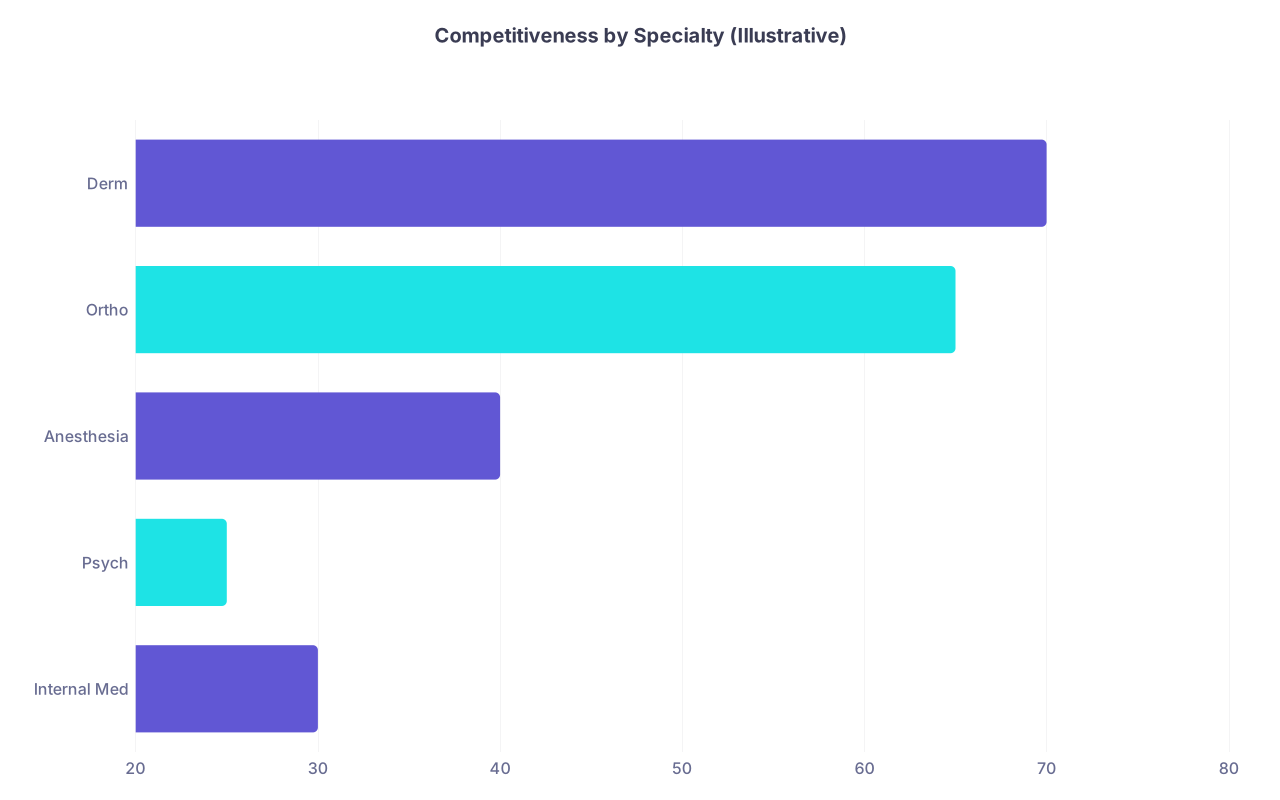
| Category | Value |
|---|---|
| Internal Med | 30 |
| Psych | 25 |
| Anesthesia | 40 |
| Ortho | 65 |
| Derm | 70 |
What If You Take a Gap Year – Does That Kill Your Chances?
The word “gap” is misleading. Programs don’t hate gaps. They hate unexplained or unproductive-looking gaps.
If your ERAS next year shows:
“2025–2026: Unemployed. Lived at home. Studied a bit. Helped family. Traveled.”
Yeah. That’s not helping you.
But if it shows:
“2025–2026: Clinical research fellow in cardiology, University Hospital X. 2 poster presentations, 1 manuscript submitted. Assisted with inpatient rounding and M&M conferences.”
That’s a different story.
Or:
“2025–2026: Preliminary internal medicine resident, Program Y. Completed 12 months of direct patient care with strong evaluations. Continued interest in [your target specialty] with focused mentorship.”
That’s absolutely something programs respect.
The anxiety here is usually: “Will they think I’m damaged goods because I didn’t match the first time?”
Some will. Honestly, yes. Some programs sort “re-applicant” into the mental category of “maybe pass.” But that’s not all of them. Enough PDs care about:
- Clear growth
- Strong letters from the gap-year role
- Improved scores or concrete achievements
- An honest, non-whiny explanation of what changed
that reapplicants do get taken seriously.

Concrete Options After No Match (And What They Cost You)
Here’s the menu everyone vaguely references but rarely breaks down.
1. SOAP (If You’re Still in That Week)
If you’re currently in the SOAP or just finished it, you already know: it’s chaos. It feels degrading. You’re sending applications at lightning speed to places you’ve never heard of, in specialties you didn’t seriously consider.
If you ended up with no SOAP spot, that does not mean you’re unmatchable. SOAP is a frenzied, distorted version of the real process.
If you got a SOAP spot in something you’re not thrilled with (say, prelim surgery or prelim medicine when you wanted categorical), that’s not the end either. Many prelims successfully reapply.
The hard question you have to ask yourself is:
“Is doing this prelim worth the stress, hours, and risk of not having enough time/mental energy to reapply well?”
Some prelims are supportive and help you reapply. Some absolutely don’t.
2. Research Year (Clinical or Translational)
Gold standard for: borderlines, red flags, competitive specialties, IMGs trying to break in.
Good research years:
- Are attached to a residency program or department you’d want to apply to
- Put you in front of a PD or big-name faculty regularly
- Give you authorship on at least a poster and ideally a paper
- Let you show up to conferences, grand rounds, and actually be part of the ecosystem
Bad research years:
- You’re a data-entry ghost no one knows by name
- Zero interaction with decision-makers
- No meaningful output
- Completely disconnected from US clinical teams (especially bad for IMGs)
You want the first kind. Even if it pays terribly.
3. Preliminary or Transitional Year
This can be amazing or pointless, depending on your plan.
Prelim that helps:
- Has a culture of supporting residents reapplying
- Gives you time off for interviews next cycle
- Has faculty connected to your target specialty
- Gives you strong evals and letters (“I would 100% take them in our categorical program if we had a spot”)
Prelim that drains you:
- Malignant or dumpy schedule, constant scut
- No one cares about your future plans
- You’re too exhausted to study, research, or network
- You come out with mediocre evaluations and no time left
You have to be honest about your own stamina. Some people can do 80-hour weeks and still reapply. A lot can’t. That’s not weakness. That’s just reality.
4. Pivoting to a Less Competitive Specialty
This is the thing everyone whispers about like it’s shameful.
It’s not.
What’s actually worse:
Grinding yourself into dust chasing derm for 3 cycles, or doing one recalculated pivot to IM, psych, path, PM&R, anesthesia, and actually having a stable, real career in medicine?
And no, that’s not “settling forever.” People do fellowships. People subspecialize. People discover they actually like a field they thought they’d never consider.
The big question: “Will I regret not trying again?”
Only you can answer that. But “trying again” doesn’t have to mean “same specialty, same strategy, same outcome.”
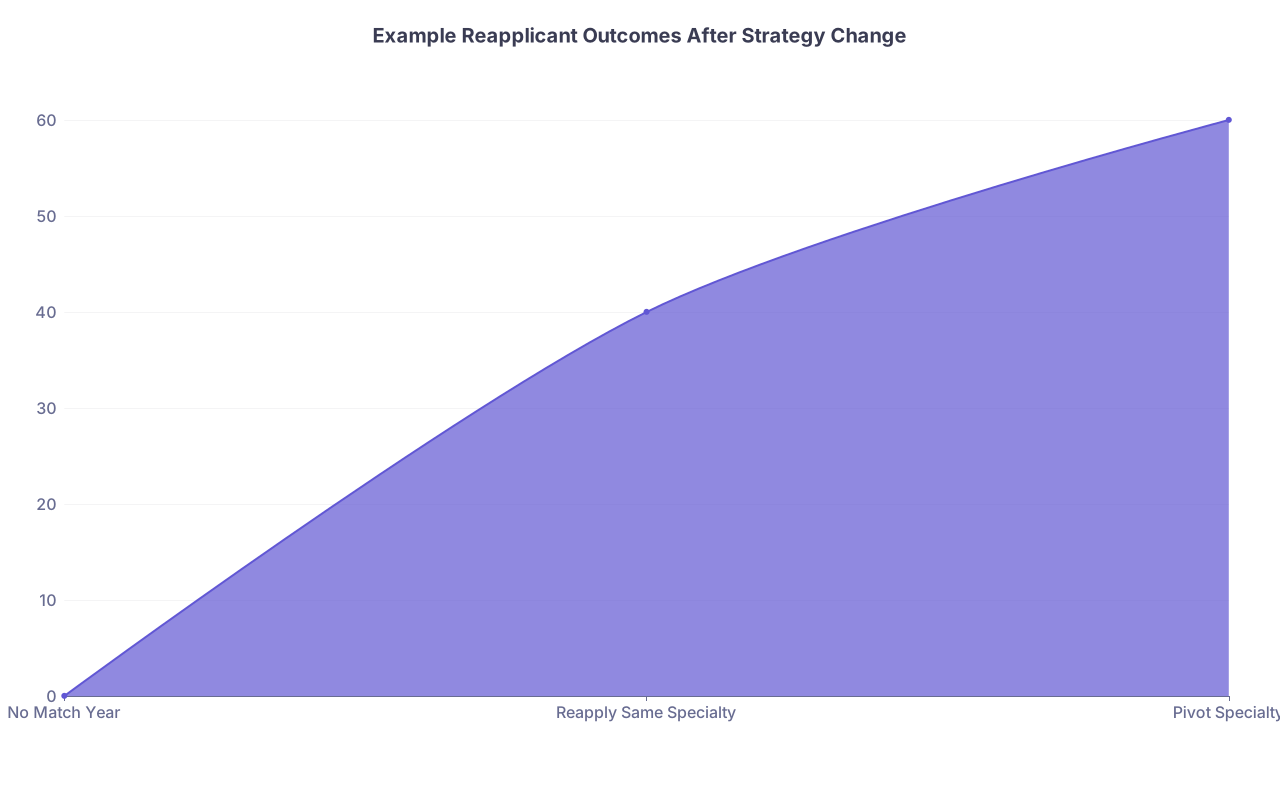
| Category | Value |
|---|---|
| No Match Year | 0 |
| Reapply Same Specialty | 40 |
| Pivot Specialty | 60 |
The Fear of Being “Too Old” or “Falling Behind”
This one eats at people way more than they admit.
Everyone else in your class is:
- Posting selfies in white coats with “PGY-1” tags
- Announcing moves to new cities
- Talking group chats about rotations and call schedules
You’re… home. Or at your old apartment. Or doing research. Or working a non-clinical job and feeling like your MD is evaporating.
The intrusive thought:
“If I don’t match by X age, I’ll be too old. No one will take me. I’ll be a 35-year-old intern.”
Reality check from what I’ve seen:
- PDs absolutely notice long gaps and multiple failed cycles.
- But they also absolutely take older interns: former PhDs, military, people who had other careers, people who took time for kids or illness.
“Too old” is rarely a simple age thing. It’s usually a “does your story make sense and show consistent commitment + growth?” thing.
If your timeline is:
- Med school → one no-match → one structured year (research/prelim) → match
That’s completely normal in PD-land. That doesn’t flag you as some outlier dinosaur.

How to Talk About Your No-Match Without Sounding Defensive or Broken
You know this is coming: interviews, personal statements, casual conversations.
“Can you tell me about your previous application cycle?”
What they’re actually asking:
Did you learn anything? Or are we getting the same version of you the system already passed on?
You don’t say:
“I just had bad luck.”
Or: “Programs are so political.”
Or: “Honestly, I think my school didn’t support me enough.”
Even if those things are partially true, they sound like blame-shifting.
Better shape is:
- Own the outcome (“I didn’t match last cycle in X specialty.”)
- Name 1–2 specific things that were weaker (“My application list was too narrow,” or “My Step 2 was borderline for that field,” or “I lacked strong home-institution letters.”)
- Describe exactly what you did this year to fix that
- Show what’s different about you now
Something like:
“I applied to anesthesiology last year and didn’t match. Looking back, my program list was overly focused on academic centers and I didn’t yet have strong letters from anesthesiology faculty. This year, I’ve spent 12 months as a clinical research fellow in perioperative medicine at X Hospital, working directly with the anesthesia department. I’ve had the chance to be in the OR regularly, expand my clinical exposure, and work on two projects that we’re submitting for publication. I’ve also built relationships with attendings who can speak to my performance in this environment. I feel much more grounded in my interest in anesthesia and more aligned with the programs I’m applying to.”
That signals: introspection, growth, and no bitterness.
So… Did You Miss Your Chance?
No.
You missed a chance. One cycle. One configuration of choices and circumstances.
If you walk away from medicine now, that doesn’t mean you “weren’t good enough.” It means you decided the cost—to your time, money, health, sanity—wasn’t worth pushing through more years of uncertainty. That’s a valid, adult decision, even if people around you don’t get it.
If you stay and reapply, it has to be with your eyes open:
- Different strategy, not just “hope this year goes better.”
- A concrete role this year that builds your story, not fills your time.
- Willingness to pivot if your original field is a wall, not a door.
The fear that haunts you—“I ruined everything”—is lying to you. What’s true is harder and less dramatic:
You’re in an ugly, uncertain middle chapter. That’s all.
Remember:
- One no-match does not erase your entire medical training or your ability to ever match.
- What you do in the year after no-match matters more than the no-match itself.
- You haven’t “missed your chance at medicine.” You’re deciding, right now, whether to build another one—and what it will cost you.


