

What if you switch specialties after not matching… and then spend the rest of your career thinking, “I panicked and ruined my life”?
Yeah. That’s the thought, right?
Not just “What’s the smart move?” but “What if I make the wrong move under pressure and it locks in forever?”
And you’re supposed to figure that out while you’re sleep-deprived, broke, watching everyone else post their “So excited to start at ___!” pictures on Instagram.
Let’s walk through this like someone who’s genuinely scared. Because you’re not just choosing a specialty. You’re choosing which regret you’d rather risk.
First: You’re Not Crazy for Being Scared
You didn’t match. That alone messes with your head.
Now people are throwing options at you:
- “Switch to IM, it’s safer.”
- “Just do a prelim year and try again.”
- “Try FM, you can specialize later.”
- “Take a research year and reapply.”
All while you’re thinking:
- What if I switch and end up hating it?
- What if I stay stubborn and never match at all?
- What if I pick something “practical” and resent it for 30 years?
And here’s the ugly part no one wants to say out loud: there is no move that’s 100% regret-proof.
There is only:
- Big risk of regret in one direction
vs. - Different risk of regret in another direction
You’re not trying to find “no regret.” You’re trying to figure out which regrets you could live with if they happen.
The 3 Main Paths After Not Matching (And Their Real Risks)
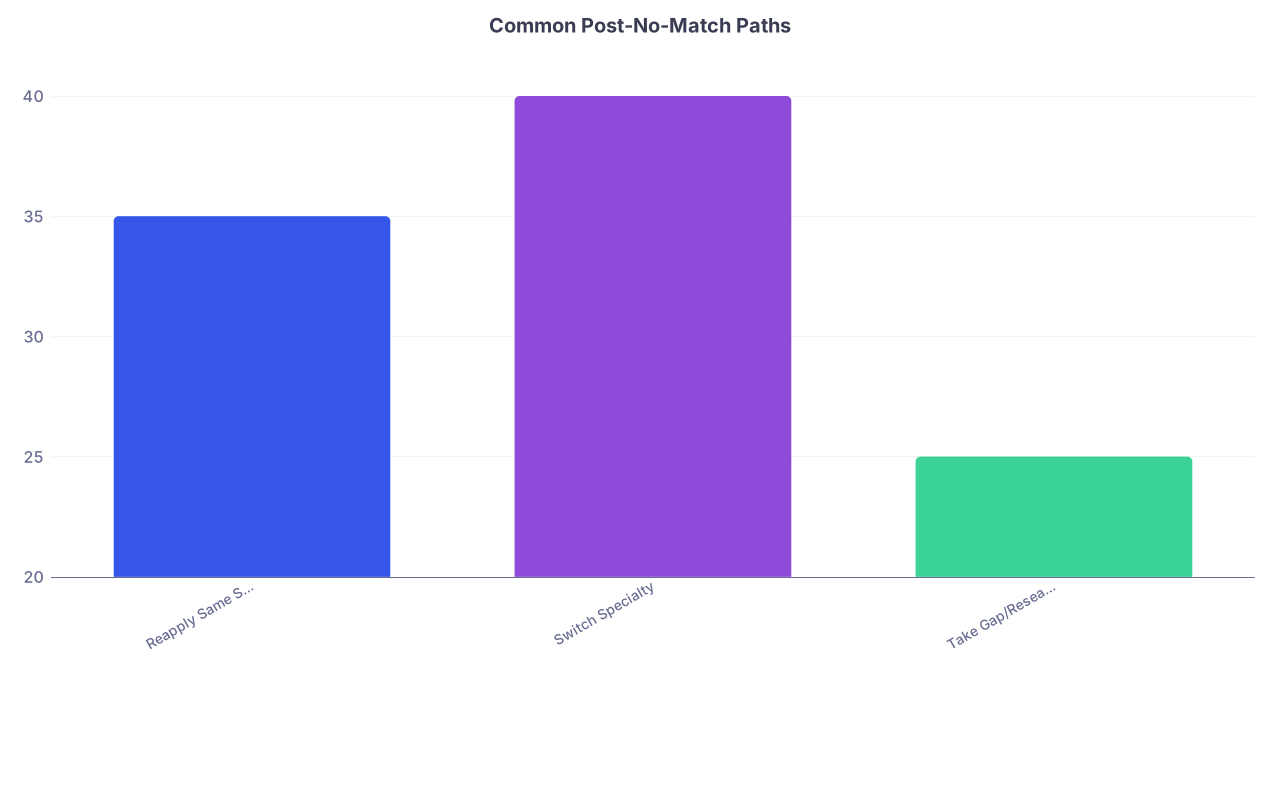
| Category | Value |
|---|---|
| Reapply Same Specialty | 35 |
| Switch Specialty | 40 |
| Take Gap/Research Year | 25 |
Let me lay out the three big archetypes I see over and over. None of them is totally safe. But they’re not all equally dangerous for you.
1. Reapply to the same specialty
This is you saying: “I still want this. I’m not done.”
When this makes sense:
- Your app was close but not quite there (borderline scores, late apps, weak LORs).
- You had interviews but didn’t match.
- There’s a clear fixable issue: late ERAS, bad personal statement, no home program, weak mentorship.
Risks:
- You spend 1–2 more years chasing something that might never happen.
- The longer you’re out, the more programs ask: “Why so many gaps?”
- Emotionally brutal if you don’t match again to the same thing.
The regret flavor here: “I wasted years chasing something that was never realistic for me.”
2. Switch specialties
This is the thing you’re scared of in this question.
When this makes sense:
- Your original specialty is ultra-competitive (derm, ortho, plastics, ENT, ophtho, some surgical subs).
- Your objective numbers or app just aren’t in that range, and won’t ever be (you can fix research; you can’t fix a 207 Step 1 into derm-level competitiveness).
- You find yourself liking other rotations but ignoring that because “I already decided.”
Risks:
- You pick something out of panic, not genuine fit.
- You get in, finish, then think: “If I’d waited or tried again, maybe I could’ve had my dream.”
- Identity shock: “I’ve always said I’m going to be a surgeon. Who am I if I’m not that?”
Regret flavor: “I bailed too early and settled.”
3. Take a gap / research year / preliminary year
This is you buying time and trying to strengthen your app.
When this makes sense:
- You’re not sure if your issue was “not competitive enough” or “bad luck.”
- You want more data, mentorship, and honest feedback.
- You can tolerate another year of uncertainty.
Risks:
- You drift, don’t truly strengthen your app, and end up in the same spot next year.
- Income delay, visa timelines (if IMG), family pressure.
- Gap years can start stacking and will need explanation.
Regret flavor: “I stalled instead of deciding and ended up back at the same crossroads older and more tired.”
The “What If I Regret Switching?” Question You’re Actually Asking
You’re probably not asking, “Is it okay to switch?”
You’re asking, “How do I know I’m not just panicking and torching my future?”
Let’s pull this apart.
There are really two questions underneath:
- Is my dream specialty truly dead—or just wounded?
- If I pick a new specialty, can I stand being that doctor every day?
If you ignore those and just think, “What’s safest?” you’ll pick based on fear.
And fear is horrible at career decisions.
1. Is your old specialty dead… or just harder now?
That depends on facts, not vibes. Stuff like:
- How many interviews did you get?
- 0–1 interviews: that specialty may be close to dead with your current profile.
- 4–8: you might be in range; something else went wrong.
- What do program directors in that field actually say about your chances if you improve X, Y, Z?
- Are you willing to put in another full throttle year (or more) on this? Not “in theory.” Actually.
If you’re scared to ask PDs bluntly—do it anyway. A real answer like:
“With your scores and IMG status, matching ortho here is extremely unlikely, even with a research year.”
Hurts. But it’s better than wasting two more cycles on hope-ium.
2. Could you stand living as the “plan B” doctor?
Let’s say you switch to internal medicine, family med, psych, peds, etc.
Not because you always loved them. Just because they’re more open.
Ask yourself:
- On your rotations, did you hate that specialty or just not prioritize it?
- Could you imagine yourself on a Tuesday morning in that field, not hating your life?
- When you picture doing only that for the next 5–10 years, do you feel:
- A dull “meh”
- Or a sick, trapped feeling?
“Meh” can be okay. You can grow into “I like this more than I expected.”
“Trapped” usually doesn’t magically become “joy.”
Switching Is Not As Permanent As It Feels (But It’s Not Totally Reversible Either)
Here’s where the anxiety spikes:
“If I switch to IM/FM/psych/whatever and later realize I hate it, I’m stuck, right?”
Mostly yes… but also not as locked as you think.
Some unsexy truths I’ve seen:
- People start in IM → later do cards, GI, pulm/crit → they’re basically in an entirely different day-to-day job than general IM clinic.
- FM folks end up doing sports med, urgent care, addiction, hospitalist work, women’s health, outpatient procedures. Very different lives.
- Psych folks end up specializing in addiction, CL psych, forensics, interventional, child/adolescent, etc.
No, you’re not going derm after matching FM.
But within a field, the sub-paths are wider than med school makes them look.

Does that magically remove the risk of regret? No.
But it means “I switched specialties” doesn’t automatically equal “I’ll be trapped in the most stereotypical version of that specialty forever.”
A Brutally Honest Self-Check: Are You Switching From Fear or From Reality?
This is the part where I’m going to be a little sharp, because I’ve seen people blow this.
You should not switch specialties just because:
- You can’t tolerate feeling behind your peers for another year.
- Your family is pressuring you to “just match into something.”
- You’re embarrassed to say publicly, “I’m reapplying.”
Those are emotionally valid. But terrible reasons to tilt your whole career.
Better reasons to consider switching:
- Objective numbers for your original specialty are way out of reach (and everyone decent being honest is telling you this).
- You liked other rotations but ignored that because they felt “less impressive.”
- You want a real shot at being a practicing physician more than you want a specific label.
Ask yourself three things:
If I knew I’d eventually match into my original specialty—but it took 2–3 more cycles—would I be willing to wait?
- If your gut screams “yes,” you may not be ready to switch.
- If your gut says “oh god, no,” that tells you something.
If nobody cared what specialty I did—no prestige, no Instagram, no med school gossip—would I still chase the same thing?
If I switch and in 5 years I’m a solid, competent, decently happy doctor in my new field… will I actually still be obsessing about this decision?
Most of the time, no. People move on more than they expect.
A Simple Framework To Decide (So You Don’t Spiral Forever)
You need structure or you’ll just spin in your head. Try this.
Step 1: Write down your top 3 options
Example:
- Reapply ortho with research year
- Switch to IM and apply next cycle
- Take prelim surgery + reapply ortho
Step 2: For each, answer 4 questions (in writing, not just in your head)
- What’s the realistic chance of success according to mentors/PDs?
- What’s the worst realistic outcome?
- What regret would I have if it fails?
- What regret would I have if it succeeds?
Yes—if it succeeds.
Because:
- If you reapply ortho and match: will you regret the years and debt and stress?
- If you switch to IM and match: will you quietly wonder “what if” forever?
Step 3: Show your answers to two types of people
- Someone who knows you well personally (partner, close friend, honest parent)
- Someone who knows your field (attending or PD-ish figure who will actually be blunt)
If both are leaning the same way? Listen hard.
If they disagree? Look at why.
You’re Scared of the Wrong Thing
You’re fixated on:
“What if I switch and regret it forever?”
You’re ignoring:
- You might also regret staying locked onto a specialty you never realistically had a shot at.
- You might regret doing nothing concrete this year and just “seeing what happens.”
- You might regret not allowing yourself to like a different life.

| Step | Description |
|---|---|
| Step 1 | Did Not Match |
| Step 2 | Explore alternative specialties seriously |
| Step 3 | Plan: Research/Prelim + Reapply |
| Step 4 | Talk to mentors in new field |
| Step 5 | Switch specialties and commit |
| Step 6 | Reassess expectations and risks |
| Step 7 | Still strongly want original specialty? |
| Step 8 | Realistic to match with improvements? |
| Step 9 | Could I live with this new path? |
The hard thing isn’t avoiding regret.
It’s choosing which possible regret you can live with, and then owning that choice.
Because here’s what I’ve seen again and again:
People who make a decision with eyes open, accepting the tradeoffs, don’t ruminate as much later.
People who decide from panic, ego, or denial? They stew on it forever.
One More Thing Nobody Tells You
You’re imagining 50-year-old you, sitting in some office whispering, “I should’ve never switched. I ruined everything.”
But real life is… messier and kinder.
- By PGY-2, most people are too tired and too busy to constantly autopsy their med school dreams.
- By attendinghood, people care way more about: coworkers, schedule, location, kids, health, debt, hobbies. Specialty still matters, but it’s not the only card on the table.
- People rewrite their own narrative. “I didn’t match X, so I went IM, and honestly, this fits me better.”
You don’t believe that now. I get it.
But your emotional intensity about this will fade. That’s just how humans work.
So your job is not to find the zero-regret path.
Your job is to pick the path that:
- Gives you a real, non-illusion chance at being a practicing physician
- Doesn’t make you dread your actual day-to-day life
- Lines up at least somewhat with what you liked on rotations and who you are as a person
And then tolerate the discomfort of not being 100% sure.

FAQ (Exactly 4 Questions)
1. If I switch specialties now, will programs think I’m flaky or indecisive?
Probably not, if you can explain it clearly and calmly. Programs see this all the time after people don’t match. What does look flaky is a chaotic story like, “I applied surgery, then psych, now I’m trying derm.”
If you can say: “I initially pursued X, didn’t match, sought feedback, realized my strengths and goals align better with Y, and here’s what I’ve done to commit to Y (shadowing, research, letters)”—that sounds mature, not unstable.
2. How do I know if my original specialty is truly out of reach?
Get out of your own head and stop guessing. Talk to:
- At least one PD or APD in that field
- One attending who actually likes you and will be honest
Show them your full app—scores, CV, LOR situation, red flags, IMG status. Ask directly: “With X improvements, do you think I have a realistic chance of matching in this specialty in the next 1–2 cycles?”
If multiple people who know the game say your chances are extremely low, believe them. Hope is not a strategy.
3. Is it better to match “something” this year than risk not matching again?
Not automatically. Matching into a specialty you truly hate, in a location you can’t stand, with no exit strategy beyond suffering through residency—that can be its own kind of trap.
But spending years in limbo reapplying to something that’s not realistic is also a trap.
The better question is: “Does this ‘something’ give me a life and day-to-day I can tolerate—and does it realistically move me toward being a practicing doctor rather than endlessly reapplying?”
4. What if my family is pressuring me to just switch to an ‘easy’ specialty?
You’re the one who has to go to that job every day, not them. You can listen to their fears without letting them drive. Say something like:
“I hear that you want me to be stable and working. I want that too. But I also need to choose something I can actually live with long term. I’m getting honest feedback, looking at real numbers, and I’ll make a decision I can stand behind—even if it’s not the fastest.”
If they’re still pushing, remember: disappointing your family for a year is better than resenting your life for 30.
Key points to hold onto:
- There is no path without risk of regret; your job is to pick the regret you can live with.
- Don’t switch—or stay—based on ego, panic, or other people’s opinions; use data and honest feedback.
- Whatever you choose, commit to it fully for at least one solid year before you judge yourself for it.


