
The most dangerous part of Match season is not the email. It is the paperwork that follows.
Most new residents obsess over programs and rank lists, then stumble through the admin gauntlet that runs from Match Day to the first paycheck. That is how you end up unpaid for a month, uninsured for two weeks, or scrambling for a DEA number the night before orientation.
Let me walk you through what actually happens, in order, and what you should be doing at each point.
Big Picture Timeline: Match Email to First Paycheck
At this point, you need a map of the next 4–5 months, not vague advice.
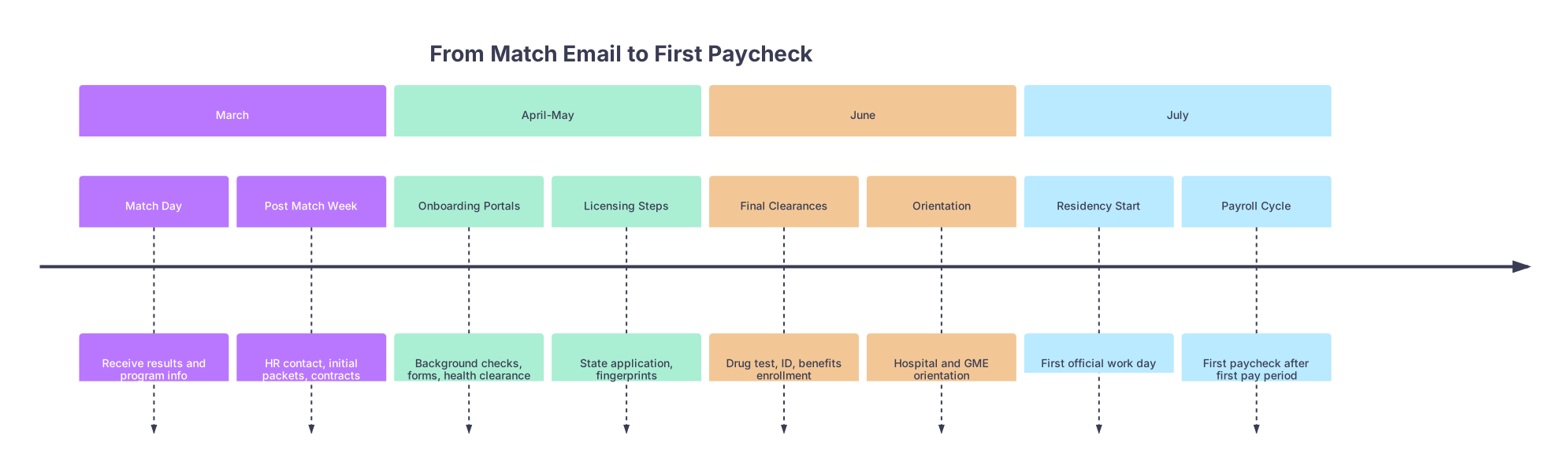
| Period | Event |
|---|---|
| March - Match Day | Receive results and program info |
| March - Post Match Week | HR contact, initial packets, contracts |
| April-May - Onboarding Portals | Background checks, forms, health clearance |
| April-May - Licensing Steps | State application, fingerprints |
| June - Final Clearances | Drug test, ID, benefits enrollment |
| June - Orientation | Hospital and GME orientation |
| July - Residency Start | First official work day |
| July - Payroll Cycle | First paycheck after first pay period |
Here is the rough structure:
- Match Week → Initial contact, acceptance, and onboarding portals
- March–April → Contracts, credentialing, state license or training license
- April–May → Visa stuff (if applicable), health forms, background checks
- June → Final clearances, benefits election, NPI/DEA if needed
- Late June–July → Orientation and first shifts
- 2–4 weeks after start → First paycheck
You will have big variation by state and program, but the skeleton is the same. Now let’s go step by step.
Match Week: From “You Matched” to “Here Is Your HR Portal”
Match Day (Friday of Match Week)
At this point, you should:
Read your Match email carefully.
Usually contains:- Program name and track (categorical, prelim, TY, advanced)
- Program coordinator contact info
- Sometimes: link for a quick “Yes, I accept” confirmation
Check for any immediate deadlines.
Some programs want:- A written confirmation within 24–72 hours
- Basic demographic info
- A photo for ID/website
Reply like a professional adult human.
Not “OMG SO EXCITED!!!”
Short, clear:- Confirm you matched and accept the position
- Thank them
- Ask if there is an onboarding timeline you should be aware of
Create a “Residency Admin” folder system.
At this point, you should:- Make a dedicated email folder + labels: “HR”, “Licensing”, “Visa”, “Benefits”
- Create a cloud folder for PDFs: “Match & Contract”, “Licensing”, “Medical Records”, “Taxes”
You will get buried in attachments. If you do not organize now, you will pay later.
Late March: Contracts, GME Paperwork, and Credentialing Start
Within 1–3 weeks after Match, the real administrative firehose opens.
At this point, you should be seeing:
- Welcome email from program coordinator or GME office
- Link to hospital onboarding portal (Workday, PeopleSoft, Lawson, etc.)
- Either:
- A resident employment contract to review/sign
- Or notice that a contract is coming after initial verification
Typical items you will be asked for:
- Legal name, SSN, permanent address
- Copy of passport or driver’s license
- Medical school diploma (or expected graduation letter)
- Official transcripts or Dean’s letter
- Step/COMLEX score reports
- Immunization records and TB/PPD history

Contract Week Checklist
At this point, you should:
Read every line of your resident contract.
Pay attention to:- Salary and pay calendar (biweekly vs monthly)
- Start date and end date
- Required notice for resignation
- Moonlighting policies
- Duty hour language
- Any “non-renewal” or probation clauses
Confirm start date and orientation dates in writing.
You want:- Official “first day of employment” date (this controls your benefits and pay)
- Orientation date(s) and whether they are paid
- Whether you must be fully licensed before that date
Ask about key administrative timelines.
One short email to the coordinator:- When will licensing packets go out?
- Do you use a training license or full license?
- By what date do these things need to be complete?
Sign and return the contract by the deadline.
Do not sit on this. Some hospitals will not start your HR file or licensing until the contract is executed.
April–May: Licensure, NPI, and Background Checks
This phase is where people get burned. State licensing boards do not care that you procrastinated. They will happily delay your ability to start.
| Step | Usual Timeframe After Match | Who Drives It |
|---|---|---|
| Contract signed | 1–3 weeks | Program + You |
| State license/training app | 3–8 weeks | You + Board |
| Background check/fingerprints | 4–10 weeks | Hospital vendor |
| Drug screen | 2–4 weeks before start | Hospital |
| NPI application | 2–6 weeks before start | You |
Early April: State License or Training License
At this point, you should:
Know exactly what your state requires.
Some states:- Issue training licenses only (faster, cheaper, tied to program)
- Require full unrestricted licenses even for interns (slower, more expensive)
Your GME office should tell you. If they have not, ask.
Start your license application the week it opens. No later.
Typical requirements:- Notarized forms
- Fingerprint cards or live scan
- Dean’s certification form sent directly from your med school
- Official exam score verification (FSMB)
- Fees (often $200–$600)
Order FSMB score reports early.
FSMB processing + state board processing = weeks.
Do not assume anything under 4 weeks is “quick”.Track every item in a simple list.
Example columns:- Item (Dean’s letter, fingerprints, fee, score report)
- Date requested
- Date sent
- Confirmation received?
If you are an IMG, double all these time estimates. Some boards will want primary source verification through ECFMG that takes extra time.
Mid–Late April: Background Check, HR Forms, and Health Clearance
By mid–April, most hospitals start tightening screws.
At this point, you should be:
- Completing HR onboarding tasks in their portal
- Scheduling employee health visits
- Uploading documentation
Expect:
Background check consent:
- Name variations
- Address history (7–10 years)
- Criminal background authorization
I-9 employment verification:
- Proof of identity and work authorization
- For citizens: passport or DL + SS card
- For non-citizens: visas, EAD, etc.
Employee health requirements:
- Immunization proofs (MMR, Hep B, Varicella, Tdap)
- TB screening (PPD or IGRA)
- Flu vaccine (in season)
- Mask fit test sometimes linked to orientation
If you do not have your immunization records ready, you will waste time running around for titers and repeat shots. Scan everything now.
May–June: Visa (If Applicable), Benefits, and Final Clearances
If you need a visa, you already know this dance is slower and higher stakes.
For International Graduates / Non-Citizens
At this point, you should have:
- Confirmed visa category with program (usually J‑1 via ECFMG or H‑1B)
- Submitted every document the program or ECFMG asked for
Typical items:
- Valid passport with enough remaining validity
- ECFMG certificate
- Contract/offer letter
- CV, medical school diploma, transcripts
- DS‑2019 processing for J‑1 or H‑1B petition documents
You cannot rush USCIS. But you can absolutely delay yourself by sending things late or incomplete. Respond to every visa-related email same day if possible.
Late May–June: Benefits and Payroll Setup
At this point, HR turns from “Who are you?” to “How do we pay and insure you?”
Expect:
- Direct deposit information
- Tax withholding (W‑4)
- Benefits elections: health, dental, vision, disability, retirement
- Life insurance beneficiaries
, Graduation & Personal](https://cdn.residencyadvisor.com/images/articles_svg/chart-resident-time-allocation-pre-start-3151.svg "Resident Time Allocation Pre-Start")
| Category | Value |
|---|---|
| Licensing & Credentialing | 35 |
| HR & Benefits | 25 |
| [Housing & Moving](https://residencyadvisor.com/resources/match-day-results/no-housing-lined-up-post-match-stepwise-strategy-to-secure-a-place) | 25 |
| Graduation & Personal | 15 |
At this point, you should:
Know your first pay date and pay frequency.
Ask explicitly:- “When is my first paycheck likely to be paid?”
- “Is it for a full or partial pay period?”
- “Is there a lag (e.g., paid 1–2 weeks after the period ends)?”
Set up direct deposit immediately.
You do not want a paper check mailed to an old address.Review health plan options like you are not a zombie.
Some resident plans:- Have strong hospital employee coverage
- Have awful high-deductible traps
Pick what makes sense for you, not your co-intern.
Capture copies of every confirmation screen.
Screenshot or PDF:- Direct deposit setup
- W‑4
- Benefits elections
HR systems lose things. I have watched it happen.
Late June: Orientation, IDs, and “You May Now Touch Patients”
Orientation is not just boring lectures. It is the last gate between you and being allowed in Epic to write orders.

At this point, you will typically complete:
- Hospital orientation (1–3 days)
- GME orientation
- EMR training (Epic, Cerner, etc.)
- Compliance modules (HIPAA, fraud/waste/abuse, safety)
- ID badge photo and pickup
- Parking or transportation registration
You may also:
- Finalize mask fit test
- Complete drug screening (some systems do this close to start date)
- Sign last-minute policy acknowledgments
Your mindset here: Show up early, with documents in hand, and check boxes relentlessly.
Ask, “Is there anything else pending on my file that could delay activation?” before you walk out.
NPI, DEA, and Prescribing: When to Do What
Not every intern will need all of these on day one. This part is highly program and specialty dependent.
At this point (6–2 weeks before start), you should clarify:
Does the program want interns to apply for their own NPI?
(Most do. It is quick and free.)Does the hospital use a shared institutional DEA for interns?
Many do, especially large academic centers.Does your state require a separate controlled substance registration?
Some states (e.g., California) require their own license number beyond DEA.
Typical order:
NPI (Type 1) application
- Do this online at NPPES
- 15–30 minutes
- Use your future hospital address if instructed by GME
DEA number
- Only if required and requested; some programs prefer to control this timing
- Costs money; sometimes reimbursed, sometimes not
State controlled substance registration
- Only if you have your state license already and your program tells you to
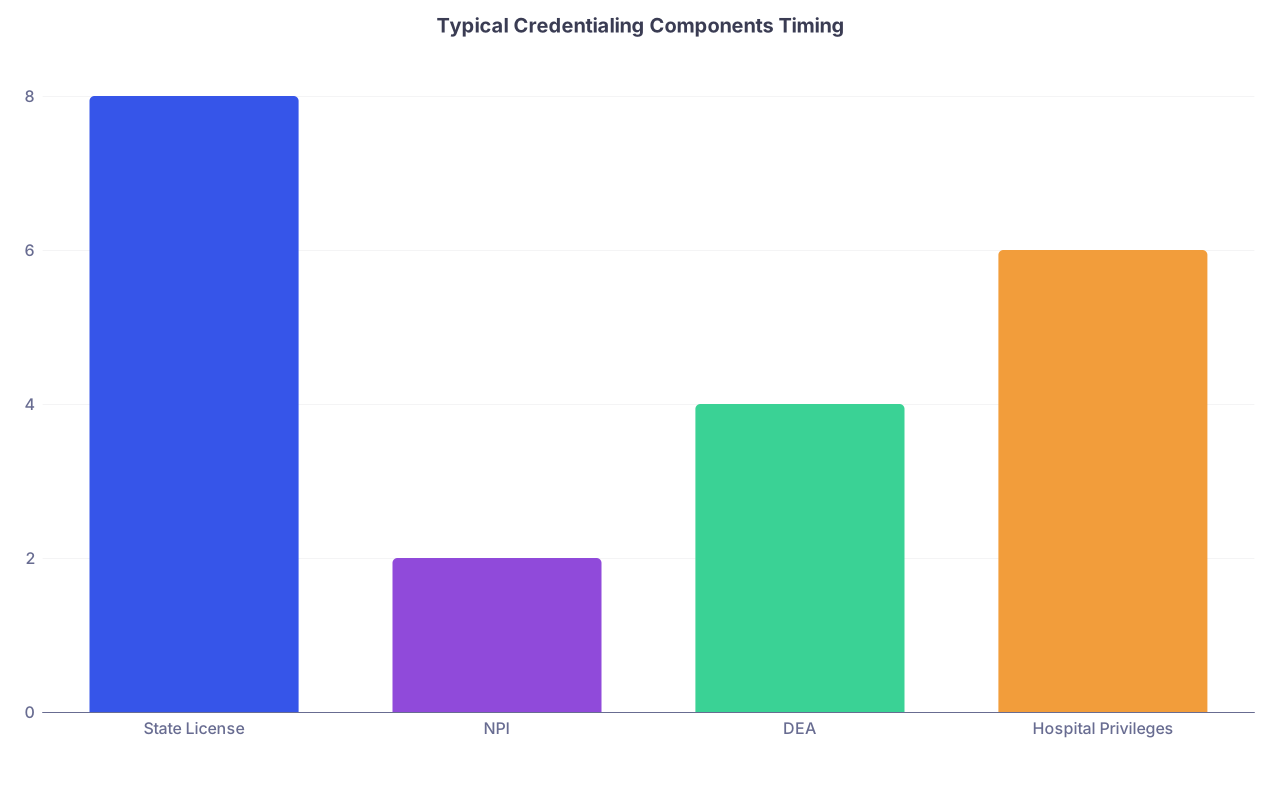
| Category | Value |
|---|---|
| State License | 8 |
| NPI | 2 |
| DEA | 4 |
| Hospital Privileges | 6 |
(values are approximate processing time in weeks when done late; do it early and you avoid the max end.)
If you are unsure, ask your chief or coordinator for the program’s usual practice. Do not freelance this.
July: First Day, First Pay Period, First Paycheck
You survived the paperwork maze. Now it is about cash flow reality.
Your First Official Day
At this point, on day one, you should:
- Confirm you are active in:
- EMR (you can log in and see patient charts)
- Paging system
- Badge access to key areas
- Make sure:
- Your state license/training license is issued (or at least marked “approved/active” for training)
- You know how to contact GME/HR if anything is missing
If any system does not work, say something that day. “It will probably fix itself” is not a strategy.
Understanding When You Actually Get Paid
Residents get burned here a lot. You work for weeks, then wonder where the money is.
Common structures:
- Biweekly pay: Every 2 weeks, usually with a 1–2 week lag
- Monthly pay: Once a month, often end-of-month
Example scenarios:
- Start July 1, biweekly pay, pay periods end on Saturdays, paid on following Friday:
- You may not see any paycheck until mid-July
- Start July 1, monthly pay on last business day:
- No paycheck until July 31
At this point, you should:
Ask payroll for the exact pay schedule and your first check date.
“When exactly is my first paycheck, and what dates will it cover?”Budget for a 4–6 week cash gap.
That means:- Do not assume instant salary
- Have some savings or short-term support lined up
Verify your first paystub is correct.
On that first check:- Is the gross pay amount correct for resident salary?
- Are benefits deducted correctly?
- Are you taxed in the correct state and city?
If anything looks off, bring it to HR/payroll immediately. Errors on check one tend to repeat until corrected.
Micro-Timeline: What To Do Week-by-Week
You want a simple reference you can pin above your desk. Here you go.
Match Week (March)
At this point, you should:
- Confirm match and respond to program professionally
- Start document organization system
- Ask for rough onboarding and licensing timeline
Late March – Early April (Weeks 2–4 after Match)
At this point, you should:
- Receive, review, sign resident contract
- Provide initial HR-required documents (ID, SSN, diploma timeline)
- Confirm whether you need state training license or full license
April (Weeks 4–8 after Match)
At this point, you should:
- Start state license or training license application
- Request Dean’s certification and official score reports
- Begin background check and fingerprinting
- Collect and scan immunization records
May (Weeks 8–12 after Match)
At this point, you should:
- Follow up with state board for license status
- Complete any outstanding HR portal tasks
- If IMG/visa: ensure visa process is active and progressing
- Confirm tentative orientation dates and start dates
June (Weeks 12–16 after Match)
At this point, you should:
- Attend or prepare for orientation
- Complete drug test, mask fit, EMR training
- Set up direct deposit, benefits, and tax withholding
- Apply for NPI (and DEA if required by program/state)
Late June – July Start
At this point, you should:
- Attend formal hospital and GME orientation
- Verify system access (badge, EMR, paging)
- Confirm license/training license is active
- Know your first pay date and pay period details
Your next move is simple: open your Match email and last message from your coordinator, and make a 2-column list titled “Already Done” and “Still Pending.” If “state license application started” is not in the first column by early April, that is your task for today.