How many Qbanks do you actually need for Step 1 and Step 2—one, two, or the absurd four that your group chat keeps talking about?
Let me give you the short version up front, then we’ll unpack it:
- For Step 1: One primary Qbank done thoroughly. At most, one secondary if you have extra time.
- For Step 2: Same thing. One primary Qbank + optional secondary for weaker areas or extra practice.
More than that? Usually a waste. Shallow repetitions, inflated anxiety, and a false sense of productivity.
Let’s break it down.
The Real Answer: How Many Qbanks You Need
Here’s my blunt take after watching a lot of students succeed and a lot of students burn out:
Step 1:
- Essential: 1 major Qbank (UWorld-level)
- Optional: 1 secondary Qbank (if and only if you finish the first with time to spare and are still missing big chunks)
Step 2 CK:
- Essential: 1 major Qbank (again, UWorld-level)
- Optional: 1 targeted add-on (Amboss, NBME CMS forms, or specialty-specific questions)
If you’re “using” three or four Qbanks, what you’re really doing is this:
You’re half-doing multiple resources and fully mastering none.
That’s how students with 4 different subscriptions end up with average scores and a lot of regret.
Why One Primary Qbank Is Usually Enough
People overcomplicate Qbanks because they confuse volume with mastery.
For both Step 1 and Step 2, your primary Qbank should be:
- High quality
- Exam-style
- Completed close to 100%
- Reviewed deeply, not skimmed
For most people, that’s UWorld. Could you substitute with something else? Yes, if it’s proven, comprehensive, and your school recommends/uses it. But if you’re asking this question, the answer is probably UWorld.
Here’s what a full run-through of one Qbank does for you:
- Exposes you to essentially every core concept the exam cares about
- Teaches you how NBME-style questions are written
- Trains your timing and stamina
- Shows you your weak areas repeatedly
What actually moves your score is not “number of questions completed.”
It’s:
- How carefully you review your mistakes
- Whether you understand why each wrong option was wrong
- Whether you see patterns between questions and concepts
- How often you revisit weak topics until they stick
Most students do not have a Qbank quantity problem. They have a Qbank depth problem.
Step 1: How Many Qbanks, Really?
For Step 1, the typical temptation is:
- UWorld
- Amboss
- Kaplan
- USMLE-Rx
- Random school Qbank
You can absolutely drown in that.
Here’s a saner structure.
Core plan for Step 1
One main Qbank (usually UWorld) – non-negotiable
- Goal: ~90–100% of questions completed
- Mode: Usually timed, random, mixed by system once you’re through content basics
- Depth: Review every question you get wrong and a sample you got right
Optional second Qbank – strictly conditional
Use a second Qbank only if:- You started early (e.g., M2 fall)
- You finished your primary Qbank well before dedicated
- You’re not just numb-clicking through questions to “finish”
Good reasons to add a second Step 1 Qbank:
- You’re scoring borderline on NBMEs and need more repetition
- There’s a specific area you’re weak in (e.g., biochem, immuno) and a targeted Qbank fits
Bad reasons:
- “Everyone else is using three”
- “I feel behind, so I bought another subscription at 2 a.m.”
- “It was on sale”
Step 1: Example Qbank setups that actually make sense
| Profile | Primary Qbank | Secondary Qbank | Comment |
|---|---|---|---|
| Average M2, 6–8 wk dedicated | UWorld | None | Ideal, sufficient |
| Early starter, strong student | UWorld | Amboss | Only after UWorld ~80–100% |
| Struggling with basics | USMLE-Rx | UWorld | Rx first, then UWorld |
| Very limited time (≤4 weeks) | UWorld | None | Depth > extra resources |
If you’re aiming for a strong pass (Step 1 is pass/fail now) and solid foundations for Step 2, one thoroughly completed primary Qbank plus good content review is enough for the vast majority of students.
Step 2 CK: Same Question, Slightly Different Game
Step 2 CK is more clinical, more interpretive, and honestly more “UWorld-like” than Step 1 was.
The pattern still holds:
- One primary Qbank (again, usually UWorld)
- Possible targeted add-ons (Amboss, NBME CMS forms, maybe a focused shelf Qbank)
The main mistake with Step 2 is thinking:
“I did two Qbanks for Step 1, so I should do three for Step 2.”
No. You should do better with less.
Core plan for Step 2
Primary Step 2 Qbank – UWorld or equivalent
- Aim for ~100% completion if possible
- Use it throughout clerkships if you can, not just in some short ‘dedicated’
- Do blocks that match your current rotation (IM, surgery, OB, etc.)
Secondary resources – use like seasoning, not the main meal
Good secondary options:- Amboss blocks for tough topics (renal, heme/onc, infectious disease, OB triage)
- NBME CMS (shelf) forms to mirror exam style and pacing
- Specific shelf-style Qbanks only if your school strongly recommends
Again: the goal is not to max out subscriptions. It’s to maximize retention and practice under test-like conditions.
The Hidden Cost of Too Many Qbanks
Buying multiple Qbanks feels productive. It also gives you three specific problems:
Shallow learning
You rush to “finish” questions instead of actually learning from them.
60% correct with deep review beats 80% correct with rushed review.Poor tracking
You cannot realistically monitor your performance trends across 3–4 platforms.
You end up with piecemeal data and a lot of confusion about where you actually stand.Burnout and anxiety
Seeing 5,000+ unused questions in your dashboards is not “motivating.”
It’s a constant reminder of what you think you “should” be doing.
If you find yourself constantly jumping between platforms, that’s usually a red flag. It means you’re chasing novelty and comfort, not mastery.
How to Choose the Right Qbank Mix (Without Getting Cute About It)
This doesn’t need a four-layer decision tree. You just need to answer a few real questions:

| Step | Description |
|---|---|
| Step 1 | Need Step 1 Qbank |
| Step 2 | Start with UWorld as primary |
| Step 3 | Use basic Qbank like USMLE-Rx |
| Step 4 | Commit to UWorld fully |
| Step 5 | Finish ~80-100% |
| Step 6 | Then move to UWorld |
| Step 7 | Stop. Focus on NBMEs & review |
| Step 8 | Add targeted secondary Qbank |
| Step 9 | Done any Qbank yet? |
| Step 10 | Time & need for more? |
For Step 1:
If you have no strong base and keep missing simple recall facts:
Start with an easier Qbank (like USMLE-Rx), then move to UWorld.If your foundations are okay and you’re in M2 or dedicated:
Go straight to UWorld. Master it.
For Step 2:
If you did UWorld for Step 1 and liked it:
Use UWorld Step 2 CK as your core, period.If you felt UWorld alone was not enough for Step 1:
For Step 2, still use UWorld as core, but plan some Amboss or CMS forms for reinforcement by rotation.
What To Do Within a Single Qbank (This Is Where Scores Are Made)
You can have the perfect resource mix and still score mediocre if your process is bad.
Basic non-negotiables for using your main Qbank well:
- Do blocks in timed mode (at least most of them). The exam is timed.
- Review every wrong question. No skipping because “oh yeah, I knew that.”
- For right answers, quickly skim the explanation and confirm you’d pick it again.
- Make notes or flashcards only for recurring concepts, not every random fact.
- Regularly revisit your marked/incorrect questions.
Here’s how most high scorers structure Qbank time: roughly half answering, half reviewing.
If you’re doing 80 questions a day and spending 30 minutes reviewing them, you’re not learning. You’re just clicking.
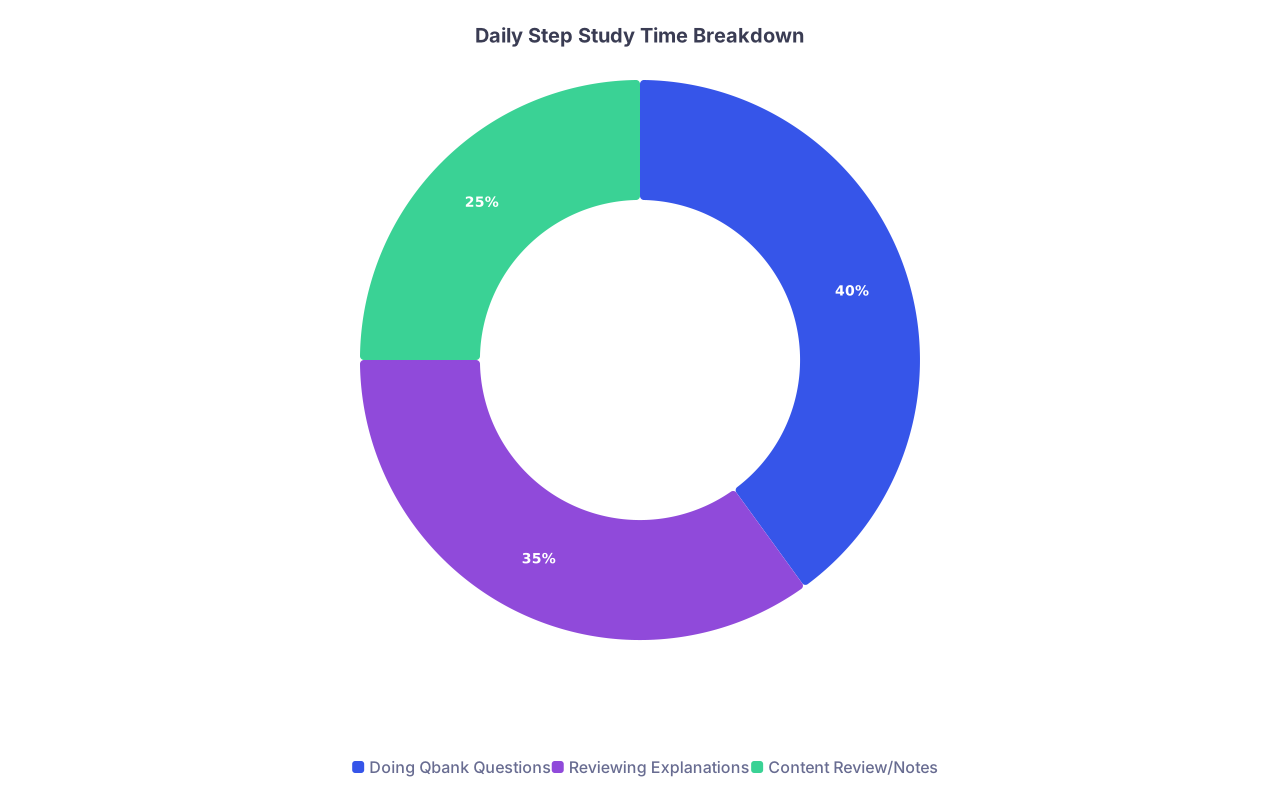
| Category | Value |
|---|---|
| Doing Qbank Questions | 40 |
| Reviewing Explanations | 35 |
| Content Review/Notes | 25 |
How Dedicated Time Changes the Equation
People ask: “If I have 6 weeks of dedicated vs 10 weeks, should I add another Qbank?”
Backwards question.
You scale depth with your time, not number of platforms.
Short dedicated (≤4 weeks):
- One primary Qbank
- Fewer total questions, more careful review
- Heavy focus on NBMEs to track if you’re on target
Moderate dedicated (6–8 weeks):
- One primary Qbank, aim for 80–100%
- Optional targeted secondary questions late in the game, if needed
Long dedicated (10+ weeks):
- One primary Qbank done thoroughly
- Possibly second Qbank, but only after first is truly mastered
- More time for spaced repetition of weak areas and dedicated NBME review
More time should mean better consolidation, not more subscriptions.
Red Flags You’re Using Too Many Qbanks
You probably have a Qbank problem if:
- You can’t name your “primary” resource without hesitating
- Your completion percentage on every Qbank is between 20–60%
- You’re constantly asking which Qbank you “should focus on this week”
- You don’t remember where you saw a given question or explanation
- You feel guilty every time you log in and see thousands of unused questions
If that’s you, here’s the move:
- Pick one Qbank to be your primary for the next 4–6 weeks.
- Ignore everything else; unsubscribe if you have to mentally.
- Work systematically and track your progress and mistakes.
You’ll almost always feel calmer and perform better.
FAQs
1. Is UWorld alone enough for Step 1 and Step 2?
For most students, yes. For Step 1 (now pass/fail), UWorld plus a solid content resource (e.g., First Aid, Boards & Beyond, Pathoma) is more than enough to pass and set you up for Step 2.
For Step 2 CK, UWorld CK is the backbone. Add NBME practice exams and, if needed, some Amboss or CMS forms, but you do not “need” three full Qbanks if you use UWorld well.
2. Should I redo UWorld or start a second Qbank after I finish it?
If you finished UWorld and your NBME/CBSSA or NBME CK practice scores are at or above your goal range, you’re usually better off redoing targeted UWorld blocks (marked and incorrect questions) plus more NBMEs, rather than buying an entirely new Qbank.
If your scores are still low, a second Qbank can help reinforce content, but only if you actually review explanations thoroughly. Redoing UWorld with brutal honesty about your reasoning is often more efficient.
3. Do I need separate Qbanks for shelf exams and Step 2?
Not always. UWorld CK used properly during rotations can cover a huge portion of both shelf exams and Step 2. Some schools strongly push NBME CMS forms or rotation-specific Qbanks; those can be added on later.
If your time is limited, you’re usually better off doing UWorld by rotation (IM blocks during IM, OB blocks during OB, etc.) plus a few CMS forms, rather than trying to juggle three parallel shelf Qbanks.
4. Is it a mistake to start with an “easier” Qbank before UWorld?
Not necessarily. If your basic sciences are weak or you’re early M2 and getting crushed by UWorld, starting with an easier, more content-based Qbank (like USMLE-Rx for Step 1) can be smart. Just do not get stuck there. The real exam feels much more like UWorld.
The mistake is never graduating to UWorld or using the easier Qbank as a procrastination tool to avoid exam-style questions.
5. How many total questions should I aim to do?
For Step 1:
- One full run of UWorld (~2,000–2,500 questions) is sufficient for most. If you start early, you might do 3,000–4,000 questions total across all sources, but quality of review matters much more than raw count.
For Step 2:
- One full run of UWorld CK (~3,000+ questions) plus some CMS forms or Amboss blocks is typical. People who score very high usually do ~3,000–5,000 questions total, but again, not at the expense of deep review.
6. What if all my friends are using more Qbanks than I am?
Then your friends are probably overspending and overcomplicating this. Scores come from mastery, not from stacking subscriptions. If your practice scores are trending up, your NBME scores are where they need to be, and you’re doing deep review with one main Qbank, you’re doing it right.
Your goal is not to match their Qbank count. Your goal is to walk into the exam with a clear brain, well-practiced reasoning, and familiarity with question style. You do not get extra points for owning more logins.
Key points:
- One primary Qbank used thoroughly is enough for both Step 1 and Step 2 for most students.
- Secondary Qbanks are optional tools, not requirements; add them only if you have time and a clear reason.
- Depth of review, not number of platforms, is what actually raises your score.