
The dogma that you must choose between clerkship research and shelf exam scores is exaggerated—and often just wrong.
Here’s the real answer: research during clerkships is worth it if you’re strategic, aligned with your specialty goals, and disciplined with your time. It’s a distraction when you chase random projects, overcommit, or sacrifice your shelf prep for low-yield academic busywork.
Let’s break this down like an attending who’s running behind but still wants you to learn something.
The Core Question: Is Research During Clerkships Worth It?
Short version:
- If you’re aiming for a competitive specialty (derm, ortho, plastics, ENT, neurosurgery, rad onc, some IM subspecialties): yes, it’s usually worth it.
- If you’re targeting less research-heavy fields (FM, psych, peds, many community IM programs): optional, but can still help if done efficiently.
- If your exam performance is borderline (barely passing pre-clinicals, struggling with Step 1/2): shelf scores come first. Research is nice. Passing and scoring decently is mandatory.
The mistake most students make isn’t doing research.
It’s doing too much of it, in the wrong way, at the wrong time.
So the right question isn’t “research vs shelves?”
It’s “How do I structure research so it helps my application without tanking my shelves?”
What Programs Actually Care About: Research vs Shelf Scores
Let’s be blunt. Most program directors don’t care how busy you were. They care about results.
| Factor | Competititve Specialties | Less Competitive Specialties |
|---|---|---|
| Step 2 CK score | Very high importance | High importance |
| Clerkship grades | High importance | Moderate–high |
| Research output | High importance | Low–moderate |
| Letters of rec | Very high importance | Very high importance |
For the more research-heavy fields (derm, rad onc, heme/onc track, academic IM), your application is judged in three big buckets:
- Board/shelf performance – shows you’re reliable clinically and won’t fail out.
- Research productivity – shows academic potential, commitment to the field.
- Letters and narrative – who’s willing to go to bat for you, and what story your app tells.
You don’t get to pick only one. You need to clear a threshold on all three.
If your shelves are solid and Step 2 is on track, then research can be a major differentiator. If your scores are weak, more posters won’t save you from a low Step 2. That’s just reality.
When Research Becomes a Problem: Red Flags and Tradeoffs
Research during clerkships turns into a distraction when:
- You’re behind on UWorld/Anki/passive reading and still saying yes to new projects.
- You’re taking post-call time you desperately need for sleep and using it to “just edit this one draft.”
- Your NBME practice scores are hovering at or below passing and you’re spending evenings on a database, not on questions.
- You’re stressed, resentful, and constantly thinking: “I have no idea what’s going on on the wards and my inbox is full of research emails.”
Here’s a simple rule I’ve used with students:
If your last two practice NBMEs are below the 50th percentile, do not add any new research commitments. Shelf and Step 2 scores are your priority.
You can maintain existing low-burden projects (e.g., revising a manuscript, occasional brief meetings) but you don’t go hunting for more.
Situations Where Research During Clerkships Is Absolutely Worth It
Let me be concrete. These are scenarios where I’d tell you flat-out: yes, it’s worth it.
1. You’ve Already Shown You Can Handle the Exams
Example:
You scored around the median or above on Step 1 (or passed comfortably if pass/fail), you’re hitting 65–70% on UWorld blocks for clerkship content, and your first couple shelves were pass/high pass.
You’re not crushing everything, but you’re steady.
In this case, adding 1–2 well-structured projects during less intense rotations (FM, outpatient psych, some electives) is very reasonable.
2. You’re Switching into a More Competitive Specialty
If you realize during third year: “I thought I wanted IM but actually I love ENT,” you’re now behind research-wise compared to people who started in M1.
You don’t fix that by daydreaming. You fix it by:
- Finding a mentor in the field.
- Getting on one or two projects with actual publication potential.
- Using your later clerkships and light electives as research-heavy blocks.
Here, avoiding research in the name of “focusing on shelves” might actually hurt your match chances more than a slightly lower shelf score.
3. You Have a Mentor Offering High-Yield Opportunities
If a strong, well-known attending in your target field says:
“We’re finishing a retrospective study and I could use help with data cleaning and drafting the discussion—there’s a clear path to first/second authorship.”
You don’t walk away from that lightly.
The key question you ask them:
“How many hours a week, realistically, do you expect from a student on this project?”
If the answer is ~3–5 hours and you’re on an easier rotation? Very doable. If it’s 10–15 hours while you’re on surgery? That’s a problem.
The Time Reality: How Many Hours Can You Actually Spare?
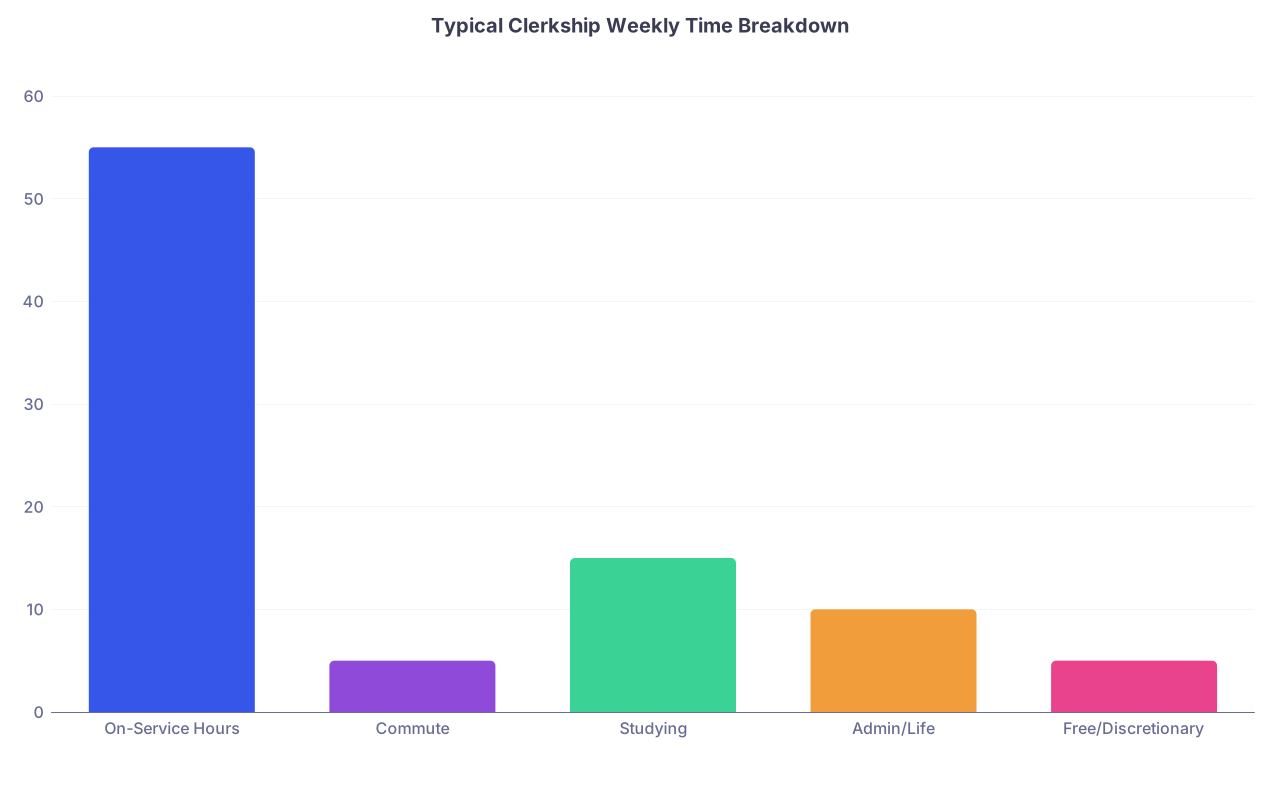
Let’s be honest about clerkship time. You’re not “off” at 5 pm in most core rotations.
| Category | Value |
|---|---|
| On-Service Hours | 55 |
| Commute | 5 |
| Studying | 15 |
| Admin/Life | 10 |
| Free/Discretionary | 5 |
Those last 5 “discretionary” hours are where research has to live. If you try to shove 10–15 research hours into a week that only has 5 free hours, something is going to give:
- Sleep
- Shelf prep
- Your mental health
- Your relationships
So set a hard budget:
Max 3–5 hours/week of research during heavy rotations, up to 8–10 during light rotations/electives.
If you can’t keep the project within that, either:
- Renegotiate the scope with your mentor, or
- Delay deeper involvement until a lighter block.
Practical Strategy: How to Do Research Without Tanking Your Shelves
Here’s the framework I’d actually use.
Step 1: Decide Your Primary Goal Per Block
You don’t need everything to peak at once. Assign each 4–8 week block a “theme”:
- “Shelf priority” block – surgery, medicine, OB, your weak area.
- “Balanced” block – FM, psych, outpatient, some sub-Is.
- “Research-heavy” block – elective, research rotation, lighter month.
Then hold yourself to it. If it’s a shelf priority block, research only happens in tiny, pre-specified windows (e.g., 2 hours Sunday afternoon).
Step 2: Protect a Non-Negotiable Shelf Study Schedule
Minimum baseline most students need to pass/honors shelves:
- 1–2 hours on weekdays (post-clinic/wards)
- 4–6 hours across the weekend
Your research plan lives around that, not instead of it.
I tell students to literally time-block:
- Weeknights: 7–9 pm – UWorld/NBME review
- Sunday: 9–11 am – research work
If a research task starts stealing weekday UWorld time, you’ve crossed the line. Fix it.
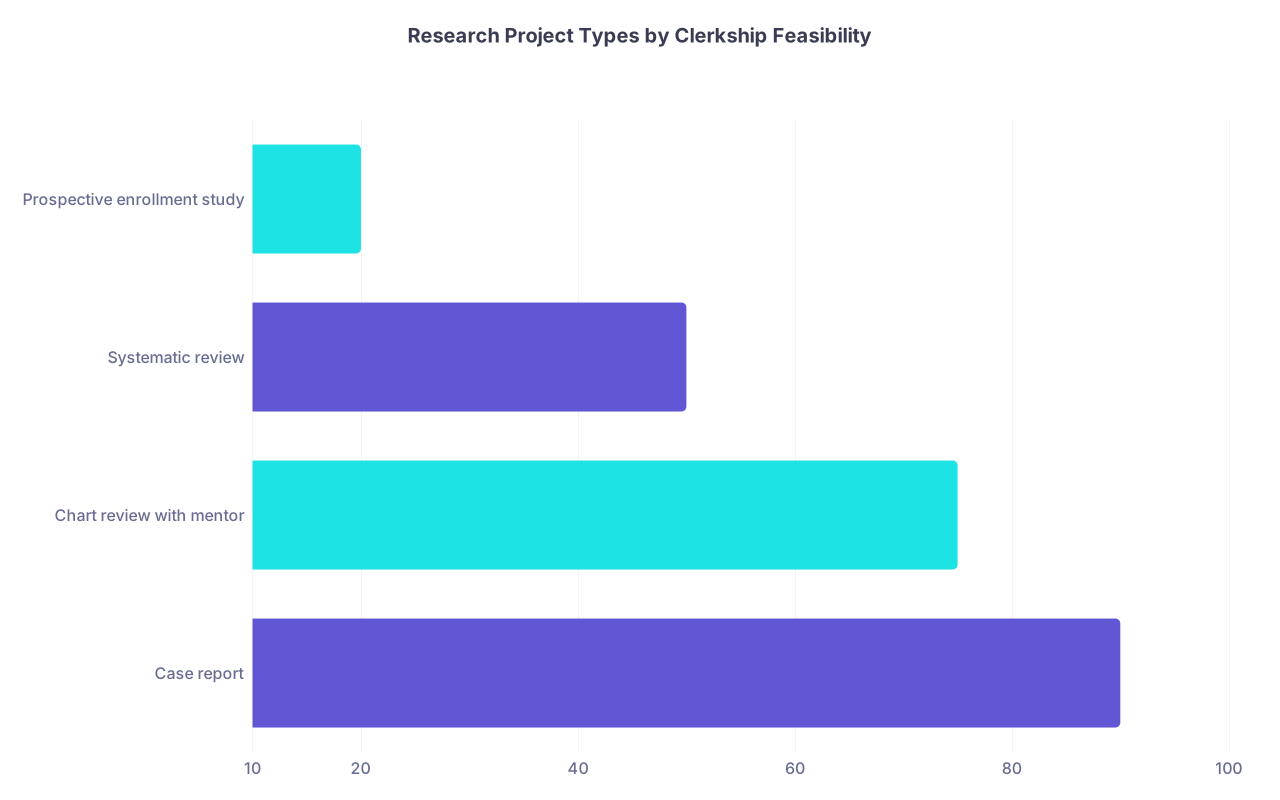
Step 3: Choose the Right Kind of Projects
During clerkships, you do not want projects that are:
- Open-ended (“Let’s explore this idea…”)
- Dependent on you for data collection across months
- Chaotic teams with no clear division of labor
- “We’ll figure out authorship later” nonsense
You want:
- Clearly scoped chart reviews with defined endpoints.
- Case reports where you can outline and draft in a weekend.
- Review articles with a clear structure.
- Pre-existing datasets where your role is analysis/write-up, not building from scratch.
| Category | Value |
|---|---|
| Case report | 90 |
| Chart review with mentor | 75 |
| Systematic review | 50 |
| Prospective enrollment study | 20 |
(Values = relative feasibility during busy clerkships; higher is easier.)
Step 4: Treat Research Like a Recurring Shift
Don’t “fit it in when you can.” That’s how it infects your entire week.
Decide:
- What exact hours you’ll work on it.
- What deliverable you’re finishing that session (e.g., “Methods draft,” “Extract data for 25 patients,” “Revise figures”).
Then when the time is up, you stop. Even if you’re mid-sentence. Your future self can handle that.
How This Actually Plays Out: Three Realistic Student Profiles
Student 1: Average Scores, Wants Competitive Specialty
- Step 1: Pass, but not stellar.
- Early shelves: mostly Pass/High Pass, no Honors yet.
- Target: Dermatology.
For this student, both Step 2 CK and research matter a lot.
What I’d advise:
- During medicine and surgery: shelves first, minimal research (1–2 hrs/week revising a manuscript).
- During FM, psych, elective blocks: ramp up to 6–8 hrs/week of research on derm-specific projects.
- Get 1–3 meaningful outputs (submitted abstract, paper under review, or at least manuscripts clearly near submission) by early M4.
If they’re still scoring borderline on NBME practice tests, I’d push Step 2 and shelves over more research. A 20th percentile Step 2 score kills your application faster than a missing extra poster.
Student 2: Strong Test Taker, Weak on Research
- Step 1: comfortably above average.
- Shelves: already have a couple Honors.
- No real research yet.
- Target: Academic IM or heme/onc down the line.
This is exactly who should be saying yes to carefully chosen clerkship research.
Strategy:
- Take on 2 projects:
- One quick-turn thing (case report, small retrospective).
- One longer-term project that may not finish until M4.
- Keep 3–5 hrs/week during most clerkships, 8–10 on electives.
- Aim for at least 1–2 first/second authorships and several co-authorships/abstracts.
Here, saying “I don’t do research during clerkships because of shelves” is just a missed opportunity.
Student 3: Struggling Academically, Anxious, Considering Research
- Step 1: barely passed, or had to remediate exams.
- First two shelves: just passing.
- Considering “maybe research will make my application stand out.”
This is where I’m very direct:
You don’t need research right now. You need to prove you can handle clinical medicine.
I’d tell this student:
- Focus 100% on shelf performance and Step 2 CK.
- If a super-low-commitment research opportunity comes up (e.g., editing text or helping with references 1–2 hrs/week), fine.
- But no big new projects until shelves are stable and practice NBMEs/Step 2 prep are in a safe zone.
How to Talk to Mentors Without Burning Bridges
You’re allowed to have boundaries. You just need to communicate like a grown-up.
If you’re mid-rotation and drowning, say something like:
“I’m really committed to this project and want to do a good job. Right now I’m on my inpatient medicine rotation and my shelf is in three weeks. Could we scale back my responsibilities temporarily—maybe focus on [one specific task]—and then I can ramp back up after my exam?”
Reasonable mentors get this. The ones who don’t… often aren’t the ones whose letters you want anyway.
Common Myths You Can Ignore
“If you’re not doing research during clerkships, you’re behind.”
False. Plenty of people do most of their research M1–M2 and during dedicated research/elective time in M4. Clerkship research is optional productivity, not mandatory unless you’re aiming very high in research-heavy specialties with no prior work.
“Study for shelves first, you can always do research later.”
Sometimes. But if “later” is M4 and you’re applying to derm, plastics, or rad onc with zero research, that’s not a great plan. For those fields, you can’t just cram research in at the end.
“Programs care more about shelf scores than research.”
Not universally. For FM, psych, and many community programs—yes, shelves and Step 2 matter more. For competitive academic specialties, weak research can knock you out even with solid scores.
A Simple Decision Flow: Should You Add Research Right Now?
Use this mental flowchart before saying yes to a new project:

| Step | Description |
|---|---|
| Step 1 | Thinking about new project |
| Step 2 | Fix exams first |
| Step 3 | Say yes, set boundaries |
| Step 4 | Negotiate scope or delay |
| Step 5 | Competitive specialty? |
| Step 6 | Step/Shelf OK? |
| Step 7 | NBMEs >= 50th%? |
| Step 8 | Time <5 hrs/week? |
If you land in “Fix exams first,” that’s your answer. If everything checks out and time is reasonable, then yes—go for it.
Making It Sustainable: Protecting Your Sanity
If you’re going to juggle research during clerkships without hating your life:
- Keep your project list short (1–3 max at any given time).
- Use small, frequent work blocks instead of giant 6-hour marathons.
- Track progress so you can see things moving (even slowly).
- Periodically reassess: “Is this still worth the time I’m putting in?”
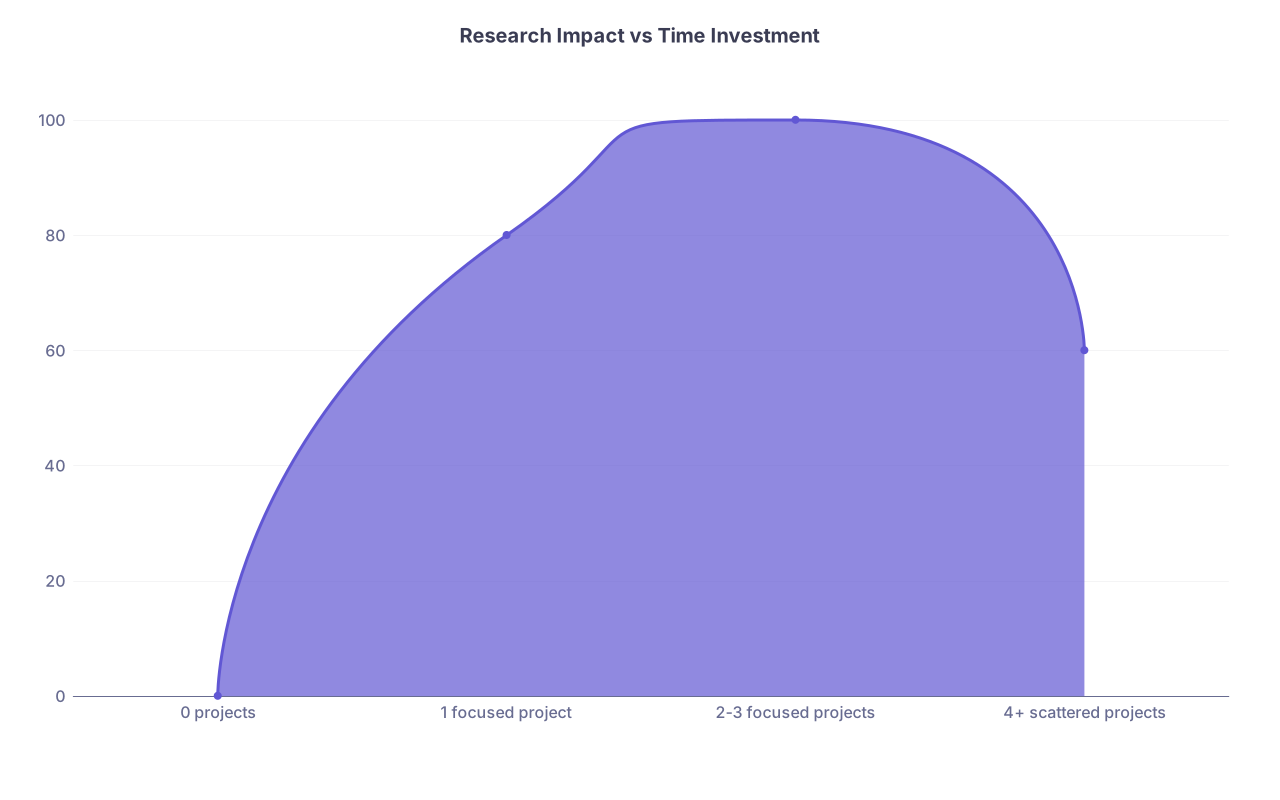
And remember: no program is impressed by the student with 12 half-finished projects and zero actual publications.
| Category | Value |
|---|---|
| 0 projects | 0 |
| 1 focused project | 80 |
| 2-3 focused projects | 100 |
| 4+ scattered projects | 60 |
You hit peak value with a small number of focused, well-chosen projects. After that, you get diminishing returns and more stress.
FAQs
1. If I have to choose, is a higher shelf score or another research line on my CV more valuable?
If it’s a core rotation (IM, surgery, OB, peds) and you’re not already clearly above average on exams, prioritize the shelf. One more line of minor research rarely outweighs a noticeably weaker transcript or Step 2 score, especially for programs that actually have to train you on the wards.
2. How many research hours per week is “safe” during a busy rotation?
For most students, 3–5 hours/week is the upper limit on busier rotations like medicine and surgery. That usually looks like one longer session (2–3 hours) on the weekend and one short evening session. If you’re consistently needing more than that, either the project needs to be re-scoped or it’s the wrong project for clerkship time.
3. Can I start a new research project right before a shelf or Step 2?
You can, but it’s usually dumb. The 2–4 weeks before a shelf or Step 2 should be your highest-yield study window. If a truly time-sensitive, amazing opportunity appears (e.g., this dataset is closing; we need help this week), you can contribute in small, tightly-defined ways. But launching into a brand-new, high-commitment project right before a major exam is asking for regret.
4. Does “just helping with data collection” actually count for anything?
Sometimes. If you’re part of a large project and your work is essential, you’ll usually land as a middle author. That absolutely still counts, especially early on. But if all you ever do is nameless data grunt work and you’re never on the manuscript or abstract, that’s low-yield. Ask explicitly: “If this leads to a paper or abstract, how would authorship be handled for student contributors?”
5. What if I already overcommitted and my shelves are suffering?
Stop digging. First, have honest conversations with your PIs/mentors: explain your current rotation demands and upcoming shelves/Step 2. Propose concrete scaling-back options: “I can finish X and Y by [date], but I can’t take on new tasks until after my exam.” Then ruthlessly protect study time for the next exam block. If your school allows, consider scheduling a lighter elective or research block before Step 2 and push most remaining project work there.
Bottom line:
- Research during clerkships can absolutely be worth it—if your exam performance is stable and the project is high-yield and time-bounded.
- Shelf and Step 2 scores are the floor of your application; research is the ceiling. Don’t sacrifice the floor to decorate the ceiling.
- One or two focused, well-managed projects will beat five chaotic, unfinished ones every single time.