

Three days into your first elective, you’re standing in a cramped workroom at 7:45 pm, eating graham crackers for dinner while your attending says, “Tomorrow will be even busier.” Your classmates’ group chat is full of beach photos from their chill outpatient elective. You’re wondering whether you just tanked a month of your life—and maybe your career plans—with one bad click in VSAS.
Let me be blunt: hating your first elective doesn’t make you weak, flaky, or doomed. It means you’re a normal student who finally got a real taste of something and realized, “Oh. This kind of sucks for me.” The goal now is not to “tough it out at all costs.” The goal is to extract maximum value, protect your sanity, and pivot without turning it into a soap opera.
Here’s exactly how to do that.
Step 1: Figure Out What You Actually Hate (Quietly and Precisely)
Before you blow anything up or start emailing course directors at midnight, you need clarity. Not vibes. Not panic. Actual reasons.
Ask yourself, preferably after sleep and food:
- Is it the content? (You find cardiology mind-numbing, not challenging.)
- Is it the culture? (Everyone’s sarcastic, impatient, or openly toxic.)
- Is it the schedule? (You’re in the hospital 14 hours a day for minimal learning.)
- Is it the role expectations? (You’re being used as a scribe or transporter.)
- Is it you, right now? (You’re burned out, depressed, or dealing with life chaos.)
Write down 3–5 specific things that are bothering you. Not “This sucks.” More like:
- “I’m pre-rounding on 14 patients but never see my attending actually examine anyone.”
- “Residents openly mock consults and patients, and I feel sick listening to it.”
- “I’m here from 6 am–7 pm and doing zero procedures, zero teaching, just scut.”
You’re going to use this list when you talk to anyone in authority. It separates “I don’t like it” from “there is a problem” and helps you decide whether you need to pivot or just adjust.
Now, one tough but fair question: Is this elective hard because it’s objectively bad, or because it’s the first time you aren’t excellent at something?
If the main issue is, “I feel dumb, I’m behind, I’m not the best student on the team,” that’s discomfort, not necessarily misfit. Don’t pivot based solely on ego pain.
Step 2: Do Not Blow Up Publicly (Yet)
The easiest way to make a small mistake into a big problem is to start venting to the wrong people.
Avoid these for now:
- Whining in the team room where residents/attendings can hear.
- Passive-aggressive comments like, “Well, I guess I’ll never go into surgery now.”
- Emailing the course director with: “I hate this elective. Can I switch?”
Talk to exactly two kinds of people first:
- One trusted upperclassman or recent grad who actually knows your school’s politics.
- One neutral-ish faculty mentor or advisor who is not directly involved in this elective.
What you say to them:
“Hey, I’m on [elective name]. I’m struggling. Not just with the workload—it feels like a bad fit for me for these reasons: [list]. I’m trying to decide if I should ride it out or if there’s a reasonable way to pivot without burning bridges. What have you seen work?”
You’re not asking for life philosophy. You want local intel: which course directors are flexible, what’s considered “drama” at your school, and what has worked for other students in your exact situation.
Step 3: Decide: Survive Smartly vs. Strategically Pivot
You really only have three options:
- Stay in the elective and grit it out.
- Stay but adjust your approach/role to make it more tolerable and useful.
- Change or drop the elective (pivot).
Let’s break them down.
Option A: Stay and Grit It Out (But Intentionally)
Staying is usually the least politically messy, especially if:
- The elective is required.
- You’re already 1–2 weeks in.
- You don’t need a letter from these people.
- The culture is annoying but not unsafe or abusive.
If you stay, don’t just “suffer.” Build a mini-plan:
- Pick 1–2 learning goals for the remaining time.
- “Get good at reading basic CXRs.”
- “Practice presenting 1 new patient each day using a tight, specialty-appropriate format.”
- Protect your mental bandwidth.
- Stop trying to impress everyone.
- Do your work, be professional, then leave when dismissed. No martyrdom.
- Lower the emotional temperature.
- Intern says something snide? You don’t need to fix the culture. Just mentally file: “This is not my people.”
And remind yourself: one bad month does not define your career. It’s a data point.
Option B: Adjust Your Role Without Officially Quitting
Sometimes you don’t need to leave. You just need to stop functioning like unpaid, over-eager staff and start functioning like a learner.
This is where a 5-minute conversation with the attending or clerkship coordinator can change the vibe.
Script:
“Dr. X, I’m really grateful for the exposure to [specialty]. I’ve realized I’m having trouble balancing the service stuff with active learning. Would it be ok if I focused a bit more on [goal: following 2–3 patients closely / seeing more clinic patients / doing more procedures when possible] and less on [duplicative scut]? I want to make sure I’m actually growing from this month.”
You’re not saying, “I hate this.” You’re saying, “Help me learn productively.” Reasonable attendings respond well to that.
Also: if hours are brutal and you’re drowning, you can negotiate small boundaries:
- “Would it be alright if I rounded with the team until noon on post-call days, then finished notes from home?”
- “On days I’m post-call from my moonlighting shift / family obligation, could I start at 8 instead of 6?”
No, you won’t always get a yes. But asking once, politely, isn’t drama. It’s being an adult.
Option C: Pivot (The Clean Way)
You consider pivoting when:
- The environment is toxic (racist/sexist comments, bullying, yelling).
- Your role is essentially non-educational scut.
- You have genuine mental health concerns.
- You realize this specialty was central to your “intended path,” and you need to re-explore quickly.
Now the key: you do not frame this as “I hate it here.”
You frame it as:
- This elective is not aligned with your learning goals right now.
- You’re concerned you won’t meet graduation/objective requirements.
- You want to explore another area that may better fit your skills and plans.
Step 4: How to Actually Ask to Switch Without Drama
Here’s the part everyone bungles by being either too apologetic or too blunt. You’re aiming for “calm, mature, and non-accusatory.”
General rules:
- Do it early: Ideally within the first 3–5 days if you know it’s a disaster.
- Use email for an initial ask, then meet if needed.
- Don’t attack the elective or people; focus on fit and learning.
Sample Email to Course Director
Subject: Elective Adjustment Request – [Your Name], MS3/4
Dr. [Last Name],
I’m currently enrolled in the [Elective Name] elective from [dates]. After a few days on service and some reflection, I’ve realized that this rotation is not aligning with my current learning goals or the areas I need to strengthen for graduation and residency preparation.
I’m very grateful for the opportunity to participate, and this has clarified that [Specialty] is likely not the direction I’ll be pursuing long term. Given that, I’m wondering if there’s any possibility of switching into an available elective that would better match my goals, such as [Alternative Elective 1] or [Alternative Elective 2], either now or for the remaining weeks of this block.
I want to be respectful of scheduling constraints and of the team’s time, so I’m completely open to your guidance on what’s feasible and professional in this situation.
Thank you for considering this,
[Name]
[Class Year]
[Contact Info]
Notice what you did:
- You didn’t say “toxic,” “hate,” or “waste of time.”
- You signaled respect.
- You framed it around learning and fit.
If your school has an official dean of student affairs or clinical education office, you can CC or contact them separately first. Sometimes they’re the ones who quietly make things happen.
Step 5: If They Say No: Minimize Damage and Extract Value
Sometimes you get a hard “No, schedule is locked” or the softer, “We’d really prefer you complete the elective.”
Fine. Then you flip into damage control + value extraction mode.
Here’s how:
-
- Show up on time.
- Don’t sulk.
- Do the baseline work reliably.
- Ask 1–2 good questions a day. Not 20.
Extract something specific:
- Ask a resident: “Can you walk me through how you think about [bread-and-butter problem]?”
- Ask the attending: “What’s your approach to breaking bad news to families?”
- Ask to scrub a procedure, sit in on clinic, or join an interesting consult.
Keep your future goals in mind:
- If you’re going into EM, maybe you use this IM elective to sharpen your presentations and differentials.
- If you’re going into surgery, maybe you focus on peri-op management that actually matters.
And then you let the rest go. You do not need to force yourself to love it. You just need to get through without burning reputation capital.
Step 6: Update Your Bigger Career Picture (Quietly, Objectively)
The point of an elective is data. You just got some. Don’t waste it.
Ask yourself, preferably after the block ends:
- Did I hate the day-to-day work, or did I hate this specific team/setup?
- Would I feel differently in a community hospital vs big academic center? In clinic vs inpatient?
- Did I hate the culture, or did I hate how lost and behind I felt?
If this elective was in a specialty you thought you wanted, do not overreact in 48 hours. But do respond.
You may need to:
- Schedule a low-stakes second look in that field in a different setting (e.g., outpatient vs inpatient).
- Book another elective ASAP in what you suspect might fit better, to compare.
- Talk to residents or attendings in other programs: “What does your day actually look like?”
Your career plan is allowed to change based on this. That’s the entire point of electives. The drama only starts when you swing wildly from “I love this” to “This is garbage and so is everyone in it” and narrate that journey to half the hospital.
Step 7: What Not to Do (If You Want to Avoid Drama)
I’ve watched students blow up their reputations over a bad elective. Not because they hated it. Because of how they handled it.
Do not:
- Trash-talk the elective on rounds, in the workroom, or on social media.
- Tell your attending you’re trying to switch out because “this isn’t real medicine” or “I’d never do this specialty.”
- Ghost. Never vanish from the service hoping admin will sort it out.
- CC half the dean’s office on a rage email about how unethical the hours are.
If you truly see unethical or dangerous behavior (patient harm, harassment, serious professionalism violations), that’s different. That goes straight to the clerkship director or dean with details, not as part of your “I want out” pitch, but as a separate professionalism concern.
Otherwise, hold your fire.
Step 8: Mental Health Check – Are You Actually Burned Out?
Sometimes it’s not the elective. It’s you, running on fumes.
Ask:
- Am I also miserable outside the hospital?
- Is my sleep wrecked, appetite off, crying randomly, or feeling numb?
- Did I come into this month already exhausted from Step/clinical grind/personal life?
If yes, your next move might not be a different elective. It might be a lighter block, a research month, or even a short leave. That’s not dramatic. That’s survival.
You can say to your dean or advisor:
“I’m realizing I came into this month pretty burned out and I’m not functioning at my best. I’m concerned about my mental health and my learning. Is there any flexibility to move a lighter elective or research block into this spot, and push this rotation later?”
You don’t need a 3-page trauma disclosure. Just be direct.
Example Pivot Scenarios (So You Can See How This Plays Out)
Let’s make this concrete.
| Situation | Smart Pivot Move |
|---|---|
| Hated inpatient cardiology elective | Finish the block, then schedule outpatient cardiology or a completely different field to confirm it's the specialty, not just the setting |
| Toxic surgery elective culture | Quietly report specific behaviors if serious, request general surgery at another site or a different surgical subspecialty next |
| Realize neuro is not for you | Ask to switch remaining weeks to EM/inpatient IM and start building experience where you might actually match |
| Burned out on heavy inpatient blocks | Talk to dean about moving a lighter elective, research, or ambulatory block earlier to recover |
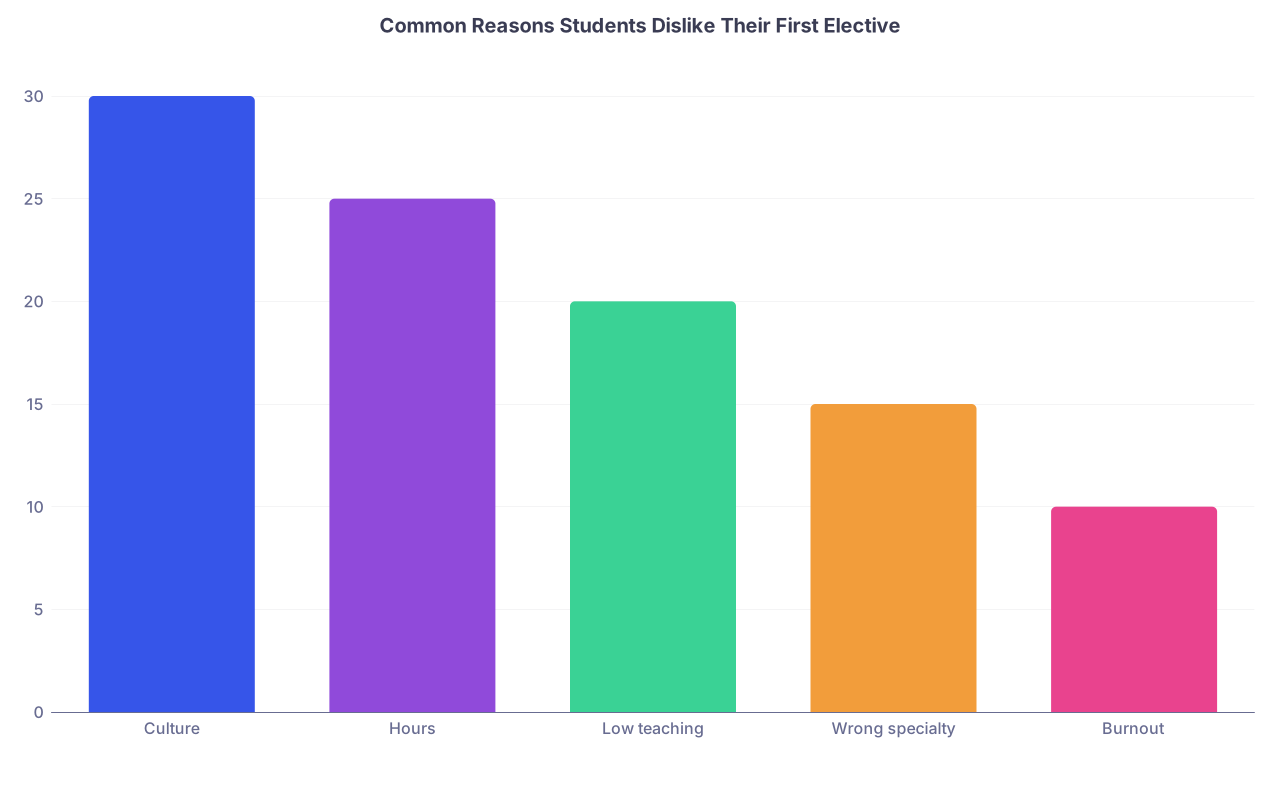
| Category | Value |
|---|---|
| Culture | 30 |
| Hours | 25 |
| Low teaching | 20 |
| Wrong specialty | 15 |
| Burnout | 10 |
How to Talk About a Bad Elective Later (In Applications & Interviews)
This will come up. People will see it on your schedule and ask: “So, how was your cardiology elective?”
You do not launch into your trauma monologue.
You say something like:
“It was intense. I learned a lot about how I don’t want to practice, which was actually useful. The hours were heavy and the culture was a little more hierarchical than I prefer, but I came away with a much stronger understanding of heart failure management, which I use all the time in [my chosen field]. It also made me realize I’m more suited to [EM/outpatient IM/etc.], where I can [reason].”
You:
- Tell the truth.
- Don’t torpedo anyone.
- Show reflection and maturity.
- Connect it to your actual path.
If you did pivot out mid-block and it shows up oddly on your transcript, own it calmly:
“I started a [specialty] elective and realized very early that it didn’t align with my goals or interests. After speaking with my advisor and the course director, I switched into [new elective] so I could get experience closer to what I was strongly considering for residency. I still learned a lot from those initial days, but I’m glad I made the adjustment.”
No drama. Just a decision.

| Step | Description |
|---|---|
| Step 1 | Realize you hate elective |
| Step 2 | Identify specific problems |
| Step 3 | Talk to dean/clerkship director |
| Step 4 | Stay & adjust role/expectations |
| Step 5 | Request switch based on learning goals |
| Step 6 | Start new elective with clear goals |
| Step 7 | Complete block, extract value, plan next electives strategically |
| Step 8 | Toxic/unsafe? |
| Step 9 | Salvageable with adjustments? |
| Step 10 | Switch approved? |
Your Next Move: Do This Today
If you’re on a miserable elective right now, don’t just scroll and nod.
Today, do two things:
- Write down, in 5–10 bullet points, exactly what’s bothering you about this elective—separate content, culture, schedule, and your own state.
- Send one message to a trusted upperclassman or faculty mentor: “Can I get your take on something? I’m on [elective], it’s feeling like a bad fit for me for a few reasons, and I’m trying to decide whether to adjust my approach or ask about switching. Can we talk for 10–15 minutes this week?”
That’s it. You don’t have to fix the month today. You just have to stop suffering silently and start moving intentionally.


