

Your rotation will not attend your family member’s funeral. You will. Act accordingly.
That’s the brutal tension you’re sitting in: you’re expected to be 100% present on service while your real life is on fire at home. And unlike pre-clinicals, you can’t just “catch the lecture later.” Rotations run on bodies physically showing up at specific times. You, or not you.
Let me walk you through how to handle frequent family emergencies in a way that 1) protects your people, 2) keeps you from failing rotations, and 3) doesn’t destroy your reputation with residents and attendings.
Step 1: Get Clear On What You’re Dealing With
Before you start emailing everyone in a panic, define the situation like an adult, not like a frantic M3.
Ask yourself three questions:
- Is this a one-off acute emergency or ongoing chronic instability?
- Are you the only realistic caregiver/decision-maker, or just one of several?
- Does this require you to be physically present, or can you support mostly by phone?
Examples:
- Acute, you must go: your mom has a stroke two states away and you’re next of kin.
- Ongoing, you must go repeatedly: your parent is in and out of chemo and you’re the only child nearby driving them to infusion, ER visits, admissions.
- Chronic chaos, but you’re not the linchpin: sibling with mental health crises, but parents and local support are available.
Why this matters: the more chronic and essential your involvement, the more you need system-level solutions (schedule changes, LOA, disability/leave), not just “sorry I’ll be out tomorrow” emails over and over.
Step 2: Know The Three Systems You Have To Satisfy
You are not just juggling “school.” You’re juggling three different systems, and each one cares about different things:
| Stakeholder | What They Care About Most | What They Fear Most |
|---|---|---|
| Clerkship Team | Coverage, reliability, fairness | No-shows, pattern of absences |
| Dean/Student Aff | Policy, documentation, liability | Hidden crises, legal risk |
| Residency PDs | Professionalism, narrative | “Red flags,” unexplained gaps |
You must manage all three:
- Clerkship directors/coordinators care about: Are you there? Are you safe to schedule? Will residents be stuck doing your work?
- Student affairs / dean’s office care about: Are we following policy? Are we protecting you and the school legally? Is there documentation?
- Future programs (through MSPE and letters) care about: Does this person consistently show up? Or are they a walking “unstable life” liability?
You do not get to treat this like a series of individual “sorry I’m out today” events. If emergencies are frequent, you need a strategy that addresses the pattern.
Step 3: Get Out Of “Hide It And Hope” Mode
The worst strategy is the one students default to: say nothing, disappear for a day, send a vague “family emergency” email, try to make it up with overwork, repeat.
That’s how you get labeled “unreliable” even if your life is objectively harder than your classmates’.
You need to:
- Tell the right people early.
- Be specific enough that they understand the pattern, without oversharing.
- Ask for structure, not ad hoc pity.
Here’s how to phrase it to student affairs or your college advisor:
“I’m starting clinicals while my father is dealing with [advanced cancer, recurrent hospitalizations]. I’m the primary person responsible for getting him to the hospital and making decisions when emergencies happen. In the past three months, we’ve had [X] unplanned ER visits and [Y] admissions. I’m worried this may cause repeated absences on short notice during rotations.
I need help planning my schedule and understanding what formal supports or leaves are possible so I don’t end up failing rotations or constantly scrambling.”
That’s the level of detail that triggers appropriate planning, not just sympathy emails.
Step 4: Learn Your School’s Actual Absence Rules (Not The Rumors)
You can’t game a system you don’t understand.
Pull up your school’s clerkship handbook. Not the one in your head. The real PDF.
You’re looking for:
- How many excused absences per rotation are allowed (often 2–3 days on a 4–6 week rotation).
- Which absences are automatically excused (funerals, illness) and which require make-up.
- Who must approve them: clerkship director vs coordinator vs dean.
- Policies on:
- “Pattern of absences”
- Long-term family caregiving
- Extended leaves / LOA
- Promotion decisions with incomplete rotations
If your school is halfway functional, the clinical dean’s office can summarize this for you in one meeting.
And you should absolutely ask them directly:
- “If I miss 3 days in week 2 for a family emergency, what actually happens?”
- “At what point does the rotation need to be repeated versus just made up?”
- “What’s the threshold where you’d recommend a leave of absence instead of trying to push through?”
Get those answers now, not at 2 a.m. the night before you’re supposed to be on surgery.
Step 5: Build A Communication Playbook Before The Next Crisis
You don’t want to invent your email strategy from scratch in the ICU waiting room.
You need three prepared templates:
- Advance warning email (when you know the situation is volatile)
- Day-of emergency email (when you have to miss with little notice)
- Follow-up / documentation email (to close the loop)
1. Advance Warning Email (to clerkship director + coordinator)
Send this before or at the start of a rotation if the family situation is unstable.
Subject: Potential Absences During [Rotation Name] Due to Family Medical Issues
Dear Dr. [Director] and [Coordinator],
I wanted to let you know in advance that a close family member is currently dealing with a serious medical condition that has required multiple unplanned hospitalizations in the past few months. I am one of the primary caregivers and may occasionally need to respond to urgent situations on short notice.
I am committed to this rotation and will do everything I can to minimize disruptions. If an emergency arises, I will notify you and my team as early as possible and follow the clerkship policies for absences and any necessary make-up time.
If there are any forms or additional steps you recommend so we can plan proactively, I’m happy to complete them.
Sincerely,
[Name], MS3
This frames you as responsible and transparent, not flaky.
2. Day-of Emergency Email
Send this to: coordinator, team senior/resident, maybe director (depending on your school’s norms).
Subject: Absent Today Due to Family Emergency – [Your Name], [Service]
Dear [Coordinator / Dr. X / Team],
I’m very sorry for the short notice, but I need to be absent from [clinic/rounds/OR] today due to an acute family emergency I must attend in person.
I have informed [Senior Resident Name] on my team. I will follow up with you and with the clerkship office about any required documentation or make-up time.
Thank you for your understanding.
[Name], MS3, [Pager/Phone]
No drama. No essay. But also not one cryptic sentence at 6:58 a.m.
3. Follow-Up Email (within 24–48 hours)
Dear [Coordinator/Dr. X],
Thank you for your understanding regarding my absence on [date]. I was dealing with [brief phrase: “a family member’s hospitalization” – no details needed].
Please let me know if any documentation is needed for the clerkship record and what, if any, make-up time would be appropriate. I want to be sure I’m meeting all rotation requirements.
Best,
[Name]
You want everything documented and professional. Later, if anyone asks, it’s all in writing.
Step 6: Decide When You Actually Need To Leave
Not every crisis requires you to physically disappear from the hospital.
Harsh truth: some students run home for every piece of bad news because they haven’t learned to triage.
Here’s a rough decision flow:

| Step | Description |
|---|---|
| Step 1 | Family emergency call/text |
| Step 2 | Ask to leave/absent |
| Step 3 | Stay, support by phone |
| Step 4 | Discuss partial absence or early leave |
| Step 5 | Life-threatening or time-critical? |
| Step 6 | Are you key decision-maker or only local caregiver? |
| Step 7 | Can you support remotely today? |
| Step 8 | Future impact if you stay? |
Leave immediately when:
- You are the medical power of attorney and big decisions are happening now.
- There is a credible risk of death or major deterioration and your presence matters to the patient.
- You are literally the only adult who can physically get the person to emergency care.
Consider staying (with frequent phone updates) when:
- The situation is scary but medically stable.
- Other adults are on-site and capable.
- What’s happening right now is mostly waiting (workup overnight, surgery scheduled for tomorrow, etc.)
I’m not telling you to abandon your family. I’m telling you to act like a future attending: hear the story, ask clarifying questions, and make a triage decision.
Step 7: Build Redundancy So You Are Not The Only Option
If you’re constantly being pulled out of the hospital because you’re the only semi-functional adult in your family, that’s a system failure at home, not just at school.
Do what you can to create backup:
- Identify at least one other person who can be physically present when you cannot: sibling, cousin, close family friend, neighbor, church member.
- Put them on HIPAA releases and as emergency contacts, so they can get info without you.
- Use MyChart/portal access so you can manage a lot remotely: messaging, test results, appointment coordination.
- Set ground rules with your family:
“If it’s [scenario A/B/C], call me immediately and I’ll come. If it’s [scenario D/E], call [other person] first, and text me an update.”
This sounds cold. It’s not. It’s reality management. You literally cannot be both a full-time caregiver and a full-time medical student in clinic every day without burning out or failing something.
Step 8: Know When To Hit The Brakes (LOA, Reduced Load, or Rotational Shifts)
There’s a threshold where the right move is not “keep grinding and hope you don’t fail.” It’s:
- Change the timing of rotations.
- Change the intensity of what you’re doing.
- Or pause entirely with a leave of absence.
Signs you may be there:
- Multiple rotations already disrupted by absences or low performance.
- You’re getting direct feedback about professionalism/reliability.
- You’re physically and mentally wrecked—barely keeping up, constant mistakes.
- Emergencies are happening monthly or more.
Options that are often on the table (students rarely know this):
| Option | When It Makes Sense | Trade-offs |
|---|---|---|
| Shift rotations | Known upcoming surgery/treatment | Longer overall schedule |
| Lighter rotation | During high-risk periods | Less “prestige” sometimes |
| Part-time enrollment | Ongoing caregiving | Delayed graduation |
| Formal LOA | Frequent major crises | Time, money, emotional toll |
You need a blunt conversation with student affairs:
“If my parent’s condition stays this unstable, is it more realistic to rearrange rotations, consider a reduced load, or take a leave? I’d rather plan that now than fail multiple clerkships.”
That’s how adults handle repeated crises. Not by martyrdom.
Step 9: Protect Your Evaluations and Narrative
You can miss time and still have strong evaluations if you control your narrative and your behavior when you are actually present.
Your job on service, especially if you’ve missed any days:
- Show up early, prepared, and engaged.
- Take ownership of patients you’re assigned.
- Don’t use your family emergency as a conversation topic every time you’re with residents.
- Do not weaponize your situation for pity points. People smell that instantly.
If an attending asks about your absence:
You:
“I had a significant family medical issue that required me to be off that day, but I’ve coordinated with the clerkship team and I’m fully available moving forward.”
If you’ve had multiple absences on one rotation, ask the clerkship director for a short meeting near the end:
“I know my absences were more than typical, given my family’s situation. I want to be sure I still meet expectations for professionalism and clinical performance. Are there specific things I can do or extra time I should complete?”
This shows insight and accountability. Programs care a lot more about that than about one or two messy months.
Step 10: Planning For ERAS and MSPE If Things Get Messy
If your family crises extend over many months and actually impact your grades, timeline, or leaves, you need a clean story for your residency applications.
Residents and PDs generally handle honest, specific hardship better than hand-wavy “personal reasons.”
Don’t do this in your personal statement:
“I faced significant personal challenges throughout medical school, which strengthened my resilience…”
Translation in PD brain: “I will be calling out of call with ‘family emergencies’ for the next three years.”
Better plan:
- Work with your dean’s letter writer / advisor on how it will appear in MSPE.
- Decide if an ERAS explanation is appropriate:
- One paragraph, factual, not melodramatic.
- Focus on:
- What happened (at a high level).
- What structural steps you took (leave, adjusted schedule).
- That the situation is now stable or has clear support systems.
Example ERAS “Miscellaneous Comments” type paragraph:
“During my third year, my mother developed a serious illness that required several prolonged hospitalizations. As her closest local relative and medical power of attorney, I took a short leave of absence and adjusted my rotation schedule to be present for critical decision points in her care. With support from student affairs, I completed all graduation requirements with strong performance on my later clerkships. This period reinforced my commitment to patient-centered care and taught me to set clear boundaries and coordinate effectively in high-stress situations.”
That’s honest. It explains irregularities. It doesn’t position you as a perpetual crisis generator.
Step 11: Taking Care of Yourself Without Pretending It’s All Fine
You’re going to be told to “practice self-care” by people who go home at 4 p.m. and have no idea what an ICU waiting room smells like.
Forget the Instagram version of self-care. Think minimum viable functioning:
- Non-negotiable sleep floor: maybe it’s 5–6 hours, but not 2–3 for weeks.
- Eat actual food on call: pack something or you’ll start making dumb mistakes.
- One brutally honest friend (classmate, partner, therapist) who knows the whole situation, not the sanitized version.
Strong recommendation: get a therapist involved early, especially if:
- You’re repeatedly getting pulled into end-of-life decisions.
- You’re seeing your family member decline while you’re simultaneously in the hospital caring for strangers.
- You feel resentment building toward either your family or medicine.
Many schools will:
- Pay for short-term counseling.
- Give you access to confidential services off campus.
- Provide documentation when mental health becomes part of the leave discussion.
Use them. This is not weakness. This is surviving something that actually breaks people.
Step 12: The Line You Cannot Cross
I’ll be blunt: there’s one behavior that will absolutely tank you, even if your family situation is tragic.
Do not lie.
Do not invent extra emergencies. Do not exaggerate severity to get more days. Do not reuse last month’s “critical situation” as this month’s.
Faculty talk. Coordinators talk more. Once there’s a hint that your story is inconsistent, you are done. You’ll get “professionalism concerns” on your record, and those are much harder to fix than a failed or delayed rotation.
If you’re at the point where you’re tempted to embellish, that’s not a “be more clever” moment. That’s a sit down with your dean and admit you’re overwhelmed moment.
Quick Reality Check: What You’re Actually Optimizing For
You are not trying to “beat the system” or “prove you can do it all.”
You’re trying to:
- Keep your family member cared for in a way that doesn’t destroy you.
- Stay professionally intact enough to graduate and match.
- Avoid burning bridges with the people who write your evaluations and letters.
To do that, your playbook is:
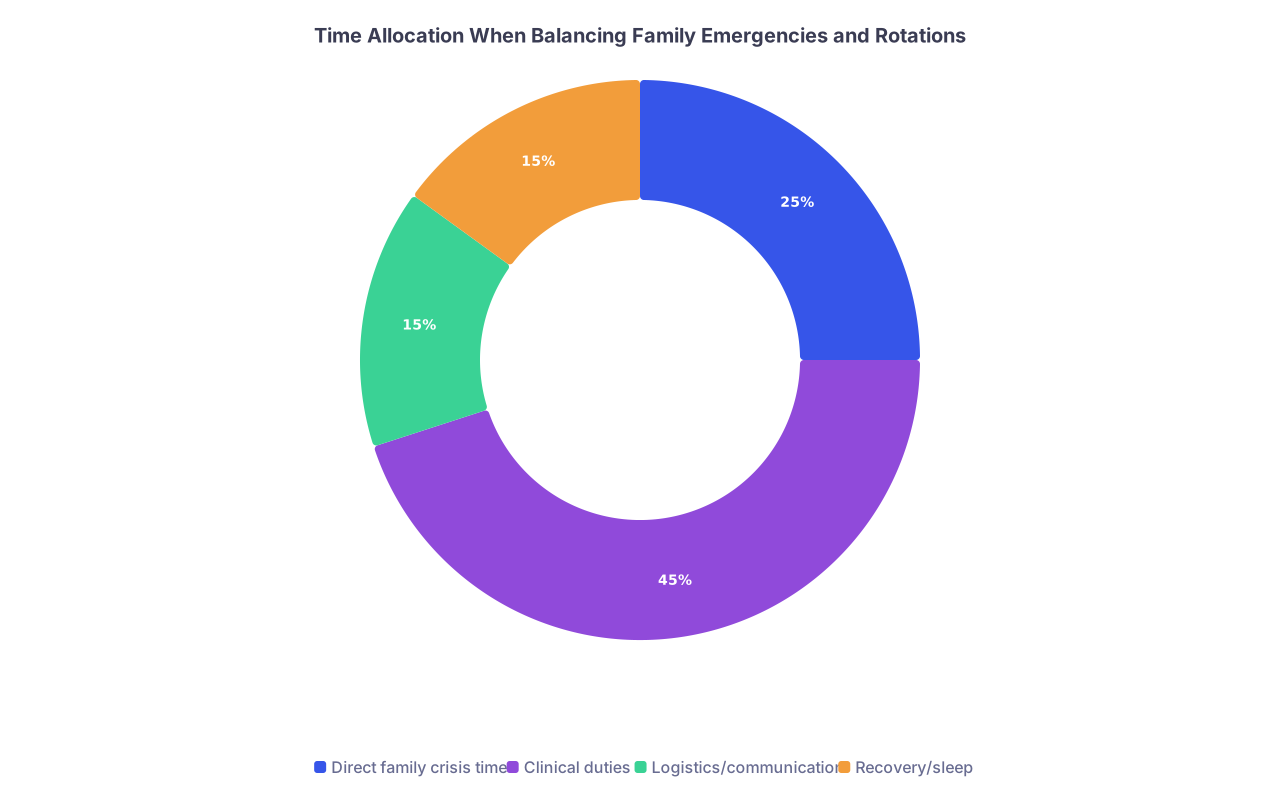
| Category | Value |
|---|---|
| Direct family crisis time | 25 |
| Clinical duties | 45 |
| Logistics/communication | 15 |
| Recovery/sleep | 15 |
Not pretty. Not “balanced.” But realistic.
On some weeks, those numbers will swing heavily toward family. On others, you’ll be mostly on service and running family life by phone. The key is that the school and rotation leadership are not surprised by this pattern.
Putting It All Together
One last visual for your mental model:

| Step | Description |
|---|---|
| Step 1 | Unstable family situation |
| Step 2 | Inform student affairs early |
| Step 3 | Understand absence/LOA policies |
| Step 4 | Pre-communicate with clerkship |
| Step 5 | Emergency occurs |
| Step 6 | Use day-of absence plan |
| Step 7 | Support remotely while staying on service |
| Step 8 | Follow-up + documentation |
| Step 9 | Discuss schedule change/LOA |
| Step 10 | Continue with communication plan |
| Step 11 | Need to be physically present? |
| Step 12 | Pattern becoming unsustainable? |
And if you’re thinking, “This is too much, I just need to survive this month,” I get it. Start small:
- Today: draft your three email templates.
- This week: schedule a meeting with student affairs or your college advisor.
- This rotation: send the advance warning email if your home situation is unstable.
- This semester: decide if you need structural changes (rotation swaps, LOA, or lighter blocks).
You’re allowed to protect your family. You’re also allowed to protect your future self as a physician.
Do both.
Key Takeaways
- Stop handling each emergency as an isolated event; treat recurring crises as a structural problem that needs planning with student affairs and clerkship leadership.
- Communicate early, specifically, and professionally—have templates ready, follow policies, and document everything.
- If the pattern is unsustainable, do not white-knuckle it; push for schedule changes, reduced load, or a leave before you collect failures and professionalism flags.


