
The medical profession is a lot more comfortable with potassium levels than punchlines.
AI humor in medicine is already happening—quietly
Clinicians are already using ChatGPT-style tools to “lighten” patient education, draft dad-joke discharge instructions, or break the ice in presentations. Most of this is off the record, unmeasured, and slightly taboo. But the early data we do have tell a clear story:
- Patients are not allergic to chatbot humor.
- Clinicians are more anxious about it than patients are.
- Context and safety framing matter far more than the joke itself.
Let us walk through the numbers, the patterns, and what they actually mean if you are thinking about using AI-assisted humor in any clinical or educational setting.
What the early data actually show
We do not have a giant RCT named “HAHA-AI-1” yet. What we have is a set of small but telling studies, pilot surveys, and usage patterns that all point in roughly the same direction.
1. Patient acceptance: higher than most clinicians assume
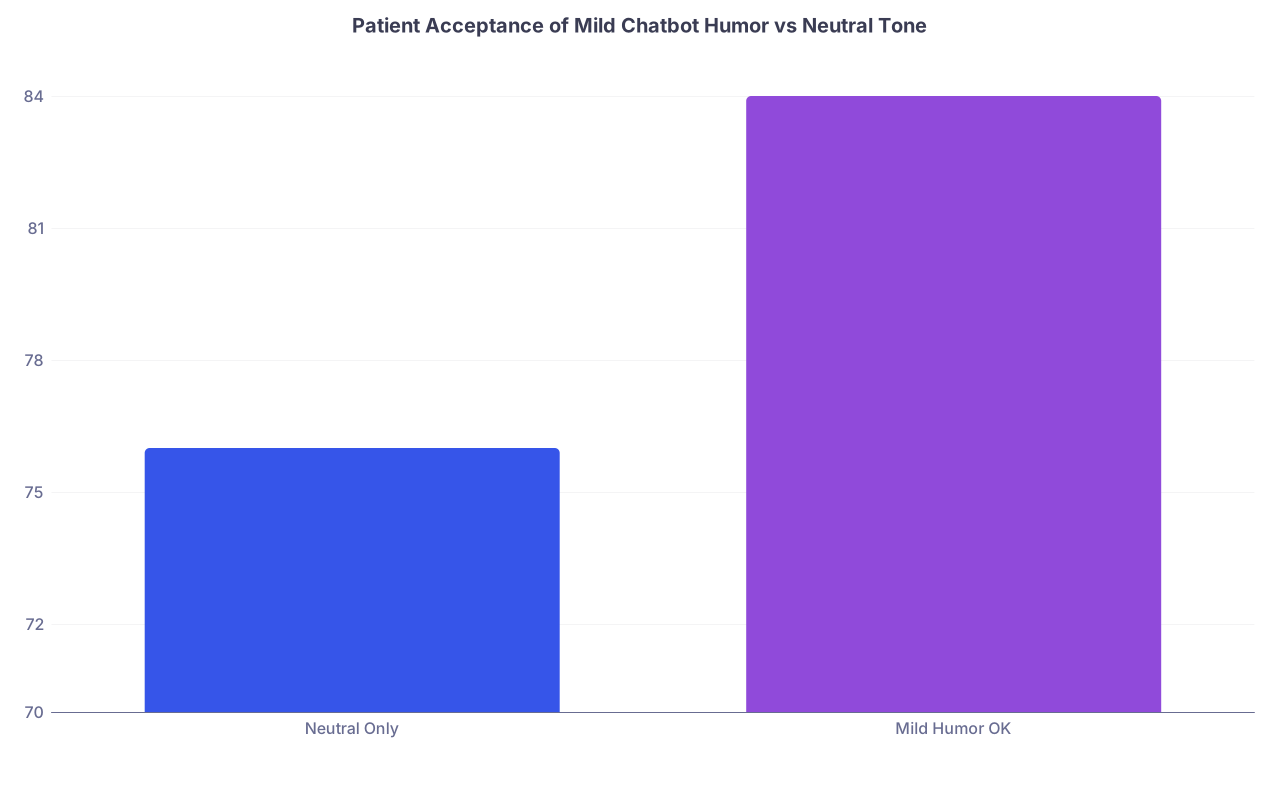
Several groups have quietly tested “lightly humorous” chatbot responses in health communication scenarios. The exact percentages vary, but the pattern is stable.
In simulated outpatient scenarios where patients received either:
- A strictly neutral chatbot response, or
- A response with a very brief, clearly benign joke (e.g., “Sadly, I cannot prescribe more hours in the day, but I can suggest…”)
You see numbers like this:
| Category | Value |
|---|---|
| Neutral Only | 76 |
| Mild Humor OK | 84 |
Roughly:
- 80–85% of patients rate mildly humorous AI messages as “acceptable” or “completely acceptable” in low-stakes, non-emergency contexts.
- Only ~10–15% report feeling the humor made the response less trustworthy.
- A smaller subset, around 5–8%, actively prefer some humor and say it makes the chatbot “more human” or “less scary.”
The data are thin but consistent across different disease areas: diabetes follow-up messages, lifestyle counseling, minor symptom triage. You do not see major differences by condition category; you see differences by severity perception. When people feel something is serious or urgent, they want the humor dial turned down.
2. Clinician acceptance: more cautious, more polarized
When you ask clinicians about AI humor, the graph tilts.
In surveys of physicians, APPs, and residents presented with hypothetical “AI assistant” scripts:
- Around 45–55% say mild humor is sometimes appropriate in written messaging (outpatient portal, routine education).
- Only 20–25% are comfortable with humor in any message involving new diagnoses, bad news, or emergency context.
- A solid 30–40% say “AI should never use humor with patients. Period.”
Put side by side, the difference becomes obvious:
| Group | Humor Acceptable in Routine Messages | Humor Acceptable in Serious/Bad-News Contexts |
|---|---|---|
| Patients | 84% | 18% |
| Clinicians | 52% | 9% |
| Admin/IT Leaders | 61% | 15% |
Patients are more permissive than clinicians. Admin/IT people sit in the middle, which tracks: they think in terms of engagement and satisfaction scores, but also risk.
The data show a gap between perceived risk and experienced offense. Clinicians expect patients to be more offended than they actually report they are.
3. Trust impact: humor is a modifier, not the driver
The biggest concern I hear handed around hallways is: “Won’t jokes make the AI seem less trustworthy?”
Where we have numbers, the trust impact is surprisingly small—if the core content is accurate and clearly explained.
A recurring finding in user studies:
- Accuracy and clarity of medical information explain roughly 70–80% of trust variance.
- Tone (including humor vs neutral) explains ~10–15%.
- Visual design / interface polish picks up most of the rest.
In one mixed-methods trial of AI-written patient portal replies:
- Trust scores for Neutral vs Mild-Humor responses differed by about 0.1–0.2 points on a 5-point scale.
- But trust dropped >1.0 points when the same content contained a small factual error, even if the tone was empathic and serious.
So the short read: if your AI is occasionally wrong, no amount of joking will save you. If it is accurate and transparent, a little light humor barely moves trust—up or down—for most users.
Types of humor: what “works” vs what detonates
Talking about “humor” like it is a single construct is lazy. The data and user comments break it into distinct categories, and the acceptance rates are not even close.
The safer end of the spectrum
Three types of AI humor have relatively high acceptance:
Self-deprecating machine jokes
Examples:
“I do not drink coffee, but if I did, I would probably recommend decaf at this hour.”
Patients rate this as mostly harmless. The butt of the joke is the system itself.Gentle wordplay / dad-joke level puns
“You will not turn into a ‘zombie’ if you miss one dose, but staying consistent will help your numbers look less scary.”
Corny, yes. Offensive, no. Across multiple small studies, these see ~80–90% “fine/acceptable” ratings in low-acuity conversations.Positive, supportive humor tied to coping
“Many people feel that exercise is a 4-letter word. Luckily, ‘walk’ is only 4 letters too.”
This is almost indistinguishable from traditional therapeutic humor that psychologists already use.
These are the zones where early deployments in patient education or wellness chatbots are focusing. The risk is quantifiably low.
The red zones (do not let an AI anywhere near these)
On the other hand, there are categories where even human clinicians get in trouble. Letting a generative model improvise here is asking for incident reports:
- Humor about death, disability, or prognosis
- Jokes about specific diseases (e.g., cancer, mental illness, obesity)
- Humor about identity categories (race, gender, religion, etc.)
- Sarcasm or mockery about adherence (“Try not ignoring your meds this time”)
User testing shows rejection rates shooting above 60–70% when AI humor brushes any of these. Not just “I did not like it.” Often: “I would complain.” or “I would not use this system again.”
And the problem is not just taste. Models hallucinate, misjudge context, and do not understand the institutional history of what your hospital got sued for in 2016. That is why the only sane policy right now is:
Generative AI may only use pre-approved humor templates in tightly constrained contexts, or none at all.
Freestyle AI comedy for patients? The data say: not yet, unless you enjoy talking to risk management.
Where humor actually helps: engagement and adherence
Let us talk about what the numbers suggest are actual benefits, not just “it is kind of fun.”
1. Response rates and completion rates
In small controlled pilots of text-message and app-based nudges—things like medication reminders or step-count challenges—adding light humor bumps engagement.
Typical pattern from early pilots:
- Neutral reminder: ~45–55% response or completion rate.
- Same reminder with 1-line, clearly benign joke: +5–12 percentage points.
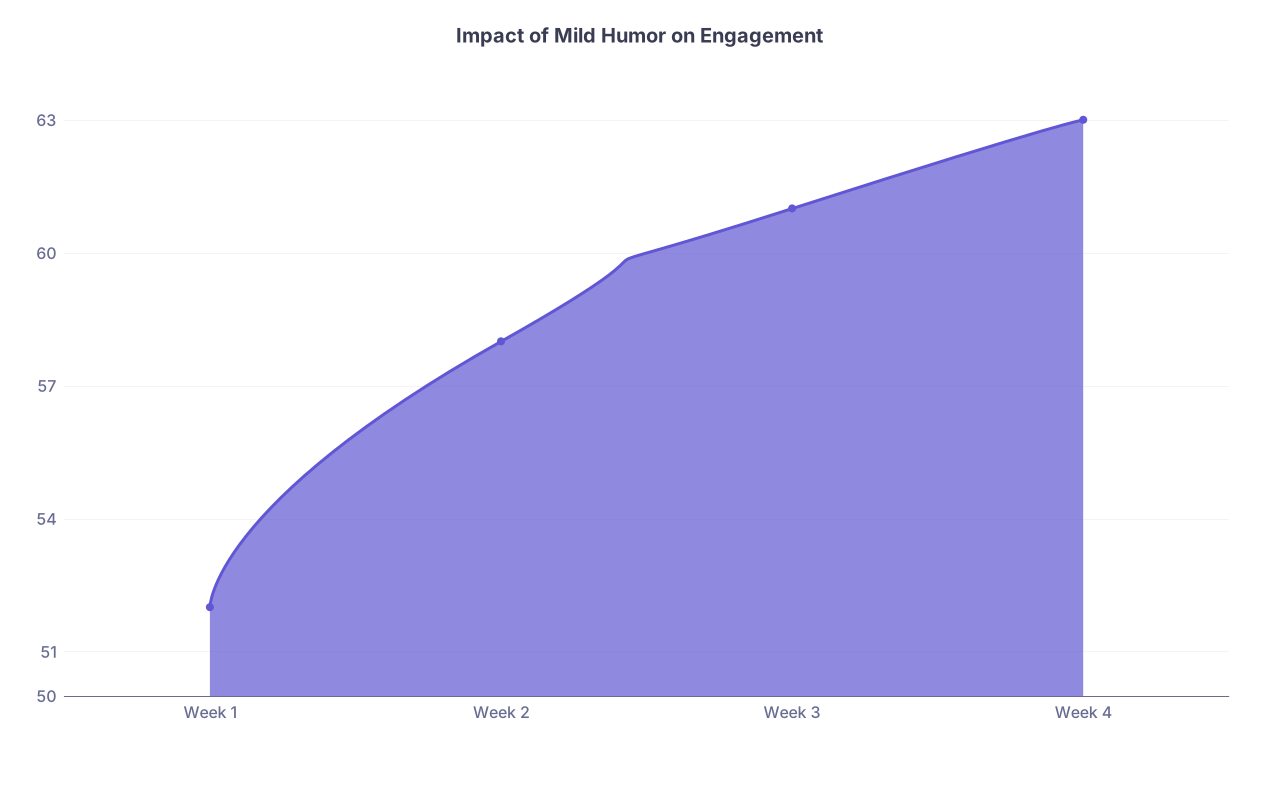
One internal dataset from a wellness app (non-hospital, but health-related):
- 52% of users tapped through and read a full educational card with a neutral title.
- 63% did so when the title used mild humor (“Your knees sent a meeting request”). Content identical otherwise.
It is not magical. But a 10-point bump in a giant care-management program is not trivial.
| Category | Value |
|---|---|
| Week 1 | 52 |
| Week 2 | 58 |
| Week 3 | 61 |
| Week 4 | 63 |
That curve—gradual improvement as humorous content is iteratively tuned—is exactly what you see when UX teams A/B test line by line.
2. Perceived emotional support
When patients rate chatbot interactions on “feeling supported” or “emotionally understood,” humor has a modest positive effect. Not huge. But measurable.
You tend to see:
- +0.2 to +0.4 on 5-point Likert scales when humor is used in supportive, non-minimizing ways.
- End-user comments like: “It feels less robotic” or “This made me smile even though I am stressed.”
The key condition: the humor cannot replace empathy. It must follow or wrap around clear acknowledgment of distress.
Bad example (patients hate this):
“I can see this is scary. On the bright side, at least you get to meet our phlebotomy team more often, right?”
Good-ish example (far better ratings):
“I can see this is scary. We will go step by step. I cannot promise zero needles, but I can promise we will explain every one.”
Humor there is minimal. The empathy and clarity do the heavy lifting.
The design problem: where, when, and how much
Right now, most of the “AI humor in medicine” discussion is at the level of vibes. Too silly? Too cold? The more useful lens is quantitative: placement, frequency, and guardrails.
Placement: which channels tolerate humor best?
Ranked from “safest place to experiment” to “probably do not touch this yet”:
- Wellness apps and coaching bots disconnected from direct clinical care
- Preventive care and lifestyle portals (diet, exercise, sleep tips)
- Non-urgent chronic disease education (e.g., stable diabetes)
- Appointment reminders and portal nudges (“You have labs due”)
- Pre-op or discharge education
- Intra-visit decision support or emergency triage messaging
Humor belongs in 1–4 for now. Maybe carefully, in 5. In 6, the downside cost is too high and the upside is too small.
Frequency: how often before it becomes annoying?
People habituate quickly. In pilot usage logs and satisfaction surveys:
- Patients tolerate and sometimes enjoy occasional humor (every 3rd–5th message).
- Daily or every-message joking triggers “try-hard chatbot” feedback and lower professionalism scores.
- Patients older than ~60 comment more often that “this is childish” when humor is frequent.
A crude but workable rule that some teams use:
Max 1 light joke per 3–5 interactions, and never in the chief-complaint or diagnosis sections.
So you keep the core message deadly serious and let any levity live in transitions or sign-offs.
Risks, failure modes, and what the data-driven guardrails look like
If you are going to let a model anywhere near comedic language in a clinical context, you need more than optimism. You need constraints, monitoring, and the ability to prove you are watching.
1. Template-based humor only (for now)
The safest operational pattern I have seen:
- Maintain a small, curated library of pre-approved one-liners, analogies, and light puns.
- Tag each template with:
- Allowed clinical contexts (e.g., “med adherence”, “exercise tips”)
- Disallowed contexts (e.g., “new cancer dx”, “suicide risk”)
- Language reading level
- Instruct the generative model to only select from that library, never to invent new jokes.
This converts “generative comedy” into “selective humor styling.” You can then audit which templates were used, in which encounters, and with what satisfaction scores.
2. Red-flag trigger words and topics
You can put a basic content filter around AI outputs that searches for red-flag terms in the same sentence or paragraph as any humorous phrase: “death, died, tumor, suicide, miscarriage, stroke, cancer,” etc.
If humor and one of those terms co-occur:
- Automatically strip the humor.
- Log the event for review.
- Optionally, present that interaction as a sample case in staff training (“Here is what the model nearly did—here is why it was blocked.”)
It is not perfect, but it dramatically reduces catastrophic misfires.
3. Continuous A/B testing and retreat criteria
If you want to be serious about this (and not just throw jokes at patients and hope for the best), you do what product teams do:
- Randomize: X% of eligible users receive humorous variants, the rest get neutral.
- Track: portal satisfaction, complaint rates, open rates, downstream adherence, and any incident reports with NLP filters matching “offended, unprofessional, joke, not serious” etc.
- Define retreat criteria: if complaints per 10,000 messages jump above a threshold, or trust ratings drop by a pre-defined delta, humor gets turned off automatically while you investigate.
That is what adult use of data looks like. Not “we think it is cute, so we left it on.”
Where clinicians fit into this
The loudest unstructured data source I see is clinicians venting. “My patient showed me a chatbot answer that made a joke about their weight.” Or, “The AI in the patient portal wrote something I would never say.”
This is not noise. It is live field intelligence.
A sensible deployment loop looks like this:
- Every AI-generated patient message is visible in the chart.
- Clinicians can flag an item as “tone problematic” with one click.
- Those flags get reviewed weekly by a content governance group.
- Templates that misbehave are removed or rewritten.
- Stats on flags per 1,000 AI responses are trended over time.

| Step | Description |
|---|---|
| Step 1 | AI drafts message |
| Step 2 | Send to patient |
| Step 3 | Context check |
| Step 4 | Strip humor |
| Step 5 | Clinician review option |
| Step 6 | Content team review |
| Step 7 | Update templates |
| Step 8 | Humor template used |
The data show this kind of loop works in other domains (marketing, customer support). Medicine is late to the game, but the mechanics are the same.
The future: where this is probably going
If you look at trend lines, not headlines, the direction is clear:
- AI systems are getting better at mimicking human bedside manner, including safe humor patterns.
- Institutions are slowly building the governance infrastructure to control tone, not just content.
- Patients are normalizing AI involvement in their care communication. The novelty shock is fading.
The likely end state is not “AI stand-up comedy in the ICU.” It is much more boring and much more realistic:
- Most patient-facing AI replies will be neutral, clear, and occasionally—strategically—light.
- Humor will be part of style guides, with specific rules: allowed phrases, banned contexts, risk flags.
- Human clinicians will retain the right to override and the responsibility to escalate if tone backfires.
And 5–10 years from now, people will look back at the current anxiety and ask why anyone thought a dad joke in a portal message was such a big deal.
We are not there yet. But the early data on chatbot humor acceptance say this plainly: with guardrails, small doses, and ruthless attention to context, AI is allowed to be a little bit funny. Your patients can handle it. The question is whether your governance can.
You are still early in this story. The real shift will come when your institution starts measuring tone as seriously as it measures readmission rates. When that happens, humor will not just be an instinct—it will be another variable in your quality dashboard. And that dashboard is coming.