
The most dangerous jokes in medicine are the ones everyone laughs at but you cannot shake off afterward.
You know the ones. The med student quips, “At least the dead ones do not press the call light,” after a long code. Everyone snorts, someone says “dark,” the moment passes. But you keep replaying it on your drive home and your stomach feels off.
If you are a resident and a student is using humor to cope in a way that worries you, you are not being oversensitive. You are doing your job.
Let’s walk through what to actually do. Not in some idealized professionalism-manual way. In a “you have 8 patients, 3 pages, and still need to finish your notes” way.
Step 1: Sort out what kind of “worry” this is
Do not treat every weird or dark joke as a crisis. You’ll burn out and everyone will stop listening when you raise real concerns. You need a mental triage system.
Ask yourself three questions:
- Is this ordinary gallows humor or does it feel off for the situation?
- Is the student using humor instead of processing, or as part of healthy coping?
- Is there any hint of risk to patient safety, self-harm, or harassment?
Use that to group what you’re seeing.
| Type of Humor | How It Feels | Priority Level |
|---|---|---|
| Normal gallows humor | Matching team vibe, brief, not targeted | Low |
| Awkward/immature joke | Off-timed, student blushes or backs off | Low–Medium |
| Detachment mask | Constant joking, flat affect afterward | Medium |
| Hostile or punching down | Directed at patients, nurses, identities | High |
| Self-destructive or suicidal | About wanting to die, disappearing | Critical |
Normal vs “this doesn’t feel right”
Examples of things that are usually fine (context-dependent):
- “If I hear ‘page stat’ one more time I’m just going to dissolve into the floor.”
- After a clean, expected death in the ICU: “At least Mr. S had better vitals than the EMR system this morning.”
That’s standard resident-to-resident banter. If the whole team is already in that register, a student echoing it once or twice is not an emergency.
Things that deserve a mental red flag:
- Talking about a specific patient’s body or condition like they’re an object: “This guy is basically a practice pin cushion; he will not notice one more stick.”
- Laughing at a vulnerable group: “Psych patients are so dramatic, it is kind of entertaining.”
- Repeatedly calling themselves “useless,” “a burden,” or joking about suicide: “If I fail this eval I will just step in front of a truck, problem solved.”
If your internal reaction is: “Oof, if the patient/family/nurse heard that, we’d be in real trouble,” or “If I saw this in an eval, I’d flag it,” then you’re right to worry.
Step 2: Check for acute risk before anything else
Before you go into teaching-mode or professionalism-mode, do a quiet, fast internal check: is this just about coping style, or are you worried about safety?
Red flags for self-harm or serious mental health risk:
- Jokes that are specific about methods or timing:
- “If we get another admission I’m genuinely going to drive into the river after shift.”
- “This call schedule is a rope-and-ceiling-beam situation.”
- Jokes that keep coming back to “I should not exist” or “you’d all be better off without me.”
- Big changes in behavior paired with dark humor: previously engaged → now withdrawn, then dropping “I’m dead inside” jokes constantly.
If you have that “I’d feel awful if I ignored this and something happened” feeling, you treat it as possibly serious, even if they say “I’m just kidding.”
Your priorities then:
- Get them out of the open ward environment (hallway, team room full of people).
- Ask blunt, direct questions (more on that below).
- Loop in someone with actual authority over student wellbeing (clerkship director / student affairs) the same day.
You are not diagnosing them. You are risk-screening and passing the ball.
Step 3: Pick the right moment and setting to talk
Do not blast them in front of the team with, “That was inappropriate.” That teaches them exactly one thing: hide better.
You want:
- Privacy: small workroom, empty hallway, call room, or quiet corner of the cafeteria.
- Time box: even 5–10 minutes is enough if you’re focused.
- Non-clinical tone: no laptop open, no half-charting while talking.
Sample openers that do not sound like you’re about to fail them:
- “Hey, got a second? I wanted to check in about something.”
- “Quick debrief about today, especially that joke you made earlier.”
- “I am not mad, but I want to understand where you’re coming from with some of the humor.”
You’re setting this up as caring, not punishment. That changes how honest they’ll be.
Step 4: Name what you saw and why it flagged you
Be specific. Vague “your humor concerns me” just makes people defensive.
Structure it like this:
- Describe the behavior, with specifics.
- Connect it to impact (or potential impact).
- Ask an open question.
Example for gallows humor that felt detached:
“On rounds after the code, you said, ‘Well, at least we freed up a bed.’ People chuckled, but I noticed you went quiet afterward and you looked kind of shut down. I want to make sure you’re actually okay about that patient. How are you doing with it?”
Example for humor that risks professionalism:
“In sign-out you referred to Ms. L as ‘the train wreck in 12B.’ That kind of language can bleed into how the team thinks about patients, and if a family overheard, it would really damage trust. What was going through your head when you said that?”
Example for self-deprecating / self-harm adjacent humor:
“You’ve called yourself ‘useless’ and joked about wanting to get hit by a bus three times this week. Hearing that repeatedly makes me worry that you’re not doing well. How much of that is a real feeling versus just joking?”
You’re not accusing. You’re inviting them to step out from behind the joke.
Step 5: Actually listen to the answer
There are usually a few patterns you’ll hear.
Pattern 1: “I’m just trying to fit in”
They’ll say things like:
- “Honestly I’m just copying the residents; that’s how everyone talks.”
- “At my last rotation, that was how they handled stuff.”
Here, the issue is culture and calibration, not pathology.
Your move:
- Normalize the need to cope.
- Give concrete guardrails.
Something like:
“I get it. We all use dark humor sometimes, me included. The trick is knowing the line. Stuff that punches up at the system, or at the absurdity of medicine, is usually okay. Stuff that punches down at patients, nurses, or about hurting yourself is not. Around patients, families, and staff, I want you in ‘if this were recorded’ mode. If you’re not sure, leave it out.”
You can even tell on yourself:
“I once got pulled aside as a student for making a joke about a ‘frequent flyer.’ I thought I was being clever. In hindsight, I was being lazy. You don’t have to repeat our worst habits to belong.”
Pattern 2: “I’m not okay, but I don’t know how else to talk about it”
They may say:
- “If I don’t joke about it, I’ll probably cry.”
- “Everyone else seems fine. I feel like a mess.”
Now you’re in the zone of real distress masked by humor.
Your moves:
- Validate that reaction: “That makes sense. What you’re seeing is heavy.”
- Normalize emotional response: “If you felt nothing, I’d be more worried.”
- Nudge toward healthier processing: “Have you had space to debrief with anyone? Friends, school, therapist?”
Then gently transition to resources (more on this in Step 7).
Pattern 3: “I’m actually not safe”
If they answer with:
- “Honestly I don’t care if I wake up tomorrow.”
- “Yeah, I’ve thought about ending it. I was half-serious about the bus thing.”
Stop everything else.
This is no longer about humor. It’s about acute risk.
You say, clearly:
“Thank you for being honest with me. That makes me concerned enough that I don’t feel comfortable just letting this go. We need to get you support today.”
Then:
- Ask directly: “Are you thinking about harming yourself right now?” and “Do you have a plan?”
- Don’t argue or minimize (“But you’re doing so well!”). Useless.
- Do not promise secrecy. Instead: “I can’t keep this just between us, but I will be thoughtful about who I involve.”
You escalate within the same shift. Not “tomorrow,” not “after the weekend.”
Step 6: Draw clear lines without shaming
Students need to know where the boundaries are. You can do that without going full “OSCE standardized patient feedback voice.”
Hit three things:
- What’s not okay.
- Why it matters.
- What you expect next.
Example for punching down at patients:
“I want to be clear: jokes that label patients as ‘train wrecks’ or ‘psychos’ are not acceptable on this team. They erode empathy and they’re one overheard comment away from a complaint. Going forward, I expect you to avoid talking about patients in that way, even when others do. If you need to vent, we can talk directly about what’s frustrating instead of turning them into punchlines.”
Example for self-harm “jokes” that keep happening:
“Given how often you joke about dying or disappearing, I need you to stop using that as humor on this rotation. It makes it hard for me to tell when you actually might be at risk, and it worries other people too. If you’re feeling that bad, I would rather you say, ‘I’m not okay’ in plain language so we can get you help.”
You are allowed to set team norms as a resident. That is part of the job.
Step 7: Decide who else needs looped in (and how)
Your internal calculus here:
- How severe is the concern?
- Is this a pattern or a one-off?
- Is it about wellness, professionalism, or safety (or all three)?
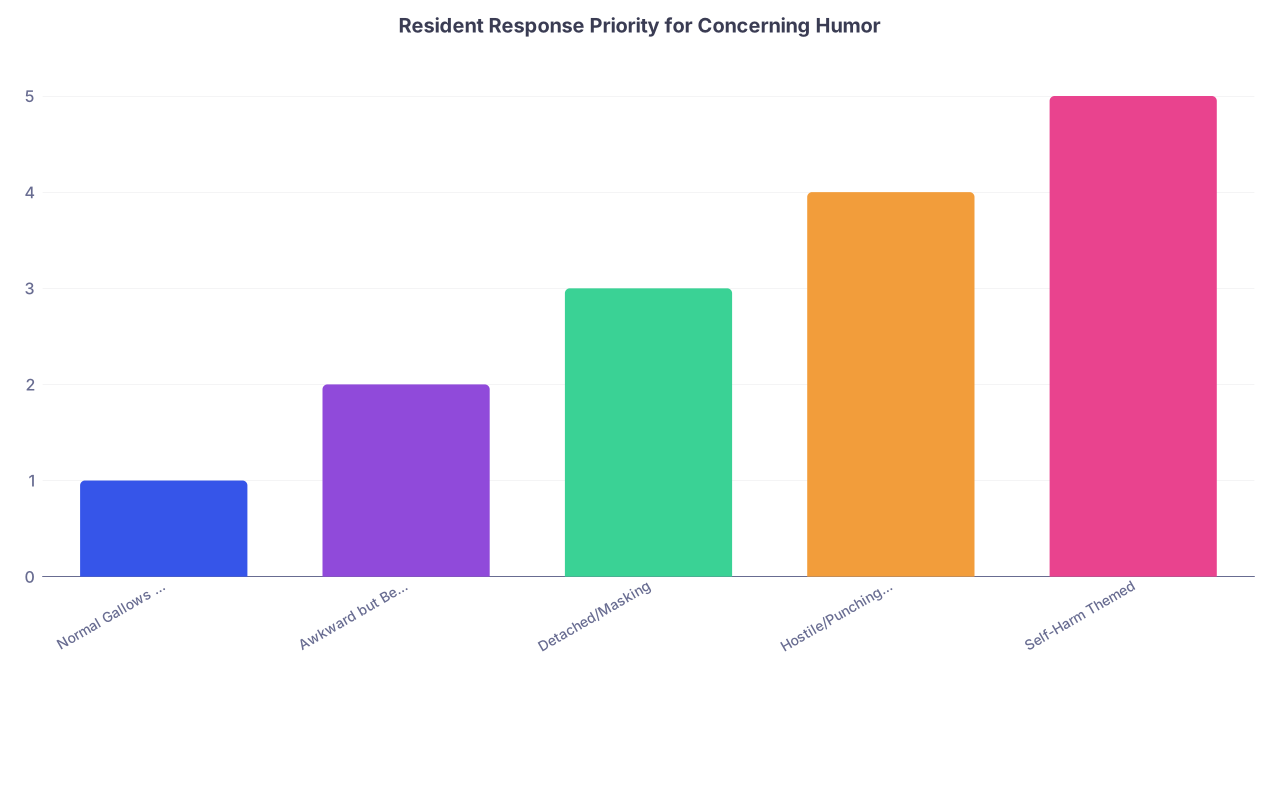
| Category | Value |
|---|---|
| Normal Gallows Humor | 1 |
| Awkward but Benign | 2 |
| Detached/Masking | 3 |
| Hostile/Punching Down | 4 |
| Self-Harm Themed | 5 |
Here’s a practical breakdown.
Low concern (awkward but benign)
- You had a single conversation.
- Student understood immediately and adjusted.
- No patient/staff impact.
Action:
You handle it yourself. Maybe mention very briefly to the attending in your debrief: “I gave [Student] some feedback on humor and professionalism, they responded well.” Done.
Medium concern (detachment, repeated comments, mild boundary issues)
Action:
- Talk with your attending: “I’m a bit concerned about how [Student] is coping and some of their jokes. I spoke with them, but I think it might help if you also keep an eye out.”
- Depending on culture, a heads-up email to the clerkship director (neutral tone, focused on support, not punishment).
Something like:
“I’m writing regarding [Student], currently on [service] from [dates]. I’ve observed several instances where they used dark humor in a way that seemed more like emotional shutdown than healthy coping (examples: [short bulleted list]. I met with them privately to discuss this and to check in on their wellbeing. They acknowledged feeling stressed and may benefit from additional support. No acute safety concerns at this time, but I wanted you aware in case this aligns with anything you’re seeing elsewhere.”
You are not labeling them “unprofessional.” You’re flagging a pattern.
High concern (hostile humor, harassment, or any self-harm content that worries you)
Action:
- Immediate conversation with attending.
- Same-day contact with clerkship director or student affairs.
- For true safety concerns, involve the on-call psychiatry or ED pathway your institution uses.
And you document your part: brief email to yourself or a secure note about date, what was said, what you did. Not for revenge. For clarity and accountability if things escalate later.
Step 8: Protect the team and patients in real time
There are moments when you can’t pull the student aside right away, but you still have to manage the fallout. For example:
- They make a joke about psych patients in front of a nurse.
- They say something flippant about a death in front of other students.
You can do a quick, in-the-moment course correction without a showdown.
Short, direct responses:
- “Let’s not talk about patients that way.”
- “Not an appropriate joke for here.”
- “We’ll debrief that later; for now, let’s focus on the patient.”
Then you actually follow up later in private. Brief public correction + private depth. That combo works.
If a patient or family overheard something, that’s a different level:
- You or the attending speak to them directly: “I’m sorry for what you heard. That does not reflect how we feel about you/your loved one. We’re addressing it.”
- You let whoever handles patient relations at your hospital know. Protect the student from being shredded, but do not cover up impact.
Step 9: Watch your own humor while you’re at it
Hard truth: students copy what they see. If you are constantly making scorched-earth jokes about your patients, admin, or yourself, they will mirror it and crank it up 10%.
You do not have to turn into a robot. But if you’re going to hold them to a standard, you need to be at least vaguely in the same ballpark.
Ask yourself honestly:
- “Would I be okay if someone recorded this and played it in M&M?”
- “Would I want a future patient to hear me saying this?”
If the answer is a hard no, maybe retire that bit.
And if you notice your own humor is getting darker, meaner, or more self-destructive month by month, do not ignore that either. Residents get chewed up too. Sometimes the student is just reflecting the water you’re both swimming in.
Step 10: Turn this into a growth moment for the student
The goal is not just “stop making me uncomfortable.” It’s to help them build a sustainable, humane way of coping in medicine.
A few practical ways to do that:
- Offer alternative outlets: “If that code is sitting with you, take ten minutes and write it down. Or talk to a co-student. Jokes can be a bridge, but they can’t be the whole road.”
- Model non-jokey debriefing: After a bad outcome, say to the team, “Okay, that was rough. I’m feeling [x]. Anyone else want to say anything before we move on?” Small, but students notice.
- Give explicit permission: “It’s okay to say, ‘That case is bothering me’ instead of laughing it off. You won’t be judged for that on this team.”
A lot of students joke because they believe real emotion is unacceptable. You can prove them wrong.
A quick decision map you can keep in your head

| Step | Description |
|---|---|
| Step 1 | Hear concerning joke |
| Step 2 | Private check in now |
| Step 3 | Escalate to attending and school today |
| Step 4 | Connect to support, inform clerkship |
| Step 5 | Brief public correction |
| Step 6 | Private feedback and expectations |
| Step 7 | Private wellness check, light escalation |
| Step 8 | Single feedback, monitor |
| Step 9 | Self harm or safety risk? |
| Step 10 | Active intent or plan? |
| Step 11 | Punching down or unprofessional? |
| Step 12 | Pattern of detachment? |
You’re not going to run that like code in real time, but after a couple of these, it becomes instinctive.
The real point here
Students will always use humor. So will you. The goal is not to sanitize medicine into this fake, sterile environment where no one ever laughs at anything dark.
The goal is to:
- Protect patients from being the butt of the joke.
- Protect students from using humor as the only shield they think they’re allowed to have.
- Protect yourself from ignoring early warning signs of someone drowning in front of you.
You will not handle every situation perfectly. Sometimes you’ll overreact. Sometimes you’ll let something slide that you later wish you’d addressed.
But the fact that you’re even worrying about that student’s jokes? That already puts you ahead of the pack.
You’re not just cranking through notes and discharges. You’re paying attention to the human being standing next to you in the workroom, laughing a little too hard at things that are not funny.
Today it’s a weird joke on rounds. Next year it might be a co-resident hiding their burnout. Ten years from now it might be your own kid coming home from their first clinical rotation, making light of things that scare them.
The muscles you build now—naming what you see, asking directly, setting boundaries, looping in help—those are the same ones you’ll need then.
For now, you’ve got one student, one rotation, and one uneasy feeling about their humor. You know how to handle that. The next step is doing it on your very next shift. The future of how we cope in this profession will be built in moments exactly like that—but that’s a bigger conversation, for another day.