Introduction: How AI Is Transforming Radiology and Diagnostic Precision
Artificial Intelligence (AI) is no longer a distant concept in healthcare technology; it is now embedded in daily clinical workflows, especially in radiology. As imaging volumes surge and case complexity increases, radiologists are under growing pressure to deliver rapid, accurate interpretations while maintaining high-quality patient care.
AI in Radiology is emerging as a powerful ally—augmenting human expertise, enhancing diagnostic precision, and reshaping how imaging services are delivered. From automated image analysis to predictive analytics that anticipate disease progression, AI is influencing not just how we read scans, but how we think about medicine, systems, and ethics.
This expanded guide explores:
- What AI in radiology really is (beyond the buzzwords)
- How it improves diagnostic precision and workflow efficiency
- Real-world clinical applications across different subspecialties
- Benefits and limitations for both trainees and practicing radiologists
- Ethical, legal, and professional implications for patient care
- Future directions and how you, as a medical student or resident, can prepare
Foundations of AI in Radiology and Medical Imaging
Understanding the Radiology Workflow and Imaging Complexity
Radiology encompasses a wide range of medical imaging modalities:
- X-ray – Fast, low-cost imaging for bones, chest, and basic screening
- Computed Tomography (CT) – Cross-sectional imaging for trauma, oncology, vascular, and more
- Magnetic Resonance Imaging (MRI) – High-contrast soft tissue imaging for brain, spine, joints, and organs
- Ultrasound – Real-time, radiation-free imaging for obstetrics, vascular, and point-of-care applications
- Nuclear Medicine and PET – Functional imaging for oncology, cardiology, and neurology
Each exam can produce dozens to thousands of images. For example, a modern CT chest/abdomen/pelvis or MRI brain may generate hundreds of slices. When multiplied across a full day’s work for a busy radiologist, the cognitive load is immense.
Radiologists must:
- Detect subtle abnormalities
- Characterize and quantify findings
- Integrate imaging with clinical context
- Communicate actionable recommendations
AI in Radiology does not replace these core responsibilities, but rather provides tools to support them more efficiently and consistently.
What Do We Mean by AI in Medical Imaging?
In radiology, “AI” is usually shorthand for a collection of techniques that include:
- Machine Learning (ML) – Algorithms that learn patterns from data
- Deep Learning (DL) – A subset of ML using artificial neural networks with multiple layers, particularly effective for image recognition
- Computer Vision – Techniques to interpret and process visual data (e.g., identifying lesions, segmenting organs)
- Natural Language Processing (NLP) – Tools to analyze text, such as radiology reports or EHR notes
For Medical Imaging, deep learning—especially convolutional neural networks (CNNs)—has been the game-changer. Trained on thousands or millions of labeled images, these models can:
- Detect pathologies (e.g., nodules, fractures, hemorrhages)
- Segment anatomical structures and lesions
- Estimate disease severity or progression
- Recommend follow-up based on established guidelines
What matters for you as a current or future physician is not the algorithm’s internal math, but:
- What it’s designed to do
- How it was validated
- Its strengths, limitations, and error patterns
- How it integrates into the clinical workflow
How AI Enhances Diagnostic Precision and Radiology Workflow
1. Advanced Image Analysis and Computer-Aided Diagnosis
AI-driven image analysis is at the core of AI in Radiology. It goes beyond classic Computer-Aided Detection (CAD) systems, offering more nuanced and clinically meaningful support.
Deep Learning for Pattern Recognition
Deep learning models can:
- Detect subtle lung nodules on CT before they are easily visible to the human eye
- Identify microcalcifications or architectural distortions in mammography
- Recognize early ischemic changes on non-contrast CT brain in stroke patients
- Flag subtle vertebral fractures or bone lesions on plain radiographs
In multiple prospective and retrospective studies, AI systems have:
- Matched or exceeded expert radiologist performance in specific, narrow tasks (e.g., breast cancer detection, lung nodule detection)
- Achieved high sensitivity with manageable false positive rates when properly tuned and supervised
However, these tools are task-specific. A model trained to detect pulmonary embolism on CT angiography is not equipped to interpret liver lesions or rib fractures on the same scan. Radiologists remain essential for contextual interpretation and comprehensive reporting.
Computer-Aided Detection vs. Computer-Aided Diagnosis
- Computer-Aided Detection (CADe): Highlights suspicious areas (e.g., circles or boxes marking potential nodules).
- Computer-Aided Diagnosis (CADx): Goes further by estimating the likelihood of malignancy, characterizing lesions, or suggesting BI-RADS or Lung-RADS categories.
The modern trend is toward integrated decision-support systems that:
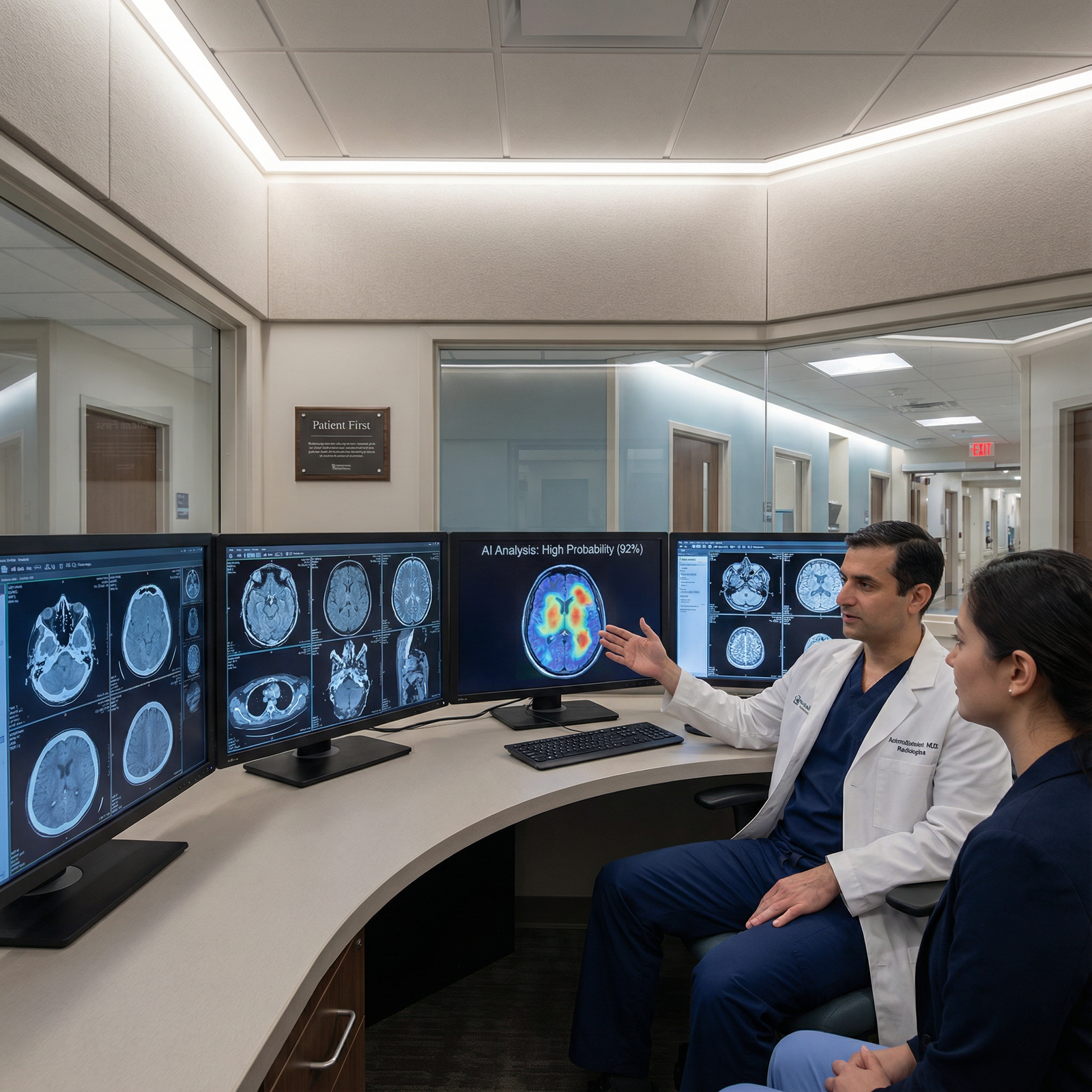
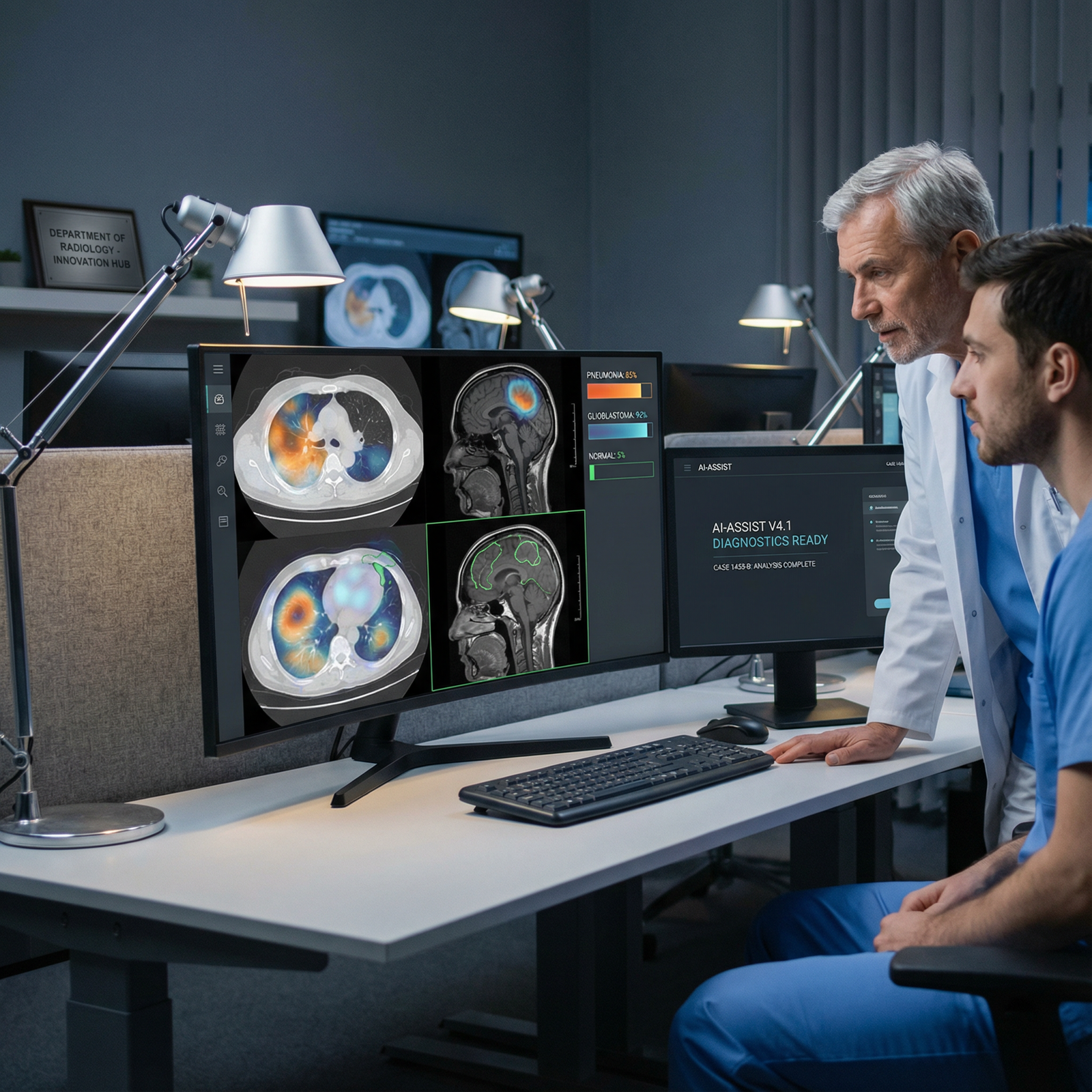
- Provide heatmaps or saliency maps showing what the model focused on
- Offer probability scores (e.g., “80% probability of intracranial hemorrhage”)
- Suggest structured report elements or differential diagnoses
The radiologist then reviews, confirms, refutes, or modifies these suggestions.
2. Streamlining Radiology Workflow and Reducing Burnout
AI can make the radiology workflow more efficient at multiple points in the imaging pipeline.
AI-Based Triage and Prioritization
In busy departments, AI can automatically:
- Scan incoming CT head studies for intracranial hemorrhage, flagging positives for immediate review
- Triage pulmonary embolism-positive CT pulmonary angiograms
- Alert teams to tension pneumothorax or other life-threatening findings on chest imaging
This improves:
- Time-to-diagnosis for critical pathologies
- Coordination with ED and ICU teams
- Overall patient care and safety
For residents on call, such triage tools can be especially valuable, helping them focus on the highest-acuity cases first.
Reducing Interpretation Time and Repetitive Tasks
AI tools can automate:
- Measurements (e.g., tumor diameters, aneurysm size, ejection fraction on cardiac MRI)
- Segmentations (e.g., liver, brain structures, musculoskeletal structures)
- Comparisons with prior exams (e.g., growth of nodules, changes in edema or infarct size)
By offloading repetitive tasks, AI allows radiologists to:
- Spend more time on complex or ambiguous cases
- Improve communication with clinicians
- Reduce fatigue-related errors
For trainees, this can also mean more time for learning and feedback rather than tedious manual measurements.
3. Predictive Analytics and Risk Stratification
Beyond image interpretation, AI can leverage large-scale data—combining imaging, clinical variables, and lab results—to make predictions that support precision medicine.
Population Health and Early Detection
AI can identify:
- Patterns across populations that correlate imaging features with future disease risk
- High-risk groups for screening programs (e.g., lung cancer screening eligibility, CAD risk based on coronary calcium scoring)
- Subtle imaging biomarkers that predict disease progression (e.g., brain atrophy patterns in dementia)
For instance, AI models may analyze chest CT scans obtained for non-cardiac reasons and automatically:
- Quantify coronary artery calcium score
- Assess emphysema burden
- Estimate cardiovascular risk, prompting preventive interventions
Individualized Risk Stratification
At the patient level, AI can:
- Integrate imaging phenotypes (e.g., tumor heterogeneity, perfusion metrics) with genetic and clinical data
- Support decisions about aggressive vs. conservative management
- Predict treatment response in oncology (radiomics)
While this is still evolving, the vision is a world where Medical Imaging is not just descriptive (“what is there”) but predictive (“what is likely to happen”).
Real-World Clinical Applications of AI in Radiology
1. AI in Mammography and Breast Imaging
Breast cancer screening programs generate high imaging volumes and demand exceptional Diagnostic Precision.
AI-driven systems can:
- Detect microcalcifications, asymmetries, and distortions
- Reduce false negatives and decrease recall rates
- Serve as a second reader in double-reading programs, particularly in resource-limited settings
Large-scale studies and regulatory approvals have shown that certain AI tools in mammography:
- Perform comparably to or better than human readers in initial screening
- Can safely replace one human reader in double-reading workflows, with the second reader handling difficult or discrepant cases
For radiology trainees, understanding the false positive and false negative patterns of these systems is crucial for safe integration.
2. Lung Cancer and Thoracic Imaging
In thoracic radiology, AI has been particularly impactful in:
- Lung nodule detection on CT
- Automated Lung-RADS categorization for screening CTs
- Distinguishing benign from malignant nodules based on radiomic features
AI tools can:
- Track nodule growth over time across multiple scans
- Standardize follow-up recommendations
- Reduce inter-observer variability
Similarly, for chest X-rays, AI systems can help detect:
- Pneumothorax, pneumonia, pulmonary edema
- Pleural effusions, misplaced lines/tubes
- Cardiomegaly and some skeletal abnormalities
These tools are increasingly integrated into Picture Archiving and Communication Systems (PACS) and point-of-care imaging workflows.
3. Neurologic Imaging: Stroke, Tumors, and Beyond
Stroke imaging is one of the most time-sensitive applications of Medical Imaging, where seconds can influence patient outcomes.
AI systems for stroke can:
- Rapidly detect large vessel occlusions on CTA
- Quantify ischemic core and penumbra on CT or MR perfusion
- Alert stroke teams with automated interpretations and standardized maps
In neuro-oncology, AI can:
- Segment brain tumors and edema
- Calculate volumetric changes between follow-up studies
- Help differentiate between tumor progression and treatment-related changes (e.g., radiation necrosis)
These tools augment radiologist decision-making and help standardize reporting for multidisciplinary care.
4. Musculoskeletal and Orthopedic Imaging
AI is increasingly used to:
- Detect fractures on plain films (e.g., wrist, ankle, hip, vertebral fractures)
- Assess severity of osteoarthritis on joint radiographs
- Measure spinal alignment and deformity parameters
For emergency settings and off-hours coverage, fracture detection tools can act as an effective safety net, especially for subtle or easily overlooked injuries.
Benefits of AI in Radiology for Clinicians, Trainees, and Patients
Key Advantages
Increased Diagnostic Precision
- Enhanced detection of subtle, early-stage disease
- Standardized quantification and reduced variability
- Support in complex, high-volume environments
Improved Workflow Efficiency
- Automated measurements, segmentations, and comparisons
- Intelligent triage and prioritization of urgent studies
- Shorter turnaround times for critical results
Enhanced Consistency and Quality
- Performance not affected by fatigue or shift timing
- More uniform application of imaging guidelines and reporting standards
Potential Cost Savings
- Reduced unnecessary follow-up or repeat studies
- Better resource allocation in radiology departments
- More efficient population screening strategies
Better Patient Care and Outcomes
- Earlier detection and intervention
- Faster communication of life-threatening findings
- More personalized treatment planning when combined with clinical data
Educational Value for Medical Students and Residents
For trainees, AI can also be a learning tool:
- Comparing your interpretations to AI outputs can highlight missed findings or alternative views.
- Reviewing cases where AI was wrong is equally educational—helping you understand limitations, edge cases, and biases.
- Exposure to AI tools prepares you for future radiology practices where AI will be woven into daily workflows.
To use AI responsibly as a trainee:
- Treat AI output as a second opinion, not a ground truth.
- Always perform your own independent read first.
- Discuss AI–human discrepancies with supervising radiologists.
Challenges, Risks, and Ethical Considerations in AI-Driven Radiology
1. Data Privacy, Security, and Governance
Training robust AI models requires large datasets of Medical Imaging and patient information.
Key concerns:
- Compliance with laws such as HIPAA, GDPR, and local regulations
- Robust de-identification of training data
- Secure storage and transfer of imaging data
- Clear data sharing agreements and governance structures
As a clinician, your role includes:
- Being aware of how your institution uses patient imaging data for AI development
- Ensuring informed consent processes (when applicable) are transparent and ethical
- Advocating for strong cybersecurity measures to protect patient data
2. Algorithm Bias and Health Equity
AI models trained predominantly on data from one population (e.g., a specific region, ethnicity, or health system) may not generalize well to others.
Risks include:
- Under-detection or misclassification in underrepresented groups
- Widening existing healthcare disparities
- Incorrect assumptions of “equal performance” without subgroup analysis
Ethical AI in Radiology requires:
- Diverse and representative training datasets
- External validation across multiple sites and populations
- Continuous post-deployment monitoring of performance and equity
As a radiologist or trainee, you should be critical of:
- Where the model was trained and tested
- Whether performance metrics are reported by subgroup (age, sex, ethnicity, site)
- How your institution monitors outcomes after implementation
3. Professional Roles, Responsibility, and Acceptance
Many radiologists worry: “Will AI replace us?” The current consensus among professional societies is clear—AI will transform radiology, not eliminate it.
Key issues:
- Responsibility: Ultimately, the licensed radiologist remains responsible for the report and its clinical impact, even when AI is involved.
- Trust and transparency: Black-box models without explainability can undermine clinician trust.
- Adoption: Radiologists must be involved in selecting, validating, and integrating AI tools into workflows.
To foster healthy collaboration:
- View AI as an advanced tool—like CT or MRI once were—not a competitor.
- Participate in pilot studies, validation efforts, and feedback loops.
- Maintain a patient-centered mindset: if an AI tool improves Patient Care, it deserves thoughtful consideration.
4. Regulatory and Legal Challenges
Regulatory bodies (e.g., FDA in the U.S., EMA/CE in Europe) are still adapting to the pace of AI innovation.
Issues include:
- How to regulate continuously learning models that update over time
- Standards for clinical validation and performance reporting
- Legal liability in case of diagnostic errors influenced by AI
For now, most AI tools are approved for narrow, specific tasks. Clinicians must:
- Understand the approved indications and limitations
- Avoid off-label uses without proper validation
- Document AI involvement where appropriate
Future Directions: Preparing for the Next Era of AI in Radiology
Integration with Electronic Health Records (EHR) and Multimodal Data
The next frontier is integrating:
- Imaging data
- EHR data (labs, vitals, clinical notes)
- Genomics and pathology
This will allow:
- Truly holistic decision support (e.g., integrating imaging, labs, and clinical notes to refine a differential)
- Advanced prognostic models for oncology, cardiology, and neurology
- More precise risk stratification and treatment selection
Toward Personalized and Predictive Imaging
In oncology, for example, AI-enhanced radiomics could:
- Characterize tumor heterogeneity that correlates with molecular subtypes
- Predict response to immunotherapy or targeted agents
- Adapt imaging follow-up intervals based on individualized risk
For trainees, this implies a future where radiology is more tightly integrated with precision medicine, requiring familiarity with data science concepts.
Global and Low-Resource Settings
AI in Radiology also has significant potential in underserved regions:
- Supporting non-radiologist clinicians in interpreting basic imaging
- Extending specialist expertise to remote or rural areas via tele-radiology and AI-based pre-reads
- Helping manage high disease burdens where radiologist numbers are limited
To be ethical and effective, such tools must be:
- Trained on diverse populations
- Designed for robustness in variable imaging conditions
- Deployed with attention to local infrastructure and needs
How Trainees Can Prepare and Engage
As a medical student or resident:
- Learn the basics of AI/ML terminology and concepts.
- Participate in AI-related research projects in radiology or imaging informatics.
- Attend conferences or webinars on AI in healthcare technology.
- Develop skills in data literacy—understanding sensitivity, specificity, ROC curves, calibration, and bias.
Building this literacy now will position you to be a leader in shaping how AI is used to enhance patient care, rather than passively adapting to it.
FAQ: AI in Radiology, Ethics, and Clinical Practice
1. How exactly does AI improve diagnostic precision in radiology?
AI algorithms—especially deep learning models—can process medical images at scale and detect subtle patterns that may be difficult for the human eye to appreciate, particularly in high-volume settings. For example:
- Flagging tiny lung nodules on CT
- Detecting early ischemic changes in stroke
- Highlighting faint fractures on X-rays
However, diagnostic precision improves most when AI is used as a complement to radiologists rather than a replacement. The combination of AI’s pattern recognition and the radiologist’s clinical reasoning yields the most accurate and clinically relevant interpretations.
2. What are the major ethical concerns with AI in Radiology and Medical Imaging?
Key ethical issues include:
- Data privacy and security – Protecting patient data used to train and run AI systems.
- Algorithmic bias – Ensuring AI performs equitably across different populations and does not worsen disparities.
- Transparency and explainability – Making sure clinicians understand AI recommendations well enough to accept or reject them rationally.
- Professional responsibility – Clarifying that radiologists remain responsible for clinical decisions and must not over-rely on AI outputs.
Ethical use means prioritizing patient welfare, fairness, and transparency at every stage—from dataset creation to clinical deployment.
3. Will AI replace radiologists or reduce the need for radiology trainees?
Radiology is evolving, not disappearing. AI is highly effective at narrow, repetitive tasks but lacks the broader clinical judgment, communication skills, and responsibility that radiologists provide. Expected changes include:
- Shift in workload composition: Less time on routine measurements and screening-only tasks; more on complex, integrative cases.
- New skills: Radiologists will need literacy in AI, data, and informatics.
- Job evolution: Radiologists may act as “information specialists” synthesizing imaging, AI outputs, and clinical data.
For trainees, there will still be strong demand—but the skill set will broaden.
4. How can radiologists and trainees safely integrate AI tools into their practice?
Best practices include:
- Perform an independent read first, then compare with AI outputs.
- Understand each tool’s intended use, limitations, and validation data.
- Use AI as a second reader or decision support, not as a final authority.
- Participate in local implementation and feedback processes, reporting recurring errors or edge cases.
- Document in reports when AI significantly influenced a decision if local policy requires.
Safe integration emphasizes human oversight and continuous quality improvement.
5. What should I learn now as a medical student or resident to be prepared for AI in Radiology?
Consider focusing on:
- Core radiology skills first: anatomy, pathology, pattern recognition, clinical reasoning.
- Basic statistics and data science concepts (sensitivity, specificity, ROC curves, overfitting, bias).
- Introductory material on machine learning and deep learning (at least conceptually).
- Participation in AI- or imaging-informatics projects, even if your role is primarily clinical.
Building foundational radiology expertise plus AI awareness will prepare you to use future tools responsibly, advocate for ethical implementation, and contribute to innovation that truly enhances patient care.
By understanding both the capabilities and the limits of AI in Radiology, you can position yourself to use these tools thoughtfully—to sharpen diagnostic precision, improve workflow efficiency, and, most importantly, deliver better, safer, and more equitable patient care.